
SinoInsight 1
On Feb. 12, the leadership page of the CCP Central Committee United Front Work Department’s website was updated to reflect the appointment of Zou Xiaodong as UFWD deputy director.
Zou, 52, was previously the Party secretary of Zhejiang University.
OUR TAKE
1. Zou Xiaodong’s new appointment is the first instance of the CCP shifting an official from the university system to deputy director of the UFWD.
We believe that this unprecedented personnel movement is a proactive measure by the CCP to cope with a political crisis, namely, the prospect of a growing unemployed youth population. Put another way, China’s youths are becoming a focus of the Party’s united front work.
2. The CCP came to officially regard China’s youths as a potential source of risk last month. In the opening ceremony of a study session for senior provincial and ministerial-level officials, Xi Jinping said that priority should be given to “strengthening the ideological and political education among the young.” The topic of the study session was “persevering with the bottom line in mind to guard against major risk.”
3. The Party is very likely wary of the potential of youths to spark and drive instability. For instance, the protests in Tiananmen Square and in college campuses in 1989 were led by students. And before the founding of the People’s Republic, the CCP roused students and youths to oppose the Kuomintang government. Meanwhile, many “color revolutions” around the world were triggered by youths and students.
On Jan. 17, Chinese public security minister Zhao Kezhi said at a national-level meeting of the public security apparatus that the authorities must “prevent and resist ‘color revolutions’ and firmly fight to protect” the political security of the CCP regime.
4. China’s rapidly worsening economy has led to increased business failure and rising unemployment. This phenomenon is likely a key reason for the CCP’s new focus in carrying out united front work on the country’s youths.
In our Nov. 22 analysis, we wrote that China’s real unemployment rate was estimated to be 22 percent as of March 2018. Typically, the unemployment rate for youths (especially fresh graduates) is higher than that of older adults.
China’s economic situation in the second half of 2018 would be noticeably worse than in the first half of the year due to the onset of the Sino-U.S. trade war. The country’s unemployment rate would almost certainly have risen, and China’s job-seeking youths have definitely been affected. To cite one example, Chinese medical instrumentation maker Mindray Medical International Limited abruptly terminated the job contracts of over 200 new graduates which it recruited in the fall of 2018 in the last two days of the year. Mindray ended up paying 5,000 yuan per fresh graduate it rejected.
If we presume a youth unemployment rate of 30 percent in 2019 (a conservative estimate), there could be at least 7 million unemployed youths in China this year based on a graduating student population of about 24.49 million between 2017 and 2019 (per China’s education ministry data).
On Jan. 7, six government departments introduced a plan to engage 1 million youths in three years of employment training, a move that is likely aimed at addressing the unemployment problem. One million youths, however, could only prove to be a fraction of the real youth unemployment number in China.
The CCP’s youth unemployment alleviation plans may turn out to be inadequate for resolving a serious social crisis and forestall a political crisis. Hence, the Party has to focus united front efforts on the youth and appoint an education system official (Zou Xiaodong) to the UFWD’s senior ranks.
5. The CCP’s youth problem is just one of several looming existential problems for the regime, and would likely give Xi Jinping added impetus to compromise and sign a trade deal that the U.S. would find agreeable.
SinoInsight 2
CCP propaganda in state and Party media are often designed to telegraph a certain messaging to various groups of people. Interesting insights into what Beijing is thinking and worrying about can thus be gleaned from parsing public sources (a SinoInsider specialty) such as the homepage of Xinhua.
Five headlines in the Feb. 14 edition of xinhuanet.com reflect the Xi Jinping leadership’s concerns about the trade war and possible pushback from officials and the general public.
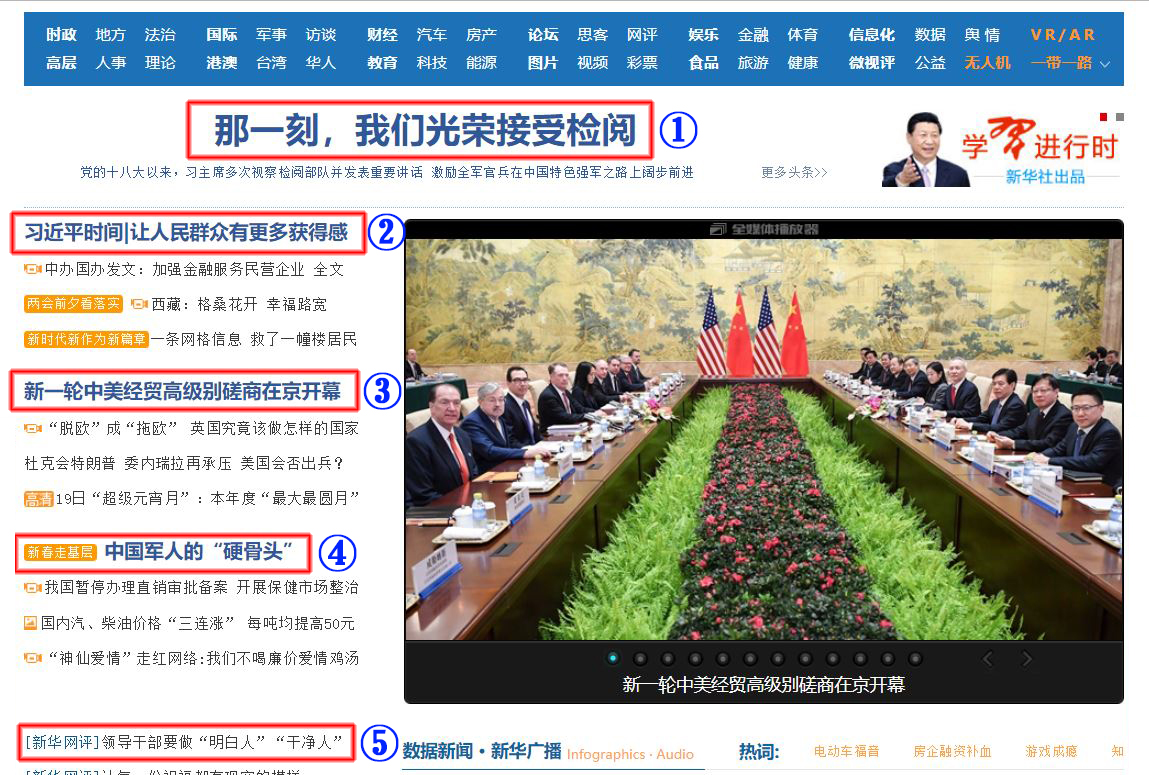
Translated headlines:
Headline 1: “At that Moment, We Were Gloriously Reviewed”
Subhead: “Since the 18th Party Congress, President Xi Jinping has reviewed the troops and gave important speeches on numerous occasions, inspiring all officers and men to march forward on the road towards a strong military with Chinese characteristics”
Headline 2: “Xi Jinping Time | Let the People Have a Greater Sense of Gaining”
Headline 3: “A New Round of High-level Sino-U.S. Economic and Trade Talks Begin in Beijing”
Headline 4: “The Chinese Military’s ‘Unyieldingness’”
Headline 5: “Leading Cadres Must be ‘Understanding’ and ‘Clean’”
OUR TAKE
1. The lead article on Xinhua (Headline 1) starts by recalling Xi’s grand parade in September 2015. The article also spotlights Xi’s review of the troops in the Zhurihe Training Base in July 2017 and his review of the PLA Navy in the South China Sea in April 2018.
For Headline 1 to be the lead article on Xinhua at this time is odd because Feb. 14 is not near the anniversaries of any of Xi’s major troop reviews. We believe that Beijing could be sending at least two messages with Headline 1.
In reading Headline 1, 3 and 4 together, Beijing could be projecting strength to signal to the Chinese people and perhaps foreigners that the Chinese regime is not prepared to “yield” to American trade negotiators. Put another way, the Xi leadership is really concerned about the trade talks, but is seeking to avoid accusations from the people that it will be “soft” in negotiations by playing up the military and nationalistic sentiments.
Beijing is also trying to rally the military and the officialdom around Xi during a crucial time by highlighting Xi’s command over the troops in the lead Xinhua article. However, the fact that Beijing feels that it needs to remind the PLA and officials that Xi is in charge of the military “out of season” (not near the anniversary of the troop reviews) hints that Xi is not quite confident that his control over the PLA or the regime is solid. (For more on Xi, the PLA, and political crisis in the regime, see here, here, and here.)
2. Headline 2 is part of a series of articles in a new column dedicated to promoting the good that Xi Jinping is doing for the people.
Given that Headline 2 comes before Headline 3, Beijing is informing the Chinese people that Xi has their best interests at heart in the latest round of Sino-U.S. trade negotiations on the mainland, and will not be “selling out” their interests.
3. By “sandwiching” Headline 3 between Headline 1 and Headline 4, Beijing is reinforcing the notion that the regime will not let America mess with a strong and “unyielding” China during the trade talks. In other words, the CCP wants the Chinese people and officials to know that there are no plans for “surrender.”
4. Headline 5 instructs leading officials to not be corrupt and be “politically correct” by aligning themselves with what “core” leader Xi Jinping wants.
Headline 5 is somewhat of a cautioning “wink” to Chinese officials at large, and when read with the previous four headlines which we highlighted, sends a very specific message to the officialdom.
In putting things together, Beijing is reminding officials that Xi is in charge of the military (Headline 1), and hence his lead should be followed and his authority should not be questioned—or else. Xi’s authority should be followed because he is trying to get the best deal for the Chinese people (Headline 2) in the Sino-U.S. trade talks (Headline 3), where he will see that China is not bullied (Headline 4). Officials should be “understanding” and “clean” (Headline 5) on Xi’s policy decisions (with an eye on the trade talks), and not seek to oppose him. Political rivals who do decide to dissent with Xi must know to whom the military answers to.
5. In sum, the Xinhua web frontpage on Feb. 14 reveals the following points:
- Xi Jinping may be the PLA’s commander-in-chief, but he probably does not feel confident that he is fully in charge, and/or there is trouble brewing in the ranks;
- Beijing is very concerned about the trade talks and the impact it would have on the Chinese officialdom and the people;
- The Xi leadership may be planning to make concessions to the U.S. on the trade issue. In the meantime, Beijing has to put on a show of being tough first so that it can later sell to the Chinese people the narrative that it was “unyielding” all the way in trying to get the best deal for China;
- The Xi leadership is warning political rivals not to try to undermine Xi regardless of the outcome of the trade talks, and to instead accept Xi’s final decision.
Those unfamiliar with the CCP factional struggle and the workings of CCP elite politics will only be able to get a partial picture of what Beijing is trying to telegraph using its mouthpiece. For instance, observers may receive further confirmation that the CCP is becoming more open about its militaristic and expansionist agenda, or guess that Xi is trying to send a tough message to American negotiators. While observers may not be wholly incorrect in making the above assumptions, they will miss out the crucial layers of messaging meant for different groups of domestic audience, as well as the hints about the state of Xi’s control over the military and his present political strength.




