
1 Qiushi piece on developing future industries reveals Xi’s political and geopolitical ambitions
Xi promotes industrial development
June 1
1. Qiushi, the CCP Central Committee ideological journal published a Xi Jinping speech under the title, “Planning Ahead for and Developing Future Industries” (前瞻佈局和發展未來產業). The speech was originally delivered on Jan. 30, 2026 during the 24th group study session of the 20th Politburo.
In the speech, Xi reviewed China’s recent progress in developing future industries, analyzed global trends in emerging industrial development, and outlined strategic priorities and policy measures across five key dimensions. Xi said that China’s overall competitiveness in future industries has entered the world’s first tier, with an increasing number of sectors moving from “keeping pace” with global leaders to, in some cases, “taking the lead.” At the same time, he acknowledged that significant weaknesses and shortcomings remain.
Xi put forward five major requirements for the development of future industries:
i) Strengthen overall strategic planning
- Clearly define the primary directions for future-industry development during the 15th Five-Year Plan period (2026–2030).
- Emphasize rigorous evaluation of technological pathways and proper timing of development efforts.
- Uphold a nationwide coordinated approach and prevent local governments from blindly following trends, launching duplicate projects, or engaging in wasteful spending.
- Promote coordination and integration among future industries, traditional industries, and emerging industries.
ii) Maintain science and technology innovation as the driving force
- Leverage the advantages of China’s “new whole-of-nation system” to intensify efforts in overcoming key technological bottlenecks through extraordinary measures.
- Address critical “chokepoint” technologies that constrain development.
- Strengthen original innovation in basic research with a long-term perspective.
- Deepen the integration of scientific innovation and industrial innovation.
iii) Strengthen the leading role of enterprises
- Direct innovation resources toward enterprises and cultivate leading technology firms.
- Emphasize that central state-owned enterprises should serve as the main force in developing future industries.
- Improve public services and provide support for technology-oriented small and medium-sized enterprises, specialized and sophisticated firms (“little giants”), single-product champions, and unicorn companies.
iv) Create a favorable policy environment
- Improve fiscal and tax support mechanisms.
- Develop technology finance and encourage long-term capital to invest early, invest in smaller firms, invest for the long term, and invest in hard-tech sectors.
- Optimize government procurement policies to support the commercialization and adoption of first-of-their-kind products and equipment.
- Strengthen efforts to cultivate, attract, and utilize talent in all dimensions.
- Foster an environment that encourages innovation and tolerates failure.
v) Improve the governance system
- Uphold the centralized and unified leadership of the Party Central.
- Strengthen coordination among government ministries and improve cooperation between central and local authorities.
- Balance development and security by proactively addressing emerging risks, including technological loss of control, ethical misconduct, and data misuse.
- Ensure that innovation is both dynamic and effectively regulated.
- Deepen international cooperation and participate in the joint development of international standards.
Xi concluded by emphasizing that officials at all levels must strengthen their understanding of frontier technologies, improve their professional capabilities, and avoid making decisions based on incomplete knowledge or superficial understanding (“blind men feeling an elephant”; 盲人摸象). He called on cadres to become proficient in science and technology, knowledgeable about industry, and capable of making informed policy decisions.
2. CCP mouthpiece People’s Daily published a signed article by Li Lecheng, Minister of Industry and Information Technology, titled “Accelerating the Forward-Looking Planning and Development of Future Industries (Deeply Studying and Implementing Xi Jinping Thought on Socialism with Chinese Characteristics for a New Era)” (同加快前瞻佈局和發展未來產業 [深入學習貫徹習近平新時代中國特色社會主義思想]).
The article provided a detailed theoretical interpretation and practical guide to the Xi Jinping speech published by Qiushi (see previous point). It was structured around four core themes: the importance, defining characteristics, current achievements, and implementation pathways of future industries.
The article emphasized that history has repeatedly demonstrated that each wave of technological revolution gives rise to new industries that become decisive factors in reshaping the global competitive landscape. As examples, it notes that Britain leveraged the steam engine to drive industrial development during the 18th and 19th centuries, while in the 20th century, the United States took the lead in developing computers and the internet, helping establish its position as a global superpower.
Drawing on these historical precedents, the article argues that China is currently facing both new historic opportunities arising from a new round of technological and industrial transformation and serious external challenges, and therefore must “seize the initiative and gain an early advantage.”
The article stresses that the development of future industries requires long-term planning, stating that policymakers must “use a long-range perspective to identify development directions for the next five, ten, twenty years, and even beyond, and make systematic arrangements in advance.” The article further argued that “whoever gains an early advantage in these fields will hold the initiative in future global competition.”
The article noted that the CCP authorities have prioritized a number of strategic sectors, including:
- Quantum technologies,
- Bio-manufacturing,
- Hydrogen energy and nuclear fusion energy,
- Brain-computer interfaces (BCIs),
- Embodied artificial intelligence and humanoid robotics, and
- 6G communications.
The article also stated that China has moved early to position itself in emerging areas such as space manufacturing, atomic-scale manufacturing, and terahertz technologies
The article asserted that multiple Chinese future-industry sectors have already produced landmark achievements, including:
- Superconducting quantum computers and photonic quantum computers achieving demonstrations of quantum advantage.
- Successful development of prototype atomic clocks, magnetometers, and other devices based on new quantum technologies.
- Broad adoption of bio-manufacturing technologies in healthcare, pharmaceuticals, cosmetics, and green energy industries.
- Expansion of brain-computer interface applications from healthcare into education and industrial sectors.
- Establishment of a complete industrial supply chain for humanoid robot manufacturing.
- Domestic robots reportedly capable of surpassing human male half-marathon performance records.
- Annual sales of key products such as single-atom catalytic materials and atomic-scale manufacturing equipment exceeding 10 billion yuan.
- China’s laser manufacturing technology reaching the world’s top tier.
- Perovskite materials, permanent magnet materials, and power battery technologies attaining internationally advanced levels.
Our take
Qiushi’s piece on developing future industries is both a technological roadmap for China’s domestic industrial transformation and a strategic manifesto that serves as a strategic manifesto that reveals the CCP’s geopolitical ambitions, its mechanisms for mobilizing state capital, and its intention during the 15th Five-Year Plan period to compete directly with the U.S. for global technological leadership.
The document suggests that Xi Jinping aims to build a sovereign technological ecosystem independent of Western systems through the development of future industries, including quantum technology, bio-manufacturing, hydrogen energy and nuclear fusion, brain-computer interfaces, embodied artificial intelligence, and sixth-generation mobile communications (6G). At the same time, Beijing appears to be prioritizing national security over economic efficiency, relying on a new whole-of-nation mobilization model to counter U.S. technological containment efforts and ultimately reshape a PRC-centered international technological and geopolitical order.
1. Xi Jinping’s call to plan for and develop future industries, particularly its publication in Qiushi, is a form of political mobilization. The primary objective of this political mobilization appears to be addressing governance challenges arising from the dual pressures of economic slowdown and external sanctions.
Xi’s remarks reveal significant dissatisfaction with what he described as the “blind men feeling an elephant” mentality among local officials. He warned that cadres who fail to understand technological frontiers and emerging trends will be incapable of making sound decisions at critical moments. This criticism appears to be part of the CCP’s attempt to transform its bureaucracy from a traditional GDP-oriented governance model into one centered on technological security and strategic adaptation.
One of the foremost priorities of the political mobilization campaign of developing future industries is the reshaping of the criteria by which local officials are evaluated. Xi emphasized the need to “guide all regions to firmly establish and practice a correct view of political achievements” and to “maintain a nationwide strategic perspective,” while preventing local governments from blindly following industrial trends, launching duplicative projects, or engaging in wasteful spending. Against the backdrop of severe fiscal pressures caused by the prolonged downturn in the property market, the central government is reasserting control over industrial planning. This is intended to prevent local governments from using poorly supervised financing mechanisms that could further expand hidden debt burdens.
Concurrently, the success or failure of future-industry development is increasingly being elevated to a test of political loyalty. Notably, the Qiushi article stresses the need to “uphold and strengthen the centralized and unified leadership of Party Central.” Under this framework, future-industry development is both an economic policy issue and a political assessment of whether local officials are sufficiently aligned with Xi’s broader vision of national rejuvenation and great-power development. Going forward, officials are expected to “understand technology, understand industry, and make sound decisions.” Those whom Beijing deems unable to adapt to this technocratic transformation risk being marginalized in subsequent political reshuffles.
2. To provide sustained funding for future industries — many of which involve long development cycles, significant uncertainty, and substantial market risks — the CCP has launched a nationwide effort to cultivate what it calls “patient capital.” The top-level design for this initiative was established through the State Council General Office’s “Document No. 1” (Guiding Opinions on Promoting the High-Quality Development of Government Investment Funds) issued in January 2025, which for the first time systematically outlined a market-oriented and professionalized framework for government investment funds.
This state-directed approach to capital allocation, however, faces deep structural contradictions.
i) To provide long-term financing at the macro level, central and local governments have built an extensive network of government-guided investment funds. By the end of 2024, the target scale of these funds exceeded 15 trillion yuan and more than 2,000 such funds had been established nationwide.
Subsequently, the central government launched a National Venture Capital Guidance Fund with a scale approaching 1 trillion yuan. Financed through ultra-long-term special treasury bonds, the fund is designed to support seed-stage and early-stage hard-technology enterprises.
ii) Despite repeated policy calls for long-term capital to “invest early, invest in small firms, invest for the long term, and invest in hard technology,” China’s capital markets continue to face severe liquidity constraints.
The venture capital and private equity sector is confronted by a significant exit bottleneck. Unlike more diversified international markets, Chinese venture capital remains heavily dependent on initial public offerings (IPOs) as an exit channel. More than 60 percent of venture investments rely on IPOs for realization. Between 2021 and 2024, only about one-third of venture-backed projects achieved successful exits, while roughly 6 trillion yuan remained tied up in unrealized investments. More than 80,000 projects remained without exits, with nearly half of these projects being early-stage technology ventures.
Tighter IPO approval standards and heightened market uncertainty have disrupted the normal investment cycle of fundraising, investing, managing, and exiting. As a result, so-called “patient capital” increasingly faces the prospect of being locked into investments for prolonged periods.
Meanwhile, additional obstacles arise from the prevalence of so-called “equity investments with debt characteristics” and continued discrimination against private-sector participants. In practice, many government-guided funds operate under stringent state-asset preservation requirements. To avoid scrutiny over potential losses of state-owned assets, fund managers frequently impose principal-protection clauses or mandatory repurchase agreements. As a result, investments that are nominally structured as equity often function more like debt financing. Concurrently, private enterprises continue to face implicit barriers in government procurement, factor allocation, and policy support. Combined with uncertainty stemming from campaign-style regulatory interventions, these conditions discourage long-term investment.
Consequently, private and social capital often prefer short-term arbitrage opportunities rather than committing resources to genuinely disruptive innovation. The result is a system in which the state increasingly relies on central SOEs as the primary drivers and “national champions” of future industries. This creates a highly concentrated structure in which a substantial share of innovation risk is ultimately borne by public finances and the state sector.
3. In his article, PRC industry minister Li Lecheng cites the historical examples of the UK and the U.S. using technological breakthroughs to elevate their national power. This suggests that top CCP leadership views the current technological revolution as a decisive historical opportunity in the strategic competition between the PRC and the U.S. for global leadership. Underlying this argument is a core historical worldview that can be described as the belief that technological supremacy determines national destiny.
Li places contemporary China alongside Britain in the 18th and 19th centuries, whose rise was driven by the steam engine and the Industrial Revolution, as well as the United States in the 20th century, whose dominance was built upon leadership in computing and the internet. This comparison suggests that, in the CCP’s historical interpretation, the UK and the U.S. became successive global superpowers primarily because they gained an early monopoly over the most advanced technologies and emerging industries of their respective eras.
Li’s article explicitly notes that major developed countries have elevated future industries to the level of national strategy, and that the U.S. has incorporated future-industry development into its legal framework in an effort to lock in advantages during the formation of new technological systems. This indicates that Beijing is fully aware that Washington is using legislation, alliance networks, and technological ecosystems to construct a strategic “moat” around key technologies. From the CCP’s perspective, this represents both a serious external challenge and a narrow window of opportunity in a competition that it views as strategically consequential.
When Li argues that China must “seize the initiative and gain an early advantage,” the implication is that every major technological paradigm shift in history has coincided with a restructuring of international power and geopolitical influence. The underlying belief is that if the PRC can achieve leadership in strategic fields such as quantum technology, nuclear fusion, and embodied artificial intelligence, it may be able to replicate the historical trajectories of Britain and the U.S., thereby weakening America’s position at the apex of the international system and reshaping the global political and economic order.
4. The Qiushi article’s call for mobilization around future industries reflects a broader competition between China’s state-led development model and the more decentralized innovation systems found in Western countries. From a geopolitical and systems perspective, however, the apparent strengths of centralized mobilization may also contain inherent vulnerabilities.
The greatest systemic flaw of the CCP system lies in the “information cocoon” and loss of feedback mechanisms that emerge when power becomes highly centralized. As political purges become normalized, both the bureaucracy and the military increasingly operate under a climate of fear.
Xi Jinping’s efforts to enforce the principle that “the Party leads everything” through repeated political rectification campaigns may ultimately create what can be described as a “dictator’s trap.” In early 2026, Xi reportedly carried out another unprecedented round of purges among the senior leadership of the People’s Liberation Army. Although framed as anti-corruption measures, such campaigns can undermine professional trust within both the bureaucracy and the military. Under these conditions, subordinate officials and military commanders may become more inclined to report only positive developments while concealing problems, or even provide information tailored to align with the leader’s expectations, such as narratives emphasizing China’s rise relative to the West. Similar dynamics have appeared repeatedly throughout history, including during the era of the Great Leap Forward.
Such politically driven incentives can contribute to data distortions in the fields of technology and economics. Local officials seeking to satisfy central government targets related to “new quality productive forces” and “future industries” may face strong incentives to inflate statistics or maximize access to government subsidies. The amendment of China’s Statistics Law by the National People’s Congress Standing Committee in September 2024 was intended, in part, to strengthen penalties against the falsification of economic data. When assessments of technological progress, subsidy effectiveness, and economic performance become distorted, the strategic judgments made by central decision-makers risk being built upon unreliable foundations.
From this perspective, competition between the Chinese system and Western systems can be viewed fundamentally as a competition in strategic error tolerance.
The CCP’s “whole-of-nation system” possesses a significant advantage in its ability to concentrate national resources on a single priority area within a short period of time, regardless of cost. Yet the system can also exhibit characteristics of high fragility, including constrained internal dissent and limited self-correcting mechanisms. If the strategic direction set by the top leadership proves mistaken (whether in foreign policy, military affairs, or domestic industrial policy) the entire state apparatus may continue along that path with few institutional checks capable of reversing course.
By contrast, the West’s decentralized and adaptive system often appears inefficient, characterized by constant debate in the media, legislatures, and electoral politics. Policies may shift frequently, resembling a pendulum. Yet this ongoing friction functions as a form of continuous correction through frequent, lower-amplitude adjustments. Innovation is driven by thousands of independent private firms and venture-capital investors responding primarily to market incentives rather than government planning cycles. Even when individual governments make policy mistakes, the diversity and resilience of the private sector can help prevent systemic collapse in technological development.
As a result, the CCP’s state-directed model may be highly effective at catching up in established technological fields, including moving from “1 to N,” where the path is already known. However, in pioneering entirely new domains (moving from “0 to 1”) or in responding to severe geopolitical crises, the opacity of decision-making and the weakening of corrective feedback mechanisms can become major vulnerabilities. Under this interpretation, a major cross-strait military conflict or a large-scale local government debt crisis could disrupt Beijing’s long-term technological ambitions during the 15th Five-Year Plan period, both financially and operationally.
5. In summary, the future-industry strategy as outlined in Qiushi is not merely as an industrial-upgrading initiative or a technology-development campaign, but is a comprehensive geopolitical project personally directed by Xi Jinping, with the securing of national security and the winning of great-power competition as its ultimate objectives.
Politically, the strategy serves as a tool for disciplining local bureaucracies and strengthening the central leadership’s authority. Financially, it seeks to consolidate and direct so-called “patient capital” in order to align market resources with state priorities. Internationally, it represents an ambitious vision aimed at overcoming U.S. technology restrictions, reshaping global industrial standards, exporting a China-centered technological ecosystem to the Global South, and extending China”s influence into emerging strategic domains, including space-based resources.
Beneath this grand narrative, however, lie structural challenges that may prove difficult to overcome. Constraints in capital-exit channels, concerns among private investors regarding regulatory predictability and continuity, and the inherent vulnerabilities associated with a highly centralized state-led system all contribute to the risk of asset bubbles and broader financial imbalances. Viewed through this lens, the effort represents a far-reaching wager in which state power and political mobilization are being deployed to accelerate technological advancement and strategic competition. Its ultimate success or failure could have profound implications for China’s development trajectory, the future balance of power between the PRC and the U.S., and the broader evolution of the global geopolitical landscape over the coming decade.
2 Assessing the hidden liabilities of rapid industrial scaling in China’s NEV sector
PRC media outlets call for ‘equal treatment for gasoline and electric vehicles’
June 1
Semi-official mainland media The Paper published an editorial titled “How Should We View the Debate Over Road Maintenance Fees for New Energy Vehicles?” The article noted that the question of whether new energy vehicles (NEVs) should be required to pay road maintenance fees has recently become a widely discussed topic in public discourse.
According to the editorial, the CCP authorities previously chose not to impose road maintenance charges on NEVs in order to encourage consumers to purchase them. In effect, this meant that owners of gasoline-powered vehicles were indirectly subsidizing NEV users through the existing road-funding system.
The article pointed out that more than half of all newly registered vehicles each year are now NEVs. At the same time, government subsidies and preferential policies for the sector are gradually being reduced. In the long run, these policies may be replaced by a framework of “equal treatment for gasoline and electric vehicles” (油電同權).
The editorial also discussed potential approaches for collecting road maintenance fees from NEV owners.
June 2
Mainland media Yicai published an analytical article titled, “It Is Time for Electric Vehicles to Pay Road Maintenance Fees.”
The article argued that the current funding model for highway maintenance is facing increasing pressure with the market penetration rate of new energy vehicles having surpassed 50 percent. Because electric vehicles do not consume gasoline, they effectively avoid paying the refined oil consumption tax, which functions in practice as a major source of road-maintenance funding. As a result, the government is facing a growing shortfall in funds available for highway construction and maintenance.
The article then called for advancing the principle of “equal treatment for gasoline and electric vehicles” and highlighted an emerging industry trend toward imposing road-use charges based on vehicle weight, regardless of whether a vehicle is powered by gasoline or electricity.
Our take
China’s NEV industry has experienced explosive growth over the past decade, fueled by strong government policy support. By April 2026, NEVs had reportedly reached a record market penetration rate of nearly 60 percent.
Recent discussions in mainland media regarding the introduction of road maintenance fees for NEVs represent the visible tip of a much larger issue, namely, the hidden costs associated with the state-driven expansion of the industry. The structural consequences of this policy-led boom are now approaching a critical threshold, exerting growing pressure on three key areas of the Chinese economy — the national tax base, local government finances, and supply-chain financial stability.
1. The fiscal balance underpinning China’s transportation infrastructure is facing increasing strain as NEVs have surpassed the critical threshold of accounting for more than 50 percent of vehicle sales.
Under China’s current automotive tax system, traditional gasoline-powered vehicles contribute substantially to government revenues through fuel taxes and related levies, whereas NEVs have long benefited from various tax exemptions and incentives. As a result, the rapid substitution of gasoline vehicles by electric vehicles has significantly eroded an important source of public revenue. To illustrate the difference in tax burdens between the two, we compare the total tax and fee obligations of a traditional 2.0T fuel vehicle priced at 300,000 yuan with those of a similarly priced new energy vehicle (under the 2026 new policies and pilot programs) in the table below.
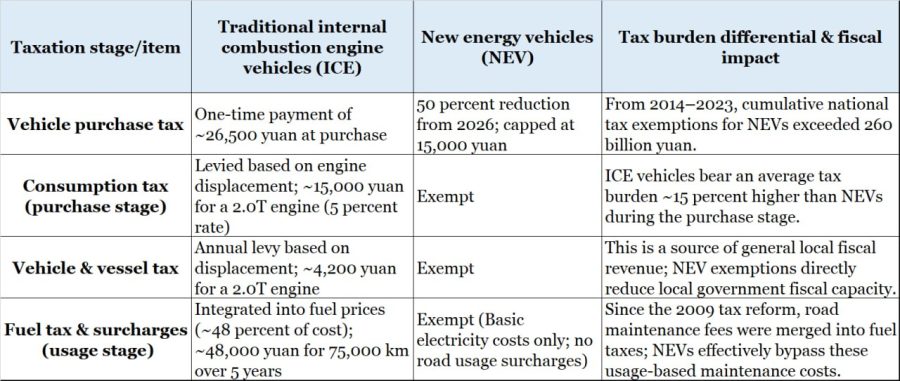
Fiscal data indicate that the rapid growth of NEVs led to an estimated decline of around 300 billion yuan in fuel-tax revenues in 2023. This loss of revenue has directly affected the funding available for maintaining ordinary public roads. According to estimates by PRC transportation authorities and highway research institutions, annual maintenance requirements for China’s non-toll road network amount to roughly 600 billion yuan. Actual government spending, however, is estimated at only about 100 billion yuan, leaving an annual funding gap of approximately 500 billion yuan.
At the same time, debt accumulated by China’s toll-road system has reached historically high levels, with outstanding liabilities reportedly totaling around 7.9 trillion yuan. In the absence of sufficient fiscal support, many provincial governments have been forced to prioritize personnel expenses within highway management agencies, resulting in reduced funding for major repairs and maintenance projects. This has created what some observers describe as a dilemma of “being able to support the workforce but not adequately maintain the roads.”
Electric vehicles generally weigh significantly more than comparable gasoline-powered vehicles because of their large battery packs. For example, a Tesla Model 3 weighs approximately 1.8 tons, roughly 300 kilograms more than a similarly sized Toyota Camry, while a BYD Tang EV weighs more than 2.2 tons, about half a ton heavier than a comparable conventional SUV. Per engineering principles commonly cited in road-maintenance studies, increases in axle load can disproportionately accelerate pavement deterioration. As a result, electric vehicles may impose substantially greater wear on road infrastructure than conventional vehicles while contributing relatively little to the traditional fuel-tax-based funding system.
To compensate for declining fuel-tax revenues, the CCP authorities have begun experimenting with new road-use charging mechanisms. Beginning in 2026, pilot programs were introduced in locations such as Hainan and Shenzhen:
- Hainan adopted a “mileage-plus-weight” model, under which pure electric vehicles pay a base road-use fee of 0.12 yuan per kilometer, with some systems using automatic distance tracking through navigation devices.
- Shenzhen introduced a weight-adjusted model that charges approximately 0.12 yuan per ton per kilometer.
- National guidance issued in 2026 established a base mileage-tax rate of 0.12 yuan per kilometer for pure electric vehicles. Vehicles weighing more than 2.5 tons or consuming more than 15 kWh of electricity per 100 kilometers may be subject to higher rates of 0.14–0.15 yuan per kilometer. Distance measurement is expected to rely on integrated vehicle systems and satellite navigation technologies.
Although mileage-based taxation is intended to restore the financial sustainability of transportation infrastructure, nationwide implementation may encounter significant challenges.
First, such charges would substantially increase operating costs for high-mileage users, including ride-hailing drivers and logistics fleets. For example, a ride-hailing vehicle traveling 80,000 kilometers annually could face additional road-use charges of at least 9,600 yuan per year. In an environment of slower household income growth and subdued consumer demand, these costs could ultimately be passed on to consumers through higher prices.
Second, the reliance on continuous vehicle-location tracking and automated mileage reporting would require extensive administrative coordination and data-management infrastructure. Such systems could also raise broader public concerns regarding privacy, data security, and the appropriate boundaries of government oversight.
2. Over the past decade, many local governments, eager to boost economic performance and attract investment, poured resources into the NEV sector without conducting sufficiently rigorous fiscal assessments or realistic market-demand forecasts. Through local government financing vehicles (LGFVs), many regions provided extensive subsidies and investment incentives, often competing aggressively to attract manufacturers. As market competition intensified, these policies left behind substantial unfinished projects, stranded assets, and debt burdens.
Publicly available data indicate that, beginning around 2014, government subsidies and industrial policies helped spur the emergence of more than 60 NEV manufacturers across China. However, as state subsidies were gradually reduced and market competition became increasingly intense, most of these companies struggled to achieve sustainable profitability and eventually exited the market. Today, only a relatively small number of major NEV manufacturers remain. The collapse of numerous start-ups and smaller automakers has left behind abandoned factories, unfinished investments, and unrecovered financing commitments, collectively amounting to hundreds of billions of RMB.
The restructuring and bankruptcy proceedings involving Neta Auto provide a prominent example of the policy problem. Neta’s parent company Hozon New Energy Automobile reportedly accumulated losses totaling around 18.3 billion yuan over a three-year period before entering bankruptcy restructuring. The case exposed the risks associated with local government investment campaigns in both Yichun and Nanning.
Neta’s smart manufacturing facility in Yichun, launched in 2021, occupied a vast industrial site and was promoted as a flagship investment project for the local economic development zone. The project involved a total planned investment of roughly 5 billion yuan, with much of the financing reportedly arranged through local government channels. To attract the company, local authorities offered a package of incentives that included equity investment, factory construction support, long-term rent exemptions, and sales-related subsidies. Following the company’s collapse, the facility became largely inactive, leaving behind substantial sunk costs and raising questions about the long-term viability of subsidy-driven industrial recruitment strategies.
A similar situation emerged in Nanning, where Neta’s manufacturing base reportedly became largely dormant following the company’s financial difficulties. Local government-affiliated financing platforms invested about 2.4 billion yuan in land development and factory construction. With the parent company’s bankruptcy, much of that investment became difficult to recover, effectively increasing the financial burden borne by local government financing entities.
While many struggling automakers have attracted attention, some analysts argue that risks are also accumulating within highly publicized industrial-development models such as that of Hefei City. The capital of Anhui Province, Hefei has gained national recognition for using state-backed investment funds to support emerging technology and automotive companies. In 2026, several state-owned investment platforms in the city reportedly participated in a financing round exceeding 2.2 billion yuan for Anhui Shenji, a chip-design subsidiary associated with NIO. Additional investments were also directed toward battery-related ventures connected to the NIO ecosystem.
The Hefei local government’s strategy is building a comprehensive NEV supply chain anchored by major companies such as NIO and Volkswagen. However, critics argue that concentrating large amounts of public capital into sectors such as automotive semiconductors and battery operations carries substantial risks. This concern is heightened by the industry’s declining profitability. According to reported figures, profit margins in China’s automobile manufacturing sector fell to around 3.9 percent in the first quarter of 2025. In such an environment, projects often require large upfront investments, lengthy payback periods, and continued access to financing.
As a result, some observers contend that local governments may be exposing themselves to significant fiscal risks by channeling large amounts of state capital and financing-vehicle resources into highly competitive industries with uncertain long-term returns. Under this view, the practice effectively transforms public funds into high-risk equity investments, leaving local governments vulnerable should industry consolidation accelerate or market conditions deteriorate further.
3. The explosive growth of China’s NEV industry has triggered an intense and often ruthless price war. The resulting strain on automotive supply-chain finance bears similarities to the credit stresses that emerged in China’s property sector during the era of the Evergrande Group crisis.
i) Amid fierce price competition, leading NEV manufacturers (OEMs) have sought to preserve operating cash flow and reported profitability by shifting financial pressure upstream to suppliers. This has often taken the form of extended payment cycles and increasingly complex settlement arrangements.
Under pressure from regulators, industry associations, and regulations designed to protect smaller enterprises, major automakers including BYD and Geely Auto have publicly pledged to shorten supplier payment periods to within 60 days. However, industry participants argue that actual practices are more complicated.
For example, BYD’s 2025 financial statements showed its accounts payable turnover period declining modestly from 127 days to 123 days. Yet numerous small and medium-sized suppliers reportedly indicated that actual payment cycles exceeding 210 days were not uncommon. Across China’s listed automotive manufacturers, average accounts payable turnover reportedly reached 182 days in 2024 — significantly longer than the averages reported by many European and American automakers. By extending payment periods, automakers effectively gain access to substantial amounts of supplier capital without incurring traditional financing costs. These funds can then support operations, expansion, and research-and-development activities. In BYD’s case, annual R&D spending reportedly reached 63.4 billion yuan in 2025.
To comply with regulatory requirements regarding payment periods while minimizing direct cash outflows, leading Chinese automakers have increasingly relied on commercial paper and other forms of payable instruments. BYD’s balance-sheet data illustrate this trend:
- Outstanding notes payable reportedly stood at 2.4 billion yuan at the end of 2024.
- By the end of 2025, that figure had surged to 22.5 billion yuan. By the end of the first quarter of 2026, notes payable reportedly reached a record 48.6 billion yuan. Concurrently, the combined balance of accounts payable and other payables declined by 34.1 billion yuan to 272.2 billion yuan.
- According to data from the Shanghai Commercial Paper Exchange, outstanding commercial paper accepted by BYD Auto Industry Co. reportedly totaled nearly 19 billion yuan as of April 2026.
Critics describe this shift as a form of financial engineering. While companies may appear to shorten payment periods on paper, suppliers often receive payment instruments rather than immediate cash. If suppliers need liquidity, they must discount those instruments themselves, effectively bearing the financing costs. This arrangement functions smoothly as long as automakers maintain strong financial conditions. However, should major manufacturers encounter liquidity stress due to market volatility, aggressive overseas expansion, or prolonged price wars, the extensive network of commercial paper obligations could become vulnerable to cascading defaults.
ii) While automakers benefit from lower costs and stronger bargaining power, upstream equipment manufacturers and materials suppliers — the so-called “pick-and-shovel sellers” of the battery industry — have come under increasing financial pressure.
A prominent example is Lead Intelligent Equipment, one of the world’s leading suppliers of intelligent manufacturing equipment for lithium-battery production. According to its 2024 annual report, the company’s revenue fell 28.57 percent year-over-year to 11.77 billion yuan. Meanwhile, its net profit plunged 84.86 percent year-over-year to 268 million yuan, representing its steepest decline in nearly a decade. These figures are often cited as evidence of deteriorating conditions among upstream suppliers.
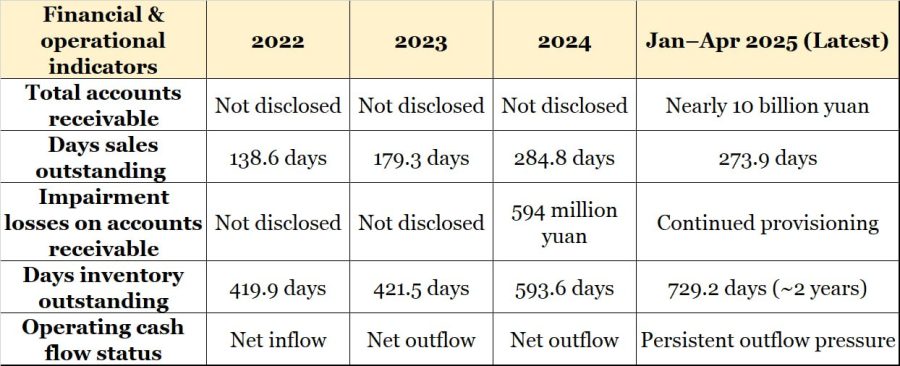
The NEV industry’s low-price competition has created a highly imbalanced relationship in which automakers capture much of the value while suppliers absorb increasing financial risk. When even major industry leaders face mounting receivables, asset-impairment charges, and legal disputes over unpaid balances, many smaller suppliers with fewer financial resources or legal options may face even greater challenges. The broader concern is that prolonged price competition may weaken the financial health of the entire supply chain, leaving smaller firms particularly vulnerable to liquidity shortages and potential business failures.
4. China’s NEV industry is increasingly unable to absorb its excess production capacity at home as domestic consumption weakens, government subsidies are gradually phased out, and market penetration approaches saturation levels. As a result, manufacturers are being pushed to export surplus capacity overseas on a large scale. This dynamic risks exporting China’s intense domestic price competition (“involution”) to foreign markets, potentially increasing trade disputes and attracting protectionist measures.
Following the pull-forward effect of 2025 subsidy incentives and weakening consumer confidence, growth in China’s domestic NEV sales in 2026 reportedly slowed to single digits. At the same time, the market exhibited clear signs of “consumer downgrading” — the retail share of vehicles priced above 300,000 yuan continued to decline, while demand for vehicles priced below 100,000 yuan increased significantly. This trend suggests that many automakers may struggle to improve profitability through premium-market positioning and instead remain locked in highly competitive, low-margin market segments.
According to analysis by S&P Global Ratings’ China division, only a handful of industry leaders (such as BYD) have maintained relatively high capacity utilization rates through scale advantages. Many joint-venture brands and second-tier EV manufacturers continue to operate with substantially lower utilization levels. For instance, Geely Auto reportedly achieved a NEV capacity utilization rate slightly above 70 percent in 2024, while NIO reportedly operated at approximately 62 percent. The elimination of excess capacity has been accompanied by factory closures, production-line shutdowns, and workforce reductions, creating pressure on local employment and regional economies. As domestic growth slows and profitability deteriorates, overseas expansion has increasingly shifted from being a strategic diversification objective to what many firms view as an operational necessity for maintaining factory utilization.
China’s electric-vehicle exports reached record levels in 2025, reportedly exceeding 2.5 million units. During the first four months of 2026, exports of battery-electric, plug-in hybrid, and range-extended vehicles together reportedly approached 1.4 million units, more than doubling year-over-year. However, this unprecedented export surge faces growing geopolitical and protectionist challenges.
- The United States has imposed a 100 percent tariff on Chinese electric vehicles, sharply limiting market access. As a result, Chinese NEV exports to the broader North American market remained relatively small, reportedly totaling only 4,422 units in April 2026. Although the European Union has also introduced trade measures targeting Chinese EV imports, Europe remains a significant market, with imports reportedly reaching 83,813 vehicles in April.
- To avoid barriers in North America and Europe, Chinese automakers have increasingly focused on emerging economies where tariffs are generally lower and price competitiveness is particularly important. Examples include Brazil, where Chinese NEV exports reportedly surged 221 percent year-over-year to 38,144 vehicles in April 2026, as well as countries across Southeast Asia, where Chinese brands have reportedly captured more than half of the electric-vehicle market.
An export model driven primarily by excess capacity carries significant structural risks.
- Data suggest that Chinese automakers’ export volumes may have exceeded actual overseas sales by more than 25 percent during 2025. This implies that substantial inventories may be accumulating at foreign ports and dealerships, potentially creating liquidity pressures throughout overseas distribution networks.
- A second concern is that a strategy centered primarily on exporting finished vehicles, without building deep local industrial ecosystems, could trigger protectionist responses in importing countries. Many emerging economies, including Brazil and several Southeast Asian nations, have welcomed Chinese vehicle imports because of their affordability. Over the longer term, however, policymakers in those countries may seek to develop domestic automotive industries rather than rely heavily on imported vehicles. If governments begin imposing local-content requirements or demanding higher localization rates for parts and production, Chinese automakers could be forced to invest heavily in overseas manufacturing facilities. Such investments would require substantial capital expenditures and could place additional strain on corporate cash flows, particularly in an industry already facing intense competition and shrinking margins.
5. In summary, China’s “explosive” NEV sector growth can be viewed as a form of forward-looking credit expansion driven jointly by central industrial policy objectives and local governments’ pursuit of economic and political achievements.
From a public-finance perspective, this growth has come at the cost of eroding fuel-tax revenues, historically one of the most stable sources of transportation infrastructure funding. The result has been an annual shortfall of roughly 500 billion yuan in funding for ordinary road maintenance, alongside around 7.9 trillion yuan in outstanding toll-road debt. These pressures have prompted local authorities to explore mileage-based road-use charges, potentially increasing transportation and logistics costs across the economy.
At the local-government level, aggressive investment promotion policies, generous subsidies, and competition among regions to attract NEV projects have reportedly contributed to hundreds of billions of yuan in unfinished investments and underutilized manufacturing facilities. In many cases, the associated financial burdens have ultimately been absorbed by LGFVs and state-owned enterprises that were already facing significant fiscal pressures.
From a supply-chain finance level, automakers have sought to manage the effects of intense price competition by extending payment periods and increasing the use of commercial paper and other credit instruments. The resulting financial strain has been shifted upstream to suppliers, contributing to profit declines, rising bad-debt risks, and slower inventory turnover among major equipment and materials producers, including firms such as Lead Intelligent Equipment.
A growth model relying simultaneously on cost compression within the domestic supply chain and aggressive low-price expansion into overseas markets may eventually face structural limits. If foreign markets become increasingly protected by tariffs, localization requirements, or other trade barriers, while domestic suppliers encounter mounting financial stress, the sustainability of the current model could come under greater scrutiny.




