
China’s economy grew 4.3 percent in the second quarter of 2026, the slowest pace of expansion in over three years. Analysts noted that domestic consumption remained weak despite booming exports, and China’s vulnerabilities could be further exposed amid the United States and Israel’s war on Iran and growing pushback towards China’s export of excess capacity in Europe and elsewhere.
The Chinese Communist Party’s early response to China’s gloomy economic outlook was doubling down on regime security. Shoring up security appeared to be the underlying theme of three seemingly unrelated developments in the week of July 20 — the purge of a former high-ranking securities regulator, the regime’s legal apparatus revising judicial interpretations governing insider trading, and reports in overseas Chinese media outlets about Beijing’s expansion of passport confiscations and travel restrictions on state personnel. These moves suggest that the CCP is moving to contain systemic financial and institutional risks as the Chinese economy is subjected to increasing stress.
Another technocrat bites the dust
On July 24, the Central Commission for Discipline Inspection announced that former vice chairman of the China Securities Regulatory Commission Fang Xinghai was being investigated for “serious violations of discipline and law.” Fang, who has a doctorate in economics from Stanford University and had a stint at the World Bank headquarters in Washington D.C., has long been regarded as one of the People’s Republic of China’s most internationally minded financial technocrats.
Fang held senior positions at China Construction Bank, China Galaxy Securities, and the Shanghai Stock Exchange before becoming one of the architects of Shanghai’s transformation into an international financial center. In 2013, he joined the Office of the Central Leading Group for Financial and Economic Affairs before serving as CSRC vice chairman from 2015 to 2024. At the CSRC, Fang helped expand the Shanghai-Hong Kong and Shenzhen-Hong Kong Stock Connect programs, internationalize China’s futures markets, and negotiate the landmark 2022 U.S.-China audit oversight agreement that reduced the risk of mass delistings of Chinese companies from U.S. exchanges. After retiring from the CSRC in July 2024, Fang became vice chairman of the China Finance Society in June 2025.
Fang Xinghai’s investigation represents more than the downfall of a senior regulator. Beijing’s purge of Fang — and to a degree, the former Xinjiang Party boss and aerospace expert Ma Xingrui — marks the marginalization of the technocratic governance model that underpinned the PRC’s reform era.
With China’s equity markets struggling, foreign investment retreating, and the property sector in a prolonged contraction, the central leadership faces increasing pressure over economic performance. The CCP’s authoritarian system and political culture, however, makes it difficult for Beijing to acknowledge policy mistakes (whether related to regulatory tightening, private-sector crackdowns, or geopolitical tensions).
Responsibility for policy mistakes therefore shifts downward. This means that officials who were once upheld as paragons of professionalism have to be sacrificed as political scapegoats. By portraying senior financial regulators like Fang as corrupt or as having undermined financial security, the central authorities can redirect public attention away from broader policy outcomes and toward individual misconduct. Political security increasingly takes precedence over market credibility.
Expanding the reach of financial enforcement
On the same day that Fang Xinghai was purged, the Supreme People’s Court and Supreme People’s Procuratorate jointly announced a revision to a judicial interpretation aimed at addressing issues concerning insider trading and disclosure of inside information, and hence better combating such crimes. For example, the updated interpretation clarifies the exact timeframe for inside information by tying it directly to the key individuals involved in its creation, thereby eliminating any loopholes that could be exploited for insider trading or tipping.
Officially, the revision is presented as part of Beijing’s “zero tolerance” approach toward financial misconduct and efforts to safeguard capital market integrity. It also reflects broader efforts to prevent capital flight and market manipulation during a period of heightened financial risk. In particular, those most familiar with China’s economic conditions—senior officials, financial executives, and politically connected business elites—have historically possessed both the information and resources needed to move assets abroad before adverse policy developments became public. At the same time, revisions to the PRC’s insider-trading rules significantly broaden regulatory authority.
The practical effect of the revised judicial interpretation is twofold. First, politically connected insiders are discouraged from liquidating domestic assets before major policy changes. Second, Beijing is looking to keep capital within China’s financial system during a period of heightened liquidity pressure.
From passport controls to ‘hostage capital’
As Beijing’s financial controls tighten, restrictions on personal mobility have also expanded.
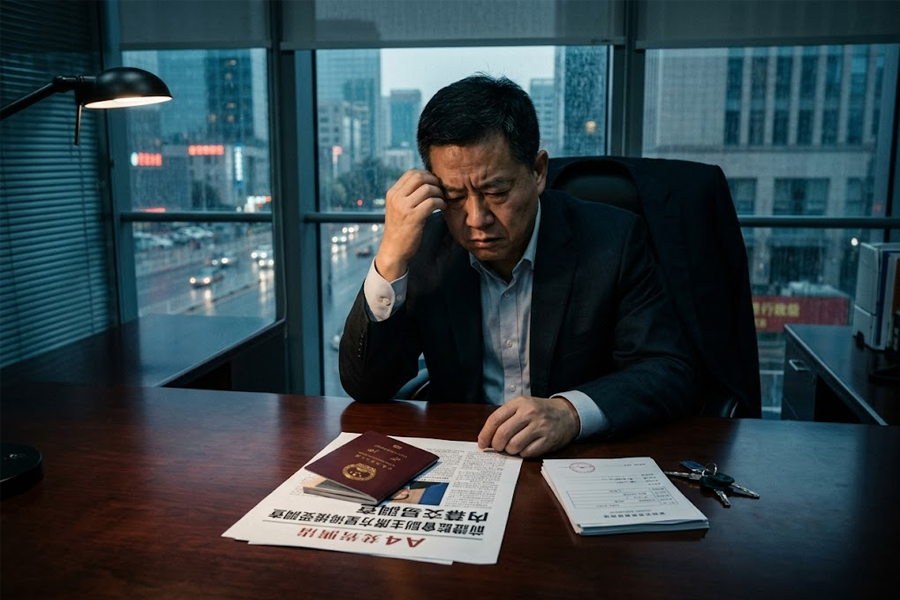
According to overseas Chinese media reports from the week of July 20, state-owned enterprise executives, public-sector employees, university personnel, and even rank-and-file civil servants are facing a new wave of passport confiscations and increasingly stringent exit controls.
Meanwhile, information circulating online on July 21 claimed that many local governments had begun reviewing passports held by public employees. Unlike previous practices where passports were simply kept in centralized custody, some local authorities are now reportedly requiring employees to cancel their passports altogether.
Numerous overseas Chinese commenters reported similar travel restriction measures nationwide. Some claimed that the CCP authorities are reviewing the overseas travel records of state personnel stretching back five years, while others said some personnel have already been barred from overseas travel even if they physically retain their passports.
Travel restrictions for state workers have reportedly tightened throughout 2026. Overseas Chinese media say that restrictions extended to retired civil servants and former government officials in January, while exit controls expanded to ordinary Chinese citizens in certain cases in March. Around the May-June period, those applying for passports were reportedly required to provide increasingly extensive supporting documentation, including proof of savings, salary records, invitation letters, and multiple layers of police approval. Teachers, nurses, and grassroots civil servants in some regions reportedly had their passports withheld by the personnel departments of their respective work units, while some Chinese travelers allegedly had their passports canceled or suspended after returning from abroad.
In May 2026, Bloomberg News reported that Beijing had restricted overseas travel for top AI professionals in private companies such as DeepSeek and Alibaba. People familiar with the matter told Bloomberg that individuals doing advanced AI work and considered to be “strategically important to the country” were required to seek approval from relevant authorities before travelling abroad.
Whether motivated by national security, anti-corruption efforts, or capital controls, Beijing’s effort to restrict the travel of private and public personnel reflects growing concern over talent and capital leaving the country. For decades, the PRC relied on two powerful incentives to keep people in the country, namely, opportunities for economic advancement and prospects for political promotion. Those incentives have weakened considerably amid fiscal tightening, wage reductions in parts of the public sector, and growing anti-corruption scrutiny. For some officials, remaining inside the system now carries greater political and personal risk than before, while offering fewer economic rewards.
More fundamentally, as Beijing increasingly relies on passport controls rather than positive incentives to retain personnel, it raises questions about confidence within the PRC’s own institutions.
Security priority
It is debatable whether the developments above primarily represent anti-corruption enforcement, financial-risk management, political consolidation, or some combination of the three. What is clear is that they reflect the CCP’s continued prioritization of financial stability, political control, and regime security amid a period of slowing economic growth and heightened geopolitical competition.




