SinoInsight 1
On May 27, the PRC National People’s Congress voted overwhelmingly to impose a national security law on Hong Kong. The PRC’s move led the Trump administration to retaliate by declaring that Hong Kong is no longer autonomous and begin the process of revoking all U.S. policy exemptions for Hong Kong.
Mainland media outlets and Hong Kong officials have insisted that U.S. action over Hong Kong would not significantly impact Hong Kong, particularly the economic and financial sectors. Hong Kong financial secretary Paul Chan said on June 1 that America’s decision to revoke preferential treatment for Hong Kong will have “little impact” on the city’s economy, and that banking and asset management business representatives had seen “no palpable outflow of capital.”
Recent information suggests otherwise:
May 25
- Hong Kong Census and Statistics Department data showed the city became a net importer of gold from mainland China in April, a first in eight years. Exports to Hong Kong from the mainland stood at 14.513 tonnes, compared with 0.685 tonnes in March.
June 1
- Foreign-currency deposits at local banks in Singapore nearly quadrupled to S$27 billion in April, according to Monetary Authority of Singapore data. Non-resident deposits increased 44 percent to S$62 billion, the highest since 1991. Analysts believe that inflows to Singapore reflects investors’ risk aversion in Hong Kong, and expect further inflows as Hong Kong’s status as an international financial center is threatened.
- The Hong Kong dollar saw depreciation since the start of the week. At about 2:30 p.m. on June 1, the Hong Kong dollar fluctuated at around the 7.7517 to the U.S. dollar range, a phenomenon that observers attribute to Hong Kong people exchanging their Hong Kong dollars for U.S. dollars to hold on standby. Local media reported that some currency exchange shops were out of U.S. dollars and other currencies as quickly as 45 minutes after opening.
June 2
- According to Bloomberg data, mainland traders have bought HK$276.5 billion of shares listed on the Hong Kong stock exchange through the Stock Connect program, the most for the same period since December 2016. The bulk of the buying was focused on big mainland companies like the China Construction Bank and the Industrial and Commercial Bank of China.
- The Hong Kong Executive Council announced that the city’s 180,000 public sector employees will not be given a raise this year due to an “unprecedentedly poor economic situation.” Hong Kong chief executive Carrie Lam said that Hong Kong’s civil servants “can understand and appreciate that Hong Kong is facing a very difficult time” and that “everyone is in the same boat and we need to be united to ride out the difficult time together.”
June 3
- According to a Reuters report, a handful of global firms are “eyeing a move of some of their corporate treasury operations to countries like Singapore, Malaysia, Thailand, and Vietnam.” A “leading U.S. retail chain, which operates hundreds of stores around Asia” is planning to move some of its cash management related operations from Hong Kong to Singapore.
OUR TAKE
1. The above information suggests that Hong Kong’s economy is suffering, with the city seeing increased capital outflows. Also, the CCP regime appears to be pumping money and gold into Hong Kong to prop up its market in anticipation that U.S. action on Hong Kong would prove disastrous for its markets and that many people in Hong Kong will rush to buy gold to hedge against financial difficulties.
The CCP regime will likely struggle to prop up Hong Kong financially over an extended period of unrest in the city once the U.S. imposes sanctions. While the PRC has about $3 trillion in foreign exchange reserves, $2 trillion consists of foreign debt and the PRC only has about $400-500 billion to use (or around $200 billion for emergencies). In 2019, there were persistent rumors that the Hong Kong Monetary Authority had even loaned its $400 billion foreign exchange reserves through currency swaps to mainland China and had yet to be repaid; while the HKMA has since denied the rumor, skepticism remains.
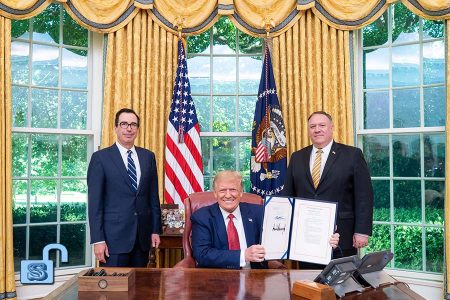
2. Despite CCP assertions, Hong Kong’s prospects bode ill as Sino-U.S. “new cold war” becomes increasingly tangible. The Trump administration officially ended the U.S. “Kissinger era” of China engagement with the release of the new “U.S. Strategic Approach to the People’s Republic of China” on May 20. Since then, the Trump administration has made several moves indicating that the U.S. is playing for keeps against the PRC. Most recently, the U.S. Transportation Department announced on June 3 that PRC airlines will be barred from flying to and from the U.S. from June 16. On the same day, U.S. Secretary of State Mike Pompeo met with survivors of the Tiananmen Square Massacre and asked them “what can we do to help China have democracy?” On June 4, U.S. media outlets reported that the Trump administration is considering designating another five of PRC media’s U.S. outlets as foreign missions in coming days.
Some observers argue that the U.S. and China are not yet in a “cold war” like the one waged between the U.S. and the Soviet Union. Other observers note that the U.S. is finding it difficult to rally allies, and particularly Europe, against the PRC. We believe that Europe, and even Germany, will eventually fall in step with America on the China issue as the CCP regime loses its economic leverage over countries and is unable to maintain its “technological advantage” with the U.S. cutting off Huawei’s access to critical technologies like advanced chips and software. As for the “cold war,” we believe that geopolitical developments since late 2017 clearly indicate the U.S. and China are embroiled in a conflict that is akin to the Cold War in spirit (the U.S. exhorting the free world to stand up against a communist “superpower”), if not entirely in substance.
3. Businesses, investors, and governments must take into view the long-term in the Sino-U.S. “new cold war” and plan for a post-communist China to avoid risks and discover hidden opportunities.
SinoInsight 2
On June 1, the CCP Central Committee and the PRC State Council jointly released a master plan to turn Hainan Province into a free trade port.
Key points in the plan include:
1. With the exception of special commodities, Hainan will implement a “zero-tariff” trade policy for imported goods. Also, products transported to the mainland from Hainan with 30 percent value added in the province can enter the mainland duty-free.
2. Hainan will institute selective tax reduction measures for selected individuals (talented and skilled persons, etc.) and companies will be capped at 15 percent.
3. Foreign financial institutions will be allowed to set up wholly-owned operations in Hainan and participate in transactions and fund settlement. Hainan will also support trading venues that establish “rules and systems that are in line with international practice.”
4. Hainan will implement a minimal approval process on investment that would allow a free flow of funds. Non-financial enterprises that can meet certain conditions will be allowed to raise fully convertible foreign debt.
5. Hainan will implement “data freedom” policies. The Hainan master plan calls for the “exploration” of ways to allow “outbound personal information” and the “cross-border flow of regional or international data” to “improve the convenience of data transmission.”
OUR TAKE
1. A glance at the Hainan master plan suggests the CCP plans to create a genuine free trade port that will enjoy important financial and data/internet freedoms. However, the CCP’s guarantees employ fuzzy language. Given the CCP’s general tightening of social controls in recent years, it is more likely than not that the CCP’s promises regarding Hainan freedoms are but word games.
2. The CCP’s recent move to strengthen control over Hong Kong by approving the National People’s Congress to draft a national security law for Hong Kong is another strong signal that the CCP regime will be unable to deliver on its promises to transform Hainan into a genuine “free” trade port.
When implemented, the NPC’s Hong Kong national security legislation will undermine the 1984 Sino-British Joint Declaration, a UN-filed international treaty, and the Hong Kong Basic Law. Hong Kong’s freedom and autonomy would no longer be assured, and “one country, two systems” would become “one country, one system.” Since the CCP is willing to essentially renege on “one country, two systems” more than two decades ahead of schedule and end what made Hong Kong an international financial hub and a free port, the international community has no reason to believe that the CCP will make good on its plan to turn Hainan into a “free” trade port.
3. Had Beijing rolled out the Hainan master plan in 2018 or earlier and took concrete steps to actualize it, there is a chance the Xi Jinping leadership is sincere about reform and the international community could have shown strong interest in the project. However, with the coronavirus outbreak and the CCP’s cover-up, the Hong Kong situation, and the Sino-U.S. “new cold war,” foreign businesses and investors are likely much less inclined now to invest in the CCP’s project due to the sharply increasing political risks of dealing with the PRC in the current geopolitical environment.
4. We believe that the Hainan master plan, while seemingly an effort by the PRC to “reform and open up China more,” is in fact just another ploy in the CCP’s long-term struggle for survival and global domination. The CCP, however, missed its strategic window of opportunity, and will likely find it very difficult to see results with the Hainan free trade port.