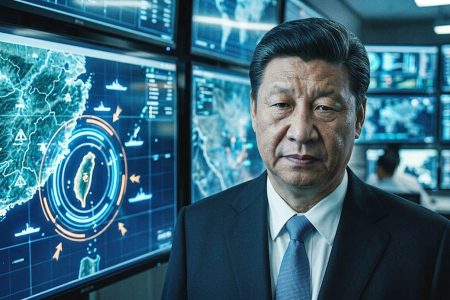
The factional struggle element in Xi’s latest Qiushi speech; Trump walks into the CCP’s trap in chasing a ‘monumental deal’

SinoInsight 1
On Sept. 15, the CCP ideological journal Qiushi published a speech given by Xi Jinping to mark the 60th anniversary of the founding of the National People’s Congress on Sept. 5, 2014.

Key points in Xi’s speech include:

  • The CCP led the Chinese people to create the NPC system. To safeguard this system, it is necessary to “persevere with the leadership of the Chinese Communist Party,” “adhere to democratic centralism,” and “borrow from useful overseas political cultures, but not give up the fundamentals of the Chinese political system.”
  • “The future and destiny of a political party and power depend upon the support or opposition of the people. What the people oppose and hate, we must resolutely guard against and attack.”
  • “To evaluate whether or not a country’s political system is democratic and effective, a main factor is whether or not the country’s leadership ranks can be replaced in accordance with the law.” And China has “abolished lifetime tenure for leading cadres that was in actual existence and established fixed term limits for leading cadres to actualize orderly replacement in the state organs and the leadership rank.”

OUR TAKE
1. From our research, there was fierce factional fighting in the CCP elite ranks between the Jiang faction and the Xi camp in the lead up to Xi Jinping’s speech on September 2014 and after:

March 15: Former Central Military Commission vice chairman Xu Caihou was investigated. Xu is a prominent ally of Jiang Zemin and a key Jiang faction member.

May 1 onwards: Jiang Zemin’s office in Zhongnanhai was abolished and downgraded to a “contact group” (聯絡組).

June 10: The State Council Information Office released a white paper on the “one country, two systems” policy which asserted that China has “comprehensive jurisdiction” over Hong Kong. The white paper sparked the Umbrella Movement protests. The protests led to the cancellation of the rehearsal ceremony for the opening of the Shanghai-Hong Kong Stock Connect on Oct. 26 and the delaying of the Stock Connect’s official opening. At the time, the Xi leadership appeared to have plans to take advantage of the Shanghai-Hong Kong Stock Connect to stimulate the markets.

June 30: Xu Caihou was officially expelled from the Party and his case was handed over to prosecutors.

July 30: Xu Caihou was officially expelled from the military and stripped of his military rank.

September 5: In his speech to commemorate the 60th anniversary of the founding of the NPC, Xi said that the Party had “abolished lifetime tenure for leading cadres that was in actual existence.”

October 27: Prosecutors send Xu Caihou’s case to the courts for charges to be recommended.

October 30: The People’s Liberation Army’s annual political work conference was held in Fujian’s Gutian Town. Xi Jinping gave a speech during the conference where he called for the purge of Xu Caihou’s “pernicious influence” from the military.

2. In the context of the Xi-Jiang struggle in 2014, it is clear that Xi’s Sept. 5 speech about abolishing lifetime tenure for leading cadres was aimed squarely at “retired but still active” (退而不休) Jiang Zemin and his persistence interference in CCP politics.

Xi’s move to abolish presidential term limits after the 19th Party Congress, while contradicting his earlier stance on lifetime tenure, is also shaped by the “you die, I live” factional struggle. We explain why Xi did away with term limits for the presidency in greater detail here.

We believe that the publication of Xi’s 2014 speech in Qiushi before the Fourth Plenum in October is Xi’s way of signaling to the Party that he only abolished presidential term limits to deal with the Jiang faction and does not actually plan to rule for life. Xi would likely be hoping that the CCP elite would get the hint, stop opposing him, and get behind his effort to tackle the multiple crises facing the regime. Whether or not the Party’s elite believe Xi is another matter.
“The breadth of SinoInsider’s insights—from economics through the military to governance, all underpinned by unparalleled reporting on the people in charge—is stunning. In my over fifty years of in-depth reading on the PRC, unclassified and classified, SinoInsider is in a class all by itself.”
James Newman, Former U.S. Navy cryptologist
“Unique insights are available frequently from the reports of Sinoinsider.”
Michael Pillsbury, Senior Fellow for China Strategy, The Heritage Foundation
“Thank you for your information and analysis. Very useful.”
Prof. Ravni Thakur, University of Delhi, India
“SinoInsider’s research has helped me with investing in or getting out of Chinese companies.”
Charles Nelson, Managing Director, Murdock Capital Partners
“I value SinoInsider because of its always brilliant articles touching on, to name just a few, CCP history, current trends, and factional politics. Its concise and incisive analysis — absent the cliches that dominate China policy discussions in DC and U.S. corporate boardrooms — also represents a major contribution to the history of our era by clearly defining the threat the CCP poses to American peace and prosperity and global stability. I am grateful to SinoInsider — long may it thrive!”
Lee Smith, Author and journalist
“Your publication insights tremendously help us complete our regular analysis on in-depth issues of major importance. ”
Ms. Nicoleta Buracinschi, Embassy of Romania to the People’s Republic of China
"I’m a very happy, satisfied subscriber to your service and all the deep information it provides to increase our understanding. SinoInsider is profoundly helping to alter the public landscape when it comes to the PRC."
James Newman, Former U.S. Navy cryptologist
“Prof. Ming’s information about the Sino-U.S. trade war is invaluable for us in Taiwan’s technology industry. Our company basically acted on Prof. Ming’s predictions and enlarged our scale and enriched our product lines. That allowed us to deal capably with larger orders from China in 2019. ”
Mr. Chiu, Realtek R&D Center
“I am following China’s growing involvement in the Middle East, seeking to gain a better understanding of China itself and the impact of domestic constraints on its foreign policy. I have found SinoInsider quite helpful in expanding my knowledge and enriching my understanding of the issues at stake.”
Ehud Yaari, Lafer International Fellow, The Washington Institute
“SinoInsider’s research on the CCP examines every detail in great depth and is a very valuable reference. Foreign researchers will find SinoInsider’s research helpful in understanding what is really going on with the CCP and China. ”
Baterdene, Researcher, The National Institute for Security Studies (Mongolian)
“The forecasts of Prof. Chu-cheng Ming and the SinoInsider team are an invaluable resource in guiding our news reporting direction and anticipating the next moves of the Chinese and Hong Kong governments.”
Chan Miu-ling, Radio Television Hong Kong China Team Deputy Leader
“SinoInsider always publishes interesting and provocative work on Chinese elite politics. It is very worthwhile to follow the work of SinoInsider to get their take on factional struggles in particular.”
Lee Jones, Reader in International Politics, Queen Mary University of London
“[SinoInsider has] been very useful in my class on American foreign policy because it contradicts the widely accepted argument that the U.S. should work cooperatively with China. And the whole point of the course is to expose students to conflicting approaches to contemporary major problems.”
Roy Licklider, Adjunct Professor of Political Science, Columbia University
“As a China-based journalist, SinoInsider is to me a very reliable source of information to understand deeply how the CCP works and learn more about the factional struggle and challenges that Xi Jinping may face. ”
Sebastien Ricci, AFP correspondent for China & Mongolia
“SinoInsider offers an interesting perspective on the Sino-U.S. trade war and North Korea. Their predictions are often accurate, which is definitely very helpful.”
Sebastien Ricci, AFP correspondent for China & Mongolia
“I have found SinoInsider to provide much greater depth and breadth of coverage with regard to developments in China. The subtlety of the descriptions of China's policy/political processes is absent from traditional media channels.”
John Lipsky, Peter G. Peterson Distinguished Scholar, Kissinger Center for Global Affairs
“My teaching at Cambridge and policy analysis for the UK audience have been informed by insights from your analyzes. ”
Dr Kun-Chin Lin, University Lecturer in Politics,
Deputy Director of the Centre for Geopolitics, Cambridge University
" SinoInsider's in-depth and nuanced analysis of Party dynamics is an excellent template to train future Sinologists with a clear understanding that what happens in the Party matters."
Stephen Nagy, Senior Associate Professor, International Christian University
“ I find Sinoinsider particularly helpful in instructing students about the complexities of Chinese politics and what elite competition means for the future of the US-China relationship.”
Howard Sanborn, Professor, Virginia Military Institute
“SinoInsider has been one of my most useful (and enjoyable) resources”
James Newman, Former U.S. Navy cryptologist
“Professor Ming and his team’s analyses of current affairs are very far-sighted and directionally accurate. In the present media environment where it is harder to distinguish between real and fake information, SinoInsider’s professional perspectives are much needed to make sense of a perilous and unpredictable world. ”
Liu Cheng-chuan, Professor Emeritus, National Chiayi University
“Since the 2019 Hong Kong anti-extradition movement, I have periodically engaged with articles from SinoInsider. SinoInsider’s insights have deepened my understanding of the Chinese Communist Party’s regime. These resources have been invaluable in navigating the opaque world of Chinese elite politics, significantly enhancing my commentary on my Hong Kong online radio program, HK Peanut.”
Andrew To Kwan-hang, former chairman of the League of Social Democrats and founder of HK Peanut