SinoInsight 1
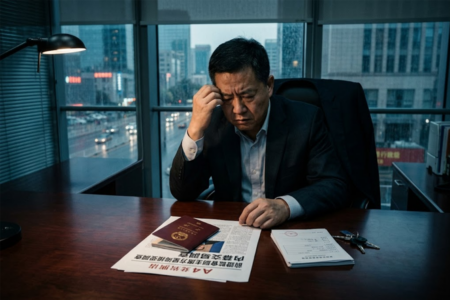
Shanghai Electric Group announced in the evening of Aug. 5 that the company’s president and executive director Huang Ou had died that day.Mainland media reported that Huang, 50, committed suicide by jumping from a building in a residential area in Shanghai’s Puxi District, citing multiple independent sources. Mainland media also quoted Huang’s wife as saying that Huang previously tried to commit suicide on July 30 by slashing his wrists.
===
Shanghai Electric was caught up in scandal in the months leading up to Huang Ou’s death.
In the evening of May 30, Shanghai Electric issued a major risk alert to shareholders warning that as much as 8.3 billion yuan ($1.3 billion) of net income was at risk because four clients of its subsidiary, Shanghai Electric Communication Technology, had delayed repayments. Publicly available information shows that Shanghai Electric generated 3.501 billion yuan and 3.758 billion yuan in net profits in 2019 and 2020 respectively, as well as 661 million yuan of net profits in the first quarter of 2021.
On July 27, the PRC anti-corruption authorities announced an investigation into Zheng Jianhua (61), the Party secretary, chairman, chief executive officer, and legal representative of Shanghai Electric.
On Aug. 4, mainland media reported that at least 13 listed Chinese companies, including Shanghai Electric, were involved in a 90 billion yuan “private network communications business” (专网通信業務) major fraud case. Private network communications services are independent communications networks used by the government, public security apparatus, businesses, or other special industries and fields. The case saw the listed companies, upstream suppliers, a company responsible for installing communications infrastructure, and downstream customers—all of whom were interconnected to varying degrees through shareholding—engage in dubious business practices that ultimately profited a handful of individuals at the expense of the listed companies.
===
Shanghai Electric is a Shanghai government-backed energy and industrial equipment manufacturer, and a supplier of integrated services. Sales of energy equipment, the company’s core business, account for 70 percent of sales revenue. Shanghai Electric is also one of China’s top power generation equipment suppliers and equipment manufacturers, ranking first in sales in the machinery industry. In 2019, the company ranked 40th in People’s Daily’s “China Brand Development Index,” and 93rd in the Fortune 500 China list.
Shanghai Electric became a corporate group in the 1990s as part of state-owned enterprise reform under then-Party boss Jiang Zemin. The company listed in Shanghai and Hong Kong in 2005. In 2006, Shanghai Electric was embroiled in the Shanghai pension scandal, which led to the downfall of then-Shanghai Electric chairman Wang Chengming and vice president Han Guozhang meeting their downfall. Then-Shanghai Party secretary Chen Liangyu, Shanghai social security director Zhu Junyi, and Baoshan District mayor Qin Yu were also purged. The fall of Chen Liangyu disrupted Jiang Zemin’s leadership succession plan, resulting in the latter compromising with Hu Jintao to pick Xi Jinping as the next Party General Secretary.
OUR TAKE
1. The investigation of Zheng Jianhua and the suicide of Huang Ou are almost certainly connected with the 90 billion yuan fraud case involving Shanghai Electric and the company’s 8.3 billion yuan income risk. The two individuals in question may either have knowledge of or are the handful of individuals who profited from the “private network communications business” fraud.
2. Since July, the PRC authorities have investigated at least 18 senior executives (bureau-level equivalent) of state-owned enterprises and regulatory agencies. Of the 18, two are from the China Banking and Insurance Regulatory Commission; four are bank presidents; five are executives from investment or insurance companies; five are executives from large SOEs, and two are from local government supply and marketing cooperatives.
The purge of regulatory agency officials and SOE executives appears to be linked with Xi Jinping’s crackdown on the technology sector and broader objective of resolving China’s financial risks and preserving the CCP regime. Xi’s targeting of large, politically well-connected SOEs like Shanghai Electric is twofold—to stem unnecessary financial losses through corruption and malpractice, and to cut his factional rivals off from their financial channels. However, the exposure of scandals such as the one involving Shanghai Electric is bad for the regime’s reputation, and the existence of the scandals show that the PRC is facing severe political and financial crises.
3. Many of Beijing’s recent major crackdowns, purges, and regulatory actions are aimed at safeguarding regime security amid mounting domestic and political problems for the regime. Xi Jinping is also looking to reduce economic, financial, and political risks in the PRC in order to help him secure a norm-breaking third term as General Secretary at the 20th Party Congress in 2022.
Beijing’s various hardline and heavy-handed measures, however, are a double-edged sword. Xi will unavoidably offend more people and powerful Party interest groups through his derisking campaign, and make his factional rivals and the broader “anti-Xi coalition” even more determined to seek his ouster (one scenario could involve successfully getting him to appoint a successor).
The aforementioned risks in the PRC will keep escalating in the leadup to the 20th Party Congress, raising the probability of Black Swans emerging in China and the arrival of the CCP’s “Berlin Wall moment.”
SinoInsight 2
Recently, many local governments in China introduced measures to regulate the property market. These include restricting transactions of those properties, as well as changing rules concerning school district housing and the “nearby enrollment” policy.
Meanwhile, the debt crisis of China’s large real estate companies continued to worsen.
Property market regulation
Aug. 2
The municipal government of Dongguan in Guangdong Province issued eight policies regulating the second-hand property market, including establishing a second-hand property transaction price guidance mechanism and guidance for commercial banks on “rationally” issuing loans for second-hand housing.
The local government of Jinhua City in Zhejiang Province issued policies to regulate the local property market from “10 aspects,” including a proposal for a “three-year sales restriction” on real estate. On July 29, Jinhua was one of five cities whose officials were summoned for a “chat” with the PRC Ministry of Housing and Urban‑Rural Development.
Aug. 5
The Hangzhou City local government issued new property market regulations (關於進一步加強房地產市場調控的通知), including restricting real estate purchases and improving the management of the sale of new commercial housing.
Meanwhile, Shenzhen, Chengdu, Wuxi, Xi’an, Shanghai, Ningbo, Shaoxing, and several other cities also rolled out price control policies to “guide” the sale of second-hand property.
School district houses and ‘nearby enrollment’
July 30
The Shenzhen local government issued draft regulations and solicited comments (深圳經濟特區社會建設條例 [草案徵求意見稿]) regarding university enrollment and the establishment of a teacher exchange system for compulsory education schools.
Many observers believe that the draft regulations are measures designed to tackle the problem of school district houses and the “nearby enrollment” policy that was instituted in the 1990s. Under the policy, children who lived near prestigious schools were guaranteed enrollment, leading parents to buy up property near those schools to secure a better future for their child. The policy also meant that school district houses sold for inflated prices and an overheating of local property markets.
July 31
The local government of Xicheng District in Beijing municipality scrapped the “nearby enrollment” policy for primary school children whose families recently purchased school district houses in Xicheng or moved to the district. Those children will be eligible to register in multiple schools in the school district or in adjacent school districts.
According to incomplete statistics from mainland media, local governments of more than 10 cities or areas have taken similar action this year, including Beijing, Shanghai, Shenzhen, Guangzhou, Chongqing, Xi’an, Xiamen, Chengdu, Dalian, Nanjing, Hefei, and Taiyuan.
Changes to the “nearby enrollment” will affect property prices in the districts of prestigious schools as those living there will no longer have an advantage in securing their child’s entry to those schools.
Crackdowns on real estate speculation
Aug. 5
Liang Tao, vice chairman of the China Banking and Insurance Regulatory Commission, was quoted by mainland media Economic Daily as saying that the authorities recently fined five banks 366 million yuan for engaging in illegal real estate financing. Economic Daily did not disclose the names of the banks or other relevant details.
Property company debt issues and bankruptcy
Aug. 1
China Evergrande Group agreed to sell 7 percent of its stake in internet unit HengTen Networks Group to Tencent Holdings for HK$2.07 billion and a 4 percent stake to an unidentified buyer for HK$1.18 billion, according to a Reuters report.
Evergrande remains HengTen’s largest shareholder after selling those shares.
Aug. 2
A construction project in Henan’s Luohe City by Evergrande subsidiary Evergrande Yuefu was suspended over payment issues. Nantong Sanjian Group, a construction company involved in the project, announced that it made advance payments of over 400 million yuan on behalf of Evergrande to continue the project. Nantong Sanjian added that Evergrande subsidiary Evergrande Luohe Yurong Real Estate Company only put up 5 percent in cash and paid the remainder using commercial papers, some of which it failed to redeem upon the due date. The construction project came to a halt after suppliers stopped sending material and the workers went on strike.
Aug. 5
1. Sichuan Languang Development issued a risk warning regarding its “uncertainty” in fulfilling commercial papers issued in 2016 (“2016年度第三期中期票據到期兌付存在不確定性的特別風險提示公告”) due to the company’s insufficient liquidity. The third term, medium-term commercial paper in question, “16 Languang MTN003,” has an interest rate of 7.5 percent, payable principal and interest of 301 million yuan, and is redeemable from Aug. 12, 2021.
According to mainland media reports, Sichuan Languang has already defaulted on 12 bonds worth 10.262 billion yuan. The company has 11.016 billion yuan in liquidity as of June 30, 2021. Also, Sichuan Languang has over 104 million shares under judicial auction (247 million yuan in market value), or 3.43 percent of the company’s total shares.
Sichuan Languang ranked 21st among China’s top 100 property companies in 2020.
2. Chinese lawyers from various law firms told mainland media that they had received separate court notices informing them that their cases involving Evergrande (including construction company cases pertaining to Evergrande) would be moved to the Guangzhou Municipal Intermediate People’s Court. A reporter from Caixin confirmed the information with a member of an unnamed provincial high court.
Aug. 6
1. S&P Global downgraded Evergrande and its subsidiaries Hengda Real Estate Group and Tianji Holding two notches from “B-” to “CCC.” S&P also downgraded the long-term issue rating on U.S. dollar notes issued by Evergrande and guaranteed by Tianji from “CCC+” to “CCC-.”
The rating agency said, “We lowered the ratings because Evergrande’s liquidity position is eroding more quickly and by more than we previously expected.”
2. According to data from the PRC judicial apparatus’s website The People’s Court Announcement, there were 236 real estate sector-related bankruptcy documents filed between Jan. 1 to Aug. 6, 2021. In comparison, there were 500 such documents filed in the whole of 2019 and 499 in the whole of 2020. (The number of companies that actually go bankrupt will be fewer than the document count due to the repetition of search results and multiple documents per company.)
Property agency ‘bankruptcy wave’
Mainland media reports on Aug. 3 noted that a “bankruptcy wave” was engulfing real estate agencies in Shenzhen in the wake of high business closure rates and the turn-over rate of employees exceeding 10 percent. A first-tier city, Shenzhen is regarded as a “weather vane” for China’s property market.
According to data released by the Shenzhen Real Estate Intermediary Association, online registrations for second-hand housing in Shenzhen in the first half of 2021 decreased 48 percent from a year ago to 30,505 cases. In July, there were only 2,557 second-hand property transactions, or four months of consecutive declines and a decade-low.
A recent report by the Shenzhen Real Estate Intermediary Association noted that the number of registered rated property agents in the city in the first half of 2021 decreased by 11.8 percent from a year ago to 45,458. The report also noted that its recent survey of 4,161 property agency branches in Shenzhen found that 104 branches had shut up shop (2.5 percent of survey sample); 220 branches were going through the process of shutting down (5.3 percent of survey sample); and 137 branches have made plans to close down (3.3 percent of survey sample).
Real estate ‘blue book’ data
On Aug. 3, the Chinese Academy of Social Sciences’s Institute for Ecological Civilization, China Real Estate Appraisers, and China Real Estate Agents jointly issued the “Real Estate Blue Book 2021” (房地產藍皮書2021; henceforth referred to as the Blue Book).
The Blue Book noted that housing price differentiation widened in 2020, with prices rising significantly faster in first- and second-tier cities as compared to third- and fourth-tier cities. While housing prices grew relatively quickly in first-tier cities and hotspot second-tier cities, they fell in some second-tier cities, as well as in third- and fourth-tier cities. Among the first-tier cities, housing prices rose the fastest in Shenzhen followed by Shanghai and Guangzhou, while housing prices in Beijing “rose steadily.” The Blue Book also pointed out that housing rents saw negative growth for the first time since 1998.
According to data by Wind, the average rent-to-price ratio of housing in 100 medium- and large-sized cities in 2020 was 1:530, or far below the 1:300 standard. The average rent-to-price ratio of housing in cities like Xiamen, Sanya, and Shenzhen were even lower at 1:800.
OUR TAKE
1. The CCP’s recent moves to regulate the property sector are designed to curb emerging real estate bubble risks, address the regime’s demographic crisis, tackle economic and financial problems, and preserve regime security.
Regulating the property sector, however, will add to the CCP’s political and financial risks as the Party seeks to defuse existing ones. Yet Beijing has to choose between the lesser of the two evils, and getting tough now is preferable to allowing problems to compound and create financial and political earthquakes further down the road.
2. Evergrande is clearly in serious trouble, and the CCP government must find ways to help the “too-big-to-fail” property developer delay defaults to avert a destabilizing chain reaction throughout the property sector and beyond. The centralizing of Evergrande’s lawsuits under the Guangzhou Municipal Intermediate People’s Court is one way in which the CCP can create delays and mitigate the situation through its control over judicial procedures. Otherwise, the avalanches of court cases in multiple regions will hasten the blowup of Evergrande’s debt crisis and seriously imperil the regime in due course.
The artificial delaying of Evergrande’s debt crisis, however, will not lower by much the risk of chain defaults and a broader crisis. Evergrande’s suppliers, workers, creditors, and financial institutions often have their own debt and liquidity problems, with some more pressing than others. Meanwhile, the suspension of Evergrande projects and growing non-acceptance of its commercial papers means that it will have trouble bringing in sales, which worsens its ability to pay off its debt. Moreover, millions of homeowners will be affected by Evergrande’s inability to complete hundreds of thousands of units. All in all, Evergrande’s plight is threatening cross-defaults and the triggering of systemic risks in China’s financial system that the company warned about in its letter seeking help from the Guangdong provincial government last September.
The CCP’s property market regulations will also make it harder for Evergrande to make sales, particularly in third- and fourth-tier cities. The company has already been rolling out steep price discounts and other unscrupulous measures to bring in sales and finance its debt, but such anti-competitive tactics will disrupt the market, put pressure on the property bubble, and invite government scrutiny and even punishment.
We noted in our China 2021 Outlook that “several large property companies could file for bankruptcy.” With Evergrande’s debt crisis seemingly spiraling out of control, our forecast is on track for verification.
3. The CCP likes to brag about the superiority of its socialist system, but its paranoia about regime security, “one-size-fits-all” approach to most problems, and the “prefer left rather than right” mentality of officials often results in policies that worsen rather than addresses problems. For instance, the CCP’s solution to the Evergrande case and the property sector at large is apt to create more market imbalances and even trigger systemic risks.
The CCP will eventually attempt to backtrack on some of its policies when it finally acknowledges that problems have become too serious to obscure, such as in the case of population control. The corrective measures, however, will usually be as heavy-handed and problematic as those they are meant to replace, resulting in heightened political risks and rising probability of Black Swans.