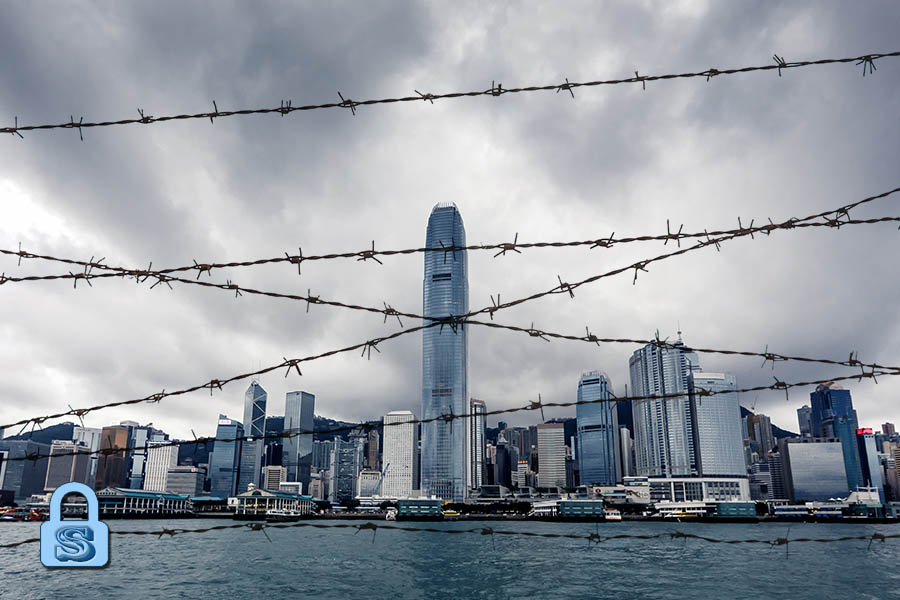
◎ The Hong Kong national security law is a double-edged sword for Xi in the factional struggle and could serve as a catalyst for political Black Swans.
On June 30, the Standing Committee of the National People’s Congress passed national security legislation on Hong Kong.
The law empowers Beijing to clamp down on activities the Chinese Communist Party considers to be “secession,” “subversion,” “terrorism,” “collusion with foreign forces,” and even “provoking hatred towards the Central People’s Government or the Government of the Region”—in other words, any activity the CCP views as threatening to regime security.
The law also calls for the establishment of an “Office for Safeguarding National Security of the Central People’s Government in the Hong Kong Special Administrative Region,” a powerful PRC organ tasked with intelligence and advisory functions. The Office is empowered to handle select cases deemed to be “major and imminent” threats to national security.
Most controversially, Article 38 of the law states that it applies to those who committed offenses as defined by the legislation outside Hong Kong and are not permanent residents of the territory. This provision has led some observers to criticize the CCP for rolling out national security legislation not just on Hong Kong, but on the whole world.
In this article, we will look at why the CCP chose to roll out the Hong Kong national security law now, and its ramifications for CCP factional politics.
Timing of the national security law
We previously estimated that there was a 50-50 chance that the CCP passes the Hong Kong national security law by the end of June. Passage of the law at this time would indicate that the CCP’s “current outlook on both domestic and foreign matters is extremely bleak.”
We believe that the CCP made the following presumptions before going ahead with the national security law:
1. The Trump administration is waging a “new cold war” against the CCP in earnest and the CCP likely believes that it cannot mend Sino-U.S. ties regardless of the outcome of the U.S. presidential election in November. The CCP, however, likely believes that it can stem economic losses from the “new cold war.” Recent foreign investment figures give the CCP regime cause for hope. As of late June 2020, the 10-year Treasury yield spread between China and the United States was about 215 basis points, the highest in the past decade. PRC official data shows that net purchases of bonds by foreign funds in May rose by 104 percent from a month ago to $19.4 billion. Meanwhile, onshore Chinese bonds owned by non-mainland investors totaled 2.43 trillion yuan ($343.4 billion) at the end of May, the highest proportion ever.
2. Despite increased foreign investments, the Chinese economy is presently very fragile due to the coronavirus pandemic and the Sino-U.S. trade war. A very fragile economy is concerning for the CCP because regime security is tied to political legitimacy, and political legitimacy is linked with economic performance. Thus, the CCP cannot allow economically and politically destabilizing unrest to continue in Hong Kong (or elsewhere in mainland China), and needs to move as soon as possible to suppress dissent.
3. The CCP believes that Hong Kong may not be that valuable or useful to the regime as an international commercial hub in the long run. In the interim, however, the CCP is looking to bring back “stability” to Hong Kong to convince investors and businesses to keep their money and operations in the territory.
4. The CCP does not have confidence that Hong Kong will enact Article 23 without strong external pressure, particularly after elections for the Hong Kong Legislative Council are held in September.
5. The CCP recognizes that unrest in Hong Kong is political and ideological in nature. In calculus, for the Party to survive and dominate, the city must be reined in before it becomes a full-fledged “anti-communist base” which the United States and other Western democracies can use to “subvert” mainland China.
6. The CCP does not feel sufficiently threatened by the words and actions that the United States and the international community have issued thus far over its decision to impose national security legislation on Hong Kong. Hence, the CCP does not see a need to delay the law from being passed.
7. Because the U.S. and the PRC drew red lines at the Hawaii meeting, the CCP is almost certainly prepared for retaliation over the passage of the Hong Kong national security law from the Trump administration. However, the CCP is likely gambling that it can weather whatever the Trump administration throws at it until a new administration takes office in 2021. The CCP is also likely betting that Trump will not win re-election (and almost certainly finding ways to secure this outcome) and that the incoming administration will be less tough on the PRC over Hong Kong and other matters.
The CCP has ideological and practical reasons for gambling on the outcome of U.S. politics—Western politicians, businessmen, and investors have found it hard to resist the lure of China’s vast market, and Vladimir Lenin allegedly quipped that “the capitalists will sell us the rope with which we will hang them.”
Black Swan catalyst
Xi Jinping’s concerns about the factional struggle in the CCP elite is likely a key reason influencing his decision to rush out the Hong Kong national security law at this time. As we noted when the anti-extradition bill protests broke out last year, Xi’s factional rivals, and particularly the Jiang Zemin faction, will seek to take advantage of crisis in Hong Kong to undermine his leadership (see here and here). We have reason to suspect from the reshuffle of key Hong Kong officials (see here and here) and the purge of Sun Lijun, the PRC public security minister overseeing Hong Kong security affairs, that Xi had moved against the Jiang faction for worsening the unrest in Hong Kong.
Xi and the CCP regime currently face a “perfect storm” of domestic and external problems. Xi’s factional rivals will exploit those problems to attack the Xi leadership for “incompetence” and find excuses to force him to “abdicate” some power or even step down. In the era of “perish together” (同歸於盡) factional struggle, Xi’s rivals will not hesitate to take actions that cause self-harm if they have potential to weaken Xi’s grip on power and eventually lead to his ouster. To deny his rivals, Xi must demonstrate that he is a “strongman” capable of leading the Party out of crisis, adhere to Party orthodoxy to preserve his “quan wei” and paramount position (such as “preferring left rather than right” [寧左勿右] on major issues like Hong Kong and Taiwan), and close off “loopholes” on key issues that his rivals can use against him. For Hong Kong, that means imposing the national security law to intimidate the Hong Kong people into submission and minimize the probability of incidents breaking out that could force him to order a Tiananmen-style crackdown in the territory. The national security law also has provisions (Article 43 in particular) that allow Xi to directly target rival factional elements in Hong Kong (Party princelings, Jiang faction, etc.) should the need arise. From the perspective of factional politics, rushing out the Hong Kong national security law is a matter of personal survival for Xi Jinping.
The Hong Kong national security law, however, is a double-edged sword for Xi in the factional struggle and could catalyze political Black Swans:
1. Instead of intimidating the Hong Kong people into silence and ending unrest, the passage of the national security law could end up inspiring even more protests and unrest. The Jiang faction and Xi’s other political rivals can exploit continued unrest and instability in the territory to both challenge and weaken Xi’s position on the Hong Kong issue.
2. The U.S. and its allies could roll out punishing retaliatory measures against the PRC over Hong Kong. Xi’s factional rivals will not pass up the chance to attack him should the retaliatory measures seriously threaten regime survival.
3. The Hong Kong national security law has the potential to develop into a political legacy issue for Xi Jinping and Jiang Zemin. In 2003, the Jiang faction-controlled CCP Hong Kong and Macau apparatus sought the enactment of local national security legislation (Article 23 of the Basic Law) in Hong Kong to perpetuate Jiang’s persecution of the Falun Gong spiritual practice in the city. The Jiang faction’s plan, however, was defeated when over half a million people took to the streets to protest Article 23. Now with the passage of the PRC’s national security law, Falun Gong practitioners in Hong Kong and media outlets run by Falun Gong adherents (Dajiyuan, The Epoch Times, New Tang Dynasty Television, Sound of Hope, etc.) can be targeted by the CCP at any time.
It is possible that the Jiang faction could sway intelligence elements in the Office for Safeguarding National Security of the Central People’s Government in the Hong Kong Special Administrative Region to open up cases against Falun Gong adherents using the excuse that they are “major and imminent” threats to regime security, and eventually make those cases public. Even without prompting from the Jiang faction or influence from the CCP elite, middle to lower ranking CCP officials will find reasons to investigate Falun Gong members in Hong Kong because the persecution of Falun Gong is still on the books.
Xi has no excuse to ignore or reject Hong Kong national security cases involving Falun Gong since the persecution campaign is official policy and Falun Gong members and their media outlets partake in many activities that the CCP can easily construe as “subversion” or “hatred towards the PRC.” But should Xi allow those cases to proceed, he would come to “own” the persecution and have a share in Jiang Zemin’s bloody political legacy. Having a share in Jiang’s political legacy would force Xi to accommodate the Jiang faction, and the Jiang faction would realize one of its key goals in undermining the Xi leadership.
What’s next
1. Because Xi Jinping relied on Party orthodoxy to consolidate power, his strategies and solutions to problems are constrained by a need to adhere to Party orthodoxy and ideology. As Xi and the CCP “prefers left rather than right,” the CCP will become less flexible but more hardline, confrontational, and pernicious in its policies. Xi and the CCP could even enact policies or take actions that defy logic or reason. Geopolitical risks are set to rise for the PRC and other countries, while Xi faces unprecedented levels of personal and political risk.
2. The Hong Kong people will unlikely be completely cowed and silenced by the national security law. Expect the Hong Kong people to keep protesting Beijing in the streets and through a variety of innovative methods.
3. President Donald Trump will be forced by re-election concerns and the coronavirus pandemic to get increasingly tougher on China. Trump will be even more determined to take action against the PRC should a second wave of infectious diseases break out in mainland China and spread around the world. We believe that it is a matter of when and how strongly, and not whether, the Trump administration takes retaliatory measures against the PRC over the Hong Kong national security law.
4. The CCP has a habit of tightening up “stability maintenance” measures around “sensitive” dates, or dates where it carried out serious human rights abuses like the Tiananmen Square Massacre. With the anniversary of the persecution of Falun Gong coming up on July 20, we will not be surprised to see the CCP move against Falun Gong members in Hong Kong around that period.