◎ The current Sino-U.S. conflict is not just a trade war or a tech war, but a critical battle of ideology, value systems, and morality.
On July 16, senior Trump administration officials gave major speeches with direct ramifications for the brewing Sino-U.S. “new cold war.”
Speaking at the Gerald R. Ford Presidential Museum, U.S. Attorney General William Barr delivered remarks on China policy, the third in a series of speeches by top administration officials on the topic. Barr spotlighted American companies’ “corporate appeasement” to the Chinese Communist Party in his speech, singling out the cases of Apple and Disney. He also warned corporations that they face repercussions from both the CCP and the United States for their behavior.
Key points in Barr’s speech include:
- “The CCP rules with an iron fist over one of the great ancient civilizations of the world. It seeks to leverage the immense power, productivity, and ingenuity of the Chinese people to overthrow the rules-based international system and to make the world safe for dictatorship. How the United States responds to this challenge will have historic implications and will determine whether the United States and its liberal democratic allies will continue to shape their own destiny or whether the CCP and its autocratic tributaries will control the future.”
- “… China would emerge after the Cold War as a near-peer competitor of the United States.”
- “The People’s Republic of China is now engaged in an economic blitzkrieg—an aggressive, orchestrated, whole-of-government (indeed, whole-of-society) campaign to seize the commanding heights of the global economy and to surpass the United States as the world’s preeminent superpower.”
- “… the ultimate ambition of China’s rulers isn’t to trade with the United States. It is to raid the United States. If you are an American business leader, appeasing the PRC may bring short-term rewards. But in the end, the PRC’s goal is to replace you.”
- “All too often, for the sake of short-term profits, American companies have succumbed to that influence—even at the expense of freedom and openness in the United States.”
- “America’s big tech companies have also allowed themselves to become pawns of Chinese influence … Over the years, corporations such as Google, Microsoft, Yahoo, and Apple have shown themselves all too willing to collaborate with the CCP.
- “The CCP has long used public threats of retaliation and barred market access to exert influence. More recently, however, the CCP has also stepped up behind-the-scenes efforts to cultivate and coerce American business executives to further its political objectives—efforts that are all the more pernicious because they are largely hidden from public view.
- “America’s corporate leaders might not think of themselves as lobbyists … But you should be alert to how you might be used, and how your efforts on behalf of a foreign company or government could implicate the Foreign Agents Registration Act.”
- “The Chinese Communist Party thinks in terms of decades and centuries, while we tend to focus on the next quarterly earnings report. But if Disney and other American corporations continue to bow to Beijing, they risk undermining both their own future competitiveness and prosperity, as well as the classical liberal order that has allowed them to thrive.”
- “The American people are more attuned than ever to the threat that the Chinese Communist Party poses not only to our way of life, but to our very lives and livelihoods. And they will increasingly call out corporate appeasement.”
- “The CCP has launched an orchestrated campaign, across all of its many tentacles in Chinese government and society, to exploit the openness of our institutions in order to destroy them.”
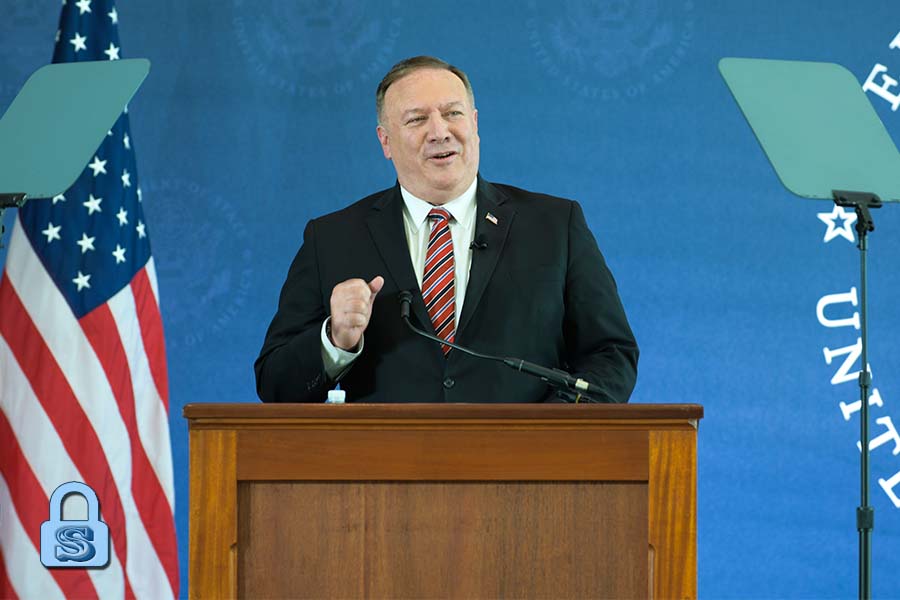
Later in the day, U.S. Secretary of State Mike Pompeo delivered a speech at the unveiling of a draft report by the Committee of Unalienable Rights at the National Constitution Center in Philadelphia. In his speech, Pompeo noted that U.S. diplomacy must be grounded in the nation’s founding principles, without which America’s efforts to “protect and promote human rights is unmoored and, therefore, destined to fail.” Pompeo also called out The New York Times for spreading “Marxist ideology” and “false doctrines” of America’s founding that would leave the CCP “gleeful.”
Key points in Pompeo’s speech include:
- “America is fundamentally good and has much to offer the world, because our founders recognized the existence of God-given, unalienable rights and designed a durable system to protect them.”
- “America is special. America is good. America does good all around the world.”
- Pompeo introduced prominent Chinese human rights activist Wei Jingsheng, who attended the event, and praised his “courageous call for the Chinese Communist Party to honor the unalienable rights that God has given to every Chinese citizen–from Tibet to Tiananmen and from Hong Kong to Hubei.”
- Pompeo noted that “the United Nations Human Rights Council does the bidding of dictators and averts its gaze from the worst human rights offenses of our times.”
- Pompeo said that he found deeply troubling a question put to him by a “well-known senior columnist for a major American media outlet” last year. He then quoted the draft report, “There can be no moral equivalence between rights-respecting countries that fall short in progress towards their ideals, and countries that regularly and massively trample on their citizens’ human rights.”
- Pompeo pointed to recent sanctions on senior CCP officials by the U.S. State Department and Treasury Department, and said, “We do all of these things, our foreign policy does all of these things, for the sake of unalienable rights.”
Our take:
1. We analyzed a year ago that the “current Sino-U.S. conflict is not just a trade war or a tech war, but a critical battle of ideology, value systems, and morality.” The July 16 speeches of AG Barr and Secretary Pompeo, as well as the CCP’s continued emphasis on ideology and the paramount role of the Party’s leadership and system, underscore our prescience.
Barr’s speech alludes to National Security Advisor Robert O’Brien’s earlier speech on the CCP’s ideology and global ambitions but focuses primarily on the difference in value systems between the U.S. and the CCP, as well as the moral dimension of the “new cold war.” This is clear from how Barr frames the CCP threat in the opening of his speech (“United States and its liberal democratic allies” versus and “the CCP and its autocratic tributaries”) and his examples of “corporate appeasement” by Hollywood and Disney.
Meanwhile, Pompeo’s speech makes clear that America’s ideological position is that of its founding principles and documents (the Constitution, Declaration of Independence, etc.). The State Department’s Commission on Unalienable Rights and its draft report provide important theoretical underpinning for what the U.S. stands for as the Trump administration moves to confront the CCP across the board. Indeed, Pompeo reveals as much in a July 16 commentary piece in The Washington Post: “Ruled with an iron fist by the Chinese Communist Party, for instance, China seeks to remake the world in its autocratic image and subordinate other nations to its hegemonic ambitions. We can’t confront Beijing or other gross human rights violators throughout the world without understanding the roots of our foreign policy, through the lens of our Founders’ intent.”
2. We have been saying since 2018 that the Trump administration is playing the human rights card against the CCP to force it to change its pernicious behavior (for some of our earlier analysis, see here, here, here, and here). And if the administration had its finger hovering over the human rights “nuclear” button a year ago, its finger is now squarely on the button with the release of the draft report on unalienable rights and recent sanctions against senior CCP officials over the persecution of Uyghurs and other ethnic minorities in Xinjiang.
3. Readers of our 2019 Special Report would find AG Barr’s remarks about the CCP planning to “raid” and “replace” U.S. corporations to be familiar. We wrote then that “top financiers that back Beijing over Washington may see short-term gains, but will end up on the losing side in the long run” because “the CCP will have no qualms about condemning ‘old friends’ of Beijing, confiscating their wealth, and purging them” once it has gained a dominant position.
What’s next:
1. We previously examined why the CCP fears an ideological battle against the United States. If Xi Jinping cannot handle America’s ideological push, he will likely be challenged by factional rivals for provoking ideological conflict with the U.S. through his policies and speeches and dooming the important Sino-U.S. relationship. Escalation in the CCP factional struggle increases the odds of political Black Swans emerging in China and hastens the arrival of the Party’s “Berlin Wall” moment.
2. Both Pompeo and Barr’s remarks are likely meant to educate the American public and bring national consensus on the CCP threat as the Trump administration prepares to take bold action against the Chinese communist regime. We believe that the Trump administration is only in the beginning phase of its education project and will likely continue the process after Secretary Pompeo has delivered the administration’s fourth and final speech in a series on China policy.
3. With AG Barr’s speech, the Trump administration has officially put American corporations on notice for collaborating with and/or kowtowing to the CCP. Going forward, the administration could punish some prominent companies over their work with the CCP to serve as a warning to others.
4. In our 2019 Special Report, we warned that “top financiers or businesses that back the CCP regime” are at risk of “suffering serious reputational damage when a Black Swan event occurs in China.” Meanwhile, the U.S. State Department recently warned American companies of “reputational, economic, and legal risks” for associating with Chinese companies involved in the CCP’s human rights abuses in Xinjiang.
Xi and the CCP face a “perfect storm” of domestic and external problems. Depending on the pace and manner in which those problems fester, rapid regime collapse cannot be ruled out. Businesses, investors, and even governments who are looking to avoid reputational damage over their support of the CCP need to find ways to reduce their political risks and even accrue “good karma” by taking a stance on the CCP’s human rights abuses.