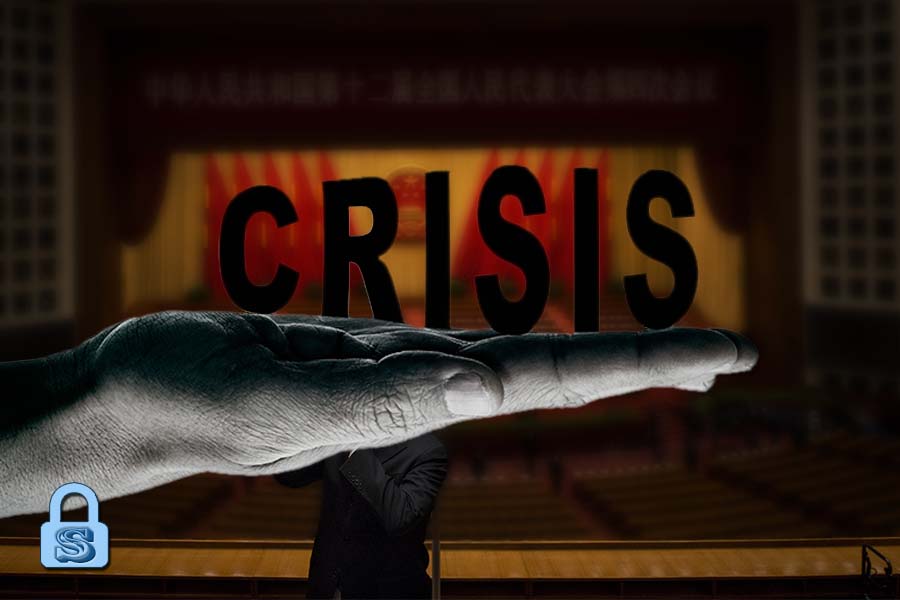
◎ This article offers an overview of the challenges that the CCP regime currently faces, the strategies and solutions it could pursue to avoid regime crisis, and the policies that it could roll out at the Two Sessions.
The Wuhan coronavirus pandemic has given rise to economic and geopolitical conditions that seriously threaten the Chinese Communist Party regime. The CCP will use various strategies to cope with the crisis, and could even implement seemingly radical solutions to achieve its strategic goals.
This article offers an overview of the challenges that the CCP regime currently faces, the strategies and solutions it could pursue to avoid regime crisis, and how this would affect the policies rolled out at the 2020 Two Sessions.
Domestic and external challenges
The coronavirus pandemic has resulted in:
1. Over 4.8 million COVID-19 cases and 322,000 deaths in over 227 countries as of May 19.
2. A severely impacted global economy due to the large concentration of supply chains in China, governments imposing lockdowns of countries and regions, and decreasing world consumption.
- According to an April 8 World Trade Organization press release, world trade is expected to fall between 13 percent and 32 percent in 2020. WTO economists also believe that the pandemic trade decline will likely exceed the trade slump caused by the 2008-2009 global financial crisis.
3. The disruption of normal life in China and other affected areas despite the gradual lifting of lockdowns due to the lack of vaccines or reliable treatments and the risk of reinfection and a “second wave” of the coronavirus.
- The Jilin provincial government declared Shulan City a high-risk area on May 10 after a fresh outbreak of infections and imposed a partial lockdown of the city on May 13.
- A spike in new coronavirus cases in the week of May 4 led South Korean president Moon Jae-in to inform the country to “brace for a second wave” on May 10.
- Coronavirus cases climbed in Germany from May 3 after an easing of lockdown restrictions.
4. Heightened global wariness or hostility towards China and the CCP as people and governments faced with economic and other hardships contemplate the CCP’s role in the pandemic.
The factors listed above have caused the following economic problems for the CCP regime:
1. Sharp economic and financial decline.
- China’s GDP officially contracted 6.8 percent in the first quarter of 2020. In accounting for the CCP’s penchant for data manipulation and understating economic figures, we believe that China’s GDP decline is much more severe than 6.8 percent.
- China’s Q1 foreign trade volume fell 6.4 percent year-on-year to 6.57 trillion yuan. Exports decreased by 11.4 percent from a year ago to 3.33 trillion yuan. Meanwhile, China’s trade surplus fell 80.6 percent to 98.33 billion.
- China’s foreign exchange reserves fell $46.085 billion in March to $3.061 trillion, much more than analysts expected.
2. Declining global consumption caused by the pandemic has led to rising business failures and unemployment.
- As many as 70 million people in China could have lost their jobs from the coronavirus, according to an April 24 report by the Shandong-based Zhongtai Securities. Seventy million people translates into an actual unemployment rate of 20.5 percent.
- Liu Chenjie, the chief economist of the Shenzhen-based fund management firm Upright Asset, noted in a Caixin article published on March 31 that as many as 205 million Chinese workers are in a state of “frictional unemployment” (workers who want to work but either cannot or are unable to do so).
3. Rising unemployment and business failure affect the Chinese people’s consumption power and government revenue.
- According to official data, the PRC’s national general public budget revenue fell 14.3 percent to 4.6 trillion yuan in Q1 2020. Meanwhile, the national deficit reached a high of 930 billion yuan, or nearly double that over the same period in 2019.
- On May 3, Outlook Weekly, a Xinhua News Agency publication, published an article which noted that some county governments in China’s central region saw their fiscal revenues drop by half or more in the first quarter of the year.
4. The CCP government’s stimulus and subsidy measures to revive the epidemic-hit economy have not been working out thus far.
- In Q1, the People’s Bank of China released nearly 2 trillion yuan in liquidity through reserve requirement ratio cuts and reverse repo operations. The PBoC also added 7.1 trillion yuan in new loans. By March, the interest rate for corporate loans fell to 4.82 percent, or down 0.3 percent from the end of 2019.
- The CCP government rolled out policies to help small and medium-sized enterprises to secure loans from January to February to tide out the coronavirus epidemic. By March, property prices in Shenzhen skyrocketed, and likewise in April in Shanghai. Mainland media reports revealed that property prices shot up in Shenzhen because people had been taking advantage of the CCP government’s new SME loan policy that was meant to help businesses weather the epidemic to instead purchase property at a “low interest rate.” Financial intermediaries estimated that half of the loans that companies took out to support operating costs ended up flowing into the property sector, according to mainland media reports.
- On May 8, the People’s Republic of China’s Ministry of Commerce announced that it had issued over 19 billion yuan worth of vouchers to consumers since the epidemic outbreak to drive consumption. The ministry, however, noted that so-called “econnoisseur” (羊毛黨) had managed to snap up the bulk of the government-issued vouchers and converted them into cash by colluding with merchants.
5. Foreign exchange shortage and rising unemployment may trigger property and financial sector risks in China.
- According to an April report by the PBoC’s financial survey and statistics department, Chinese urban households have 74.2 percent of their total assets in property. Urban households also have a debt ratio of 56.5 percent, 75.9 percent of which is property debt that is financed by Chinese banks. Meanwhile, financial assets comprise 44.6 percent of all urban households’ debt ratio; financial asset make up over 100 percent of the debt ratio for more than half of urban households in China. In other words, a debt crisis centered around the property sector will be triggered in China if the CCP is unable to rescue the Chinese economy.
- According to a recent report by mainland newspaper 21st Century Business Herald, 1.46 trillion yuan worth of property debt will mature in 2020.
- The issuance of Chinese-issued U.S. dollar bonds totaled $910 billion (excluding interbank certificates of deposit) as of March 23, 2020, according to Bloomberg data cited by Sina’s financial news portal. The bulk of the bonds were concentrated in the financial industry (31 percent), property (22.27 percent), and urban investment (7.65 percent). As of April 9, $87.9 billion worth of Chinese-issued U.S. dollar bonds were set to mature between the second to fourth quarters of 2020, $63.6 billion (72.3 percent) of which were bonds issued by financial institutions, real estate companies, and urban investments.
- According to data released by Evergrande Research Institute, the interest-bearing liabilities that Chinese property companies need to pay in 2020 and 2021 are 5.85 trillion yuan and 3.4 trillion yuan respectively.
- China’s foreign exchange reserves will keep depleting as China’s exports shrink, and this would lead to a dollar shortage for the CCP regime and increasing cost of U.S. debt. Meanwhile, company closures and rising unemployment will affect consumption and leave people unable to pay their mortgages, leading to the collapse of property companies. Increasing bad debts in the property sector will in turn impact the financial sector and heighten financial risks in China.
6. China’s growing food crisis.
- We previously examined China’s food crisis here and here. Recent developments include unusually heavy hail and snowfall in April and May in some regions in China and Chinese people rushing to stockpile food since April. The CCP authorities have also repeatedly refuted the existence of a food crisis and insist that China has ample quantities of three main food staples (rice, wheat, millet). Given the CCP’s penchant for fraud and misinformation, however, its repeated denials point to a cover-up of food problems in China. We believe that China’s grain production in 2020 will be greatly reduced and food prices will soar.
- China’s food crisis will almost certainly be worsened by global food shortages. At the end of April, at least 14 countries have introduced measures to restrict or prohibit the export of agricultural products and other foodstuff. According to an April 21 report by the World Food Program, as many as 265 million people in the world will be affected by food insecurity in 2020.
The CCP also faces the following external problems:
1. Increasing trends of de-globalization and “de-Sinicization.”
- Countries like the U.S. and Japan are pulling supply chains and production out of mainland China due to national security concerns. Other countries and multinational corporations will likely follow suit as they seek to mitigate the risks of another outbreak of deadly infectious diseases in China. De-globalization will compound China’s economic problems and worsen the CCP’s regime crisis.
- The Sino-U.S. “new cold war” will result in a degree of “de-Sinicization” as countries and corporations move to balance or minimize risks during a time of great power competition.
2. Increasing push back against the CCP’s “wolf warrior” diplomacy and disinformation campaigns.
- The U.S. and its allies (Australia, New Zealand, the United Kingdom, etc.), as well as the European Union and some Asian countries, have been standing up to the CCP’s “wolf warrior” diplomacy with varying degrees of firmness. Previously, many of the aforementioned countries were largely pro-China and would more often than not cave to PRC pressure.
- The U.S. and several other countries have been actively calling out CCP disinformation on the Wuhan coronavirus and its origins.
3. Growing calls for an international investigation into the origins of the coronavirus.
- Global pressure on the CCP to allow an international investigation into the coronavirus and its origins will have an impact on the CCP factional struggle.
4. Growing “irrelevance” of the Sino-U.S. “phase one” trade deal and trade negotiations.
- China’s economic troubles and the pandemic make it virtually impossible for the CCP to fulfill its trade deal commitments.
- The need for an inquest into the origins of the coronavirus, as well as the upcoming U.S. presidential election and other domestic political factors, mean that President Trump is better off canceling the “phase one” deal and getting tougher on China than sticking with the deal. On May 14, Trump said that the U.S. could “cut off the whole relationship” with China.
- The CCP is disadvantaged in a Sino-U.S. “cold war” if it does not have a Sino-U.S. trade deal or meaningful trade negotiations to restrain the relationship and prevent an escalation of tensions.
5. A “new cold war” and ideological battle with the United States.
- The U.S. and China appear to be headed for an open “cold war.” An open Sino-U.S. “cold war” will make it much harder for the CCP regime to compete with the U.S. on all fronts, recover economically from the coronavirus, and advance its domination agenda.
- Since October 2019, the Trump administration has been increasingly challenging the CCP on the ideological front by calling out the regime’s Marxist-Leninist heritage and authoritarian nature. U.S. Deputy National Security Advisor Matt Pottinger’s May 4 speech is the most prominent recent example of the Trump administration engaging in ideological battle against the CCP. We previously explained why the CCP is disadvantaged in an ideological battle with the United States and why an ideological battle will result in a crisis for the CCP regime.
6. Taiwan’s growing international profile and support.
- Taiwan’s stellar handling of the coronavirus outbreak has boosted its international profile. The U.S. and many other countries have also pushed the World Health Organization to restore Taiwan’s observer status, albeit unsuccessfully.
- The U.S. continues to strengthen its relationship with Taiwan and grow international support for the ROC.
- A successful Taiwan with strong U.S. support represents an inherent challenge to the CCP’s legitimacy and ideology.
The CCP’s crisis strategy
The CCP’s strategy for handling its many crises will revolve around its “six stabilities” and “six guarantees”:
- “Six stabilities”: Employment, finance, foreign trade, foreign and domestic investments, and job expectations.
- “Six guarantees”: Employment, basic livelihood, market entities, food and energy security, supply chain stability, and operations of grassroots institutions.
1. Solving issues involving employment and people’s livelihoods are paramount for the CCP if it is to preserve its eroding political legitimacy. To solve those issues, the CCP will look to boost economic growth, increase exports, support small and medium-sized enterprises, and fix food shortages.
2. The CCP will look to restore economic growth and resolve issues with regard to industrial layout (產業佈局, including 5G rollout, etc.) to forestall financial and debt crises, prevent an expansion and bursting of the property bubble, and grow its foreign exchange reserves.
3. The CCP will look to stabilize Sino-U.S. relations and prevent an accelerated decoupling of their economies so that it still has a reliable outlet for exports, increase its U.S. dollar reserves, continue to attract foreign capital and investments to China, and stem accelerated capital outflows.
4. To resolve industrial layout and property bubble problems, the CCP will look to roll out measures to arrest the decline of China’s working-age population, fix the household registration (hukou) system, and reform land policies.
5. The CCP will look to resolve food shortages through intensive farming measures and increasing food procurement from overseas.
6. The CCP will look to guarantee the operations of grassroots institutions by finding ways to keep revenue generation stable while investing resources to upkeep the regime’s “stability maintenance” forces.
7. The CCP will look to advance its Belt and Road Initiative and promote the internationalization of the renminbi to avoid international isolation.
8. The CCP will look to further “guarantee” domestic stability by “stabilizing” the Hong Kong situation and finding workarounds to “resolve” the Taiwan issue.
How the CCP could actualize its crisis strategy
Stabilize finances and stimulate the economy
1. The CCP could roll out huge stimulus measures, including issuing large quantities of local government bonds, special treasury bonds, and special bonds for local governments. The scale of the stimulus could be between 5 trillion yuan to 10 trillion yuan.
2. The CCP could monetize its fiscal deficit through quantitative easing in a bid to stimulate the economy and replenish the regime’s finances. However, the CCP’s “debt monetization” will likely fail due to the regime’s authoritarian nature and local officials prioritizing their own interests over the regime’s. Thus, instead of stimulating the economy, “debt monetization” will accelerate the collapse of the CCP regime’s sovereign credit ratings.
3. The CCP could invest heavily in building infrastructure (roads, public amenities, etc.) and so-called “new infrastructure” (5G, data centers, artificial intelligence, Internet of things, etc.) to stimulate the economy.
4. The CCP will introduce measures aimed at further liberalizing the economy and lifting investment restrictions to attract foreign investments. Foreign investors who believe the CCP’s propaganda could shift funds to China as they seek a financial “safe haven” amid tumultuous times. The “transfusion” of foreign capital, however, would likely be “too little, too late” to rescue the CCP regime.
5. The CCP will push the internationalization of the renminbi. Recently, the CCP took the opportunity to push RMB internationalization and its blockchain technology in the commodity market by having foreign companies make yuan-denominated transactions. The CCP could take advantage of shrinking global demand during the pandemic and China’s demand for commodities to settle more transactions with suppliers in RMB. Also, the CCP could further promote the circulation and use of RMB cryptocurrency in China to facilitate the internationalization of the RMB.
Grow strategic emerging industries
1. The CCP will carry out so-called “industrial layout optimization” (分工佈局) for technology industries like 5G, artificial intelligence, Internet of Things, Industry of Internet, big data, cloud services, so-called new energy vehicles (electric cars), biotechnology, etc. (“Industrial layout optimization” refers to government planning of where certain industries and supply chains should be located so as to benefit production and resource allocation. This type of planning is typical of a command economy in a socialist country)
2. The CCP will strive to ensure the economic development of coastal areas and improve on existing industrial chains.
3. The CCP will prioritize and invest in basic research and the development of core technologies.
Population policies
1. The CCP will likely look to liberalize the household registration system to:
- Attract people with ability and wealth to medium- to large-sized cities.
- Resolves labor shortage problems brought about by very low population growth.
- Drive the development of areas and cities neighboring first-tier cities in China.
- Facilitate labor and capital needs for “industrial layout optimization.”
- Drive up consumption in medium- to large-sized cities.
- Prop up property prices in medium- to large-sized cities.
2. The CCP will look to drive out the so-called “low-end population” and migrant workers without a job from first- and second-tier cities to curb or eliminate social instability.
Property, land, and ‘stability maintenance’ policies
1. The CCP will seek to stabilize property prices in first- and second-tier cities.
2. The central government will delegate the approval of land sales and use to provincial authorities. Land would be allocated/used for:
- Increased urban construction in medium- to large-sized cities to expand city size.
- Increase the scale of agricultural land in rural areas to ensure that the overall scale of agricultural land is not diminished.
3. The CCP could consolidate rural agricultural land through “shareholding” policies and promote intensive farming to increase food production.
4. The CCP will strengthen online censorship and speech restrictions.
5. The CCP will strengthen control over and persecution of religious groups.
6. The CCP will make it compulsory for civil servants and public-sector employees to use its RMB cryptocurrency, strictly monitor the flow of funds in China, and implement a form of covert rationing should the need arise.
7. The CCP will restore supply and marketing cooperatives in third- and fourth-tier cities, as well as in rural areas. These cooperatives will be tasked with implementing a partial rationing system in the event of food shortages.
8. The CCP will expand its military recruitment to resolve China’s unemployment issues and bolster its “stability maintenance” ability. In particular, the CCP will want to keep fresh graduates and young people—a segment of the population that is more likely to be belligerent and radicalized—in the regime’s employment for several years so that they cannot create trouble for the regime.
Hong Kong
1. The CCP will work through the authorities in Hong Kong to keep protestors and pan-democrats suppressed in Hong Kong. For instance, the Hong Kong police force could come up with various pretexts or even create incidents to arrest anti-extradition bill protesters. The Hong Kong authorities could also move to tie down the pan-democrats through lawsuits and arrests so that they will not be able to interfere in the CCP’s plans for Hong Kong.
2. The CCP will want Hong Kong to pass national security legislation in Hong Kong (Article 23 of the Basic Law) and other legislation that will not be conducive for freedom and democracy in the city before Legislative Council elections are held in September 2020. To this end, the pro-establishment camp in Hong Kong are already subverting LegCo rules; the CCP could attempt other shenanigans through pro-Beijing elements in Hong Kong to achieve its goal.
3. The CCP will continue to roll out propaganda and disinformation about the Hong Kong protesters and the United States (“black hands” behind the anti-extradition bill protests, etc.) to discredit them.
4. The PRC central government could roll out policies to support the Hong Kong economy while tightening control over the city. For instance, Chinese companies could increase their investments in Hong Kong and the central government could offer preferential terms for Hong Kong youths to set up shop on the mainland.
Taiwan
1. The CCP will propose policies to support and give preferential treatment to Taiwanese businesses, as well as expand upon existing policies meant to “benefit” Taiwan.
2. The CCP will continue to menace Taiwan through military action (naval vessels circumnavigating Taiwan, jet fighters flying close to Taiwan, etc.), but will take care to avoid provoking military conflict with the United States.
Two Session policies
The policy direction in this year’s PRC government work report will build on the 2019 work report and address issues pertaining to the Sino-U.S. trade war. The 2020 government work report will likely also address the adjustments that need to be made due to the impact of the coronavirus on the Chinese economy.
The policies introduced at the 2020 Two Sessions are very likely aimed at actualizing the items listed in a new guideline to “accelerate the improvement of the socialist market economy in the new era” that was rolled out on May 11.
Key policies could include:
1. The PRC government will announce that so-called “socialism with Chinese characteristics under the guidance of ‘Xi Jinping Thought’” and public ownership will remain unchanged.
2. The PRC government could strengthen the “state advances, private sector retreats” (國進民退) policy under the guise of state sector reform. Policies could also be introduced to strengthen the market advantages of state-owned enterprises.
3. The PRC government will introduce key policies this year that could revolve around guaranteeing employment and people’s livelihood (including poverty alleviation), as well as maintaining social stability and governance.
4. The PRC government could push through “debt monetization” through issuing large quantities of local government bonds, special treasury bonds, and special bonds for local governments. The “debt monetization” scale could be between 5 trillion yuan to 10 trillion yuan.
5. The PRC government will introduce financial liberalization measures and promote them as a sign that China is reforming and opening up further to the world. Measures could include lowered tariffs, as well as so-called “marketization” and “internationalization” of securities, bonds, and financial industries where the CCP has a monopoly.
6. The PRC government could propose plans for “industrial layout optimization.”
7. The PRC government could introduce measures to simplify administration and decentralization, as well as introduce a national “negative list” for local governments to comply.
8. The PRC government could roll out preferential policies to support small- and medium-sized enterprises.
9. The central government could encourage local governments to expand the scale and scope of consumer vouchers to stimulate the coronavirus-hit economy.
10. The PRC government could propose tax relief for companies and individuals.
11. The PRC government could set aside government funding for re-employment and re-training of out-of-job workers.
12. The PRC government will likely announce measures to advance the Belt and Road Initiative and facilitate the development of emerging industries and biotechnology (including coronavirus vaccine development and research).
13. The PRC government will likely announce measures to further develop free trade zones and free trade ports.
14. The PRC government will likely introduce policies to relax land use restrictions in medium- and large-sized cities.
15. The PRC government will likely introduce rural land trading and consolidation policies to facilitate intensive farming.
16. The PRC government could liberalize household registration policies in most cities to promote selective urbanization.
17. The PRC government could stress that “houses are built to be lived in, not for speculation.”
18. The PRC government could roll out measures to govern society more strictly in the name of facilitating epidemic prevention and control work. This could include the introduction of new technologies to bolster surveillance.