◎ Secretary Pompeo’s speech affirms several trends in U.S. policy toward the PRC which we have identified since July 2018.
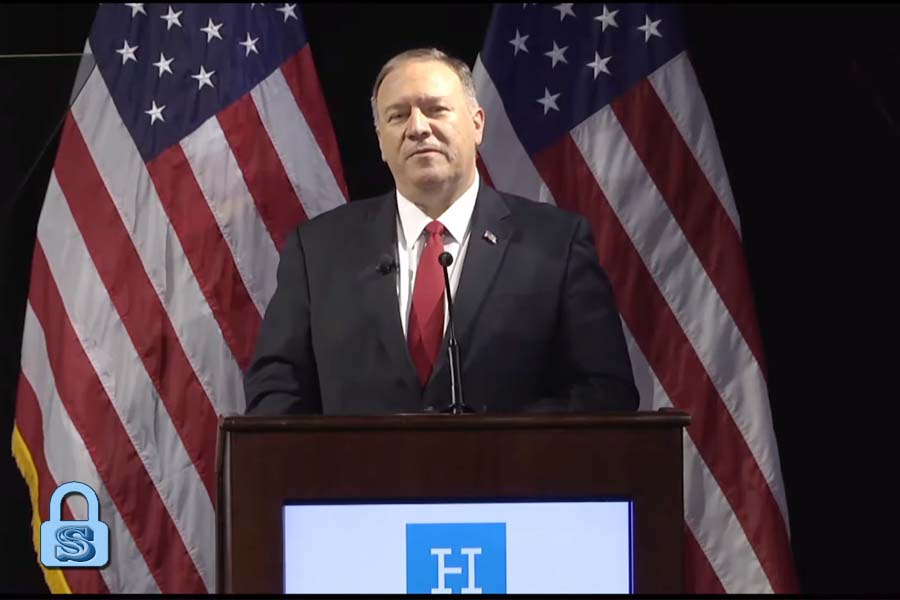
On Oct. 30, United States Secretary of State Mike Pompeo gave a speech titled “The China Challenge” at the Hudson Institute’s Herman Kahn Award Gala in New York City.
Key points in Pompeo’s speech include:
1. Early into his remarks on the People’s Republic of China, Pompeo said that the “communist government in China today is not the same as the people of China. They’re reaching for and using methods that have created challenges for the United States and for the world.”
2. Pompeo said that there is a need for America to “confront these challenges from the PRC head-on, and along each of the many facets.” He added that it “is no longer realistic to ignore the fundamental differences between our two systems and the impact, the impact that those two systems have, the differences in those systems have on American national security.”
3. Pompeo said: “We know too that the Chinese Communist Party is offering its people and the world an entirely different model of governance. It’s one in which a Leninist Party rules and everyone must think and act according to the will of the Communist elites. That’s not a future that I want, I think it’s not a future that anyone in this room wants, it’s not a future that other democracies want, and it’s not a future that the people of China – the freedom-loving people of China everywhere don’t want this model.”
4. Pompeo announced that he would be giving a “series of sets of remarks” about various challenges posed by the PRC, including:
- “…competing ideologies and values and the impact that has on America and the world. The Chinese Communist Party is a Marxist-Leninist Party focused on struggle and international domination. We need only listen to the words of their leaders.”
- PRC interference in the United States. “The party’s intelligence agencies, the United Front Work, and its propaganda outlets have embarked on a global campaign to change public opinion in favor of Beijing,” he said.
- The PRC’s impact on the international order. “Beijing is actively creating its own international space and it participates in international organizations to validate its authoritarian system and spread its reach,” he said.
- The PRC’s economic practices. “China has engaged in unfair predatory economic practices and it’s utilizing state assets to build its economic footprint all around the world,” he said.
5. Pompeo said that “we don’t want a confrontation with the People’s Republic of China. In fact, we want just the opposite.” He then talked about wanting to see a prosperous, thriving, and liberalized China that respects human rights. “But above all, it’s critical that as Americans, we engage China as it is, not as we wish it were,” Pompeo said.
6. Near the conclusion of his speech, Pompeo said that the United States has to “think anew, and unconventionally, about the People’s Republic of China.”
Our take:
1. Secretary Pompeo’s speech affirms several trends in U.S. policy toward the PRC which we have identified since July 2018, including:
- The Trump administration is looking to reshape the CCP-hijacked world order.
- There is an ideological turn in U.S. policy towards China.
- The U.S. is consciously differentiating between China and the CCP.
- The U.S. and China are already in a “new cold war.”
2. In analyzing U.S. Vice President Mike Pence’s second China policy speech, we noted that one of the reasons why it was more conciliatory than his first one given at the Hudson Institute in 2018 was because the Trump administration had likely taken into consideration Xi Jinping’s sensitive political situation in the PRC, namely, his need to hold the delayed Fourth Plenum meeting to get the CCP elites on board with his policies. (It should be noted that while Pence’s second China policy speech opens the possibility of rapprochement, it does not otherwise indicate a shift in the Trump administration’s current China policy.)
With Xi successfully convening the Fourth Plenum on Oct. 28, it becomes much less sensitive and consequential for Secretary Pompeo to deliver his far more explosive “China Challenge” speech on Oct. 30 (Oct. 31 China time), the last day of the Fourth Plenum meeting.
3. There is a good chance that the PRC could press the Trump administration to “tone down” or even sideline Pompeo and other administration “China hawks” to “facilitate” the signing of an interim trade deal and further trade talks.
We believe, however, that the Trump administration’s overall China strategy and political crisis in the CCP will doom any rapprochement attempt and escalate the Sino-U.S. rivalry.
Get smart:
If the U.S. continues along the trajectory as outlined in Pompeo’s speech, then the Sino-U.S. rivalry will shape out to be “not just a trade war or a tech war, but a critical battle of ideology, value systems, and morality.”
Businesses, investors, and governments must get acclimated to the “new normal” in Sino-U.S. relations and pick sides carefully to avoid political risks and discover opportunities as China heads for tremendous change.