◎ The CCP’s recent “war of words” with the U.S. and other countries is the natural outcome of its political culture and a reaction to issues that the communist regime finds most troubling to deal with.
Just after mid-April, the People’s Republic of China stepped up its criticism of countries that were repeatedly calling for an investigation into the origins of the coronavirus and for holding the Chinese Communist Party regime accountable for the coronavirus outbreak. The PRC reserved its strongest condemnation for countries (like the United States and Australia) and people (U.S. Secretary of State Mike Pompeo and Steve Bannon) that have been persistently outspoken on the issue of holding China accountable.
The PRC’s recent “war of words” with countries and people is the necessary outcome of its political culture. While the PRC could have gotten away with its aggressive rhetoric in the past, the coronavirus pandemic and the current economic and geopolitical climate have made many countries much less tolerant of PRC behavior and information warfare. We believe that the PRC’s “war of words” foreshadows a “Waterloo moment” for the CCP regime.
The backdrop:
United States
Since early April, Republican lawmakers in Congress have been condemning the PRC over the coronavirus pandemic. Republican lawmakers called out the CCP for covering up the epidemic when it first broke out in China, its subsequent COVID-19 propaganda and disinformation campaign, and its influence over the World Health Organization and other international institutions. U.S. lawmakers in the House and Senate (mostly Republican and some Democrats) have also been introducing or drafting bills that address the CCP’s role in the coronavirus and its other activities, including securing research at U.S. institutions, allowing Americans to sue China over the coronavirus, blocking the U.S. Department of Defense from supporting film studios that accommodate PRC censorship, and incentivizing medical supply companies to manufacture in the United States.
From mid-April, the Trump administration stepped up calls for the PRC to be forthcoming about the origins of the Wuhan coronavirus and announced an investigation into the virus origins. In an interview with ABC News on May 3, U.S. Secretary of State Mike Pompeo said that “there is a significant amount of evidence” that COVID-19 “came from that laboratory in Wuhan.” Pompeo and other members of the Trump administration have also talked publicly about the U.S. holding the PRC accountable for the coronavirus pandemic. “This is an enormous crisis created by the fact that the Chinese Communist Party reverted to form, reverted to the kinds of disinformation, the kinds of concealment, that authoritarian regimes do … I think the whole world is united in understanding that China brought this virus to the world,” Pompeo said in his interview with ABC News. Meanwhile, U.S. President Donald Trump noted that tariffs are an option as his administration considers retaliatory measures against the PRC over the spread of the coronavirus out of Wuhan.
On April 20, Politico Magazine reported on a 57-page memo produced by a top Republican strategist that advised Republican candidates to draw attention to the CCP and its role in the coronavirus. The April 17 memo was sent to various Republican campaigns.
Australia
On April 23, Australian prime minister Scott Morrison said that Australia will push for an international investigation into the coronavirus at the World Health Assembly meeting in May. After facing pushback from the PRC (see the subsection below), Morrison again confirmed on April 29 that Australia will continue to push for an inquiry into the coronavirus and its origins, which he described as a “very reasonable and sensible course of action.” Speaking to reporters in Canberra, Morrison said, “This is a virus that has taken more than 200,000 lives across the world. Now it would seem entirely reasonable and sensible that the world would want to have an independent assessment of how all this occurred, so we can learn the lessons and prevent it from happening again.”
The PRC
The CCP continued to advance its global disinformation campaign in April by insisting that the coronavirus did not come from China and that its origins are still “unknown.” Simultaneously, the PRC’s propaganda and diplomatic apparatuses engaged in a “war of words” with countries and persons who are pushing for an investigation into the origins of the coronavirus and/or are seeking to hold the CCP regime accountable for causing a pandemic.
In responding to Australia’s call for an international investigation into the coronavirus, PRC ambassador to Australia Cheng Jingye threatened that the “Chinese public” could boycott Australian products and colleges. Global Times, a nationalistic official media outlet, also accused Australia of “spearheading” a “malicious campaign to frame and incriminate China” and becoming a “chess piece” of the United States.
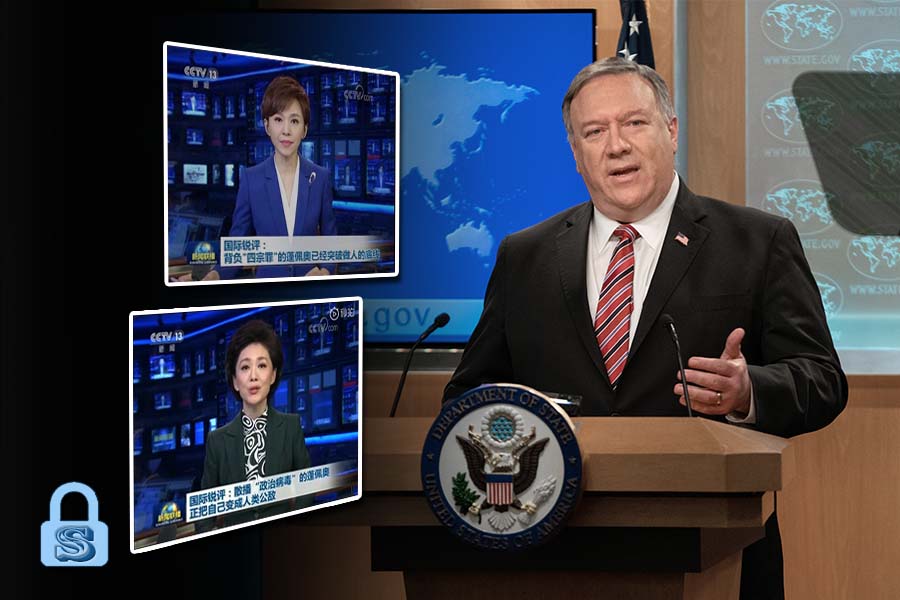
Meanwhile, PRC official media and diplomats attacked American officials and politicians who have been very critical of the CCP regime and its role in the coronavirus pandemic. PRC media seized upon the 57-page memo that Politico reported on to dismiss Republican lawmakers’ call to hold China accountable for the coronavirus pandemic as nothing more than a political/re-election ploy. Former White House Chief Strategist Steve Bannon (“Cold War living fossil”) and White House trade advisor Peter Navarro (“spreader of political viruses”) were also singled out for criticism. The CCP’s harshest criticisms were directed at Secretary Pompeo, who has been consistently calling out the communist regime in his public remarks for not being forthcoming with information about the coronavirus, taking advantage of the pandemic to advance its global interests, and for carrying out disinformation and influence campaigns during the coronavirus outbreak. In numerous critical commentaries published between April 20 to May 5, PRC media described Pompeo as:
- “Evil”;
- “Insane”;
- “Highly venomous”;
- “A common enemy of mankind”;
- A spreader of “lies” and “poison” who “breaks the bottomline of being a human”;
- A spreader of “political viruses”;
- A “Cold War living fossil”;
- “One of the worst Secretaries of the State in American history”;
- Overseeing the “CIA-izing” of the U.S. Department of State and “truly turning the 21st century into a century of great power struggle”;
- Carrying out “a direct assault on the Chinese Communist Party and China’s political system”;
- “Betraying Christianity with lies.”
Our take:
1. The CCP’s recent “war of words” with the U.S. and other countries may seem petty and needless, but it is the natural outcome of its political culture and a reaction to issues that the communist regime finds most troubling to deal with.
While Party culture is defined by “deceit, perniciousness, and struggle” (假惡鬥), the CCP always seeks to portray itself as “great, glorious, and correct” (偉光正). Thus, when faced with external criticism, the CCP will always portray itself as the innocent and reasonable “victim” or the “oppressed” that is being “attacked” by a malicious and unreasonable “oppressor” (or in the case of America, the “hegemon”). For countries that the CCP believes can be bullied and coerced, it will simultaneously play the “victim” while threatening to withhold economic and trade interests (see the recent Australian example). By responding to external criticisms in this manner, the CCP will at the very least satisfy its domestic propaganda and disinformation requirements and preserve “social stability”; in more optimistic scenarios, the CCP will be able to move its global influence efforts another step forward.
We previously observed that “the current Sino-U.S. conflict is not just a trade war or a tech war, but a critical battle of ideology, value systems, and morality.” We believe that the battle of ideology, value systems, and morality is why the CCP reacted very strongly to U.S. Secretary of State Mike Pompeo’s recent remarks:
a) Pompeo has been jousting effectively with the CCP on the ideological front since his “China Challenge” speech on Oct. 31, 2019. We explained in May 2019 why the CCP fears an ideological battle the most. The CCP will view U.S. efforts to expose its ideology as an attempt at fostering regime change in China. This is why PRC official media criticized Pompeo of launching “a direct assault on the Chinese Communist Party and China’s political system,” and why PRC ambassador to the United States Cui Tiankai wrote in his May 5 op-ed in The Washington Post that “the nature of China’s political system dominates the content of their attacks, and the Communist Party is the ultimate target of their barrage.”
The CCP’s recent harsh criticism of Pompeo is both defensive and offensive, and is an attempt to forestall all-out ideological confrontation with the United States. By “problematizing” Pompeo’s remarks, the CCP is likely betting that the U.S. will back away from ideological confrontation instead of risking a sharp escalation in Sino-U.S. tensions. If the Trump administration does shy away from an ideological battle, the CCP’s “belligerence” would be justified and the regime stands a good chance of outlasting America in the “new cold war.” But if the Trump administration persists with its current China strategy, then the CCP’s “bluff” is at risk of being called.
b) The CCP could be lashing out at Pompeo in particular and Trump administration officials (active and former) in general because it again suspects that the Trump administration is working with anti-communist groups to push for regime change in China (see here for an analysis of a previous incident).
The CCP would have noticed that the Trump administration pushed for an investigation into the origins of the coronavirus on the same day that The Epoch Times, a media outlet associated with Falun Gong, released a documentary on the Wuhan coronavirus’s origins that advanced the “escaped from laboratory” theory on April 7. Meanwhile, an April 30 report by The New York Times noted that the Office of the Director of National Intelligence had “convened a review of intelligence officials on April 7 to see whether the agencies could reach a consensus” on the origins of the coronavirus.
We earlier wrote that the CCP is “paranoid enough to suspect the worst of its political and geopolitical enemies” and will “read broader motives into the actions of its enemies even when there is none.” We believe that the CCP is again presuming the worst of the Trump administration because there are parallels between the CCP’s recent prolonged barrage of criticisms directed at Secretary Pompeo and its previous barrage of criticisms directed at an open letter in support of Trump’s China policy, especially the intensity and duration of both “outbursts.” Thus, it cannot be ruled out that the CCP is suspecting that the Trump administration could be collaborating with a Falun Gong-linked organization to push for an investigation into the coronavirus that could ultimately turn into an inquest into the CCP regime itself. Given the implications of what a coronavirus investigation could mean for the CCP’s survival, it is unsurprising that it reacted with substantial ferocity in targeting Secretary Pompeo as a proxy for the Trump administration.
2. With the coronavirus pandemic seriously affecting the global economy and the lives of people around the world, there is great incentive for many governments to hold the CCP regime accountable and avoid being themselves held accountable by the electorate for the domestic outbreak of COVID-19. Blaming the CCP for the coronavirus pandemic is not, as some observers claim, purely a cynical strategy by governments and politicians to advance political or geopolitical interests. The CCP covered up the outbreak during the early phase and is still not being transparent about the epidemic situation in China and the coronavirus’s origins. Much of the world reacted too slowly to the spread of the coronavirus precisely because the CCP confirmed human-to-human transmission to the WHO only weeks after the outbreak in China. Some countries also ended up using less-than-optimal epidemic control measures to craft responses to local coronavirus outbreaks after relying on the CCP’s official coronavirus data (which is notorious for being manipulated). Meanwhile, the CCP continues to spread propaganda and disinformation about the origins of the coronavirus, and sought to take advantage of the pandemic to further its world domination agenda.
The Trump administration and the Republican Party are almost certainly looking to hold the CCP accountable with one eye on the upcoming U.S. presidential election scheduled for November. Holding the CCP accountable suits President Trump’s “tough on China” re-election strategy, and is also a reasonable defense to use when the Democratic Party proceeds with plans to investigate the Trump administration’s handling of the domestic coronavirus situation. Under current circumstances, we believe that the Trump administration will ultimately move to hold the CCP accountable for the pandemic, and likely as soon as the domestic epidemic situation improves in the United States. When the U.S. makes its move, its allies and other countries will likely follow suit.
What’s next:
Party nature and regime survival dictate that the CCP cannot tone down its aggressive rhetoric and cease its “war of words” over the coronavirus with other countries. Meanwhile, domestic circumstances are pushing the Trump administration to make preparations to hold the CCP accountable for the coronavirus once the pandemic weakens. With neither side able and willing to back down from confrontation, Sino-U.S. tensions are bound to escalate and affect the larger geopolitical climate.
The CCP will play the “racism” card (see here, here, here) with increased regularity as the U.S. and its allies apply more pressure on the PRC (the CCP’s propaganda and disinformation campaign is already successful on the mainland; some shopping malls in China have recently put up signs at mall entrances warning about the “American virus.”) The Trump administration could play into the CCP’s hands if it persists with some of its rhetoric, such as calling the coronavirus the “Chinese virus” or the “Wuhan virus.” Secretary Pompeo and other administration officials have argued that the label “Wuhan virus” is sound because the CCP itself used that term during the early days of the outbreak, but logic and facts alone are not always the most effective tools to counter CCP propaganda and disinformation, which relies on censorship (“we never called it the ‘Wuhan virus’!”), faulty but seemingly “intuitive” logic (“the disease was given a scientific name by the WHO precisely to avoid stigmatization, so it is disingenuous to keep referring to it as the ‘Wuhan virus’”) and emotional manipulation to sway people. We wrote previously that “a more effective way to do counter propaganda would be to refer to COVID-19 as the “PRC virus” or “CCP virus” (中共病毒) or even the “CCP pandemic” (中共瘟疫).”
An increasingly hostile geopolitical climate and fiercer Sino-U.S. competition will impact the factional struggle in the CCP and raise the odds of Black Swans emerging in China in the second half of this year. Businesses, investors, and governments must recognize that the Sino-U.S. conflict is a “critical battle of ideology, value systems, and morality,” and pick sides accordingly to minimize risks and uncover opportunities during turbulent times.