◎ The CCP’s trade war strategy is revealed in its propaganda. Meanwhile, America struggles with the Party’s delaying tactic.
Recent moves by Beijing and articles in state propaganda indicate that the Xi Jinping leadership is continuing to lay the groundwork to make concessions to the United States in a trade deal, a development which we have been closely tracking (see here and here).
As we previously analyzed, the Xi leadership needs to reach a trade agreement with America to avoid a prolonged and more intense trade war. Yet in classic Chinese Communist Party fashion, Beijing appears to be using delay tactics while simultaneously preparing to make concessions to seal a deal.
Our take:
1. Beijing continues to lay the groundwork to make concessions
In February, we spotted three broad narrative threads running through CCP propaganda:
- Xi Jinping wants the Chinese people to know that he has their and the country’s best interest at heart;
- Xi wants to demonstrate his paramount authority over the military;
- Xi wants officials to support, and not resist, his policies.
The propaganda narratives seem to be pushed with the trade war in mind.
The first narrative allows Beijing to claim that trade concessions were made in the best interests of the people and that the Sino-U.S. trade deal is not an “unequal treaty” (see point 3). In the event that trade talks fail, the Xi leadership can use the “best interests” argument as a defense against criticism while playing up nationalism.
The second and third narratives are aimed at getting the regime to fully get behind Xi Jinping and his policies, particularly on the trade deal with America. The narratives also serve to put Xi’s political rivals on notice should they try to undermine his leadership after a decision has been made on the trade issue.
Below we look at how Beijing is advancing the aforementioned narratives.
First narrative
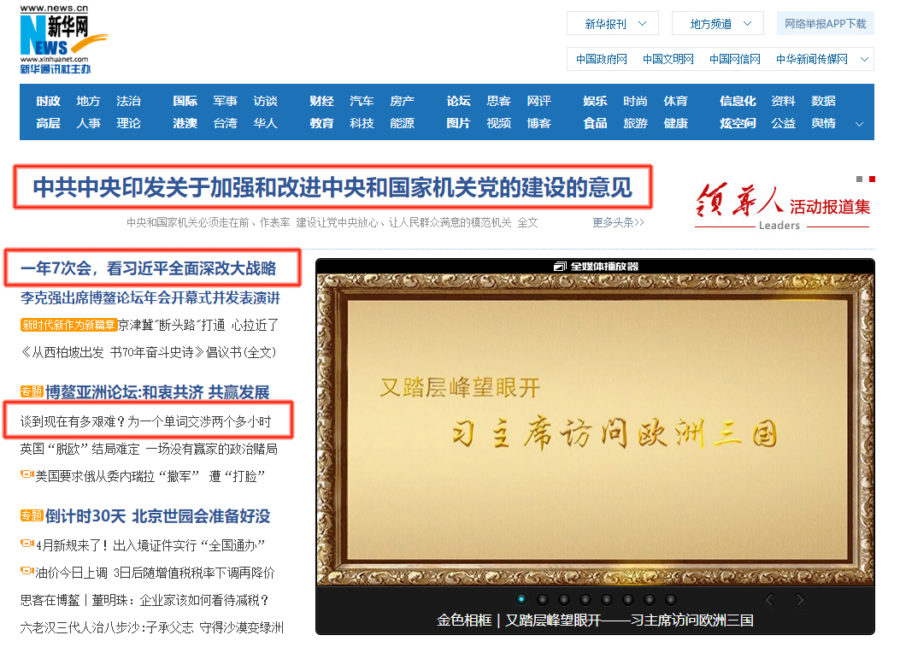
On March 29, Xinhua published its homepage an article on Xi Jinping’s “comprehensive reform grand strategy” (Article 1) and an article on the difficulty of the trade talks (Article 2).
Article 1

Article 1 noted that the Central Comprehensively Deepening Reforms Commission had held as many as seven meetings between March 2018 to March 2019. The article added that Xi would deliver an important speech at each meeting, as well as issue specific instructions on handling the most crucial reform work.
Reading between the lines: When viewed from the perspective of the trade war, Beijing is implying that the outcome of Sino-U.S. negotiations is part of Xi’s “grand strategy” for pushing reform in the regime.
Article 2

Article 2 claims that both Chinese and American trade negotiators had been working hard on the trade deal prior to U.S. Trade Representative Robert Lighthizer and U.S. Treasury Secretary Steven Mnuchin’s visit to Beijing on March 28. The article said that both trade teams kept in close contact via video conferencing and had argued intensely over the wording of the text of the agreement. In one case, both parties “fought for over two hours” on video over the usage of a single word, according to the Xinhua article. “As negotiations draw to a close, both sides are going all-out. This is a competition of willpower and perseverance. At this stage of the negotiations, we must consider our bottom line and be mentally prepared for talks to fail. It’s great if the talks succeed, but we don’t insist that they do,” the article concluded.
Reading between the lines: Beijing is stressing the difficulties of reaching a final Sino-U.S. trade agreement to absolve the Xi leadership of criticism that it is about to sell out China. By detailing how both sides literally fought over each word of the agreement text, Beijing is implying that the Xi leadership is putting in its utmost effort for the benefit of the people.
Second and third narratives

On March 29, Xinhua published on its homepage an article on a recent Politburo meeting chaired by Xi Jinping where the work of leading Party members groups and the work on the education and management of Party members were reviewed (Article 3).

Yet another Xinhua homepage article highlighted a new CCP General Office circular on enhancing Party building in Party Central and state organs (Article 4). The circular urged central and state organs to “resolve and guard against the ‘dark under the lamp’ problem” while keeping in line with “core” leader Xi Jinping and implementing Party Central’s decisions. The phrase “dark under the lamp” (“燈下黑”) refers to how people tend to miss things that are happening right under their noses.
The General Office circular also instructs cadres and officials in central and state organs to be “conscious” of their political behavior outside of work. Cadres and officials are forbidden from:
- “Spreading remarks that go against the Party’s theory, line, principles, and policies”;
- “Having improper discussions of Party Central policies (“妄議中央”)”;
- “Spreading political rumors and vilifying the Party or country’s image”;
- “Forming cliques, gangs, and factions”;
- “Siding with two factions and being two-faced people.”
The circular warns that those who break political discipline will be severely disciplined.
Reading between the lines: In the context of the trade war, Article 3 and Article 4 are designed to prevent cadres and officials from openly criticizing the Xi leadership when Beijing makes concessions to America (“unequal treaty,” “century of humiliation,” etc.). Instead, officials and cadres are encouraged to get behind the Xi leadership to avoid facing punishment. In classic “you know what I mean” (“你懂的”) fashion, the General Office circular cautions the various CCP factions against escalating the factional struggle by referencing “cliques, gangs, and factions.”
2. CCP brinkmanship
Beijing may be preparing to make concessions, but it has not abandoned standard CCP strategies and tactics to swing things in its favor.
In our March 26 analysis, we wrote that: “The CCP seems to have sensed Washington’s unwillingness to abandon negotiations when things look like they are ‘close’ to being wrapped up. The Trump administration’s attachment to the deal has thus created an opening for the CCP to exploit with its classic delaying tactics.”
Recent information about the trade talks confirms our suspicions.
On March 27, Reuters reported that “China has made proposals in talks with the United States on a range of issues that go further than it has before, including on forced technology transfer.” Previously, the Chinese regime refused to even acknowledge that forced technology transfers were taking place.
On March 28, The Wall Street Journal reported that U.S. and Chinese trade negotiators talked about “issues related to Chinese regulations of information security and cross-border data flows, as well as high-tech sectors such as cloud computing,” or subjects that the Chinese regime “previously viewed as off-limits for negotiation.” Officials on both sides tell the Journal that the leading negotiators are “shooting to close a deal by the end of April.”
At the conclusion of the latest round of trade talks in Beijing, the White House said in a statement that “the two parties continued to make progress during candid and constructive discussions on the negotiations and important next steps.”
Above all, the CCP wants to avoid further tariffs and an escalation of the trade war. Signing a trade deal with America is the only way to achieve both objectives. And Beijing knows that it must make concessions to get a trade agreement which meets Trump’s demands. While Beijing cannot control that outcome, it can lengthen the process of reaching a deal to buy itself time to catch a breather, regroup, and possibly come up with new strategies to cope with U.S. pressure. Thus, the CCP utilizes delaying tactics.
The CCP’s “step-by-step” making of concessions ultimately drags out the period of trade negotiations. The “ceasefire” which Xi Jinping brokered with President Trump in Argentina on Dec. 1 last year is the start of the delay process. The extension of trade talks beyond the March 1 deadline indicates that the delay tactic is working. Per The Wall Street Journal, Lighthizer, Mnuchin, and Liu He are looking to seal the deal by the end of April. Given its past operations, however, the CCP will likely try to extend the talks beyond April and for as long a period of time as possible. The longer trade negotiations take, the longer the Chinese regime can avoid additional tariffs while gaining additional time to “recover” from the initial tariffs and find alternative solutions to fix its economic woes (like courting Europe). In sum, it is in the CCP’s best interests keep negotiating without closing.
In mid-March, Trump said that he was not “in a rush whatsoever” to reach a trade agreement with China. “It’s got to be the right deal. It’s got to be a good deal for us and if it’s not, we’re not going to make that deal,” he said. However, time is not on Trump’s side in 2019, a watershed year for Sino-U.S. relations (see our 2019 Special Report). If Trump cannot get a deal by June, his administration will face exponentially increasing levels of political risk going forward.
3. On ‘unequal treaties’
The CCP has used the term “unequal treaties” as part of the trade war rhetorical back-and-forth for propaganda purposes. By selling the notion that the U.S. wants to force China to sign a trade deal that is akin to the one-sided treaties made between the Qing dynasty and Western powers in the 19th century, the CCP is both turning to nationalism to generate popular support from the masses and using political correctness against America.
Propaganda aside, the CCP is being disingenuous in claiming that the U.S. wants an “unequal treaty” from China. The Trump administration core concerns are the Chinese regime’s unfair trading practices (tariff and nontariff barriers, forced technology transfers, state subsidies, market access, etc.) and illegal activities (intellectual property theft, cyber theft, corporate espionage, etc.). Also, Washington wants the regime to abide by its commitments on joining the World Trade Organization in 2001 instead of continually flouting the rules. In sum, the U.S. is looking for fair play while the CCP is looking to avoid observing global rules of trade.
The CCP is right that a trade deal on America’s terms will be an “unequal treaty” in the sense that the regime’s interests will be hurt. State-owned enterprises, who enjoy massive state subsidies and monopolies, will unlikely be able to compete if the CCP played by the rules. And the CCP will find it much harder to exercise control over the economy and the country after implementing the trade reforms which the U.S. demands. On the flipside, China and the Chinese people will benefit from the structural changes that the Trump administration is asking Beijing to make. The private sector will have an environment to flourish, while local innovation, which has long been stifled by the CCP’s theft-driven model of growth, will be spurred. In a March 25 interview with NPR, U.S. Trade Representative Robert Lighthizer noted that high-level Chinese reformers would say that structural changes are “pro-Chinese,” and will help but “not hurt their economy.”
Based on our research, the CCP is not exactly hyping up the “unequal treaties” or “century of humiliation” card because to do so is a double-edged sword. However, we have also observed that factional interests are latching on to both terms to make life difficult for the Xi leadership.
What’s next:
Based on our understanding of the CCP, Beijing is now prepared to sign a trade deal but will play hard to get for as long as it can get away with it. This places the ball squarely in America’s court. We believe that President Trump’s patience (or lack thereof) would ultimately determine how quickly China and the U.S. can reach an agreement.
Get smart:
The Trump administration has to get tough and decisive with China to avoid missing strategic windows of opportunity. Timing is a critical factor in dealing effectively with the CCP.
Conversely, businesses and investors must recognize that China is heading in a direction that would lead to tremendous change. Thus, they need to exercise patience and wait for the appropriate time to make key decisions on China.