◎ When faced with popular uprisings or protests, the CCP typically resorts to the seemingly counterintuitive move of inciting the demonstrators or an entire population to violence.
On Oct. 15, the United States House of Representatives unanimously passed the Hong Kong Human Rights and Democracy Act of 2019. The legislation, which will become law if it is passed in a Senate vote that could come as early as this week, would require the U.S. Secretary of State to annually certify that Hong Kong retains its autonomy for the city to be considered a separate customs and trading zone from mainland China. The legislation also allows the U.S. to take diplomatic action and economic sanctions against the Hong Kong government, as well as sanction Chinese officials deemed responsible for undermining Hong Kong’s autonomy.
In response to the House passing the Hong Kong Human Rights and Democracy Act, People’s Republic of China foreign ministry spokesperson Geng Shuang said that “China will definitely take strong countermeasures.”
Based on our observation, the Chinese Communist Party has already been taking steps in recent weeks to nullify the Hong Kong Human Rights and Democracy Act. The CCP’s strategy is two-fold: Incite the protesters to violence to get an excuse to label them as “terrorists,” and offer “concessions” to the Hong Kong people and the United States.
Incitement
When faced with popular uprisings or protests, the CCP typically resorts to the seemingly counterintuitive move of inciting the demonstrators or an entire population to violence. Once there is enough or severe violence, the CCP can justifiably move in to quell the uprisings or protests to “normalize” the situation (think the 1956 Hungarian Revolution or 1968 Prague Spring) while suffering minimal international condemnation or repercussions (see the 1989 Tiananmen Square Massacre; CCP agents were the ones who provoked the troops into launching a crackdown).
We have observed attempts by the CCP to incite the Hong Kong protesters and the population from as early as July (see here and here). Common incitement tactics include, but are not limited to:
- Hong Kong police or mainland security forces imposing as protesters to carry out violence, vandalism, arson, carrying out unauthorized “stop-and-search” of random passersby, and other disruptive acts;
- Local triads, pro-CCP groups, and mainland groups assaulting protesters and provoking protester retaliation (protesters say that they are taking matters into their own hands because the Hong Kong police ignore protester complaints);
- In recent weeks, there has been a sharp uptick in “missing person” and highly suspicious “suicide” and death cases in Hong Kong;
- We believe that the assault of prominent protest march organizer Jimmy Sham was an effort to provoke ethnic conflict in Hong Kong;
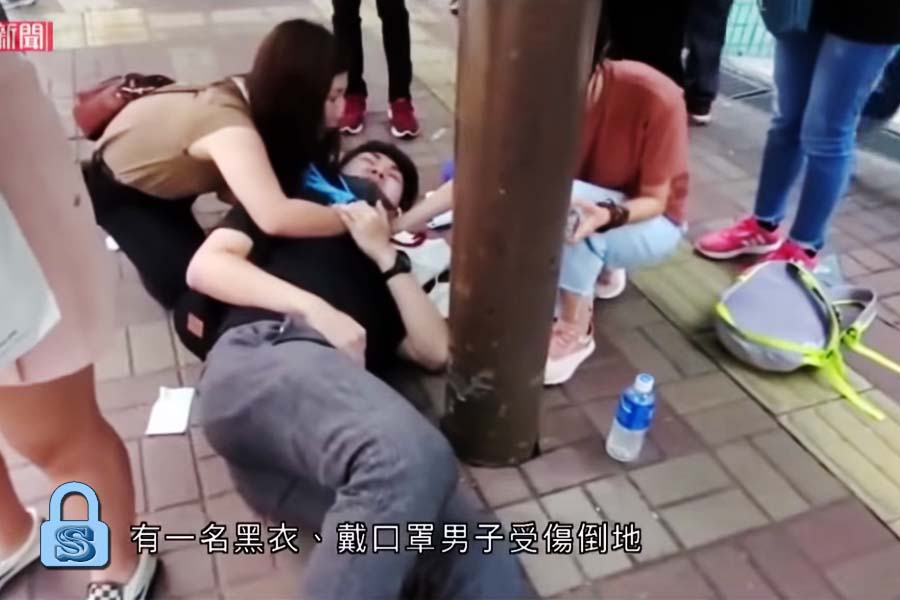
- Pro-CCP persons have been trying to inflame anti-CCP sentiment among the protesters. A prominent case occurred on Oct. 19 when a knife-wielding man shouting pro-CCP slogans stabbed and badly wounded a 19-year-old who was handing out pro-democracy flyers near a Lennon Wall; the attempt to incite was obvious from how there was a bystander on hand to record the incident and the fact that the pro-CCP man chose to remain on scene and yell at passersby instead of fleeing. On the same day, a knife-wielding mainlander planted a PRC flag atop an MTR station and heckled the crowds below; the police only arrived half-an-hour later to make an arrest.
Recent developments suggest that the CCP is taking a leaf out of its Xinjiang “counterterrorism” playbook in dealing with Hong Kong:
- In mid-August, the Hong Kong and Macau Affairs Office of the PRC State Council warned of ‘signs of terrorism’ in Hong Kong.
- At the end of September, the Hong Kong police claim that the protesters are “increasingly resorting to terrorism” and noted that the city had taken “one step closer to terrorism.”
- According to an Oct. 8 article by the South China Morning Post, senior Hong Kong government officials told the newspaper that “we cannot possibly tell the world that Hong Kong grooms local terrorists, hundreds of them.”
- According to an Oct. 8 article by The News Lens, while the Hong Kong police have stopped using the controversial San Uk Ling Holding Center to detain protesters, the Hong Kong government is still quietly constructing a comprehensive “police counter-terrorism training facility” at Kong Nga Po near San Uk Ling. The Kong Nga Po facility is believed to be similar to a large-scale “global anti-terrorist base” in Xinjiang which Hong Kong deputy security minister Sonny Au and members of the Hong Kong police’s counterterrorism unit visited in December 2018. In January 2019, Hong Kong security minister John Lee said that all counterterrorism measures in Xinjiang which the Hong Kong delegation viewed in December were “humane” and people should not view the matter with “colored glasses.”
- On Oct. 13, the Hong Kong police said that a “rioter” has slashed one of their officers in the neck with a “sharp-edged object.”
- On Oct. 14, the Hong Kong police claimed that protesters had denoted a remote-controlled homemade bomb similar to those used in “terrorist attacks.”
- On Oct. 18, Reuters reported that the Hong Kong Junior Police Officers’ Association is in talks with a Chinese property developer about building a “retirement community” in mainland China. The Hong Kong Chinese Civil Servants’ Association was also involved in the “Hong Kong City” project in Zhaoqing, Guangdong Province. Prior to the Reuters report, the Taiwanese Ministry of the Interior had referred to Hong Kong police as “black police” (黑警) in a post clarifying that those who engaged in “criminal acts, endanger national interests and public safety, or engage in terrorist activities, etc.” will not be granted long-term residency in Taiwan. Also, unconfirmed information on social media noted that Malaysia had rejected Hong Kong police officers who applied for its long-term residency scheme.
From the developments above, it is clear that the CCP and the Hong Kong police are promoting the “terrorism” narrative in describing and condemning the anti-extradition bill protests. And regardless of who was responsible for the police slashing incident and the “homemade bomb,” both episodes fit and affirm the CCP’s propaganda about terrorism in Hong Kong. Meanwhile, the information about the building of a “retirement community” for the Hong Kong police and possibly civil servants on the mainland is likely intended to dispel fears of being impacted by the Hong Kong Human Rights and Democracy Act. Finally, the CCP appears to long have plans to use its Xinjiang playbook in Hong Kong; indeed, Hong Kong would become the next Xinjiang if the CCP succeeds in branding the protest movement as “terrorism” without strong pushback from the international community.
The U.S. will find it difficult to use the Hong Kong Human Rights and Democracy Act to punish the Hong Kong government and the CCP regime should the Hong Kong people fall for the CCP’s incitement tactics and ramp up violence to an extreme level, or the international community come to condemn protester violence in Hong Kong and echo the CCP’s “terrorism” propaganda about Hong Kong without carefully ascertaining the facts and accounting for CCP strategy and tactics. With America’s hands tied, the CCP can proceed with even more hardline measures to suppress the anti-extradition bill protests.
‘Concessions’
Legislation that is passed but not enforced ultimately serves no purpose. From our observation, the CCP is making “concessions” to the Hong Kong people and the U.S. in a bid to prevent the Hong Kong Human Rights and Democracy Act from being enforced should it pass the Senate.
We previously noted that the CCP is trying to blame the cause of the anti-extradition bill protests on Hong Kong’s long-standing social and economic problems to make people forget that it was responsible for sparking months of chaos in the city to begin with (see here and here). By reframing the cause of the anti-extradition bill protests, the CCP and the Hong Kong authorities can then come up with “solutions” and show the world that it is making “concessions” to the Hong Kong people without actually making meeting the protesters’ key demands.
An example of “concessions” being made can be seen from Hong Kong chief executive Carrie Lam’s 2019 policy address on Oct. 16 and a subsequent radio interviews on Oct. 19. Lam’s 20-page policy address report contained nine pages of favorable property and land policies, and did not mention the controversial Article 23 national security law, a topic of her past policy addresses. During a radio interview, Lam said that her government “will not tolerate violence” regardless of position or identity, “including the police,” she said after being asked by the radio host. The police had used “appropriate force” in handling the protests, Lam said. In the same interview, Lam said that amnesty for arrested citizens would be “very difficult to implement” but she is willing to explore additional support for arrested minors. Also, Lam said that she is not a CCP member. All in all, Carrie Lam appeared to be reasonable and coming up with solutions to resolve Hong Kong’s problems, but had actually given up nothing that the protesters were asking of her and her government.
Meanwhile, the “very substantial phase one deal” which the U.S. and the PRC had agreed to sign during high-level Sino-U.S. trade talks on Oct. 10 and Oct. 11 appears to also be partly a “concession” of sorts from the CCP to get the Trump administration to go along with the CCP’s narrative on Hong Kong. The CCP would likely be very encouraged by President Donald Trump “tacitly approving the CCP’s handling of Hong Kong” when meeting with PRC vice premier Liu He at the Oval Office on Oct. 11. Unless Trump suddenly has a change of heart, it seems like he will continue to toe the CCP’s “bottom line” on Hong Kong in exchange for sealing a “monumental deal” with China. And if Trump does not wish to break the CCP’s bottom line, then it is difficult to envision a scenario where the Hong Kong Human Rights and Democracy Act will be used or enforced in any genuinely meaningful way.
What’s next
Whether or not the CCP succeeds in inciting the Hong Kong people and thoroughly discrediting the anti-extradition bill protests depends on the self-restraint of the people of Hong Kong and whether they are sharp enough to spot incitement attempts and circulate warnings before incidents flare up. (An incident on Oct. 20 involving riot police spraying blue liquid at protesters in Tsim Sha Tsui suggests that the protesters are still one step ahead. The police’s blue liquid hit bystanders, journalists, a lawmaker, South Asian minorities, as well as the steps and gates of a local mosque. After the police left, protesters returned to clean up the mosque. In an interview, a mosque attendee proclaimed himself a “Hongkonger” and criticized the Carrie Lam government and the Hong Kong police for insulting Islam by spraying the mosque with blue liquid and not respecting religious freedoms as enshrined in the Basic Law. “Why don’t [the police] spray blue dye at the chief executive’s office,” he said.)
The success of CCP incitement in Hong Kong is also dependent on U.S. attitude towards the PRC. The U.S. government on the whole is already very wary of the PRC and appears to be following the Hong Kong situation very closely. Randall Schriver, the assistant secretary of defense for Indo-Pacific Security Affairs, said at a Jamestown Foundation conference on Oct. 16 that the U.S. was “100 percent” behind those in Hong Kong who were speaking out for fundamental rights guaranteed in the 1984 Sino-British Joint Declaration to be respected, and that while the U.S. has “some concern about some of the tactics that the protesters have been using and may use, and I think in single instances where that becomes a real problem we would point that out.” Schriver added that “in general, we are concerned about the heavier hand that Beijing has taken and the Hong Kong authorities have taken with what we regard as legitimate activities on the part of the people of Hong Kong.”
We believe that how the Sino-U.S. trade negotiations play out will ultimately determine how the Trump administration handles the Hong Kong situation; the outcome of the trade negotiations in turn hinges on the CCP factional struggle. If trade talks break down again, the U.S. could move immediately to “reassess Hong Kong’s status as a free port, and even consider reclassifying Hong Kong as part of the same customs territory as mainland China,” a prediction which we made in our China 2019 outlook.