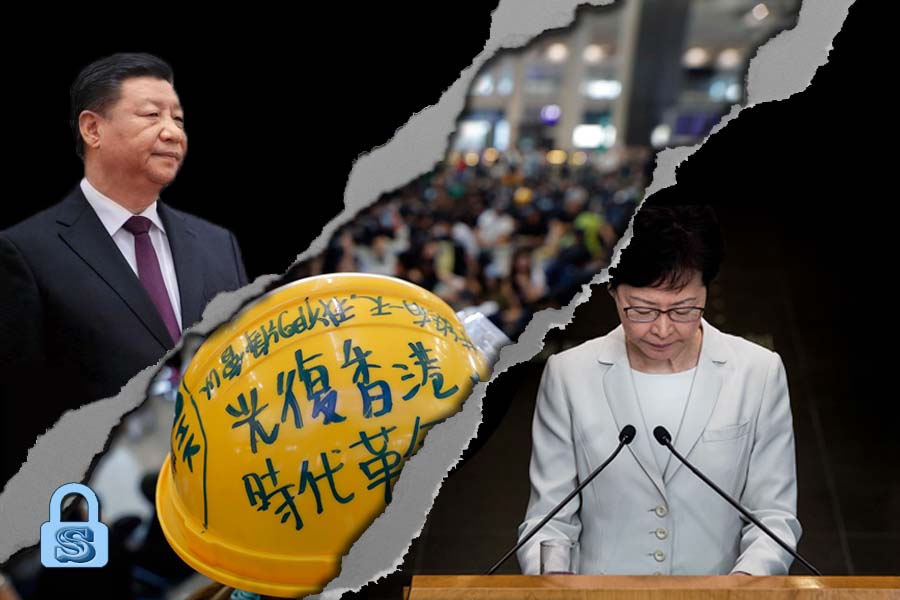
◎ With the “villains” properly designated and the blame properly assigned, the CCP can next play the hero and punish the responsible parties.
Edited on Sept. 8, 2019.
In what seemed like a surprise twist, Hong Kong chief executive Carrie Lam suddenly announced that her government is withdrawing a highly controversial extradition bill when the city’s legislature reopens in October.
In analyzing the messaging released by the Chinese communist regime after Lam’s announcement, we believe that the Chinese Communist Party is preparing to scapegoat the government and business elites in Hong Kong to appease the protesters and the masses.
The backdrop:
On Sept. 4, Carrie Lam held a televised address to announce that her government will “formally withdraw” the extradition law.
On the same day, state mouthpiece Xinhua News Agency published an article titled, “Tinted Lens Distort the Picture — The Deep Social Problems Behind the Hong Kong Extradition Bill Disturbances.” The article proceeds to blame long-term economic and livelihood contradictions for the unrest. Key points in the article include:
- The youth of Hong Kong earn low wages, find it difficult to pay rent, and cannot afford to buy housing;
- The Hong Kong middle class are leading a tough life;
- The wealth disparity in Hong Kong is ever-widening;
- Many industries are hollowing out and the economy is heavily dependent on just a few sectors;
- Wealth is concentrated in Hong Kong’s property clans;
- The financial industry, which accounts for 19 percent of Hong Kong’s GDP, can only absorb so many of the city’s best and brightest;
- Manufacturing accounts for about 1 percent of the GDP and cannot provide employment opportunities;
- The [pro-democracy] opposition in the legislature creates political strife and democracy is affecting the people’s livelihood;
- The [pro-democracy] opposition extends its dissatisfaction with the Hong Kong government to Party central and mainland China.
On Sept. 5, Hu Xijin, the editor-in-chief of the far-left CCP mouthpiece Global Times, published an article titled, “Hong Kong People’s ‘Snail Homes’ are the Bane of Extreme Capitalism, A Pity that They Hate the Wrong Side,” where he blames Hong Kong’s ills on capitalism and democracy.
In the article, Hu claims that Hong Kong’s high housing and rental prices are not due to a lack of land in the city, but because pro-democracy lawmakers and society “impose various restrictions on government power.” Because of these “restrictions,” the Hong Kong government’s land policies were rejected in the legislature, and is proof of the “inefficiencies of the democratic system.” Hu also claims that public opinion has caused the Hong Kong people to hate Party central. “The people hate the wrong side; they do not hate the side that they should hate, and do not support the side that they should support,” he wrote.
Our take:
1. From the above CCP propaganda messaging, it is clear that the PRC is trying to spread the narrative that the protests over the extradition bill are the result of local economic and social conditions. In other words, it is the Hong Kong government and the local business elite, and not the CCP and its attempts to turn Hong Kong “red” and tighten control over the city, who are responsible for the months of unrest and chaos. This is a classic CCP propaganda tactic to incite the masses by turning one class against the other.
The CCP is also looking to discredit capitalism and position its “socialism with Chinese characteristics” as an alternative. The “blame extreme capitalism” rhetoric seems to be in line with the CCP’s recently announced plan to turn neighboring Shenzhen into “a pilot demonstration area of socialism with Chinese characteristics” by 2025.
2. We previously wrote that the CCP is “advancing to retreat” on Hong Kong because it cannot afford to sacrifice Hong Kong’s status as an international trading hub and invite more international pressure against the communist regime. The CCP also needs to focus on other pressing external matters, including the subversion of Taiwan’s 2020 presidential election and surviving the trade war with the United States.
“Advancing to retreat” involves making threatening gestures before appearing to make concessions to the protesters. The CCP’s attempt to “fix” the narrative on why protests broke out in Hong Kong paves the way for the CCP to make further “concessions” to the protesters while saving face.
According to the CCP’s narrative, economic and social problems in Hong Kong caused the protests, and the people of Hong Kong should redirect their anger to those who are responsible for creating the problems, i.e. the Hong Kong government and the local business elites. With the “villains” properly designated and the blame properly assigned, the CCP can next play the hero and punish the responsible parties.
3. We previously wrote that “to survive and dominate, the CCP can make all sorts of compromises and promise virtually anything.” After the handover in 1997, the CCP worked to “buy off” the Hong Kong government and local business elites. With the Hong Kong governing and business elites in their pockets (some more literally than others), the CCP was able to slowly tighten its grip over the city and erode the “one country, two systems” model. Now in a bid to subdue the anti-extradition bill protests, the CCP seems to be laying the groundwork to turn the Hong Kong government and the local business elites into sacrificial scapegoats.
Shortly after the anti-extradition bill protests broke out in June, Liu Xiaoming, the Chinese ambassador to the United Kingdom, said in an interview with the BBC that “the Beijing central government gave no instruction, no order” to the Hong Kong government regarding passing the extradition bill and that the bill was self-initiated by the Hong Kong government. Liu’s statement, which represents the official PRC line, effectively holds the Carrie Lam government responsible for the chaos in Hong Kong.
4. Many prominent Hong Kong protesters and commentators were unconvinced with Carrie Lam announcing the withdrawal of the extradition bill. The Hong Kong people at large will unlikely buy the CCP’s attempt to blame others for triggering the mass protest movement.
Meanwhile, there are officials in the Hong Kong government and local business elite who are angry at the CCP for causing the outbreak of chaos in the city. Some pro-establishment figures and businessmen are now backing the protesters. The CCP will only inspire more of its supporters in Hong Kong to “switch sides” when it starts to sacrifice them. Due to mutual self-interests, however, it is unlikely that the bulk of Hong Kong’s elites will be completely alienated from Beijing, and vice versa.
5. Xi Jinping could take advantage of the situation in Hong Kong to purge the city of Jiang faction influence.
6. We believe that the CCP’s attempts to calm things down in Hong Kong and subdue the protests will only worsen the situation in the city and the division in the Communist Party.
What’s next:
1. In sacrificing the elites in Hong Kong, the CCP could:
- Force Carrie Lam to resign due to “health” or “personal” issues. Matthew Cheung, Hong Kong’s chief secretary for administration, could take over;
- Get the Hong Kong government to establish an independent committee to investigate police brutality, one of the five requests made by the protesters.
- The committee will likely be staffed with many pro-establishment figures;
- The investigation into the Hong Kong police force will likely be allowed to drag on for as long as possible before a conclusion is reached;
- Some policemen who have been publicly accused or exposed for their involvement in particular incidents of brutality could be punished. However, the bulk of the complaints will likely be either suppressed or amount to nothing.
2. Hong Kong’s Independent Commission Against Corruption could start to probe highly disputed municipal projects. The investigations could result in the purge of some government officials and contractors.
There is also a possibility that former Hong Kong leader Leung Chun-ying and Leighton Contractors, an Australian company with close ties to Leung, could be sacrificed to appease the Hong Kong people.
3. Zhang Xiaoming, director of the Hong Kong and Macao Affairs Office, and Wang Zhimin, director of the Hong Kong Liaison Office, both face high levels of political risk. Zhang could be investigated, and Wang could be transferred.
Junius Ho, a pro-establishment Hong Kong legislator who behaved questionably during the triad attacks against protesters on July 21, could also find himself being investigated by the authorities.
4. The bulk of the protesters who have been arrested could be let off with light sentences as the CCP continues to “advance to retreat” on Hong Kong. However, the so-called “brave martial clique” (勇武派) will likely be severely punished as the CCP finds a way to “send a message” to the Hong Kong people about radical protesting.
5. The CCP could continue to “expose” capitalism and its “extremes” in its propaganda. Concurrently, the CCP could show “care” to the Hong Kong people by offering them “advice” on how to pursue “highly efficient” economics, including “socialism with Chinese characteristics.”
Additionally, CCP propaganda could assert that there is chaos in Hong Kong precisely because Party central did not interfere in Hong Kong’s affairs due to the “one country, two systems” model. In other words, Beijing was “unable” to assist the Hong Kong government because it was restricted by “one country, two systems.”