◎ Hong Kong’s chief executive and pro-Beijing lawmakers will likely try to determine Party central’s intention from Liu Xiaoming’s remarks and act accordingly.
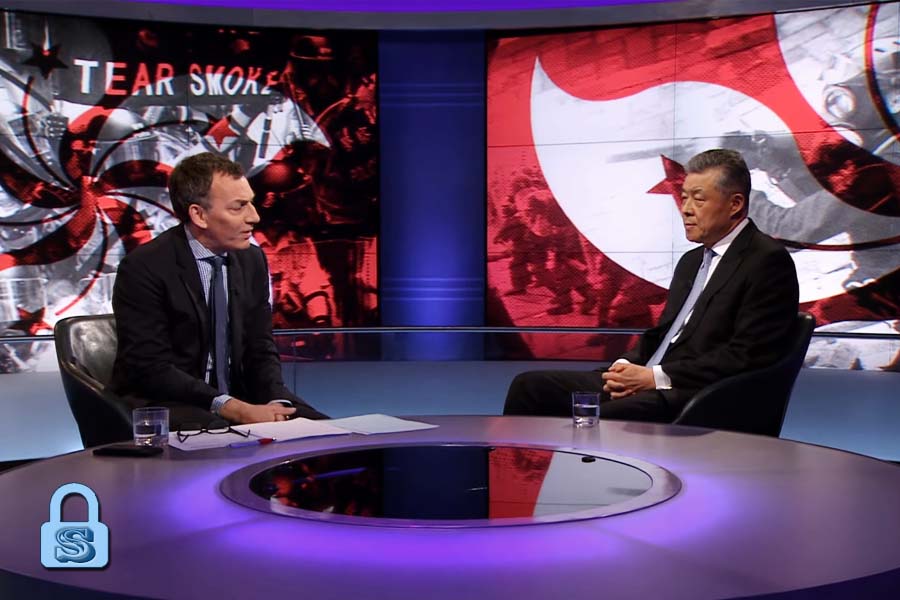
In an interview with the BBC on June 13, Liu Xiaoming, the Chinese ambassador to the United Kingdom, waved off the suggestion that Beijing had a hand in getting the Hong Kong government to pass a controversial amendment to the city’s extradition law.
“As a matter of fact, the Beijing central government gave no instruction, no order about making the amendment. This amendment was initiated by the Hong Kong government, it was prompted by a murder case in Taiwan,” he said.
Liu’s remarks diverge from earlier remarks by the Chinese regime’s top Hong Kong overseer. On May 21, Politburo Standing Committee member and Central Coordination Group for Hong Kong and Macau Affairs head Han Zheng told a delegation of the Hong Kong Federation of Fujian Associations in Beijing that the central authorities support the Hong Kong government’s move to pass the proposed extradition law.
Our take:
1. We noted in an earlier analysis that the Hong Kong government’s decision to push ahead with the extradition bill is influenced by the Party’s survival instincts and the CCP factional struggle. We see the two factors in play again in the remarks of Liu Xiaoming and Han Zheng.
2. Party central would have to approve of Liu Xiaoming speaking to the BBC on the Hong Kong issue, or else he would not even be available for an interview. However, Party central approval does not necessarily mean that Liu had received specific instructions from the top on what to say to the BBC. And if Liu did not get any special guidance, then his remarks to the BBC would be classic CCP boilerplate material. We believe that this is very likely the case in parsing Liu’s interview.
When accused of wrongdoing, a classic CCP response is to deny everything and shift blame. So Liu Xiaoming’s remarks should not be read as a change of heart in the Chinese Communist Party, but rather an effort at delaying tactics and self-preservation. Put another way, Party central will fault Hong Kong Chief Executive Carrie Lam and her government for any trouble associated with the proposed extradition bill. Party central could also later implicate Chinese officials who backed the bill should the need arise, which puts top Hong Kong overseer Han Zheng at risk. Ultimately, Party central is preparing to wash its hands off any extradition bill-related problems, including possible bloodshed as protesters clash with the police.
Hong Kong’s chief executive and pro-Beijing lawmakers will likely try to determine Party central’s intention from Liu Xiaoming’s remarks and act accordingly.
3. Hong Kong is a key “battleground” in the factional struggle between the Jiang faction and the Xi camp. The steady erosion of freedoms and democracy in the city, as well as the fracturing of Hong Kong society, appear to be the handiwork of the Jiang faction, which sways important influence and intelligence networks in Hong Kong. We previously wrote that the Jiang faction is “‘weaponizing’ Party orthodoxy against the Xi camp in Hong Kong affairs to further undermine Xi Jinping’s authority and tip the factional struggle in their favor.” One of the Jiang faction’s likely end goals is to ruin Hong Kong and make sure that Xi Jinping takes the full blame for it. In the context of the factional struggle, it makes sense that Jiang faction member Han Zheng would back the Hong Kong government over the proposed extradition law.
Given that the Jiang faction would want to turn Hong Kong into a figurative “basket case” and hold Xi responsible for their work, it makes sense that Xi would hedge against that outcome. Thus, Han Zheng, and not Xi ally Li Zhanshu, got the job of Central Coordination Group for Hong Kong and Macau Affairs head at the 19th Party Congress reshuffle; per Party norms, the head of Chinese regime’s National People’s Congress usually gets the role of top Hong Kong overseer, as in the case of the previous NPC chief and Jiang faction member Zhang Dejiang. With Han placed in charge of Hong Kong, Xi had both compromised with his political rivals (the Jiang faction retains control of the city after the retirement of Zhang Dejiang) and created an “opening” to turn the tables on the Jiang faction and blame them instead for ruining Hong Kong.
Han Zheng faces increasing levels of political risk in light of the recent turmoil in Hong Kong and Liu Xiaoming’s remarks to the BBC.
What’s next:
1. Hong Kong’s pro-Beijing lawmakers might be less inclined to support Carrie Lam over the proposed extradition law given Liu Xiaoming’s remarks. How the lawmakers would ultimately vote, however, remains unclear because CCP factional elements are almost certainly in play.
2. A meeting between Xi Jinping and U.S. President Donald Trump at the G20 could decisively influence the “impasse” over the proposed extradition law.