
◎ How the CCP reacts to Trump’s tariff threat would determine the outcome of the trade talks.
On May 5, United States President Donald Trump said that he plans to add tariffs on all Chinese goods.
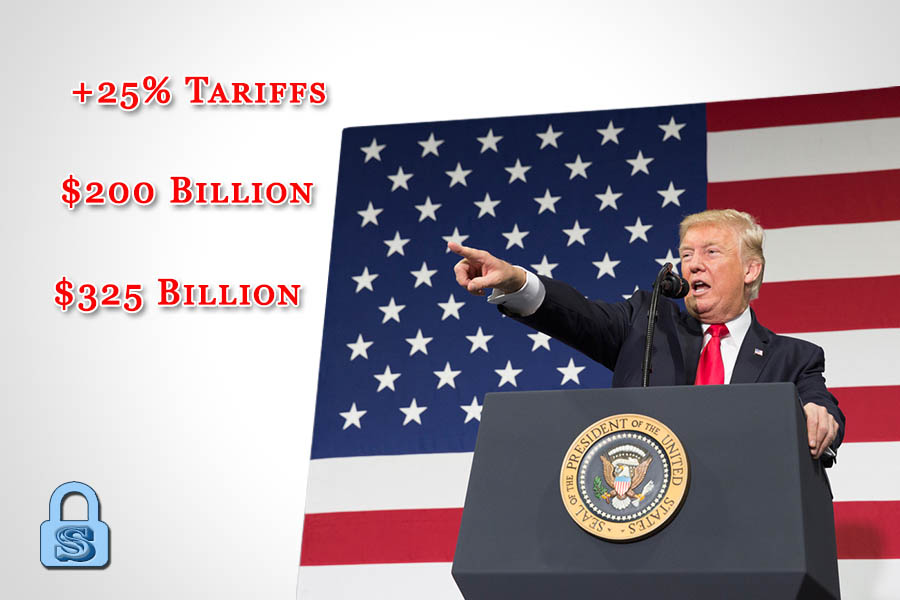
Trump tweeted that an existing 10 percent tariff rate on $200 billion worth of Chinese imports will be raised to 25 percent on Friday (May 10), while 25 percent tariffs will be added to $325 billion of additional goods “shortly.”
“The Trade Deal with China continues, but too slowly, as they attempt to renegotiate. No!” he wrote.
The backdrop:
1. The Trump administration had been signaling last week that America is looking to wrap up trade negotiations or resume the trade conflict.
On April 29, U.S. Treasury Secretary Steven Mnuchin told Fox Business, “We hope within the next two rounds in China and in DC to be at the point where we can either recommend to the president we have a deal or make a recommendation that we don’t.”
On April 30, White House Chief of Staff Mick Mulvaney said at the Milken Institute Global Conference that America and China will resolve the trade dispute “one way or the other” in the next two weeks.
On May 3, President Trump told reporters that “the deal itself is going along pretty well. I would even say very well.”
2. In April, China released “better-than-expected” economic data for the first quarter of 2019, leading analysts to believe that China’s economy is “rebounding.”
We believe that China’s economy has not “bottomed out” and that trouble looms ahead.
3. In late April, Chinese Communist Party elders Jiang Zemin and Zeng Qinghong each made a rare public appearance. Jiang and Zeng are the foremost figures of the Jiang faction which rivals the Xi Jinping leadership.
Our take:
1. In our China 2019 outlook, we wrote that “the U.S. may raise tariff rates on $200 billion worth of Chinese goods from 10 percent to 25 percent before June. President Donald Trump may order 25 percent tariffs on an additional $267 billion worth of Chinese goods in the second half of 2019.”
Our prediction will be confirmed should Trump follow through on his tariff threat.
2. Trump said that the trade talks “with China continues, but too slowly, as they attempt to renegotiate.”
We are not surprised by the Chinese regime’s “attempt to renegotiate” or the slow progress of the trade talks. We are anticipated that the CCP would use delaying tactics, as well as other measures, during the trade talks in January in our special report, “2019: A Waterloo Year for China and the United States.”
Also, we wrote on May 1 that: “Ultimately, the CCP will do its best to give Trump an ‘empty’ victory in the trade war while exploiting delays to put itself beyond defeat and advance its domination agenda.”
3. Several factors could have led the Chinese regime to pursue “renegotiating” a trade deal at this state:
- The CCP’s delaying tactics have allowed it to “catch its breath” and regroup from the impact of the tariffs;
- The CCP continues to find success with its recent Belt and Road efforts despite U.S. warnings about China’s debt trap diplomacy and the regime’s hegemonic ambitions;
- The CCP has been successful in courting the European Union;
- The CCP has managed to escape U.S. efforts to “contain” 5G with several European countries still keen on using Huawei equipment for their 5G networks
The above factors place the regime in a better position to talk trade with the United States.
4. Factional politics could be another reason why Beijing is looking to slowly “renegotiate” trade with Washington.
We previously analyzed that Xi Jinping is paving the way to make concessions to secure a trade deal. The CCP factional struggle, however, appears to have complicated any reform-minded plans which Xi might have had. Signs that the factional struggle is particularly intense include Xi’s inability to convene the Fourth Plenum, the recent public appearances of Jiang Zemin and Zeng Qinghong, as well as Xi’s use of the phrase “structural arrangements” as opposed to “structural reforms” at the Second Belt and Road Forum.
Xi very likely cannot push through structural reforms at this stage without incurring stiff pushback from his political rivals. And if Xi cannot implement structural reforms or at least give the impression that he is trying to carry out the reforms, then a trade deal with America is effectively “dead on arrival.” Hence, Xi’s best option is to drag out the trade negotiations until he can break the impasse in CCP elite politics.
Note that the CCP regime and leader may not always be in sync on how to handle issues. An example is Zhao Ziyang clashing with Deng Xiaoping and other elite cadres over what to do with protesting students in Tiananmen Square in 1989. We believe that the Chinese regime has again arrived at a watershed moment in the clash between Xi Jinping and the Jiang faction over trade issues with the United States.
What’s next:
1. Chinese vice premier Liu He is due in Washington on May 8 for trade talks. Liu may or may not cancel his DC trip over Trump’s tariff announcement.
If Liu cancels his trip to Washington, then hardline voices in the CCP elite have likely won the argument over whether to seek cooperation or confrontation with the United States to preserve regime survival. In this scenario, it is very unlikely that China and the U.S. will trade deal. Instead, Sino-U.S. tensions would escalate, and the regime could move to partially “close up” China per earlier preparations.
If Liu goes ahead with his trip, then Xi might have convinced the CCP elite that compromise and cooperation are the way to go to ensure regime survival and future dominance (the “survival-dominance” dynamic). China and the U.S. will likely reach an agreement on the trade deal by the end of the week pending the signature of Xi Jinping and Donald Trump. However, the CCP will likely continue delaying tactics during the implementation and mediation phases of the trade agreement.
How the Chinese regime reacts to Trump’s tariff announcement will determine which of the above scenarios will play out.
If state media stays silent and heavy censorship is practiced, then Liu He may yet travel to Washington. Individual CCP commentators, however, may be “allowed” to make mild criticism.
If state media prominently attacks the tariff announcement, then Sino-U.S. trade negotiations are likely finished.
2. If China and the U.S. do not reach a trade deal or the uncertainty of a deal is prolonged, then:
- China’s stock markets could collapse;
- The renminbi could fall below the 7 mark;
- Debt defaults could rise;
- The property market could see massive sell-offs and major property developers could shutter;
- China could see severe inflation;
- The CCP would step up societal controls to an unprecedented level;
- Most of the political, economic, and societal forecasts in our China 2019 outlook could become reality.
3. Xi Jinping faces unprecedented political risks regardless of the outcome of the latest round of trade negotiations. There is a high probability of political Black Swan events breaking out in China.




