◎ Why did Xi Jinping honor both Mao Zedong and a prominent Mao critic as part of the PRC’s 70th anniversary celebrations? We examine this and other signs.
On Oct. 1, the Chinese Communist Party held a grand military parade and other celebrations to commemorate the 70th anniversary of the founding of the People’s Republic of China.
From a study of the PRC anniversary celebrations and other related developments around the celebration period, we have identified four broad trends in CCP elite politics:
- The political crisis in the CCP is sharply worsening under increasing domestic and international pressures on the communist regime.
- To preserve the Party, the various CCP factions appear to have reached a compromise.
- Xi Jinping is taking steps to boost his “quan wei” (權威), cautioning would-be challengers inside the Party, and offering concessions to his political rivals.
- The Jiang Zemin faction and other opponents of the Xi camp continue to find ways to undermine the Xi leadership, including provoking greater chaos in Hong Kong.
We examine the signs of compromise and crisis in the CCP that have emerged around the PRC anniversary period below.
Costly ‘wartime measures’
Starting in August, various provincial local governments issued documents calling for “wartime measures” (戰時機制) to be implemented for the purposes of “stability maintenance” as the PRC prepares to celebrate its 70th anniversary. The documents note that the authorities were “combat ready” (臨戰狀態) to deal with “national resonance” (全民共振; Party parlance for anti-regime unrests) and “color revolutions” (顏色革命). The authorities were also to clamp down on “harmful information” (有害信息) and pay attention to the anti-extradition bill protests in Hong Kong and the impact of the Sino-U.S. trade war. Meanwhile, security in Beijing was greatly heightened ahead of the Oct. 1 parade.
A military expert from Macau estimated that the PRC government could have spent as much as 15 billion yuan (about $2.089 billion) to hold its grand military parade on Oct. 1 and finance its “stability maintenance” work for the 70th anniversary celebrations, according to a Hong Kong newspaper report.
Our take: It is normal for countries to boost security and spend more money on it when they hold national day celebrations. The CCP’s “combat readiness” and “wartime measures” security work, however, is abnormal by any measure.
The CCP’s expensive and excessive “security maintenance” work indicates that despite having ruled the country for seven decades, it continues to view the Chinese people as an enemy that it must subjugate. The CCP’s “stability maintenance” work, coupled with its grand military parade (undoubtedly the CCP’s way of projecting an illusion of “national” strength), are revealing of the Party’s deep insecurities and sense of crisis.
Honoring Mao—and his critic
On Sept. 25, the PRC government held an awards ceremony to honor the CCP’s “Most Beautiful Fighters” (最美奮鬥者). Of the 278 individuals and 22 groups in the list published by state mouthpiece Xinhua, the name that stood out was Zhang Zhixin, a female CCP cadre and former propaganda worker.
Zhang was arrested during the Cultural Revolution for openly criticizing Mao Zedong. She was later severely persecuted in prison and was driven mad under torture. The authorities finally killed Zhang Zhixin in 1975, slitting her larynx just before her execution. After the Cultural Revolution, Zhang was rehabilitated in 1979 and lauded with the title, “martyr of the revolution” (革命烈士).
On Sept. 30, Xi Jinping and other CCP elites went to Mao’s mausoleum in Beijing. According to Xinhua, Xi bowed three times to Mao’s statue and paid respect to his remains.
Our take: Xi’s honoring of Mao and a prominent critic is only contradictory if one adheres to the mainstream views that “Xi is another Mao Zedong” and that Xi is unrivaled in the CCP. In considering the CCP factional struggle and power operations, however, Xi’s “contradictory” moves make perfect sense.
We previously explained that Xi Jinping was politically weak when he became CCP General Secretary in 2012 (see here and here). To survive a “you die, I live” factional struggle against the Jiang faction and other factional interest groups, as well as ram through his own agenda, Xi needed to consolidate power to a high degree and boost his “quan wei.” Xi’s need to enhance his political strength and prestige has only grown in his second term in office as he faces a “perfect storm” of domestic problems, “soft coups” and pushback from Party hardliners in an escalating factional struggle, and the pressures of a trade war with America. The political crisis in the CCP regime has already led to the delay of the CCP Fourth Plenum and was very likely a key factor in the Xi leadership abruptly “reneging” on a draft trade deal in May 2019.
Based on our research, Xi Jinping’s honoring of Mao Zedong as part of the PRC 70th anniversary celebrations and on multiple occasions earlier in his tenure seem more like an attempt to borrow Mao’s prestige to boost his own “quan wei” instead of yet another effort at becoming the next Mao. First, Xi and his family suffered first-hand the horrors of the Cultural Revolution, and like many persecuted cadres, reject that part of Mao’s legacy. Second, Xi had officially repudiated the Cultural Revolution and the Mao personality cult several times during his first term, moves that were not widely reported in Western media. Third, Xi’s honoring of Mao critic Zhang Zhixin as part of the PRC 70th anniversary celebrations is likely intended to again show his disdain for the Cultural Revolution, and in the process, somewhat offset his honoring of Mao and dispel the popular notion that he is aiming to be the next Mao Zedong.
Xi’s continued borrowing of Mao’s prestige at a time when many fear that he is trying to become the next Mao indicates that he is scraping the bottom of the barrel in growing his “quan wei” to resolve severe political problems in the CCP regime. Indeed, Xi’s move could potentially backfire and further increase the already very high levels of political risk which he currently faces.
The 70th anniversary celebrations guest list
On Sept. 30, the CCP held a 70th anniversary reception dinner at Zhongnanhai. Many Party elders were present, including Song Ping, Hu Jintao’s 92-year-old political patron and former Politburo Standing Committee member. However, former Party leaders Jiang Zemin and Hu Jintao did not attend the reception.
Prominent Jiang faction members who were previously on the Politburo Standing Committee or held other high office were also present at the reception, including former Chinese vice president Li Yuanchao, former Central Military Commission vice chair Fan Changlong, former PLA Navy chief Wu Shengli, and former CMC General Political Department head Li Jinai. The aforementioned elite cadres were all the subject of intense speculation about whether or not they were being investigated for corruption.
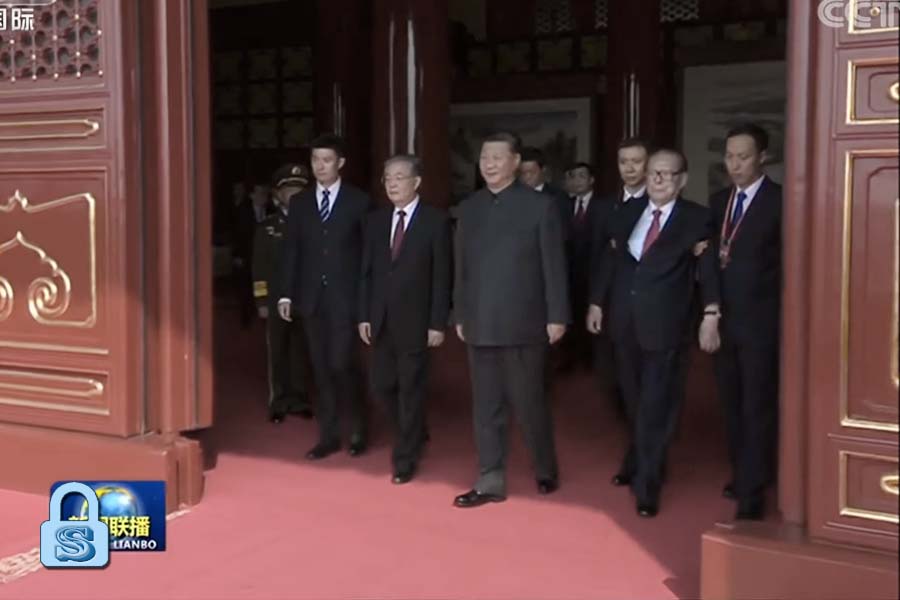
On Oct. 1, the CCP held a grand military parade to mark the PRC’s 70 anniversary. On Oct. 1, the CCP held a grand military parade to mark the PRC’s 70 anniversary. Flanking Xi Jinping at the parade viewing platform overlooking Tiananmen were Jiang Zemin and Hu Jintao. Hu spotted a full head of white hair, while the 93-year-old Jiang had to be helped to his seat with the assistance of two men and later disappeared for a prolonged period during the parade.
The guest lists for the Sept. 30 and Oct. 1 events were largely identical with a few exceptions. Notably, former State Council Hong Kong and Macau Affairs Office director Liao Hui did not attend the reception but showed up at the Tiananmen viewing platform for the parade. (Liao, a Jiang faction member, oversaw Hong Kong and Macau affairs from 1997 to 2010, and holds responsibility for creating the conditions that resulted in the outbreak of chaos in Hong Kong today.)
A particularly noteworthy aspect of the Oct. 1 grand military parade was the inclusion of a contingent of Party princelings (“second generation red”/紅二代) seated in vehicles and with some holding aloft a picture of their revolutionary father. In one of the vehicles was one Bo Xicheng, the third son of the powerful revolutionary Bo Yibo and brother of the purged Jiang faction member Bo Xilai.
Our take: In a piece titled, “The Art of Interpreting Nonexistent Inscriptions Written in Invisible Ink on a Blank Page,” the late Belgium sinologist Simon Leys listed several things that pose the “greatest challenge” to analyzing political developments in the Chinese regime, including “the celebration of anniversaries, the noncelebration of anniversaries, and the celebration of nonanniversaries; he must check the lists of guests at official functions, and note the order in which their names appear.” Put another way, there are always political reasons for why certain CCP cadres are included or excluded from anniversary celebrations. And in the context of factional struggle, public appearances of leading faction members or faction figureheads (like Jiang Zemin and Zeng Qinghong) serve to galvanize their supporters and signal to the rest of the regime that their faction is still a political force.
The PRC 70th anniversary guest list offers a rare glimpse at the current state of the central factional struggle in the Party between the Xi camp and the Jiang faction.
A study of the guest list affirms our previous analysis of political crisis in the regime (see here and here), and indicates that Xi Jinping has reached some sort of compromise with the Jiang faction and other Party hardliners. The most obvious sign of a compromise can be seen from the public appearance of Bo Xicheng bearing the portrait of Bo Yibo; given that Bo Xilai has been continually upheld as a wayward cadre over the past seven years, it would be entirely reasonable for his family to be excluded from the princeling contingent. For Xi to make that compromise reveals that he still lacks the “quan wei” of a Mao Zedong or Deng Xiaoping in the Party.
Xi’s insecurities about his “quan wei” and his efforts to boost it is best observed from the parade contingents representing the five CCP leaders and their policies. Mao was represented by five parade contingents; nine contingents represented the “reform and opening up” era of Deng, Jiang, and Hu; and Xi’s “great rejuvenation/China Dream” era was represented by 18 contingents, or more contingents than the previous four leaders combined.
We see similarities in Xi Jinping’s current moves and those in 2017 before the 19th Party Congress personnel reshuffle. At the time, Xi was able to consolidate his power to a higher degree (getting his allies into the Politburo Standing Committee and other top offices) and boost his “quan wei” (adding “Xi Jinping Thought” to the Party and state constitution) by pointing to political crisis in the regime (“soft coups” by Sun Zhengcai, Fang Fenghui, and Zhang Yang) and making some partial compromises with his political rivals (not granting Wang Qishan a seat on the Politburo Standing Committee but appointing him instead to the vice presidency). Now, Xi appears to again be leveraging on crisis and making compromises to ensure the smooth convening of the Fourth Plenum of the 19th CCP Central Committee in October; the fact that a specific date has not been announced is a clear sign of political crisis in the CCP.
The crisis-compromise dynamic is echoed in several of Xi’s political moves around the PRC 70th anniversary celebrations (see the following two sections).
Qiushi article puts CCP cadres on notice
On Oct. 1, the CCP ideological journal Qiushi published a speech that Xi Jinping gave to full and alternate Central Committee members of the 19th Party Congress and key provincial government officials during a study session at the CCP Central Party School on Jan. 5, 2018.
Xi’s speech, titled, “There Must Be Consistency in Promoting the New Major Party Building Project,” made the following noteworthy points:
- Xi again emphasized the need to “strictly govern the Party” (從嚴治黨) and carry out “self-revolution” (自我革命). Cadres must also “dare to turn the blade inward, dare to scrap the disease off the bone,” dare to cut off one’s poisoned arm to prevent the spread of disease (or nip trouble in the bud), and be on the watch out for coups and color revolutions.
- Xi warned that all dynasties collapsed as a result of being unable to shake off corruption and losing the people’s hearts, and cited the fall of the Soviet Union as an example.
- Xi called on cadres to “guarantee that the whole Party obeys Party central, as well as uphold the Party central’s “quan wei” and centralized, unified leadership.” He added that “a common reason for the collapse or decline of the world’s great powers is the loss of the center’s “quan wei” and the inability of the country to centralize and unify.”
- Xi said that with the CCP’s 89 million Party members and over 4.5 million grassroots Party organizations, “the only thing that can defeat us is ourselves.” He also cited a parable from the classic Chinese novel “Dreams of a Red Mansion” concerning the notion of defeat coming not from the outside, but from the rot within.
Our take: We believe that the publication of Xi’s 2018 speech in the Oct. 1 edition of Qiushi Magazine is an attempt by Xi Jinping to call attention to crises in the regime to get cadres to acknowledge his “quan wei” and rally behind his efforts to save the Party.
Simultaneously, the Qiushi piece is a stern warning to cadres that they will be purged in the name of preserving the Party if they continue to engage in corruption or challenge Party central/the Xi leadership given that now is a time of crisis.
Xi sacrifices a political ally
On Oct. 4, the Central Commission for Discipline Inspection announced that Liu Shiyu, the former head of the China Securities Regulatory Commission, had “severely violated political discipline and political rules” and handed out the following punishments:
- Liu would remain a CCP member but would be placed on two-year probation; most cadres who were found guilty of corruption were expelled from the Party.
- Liu would be removed from his government position and demoted to a first-ranked researcher.
- Liu’s status as a participant of the 19th Party Congress would be revoked.
- Liu’s illegally obtained gifts, money, and other assets would be confiscated.
In January, Liu was suddenly transferred from the top securities regulator to serve as deputy Party secretary at the All-China Federation of Supply and Marketing Cooperatives. In May, he had reportedly “turned himself in” to the authorities to be investigated for “violations of law and discipline.”
Our take: The punishing of Liu Shiyu has played out exactly as we predicted back in May when an investigation into him was announced. We wrote: “Barring a dramatic alteration in the current balance of power in the regime, Liu Shiyu could only be subjected to internal discipline (removed from office, demotion, posted to a lesser position, etc.) but not criminal prosecution.”
We also wrote: “From Xi’s perspective, the investigation of Liu Shiyu is a form of damage control. Political rivals and others who are looking for scapegoats to blame for Beijing’s recent financial and trade failings would be somewhat appeased by the ‘sacrifice’ of Liu. The ‘open-ended’ nature of Liu’s fate suggests that the compromise might yet work out in the Xi camp’s favor down the road. However, Xi has lost face and his authority has been weakened at a crucial time.”
The timing of the announcement of the outcome of the investigation into Liu Shiyu (three days after the celebrations on Oct. 1) suggests that Xi Jinping finally feels comfortable with granting him a “soft landing” after appeasing Jiang Zemin and key Jiang faction members by allowing them to make politically significant public appearances at the PRC 70th anniversary events.
What’s next
1. As we wrote earlier, “compromise is short-lived in the Chinese regime given the ‘you die, I live’ nature of CCP factional fighting.” Also, “truces in factional struggles are temporary and consensus can be sacrificed to further factional interests.” The fierce factional struggle is highly consequential and can be glimpsed from contradictions in the CCP’s implementation of domestic policies, foreign affairs, Hong Kong, etc.
We believe that there is a high chance of the Xi-Jiang factional struggle coming to a head before the year is out. High-profile purges or other political Black Swan events will be important indicators of a major factional clash.
2. How long it takes for the CCP to announce a specific date for the Fourth Plenum will offer clues as to how severe the split in the CCP elite is, how far the elites are away from reaching a consensus, and how unstable the current factional compromise is.
3. The political crisis in the CCP regime will definitely affect Sino-U.S. trade negotiations. The instability in the CCP’s elite ranks means that any trade agreement will likely be short-lived.
We believe that there is a good chance that United States President Donald Trump could lose his patience and confidence in negotiating with China in the coming months. Trump could then impose tariffs on all Chinese products and raise tariff rates.
4. The compromise between the Xi camp and the Jiang faction could result in greater antagonism between the Hong Kong government and the Hong Kong people. Hong Kong is in danger of seeing a humanitarian crisis, which could in turn trigger a financial crisis.