◎ The outcome of the Fourth Plenum suggests that it unfolded as we previously analyzed.
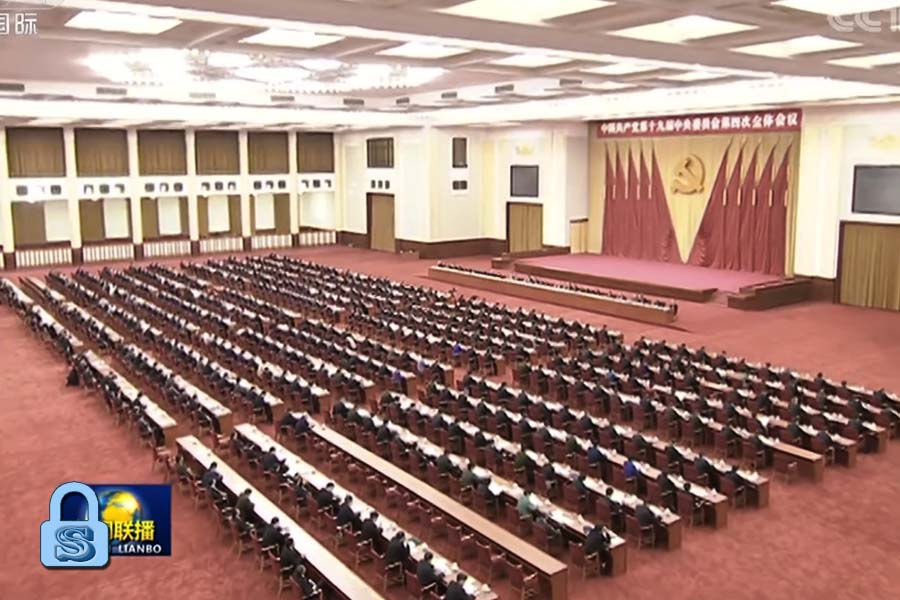
From Oct. 28 to Oct. 31, the 370-plus full (202) and alternate (169) members of the 19th Central Committee of the Chinese Communist Party held their fourth plenary session, or the Fourth Plenum.
Key personnel changes at the plenum and points from the official communiqué include:
1. 19th Central Committee alternate members Ma Zhengwu (China Chengtong Holdings Group Ltd. chairman) and Ma Weiming (director of the Naval University of Engineering’s Institute of Power Electronics Technology) replaced former full members Liu Shiyu (former China Securities Regulatory Commission chairman) and Zheng Xiaosong (former Macau Liaison Office). The Fourth Plenum communiqué confirmed Liu Shiyu’s two-year probation within the Party.
2. The Fourth Plenum adopted the “Decisions on Some Major Issues Concerning How to Uphold and Improve the System of Socialism with Chinese Characteristics, and Advance the Modernization of China’s System and Capacity for Governance.”
3. The Fourth Plenum communiqué emphasized the primacy of CCP governance and called for the preservation of Marxism-Leninism and the socialist system.
4. The communiqué stressed that “the government, the military, the people, and the schools, north, south, east, west, and center—the Party leads everything.”
5. The communiqué called for the upholding of “Party central authority and the centralized and unified leadership” — Party-speak for the upholding of Xi Jinping’s “quan wei” (權威).
6. The communiqué called for “rule of law” and “governance” with “Chinese characteristics.”
7. The communiqué emphasized the role of public ownership in the economy.
8. The communiqué emphasized the need for “cultural self-confidence” in the ideology of Marxism.
9. The communiqué proposed improving social security, poverty alleviation, and environmental protection.
10. The communiqué proposed a strengthening of systems overseeing social governance, stability maintenance, and national security.
11. The communiqué stressed the Party’s absolute leadership over the military and the guiding position of Xi Jinping’s “strong military” (强軍) thought.
12. The communiqué emphasized the importance of the “one country, two systems” model for so-called “peaceful reunification”; called for the establishment of a “legal system and enforcement mechanism for safeguarding national security” in the special administrative regions of Hong Kong and Macau; and proposed the formulation of a policy for the “peaceful reunification” of Taiwan and called on the Taiwanese people to reject “Taiwan independence.”
13. The communiqué called for a strengthening of Party’s leadership in foreign affairs work and the promotion of a “community of shared destiny for mankind.”
14. The communiqué called for the strengthening of supervisory and anti-corruption mechanisms for Party cadres.
15. The communiqué called on Party committees and leaders at all levels to uphold the authority of the Party and its governance system.
Our take:
1. The content of the Fourth Plenum communiqué suggests that the meeting was carried out without “accident” or unexpected political challenges.
The communiqué did not reveal any major changes to the political system, economy, or any unusual personnel movement. The lack of prominent personnel movement sharply contrasted with the deluge of personnel-related rumors before the plenum, such as the imminent promotion of Xi’s would-be successors to an expanded Politburo Standing Committee. As we wrote in October, “we noted that one should be ‘especially skeptical about all news articles published [before major political meetings] that reveal damaging information about the CCP elite, and the information in those articles should be assessed for its impact on the ‘you die, I live’ factional struggles in the Communist Party.’ The same guideline should be applied to all rumors and speculation about the CCP elite. Hence, we are deeply skeptical about the recent speculation on Xi’s health and his “plans” to hand over power, particularly to officials who are either Jiang faction members (Han Zheng) or those who rapidly rose through the official rungs during the Jiang era (Chen Min’er).”
There was even no mention in the communiqué of the Sino-U.S. trade war, China’s rapidly worsening economic situation, or the mass protests in Hong Kong. We believe that the communiqué’s “silence” on the aforementioned issues is an indication that the CCP either has no effective solutions to address those issues or the CCP elites cannot reach a consensus on the best way to resolve those issues.
2. The outcome of the Fourth Plenum suggests that it unfolded as we previously analyzed.
In August, we wrote that Xi Jinping is “again looking to reinforce his ‘core’ leadership, reassert his ‘quan wei,’ and get the Party behind his effort to tackle the multiple crises facing the regime” at the Fourth Plenum. The plenum’s focus on strengthening the primacy of the Party, Party central, and his leadership indicates that Xi’s agenda was precisely what we outlined.
In the Oct. 24 edition of our newsletter, we wrote that “the Xi camp and the Jiang faction are locked in a stalemate; neither side has the confidence or the means to subjugate/overthrow the other. In a stalemate, Xi needs to boost his ‘quan wei’ and cannot afford to show any sign of weakness. Thus, it is extremely unlikely that Xi would be floating trial balloons about his imminent retirement and ‘retirement plans,’ or naming his successors at this stage. Xi is also not powerful enough or has established a broad enough factional network to rule as a ‘power behind the throne’ like Jiang Zemin or Deng Xiaoping.”
It should be noted that Xi Jinping is not necessarily more powerful now despite reasserting his “quan wei” and tightening his grip over the Party at the Fourth Plenum. (We explained how power works in the CCP in our brief guide to factional politics.)
3. As is characteristic of CCP elite politics, the conclusion of a “bland” high-level conclave (in this case, the recent Fourth Plenum) with no concrete policy or personnel developments is an indicator of fierce factional struggle in the CCP. Xi Jinping only appears to have been able to “smoothly” convene the Fourth Plenum while facing lower political risk levels partially because he had “help” from the Trump administration with United States Vice President Mike Pence’s more conciliatory second China policy speech and partially because the Central Committee members were being kept virtually under “house arrest” at the military-run Jingxi Hotel in Beijing were plenary sessions are held.
Being able to convene a Fourth Plenum does not mean that Xi is out of the woods. As we previously wrote, “CCP history has shown that truces in factional struggles are temporary and consensus can be sacrificed to further factional interests. Thus, Xi Jinping will not enjoy any real advantage from boosting his ‘quan wei’ at the coming Fourth Plenum in the name of ‘protecting the Party.’ Put another way, Xi cannot resolve any of the PRC’s pressing problems as long as he seeks answers from within the CCP system.”
4. The Fourth Plenum communiqué makes it clear that the Hong Kong issue is a national security issue for the CCP regime. The CCP may not necessarily push the Hong Kong government to immediately enact Article 23 of the Basic Law, a highly controversial national security legislation that the Hong Kong people rejected with a 500,000-strong march in 2003. However, we do not rule out attempts by the Hong Kong government to pass legislation or injunction orders that amount to the de facto imposing of Article 23; on Oct. 31, the Hong Kong High Court granted an interim injunction order “against promotion, encouragement and incitement of the use or threat of violence via internet-based platform or medium.”
Meanwhile, the communiqué did not mention that the CCP regime will not rule out reunification with Taiwan “by force if necessary,” but instead called on the Taiwanese people to reject “Taiwan independence” instead. We believe that the “softer” approach to Taiwan is the CCP’s way of attempting to get back into the Republic of China’s good graces before the 2020 Taiwan presidential election. To influence the upcoming presidential election in January, it is entirely within the CCP’s means to suddenly make significant concessions to the Hong Kong protesters (such as agreeing to meet all five major protester demands, replacing chief executive Carrie Lam, etc.) to calm the city and greatly lessen fears in Taiwan about the CCP threat.
What’s next:
Nothing appears to have changed with the “you die, I live” CCP factional struggle and stalemate at the Fourth Plenum. We expect the various factions to ramp up their rivalry after the “peaceful” Fourth Plenum; “ceasefires” between the Party elite usually come during important meetings where the CCP needs to project an image of unity to the world. The factional struggle will be an important factor determining whether or not China and America sign a trade deal and how the Hong Kong situation shapes up.
Businesses, investors, and governments need to closely track developments in the CCP factional struggle to accurately gauge political and economic trends in China, as well as minimize political risk from Black Swan events.