
◎ We believe that there is a very good chance that China and the U.S. will get a trade agreement even as American tariffs go into effect.
A twist in Sino-U.S. trade negotiations has cast doubt on whether a final deal would be reached.
On May 5, U.S. President Donald Trump announced plans to raise tariffs this Friday on all Chinese goods because “the Trade Deal with China continues, but too slowly, as they attempt to renegotiate.” The next day, U.S. Trade Representative Robert Lighthizer said that “Over the course of the last week or so, we’ve seen an erosion in commitments by China, I would say retreating from commitments that have already been made, in our judgment.” On May 8, Reuters, citing three U.S. government sources and three private sector sources, noted that China had made “systematic edits to a nearly 150-page draft trade agreement that would blow up months of negotiations” between the two countries.
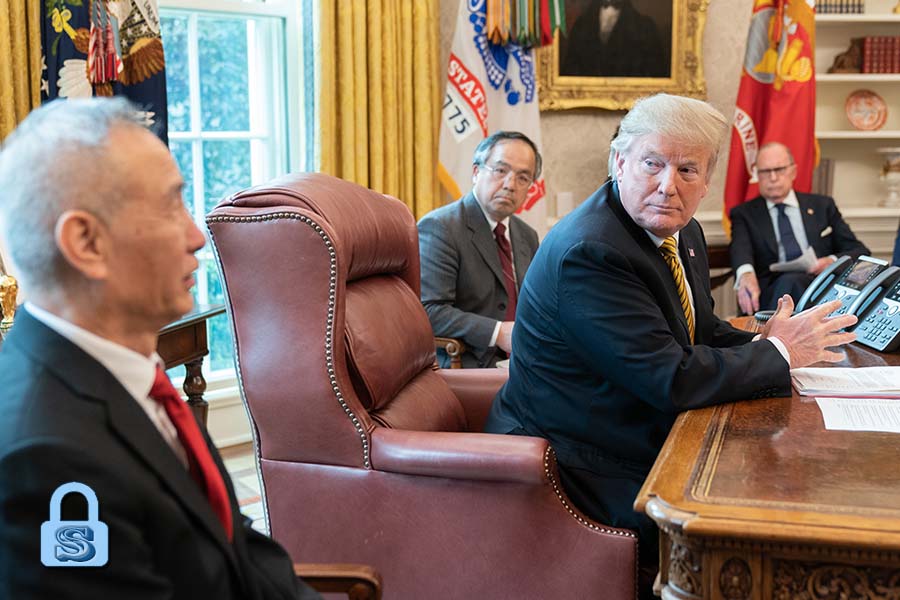
The Chinese regime’s response to the U.S. tariff threat was mixed. On the one hand, the regime continued its “tit-for-tat” approach to tariffs by threatening to impose retaliatory tariffs after the U.S. Trade Representative office filed paperwork on May 8 to formally raise tariffs. On the other hand, Chinese vice premier Liu He and his team are still scheduled to arrive in Washington to hold the latest round of trade talks on May 9 and May 10. Before Trump announced tariffs, Liu was due in DC on May 8.
Many observers believe that America’s recent threat to escalate tariffs have endangered the trade talks. Chinese leader Xi Jinping, observers say, will unlikely give up concessions to make a deal now that Trump has placed him in a position to lose face. Xi cannot afford to lose face in 2019, a year of sensitive anniversaries (“reform and opening up,” Tiananmen, Falun Gong, Urumqi riots, etc.), some observers argue. Other observers believe that the shortened period of the latest round of trade talks do not give much time for a trade deal to be reached before the tariffs kick in.
Based on our observations, we believe that there is a very good chance that China and the U.S. will get a trade agreement on May 10 even as American tariffs go into effect.
Our take:
1. We wrote on May 5: “If state media stays silent and heavy censorship is practiced, then Liu He may yet travel to Washington.”
The scenario which we described has unfolded this week. While the Chinese stock markets plunged due to Trump’s tweets, state media made no mention of the tweets or offered any analysis or explanation of the poor stock performance. Chinese social media posts on the tariff threat or the markets were quickly deleted. When state media finally addressed the tariff issue, it did so in a muted way. Meanwhile, Beijing announced on May 7 that Liu He would be traveling to DC on May 9.
2. We also wrote on May 5: “If Liu goes ahead with his trip, then Xi might have convinced the CCP elite that compromise and cooperation are the way to go to ensure regime survival and future dominance (the ‘survival-dominance’ dynamic). China and the U.S. will likely reach an agreement on the trade deal by the end of the week pending the signature of Xi Jinping and Donald Trump.”
Our assessment has not changed. In fact, recent developments have only reinforced our view that a deal will be reached.
First, the Trump administration has announced China’s intent to reach an agreement in the latest round of trade talks. On May 8, Trump tweeted that “China has just informed us that they (Vice-Premier) are now coming to the U.S. to make a deal.” On the same day, White House press secretary Sarah Sanders said that “we’ve got indications they want to make a deal.”
Second, the Chinese side has reacted in a way after Trump’s tweets about tariffs which indicates that they will indeed make a deal in this round of trade talks. A leading indicator is the media censorship and muted behavior which we mentioned in point 1. Another clue is Liu He’s shortened schedule; when the “midnight hour” is at hand, the Chinese regime will agree to a trade deal that meets U.S. demands to avoid endless escalation in the trade war, and not much time is required to make concessions that the regime is already prepared to make. Indeed, the Wall Street Journal quotes a Chinese official involved in policy-making as saying, “There is definitely a sense of urgency that we should get this resolved sooner rather than later. An all-out trade war is in no one’s interest.”
Finally, Beijing has been paving the way to make concessions since earlier in the year. We previously analyzed how Beijing had been shifting rhetorically on reform and trade issues in propaganda (see here and here). Xi Jinping’s remarks at the recently concluded Second Belt and Road Forum also appear to be made with “an eye on ongoing trade negotiations between China and the United States.”
3. There are several possible reasons why the Chinese regime “backtracked” on trade commitments last week.
One reason is classic Chinese Communist Party delaying tactics. We predicted that the Chinese regime would seek to drag out trade negotiations in our 2019 Special Report, and explained why the CCP wants to exploit the trade issue to buy time in an earlier analysis. On May 8, President Trump wrote in a tweet that China had “pullback & attempted renegotiation of the Trade Deal” with an eye on “negotiating” a deal with the Democrats should one of their candidates oust Trump in the 2020 presidential election; this is one of the scenarios which we noted that the Chinese regime is aiming for in our 2019 Special Report.
Another reason is negotiating tactic. The CCP could be thinking about playing hardball on some aspects of the trade deal to make America “give up” pursuing highly sensitive concessions such as allowing foreign companies greater access to China’s cloud-computing market (according to news reports, China offered to make cloud concessions in March, April, and May). The CCP does not want to lift cloud-computing restrictions on foreign companies because it would severely compromise regime security. By putting cloud-computing on the table before threatening to “renegotiate” the entire trade deal, the CCP is likely hoping that the U.S. eventually “settles” for a final trade agreement that either does not include any cloud-computing concessions or includes very minimal concessions.
Finally, factional politics could have been a factor in Beijing “reneging” on commitments. We have written several articles about the Jiang faction exploiting China’s trade troubles with America to undermine the Xi leadership. Recently, we observed that Jiang Zemin (April 26) and Zeng Qinghong (April 22) each made a public appearance near the day of Xi Jinping’s speech (April 26) at the Second Belt and Road Forum. Xi’s remarks at the forum served to lay the groundwork for Beijing to make trade concessions to America. With Beijing close to reaching a trade deal, the Jiang faction would likely try to pressure Xi Jinping into backing away from concessions and adopting a more “hardline” stance.[1]
All of the above reasons could be in play at the same time with no contradictions due to the complexities of the CCP’s “survival-dominance” dynamic and the factional struggle (the “survival-dominance” dynamic played out at a lower level).
What’s next:
1. China and the U.S. will likely reach a trade agreement this week. Both sides could also settle upon a signing date and location. The U.S. could still go ahead with tariffs on Friday, but may agree to remove the tariffs at an early date if commitments are fulfilled. The Chinese side may request that Trump welcome Xi Jinping with a grand state visit so that Xi can save face despite making concessions.
To avoid criticism from hardliners or rival factions, the Xi leadership will likely spin an “unequal treaty” into a “necessary process” of “deepening reforms” for the “betterment of the people.”
2. The CCP will likely continue delaying tactics during the implementation and mediation phases of the trade deal. The goal of delaying tactics is to avoid fully implementing the deal before the 2020 U.S. presidential election. Further, the CCP will likely deploy influence and interference measures in the upcoming presidential election to get Trump out of office.
3. The CCP factional struggle will escalate, and Xi Jinping faces very high levels of political risk. To counter Jiang faction pushback, Xi may prosecute or purge Jiang faction members. There is a very high probability of political Black Swan events occurring.
Notes
[1] Some China commentators have suggested that “hawks” and “reformers” are swaying the outcome of the Sino-U.S. trade negotiations. While there are indeed Party cadres with hardline viewers, the idea of “hawks” and “reformers” is a misnomer. This is because the CCP prioritizes survival above all, and will do whatever it takes to live to fight another day. As long as the regime survives, it can get “hawkish” when it is strong to pursue its domination agenda. The CCP’s “survival-dominance” dynamic explains why there is no contradiction in Deng Xiaoping ordering the military to fire on student protesters in 1989 but forcing Jiang Zemin to carry out “reform and opening up” in 1992. Rather, the “contradictions” in the Party which are shaping the trade talks stem from the factional struggle.




