◎ Xi’s Jan. 8 speech reveals his and the Party’s concerns about regime-threatening risks.
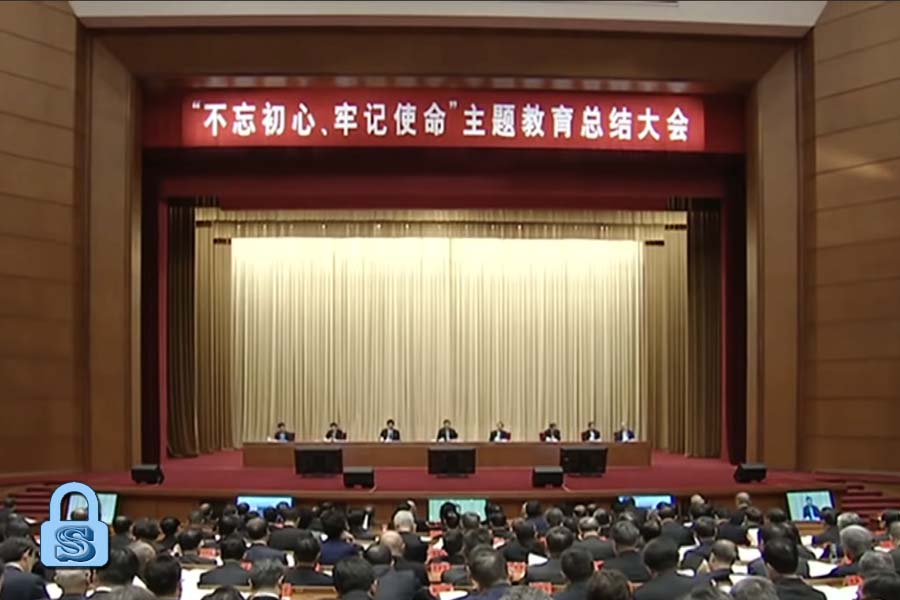
On Jan. 8, Xi Jinping gave a speech at a meeting in Beijing on the theme of “staying true to our founding mission” (alternatively, “remember our original aspiration and mission” 不忘初心、牢記使命). The meeting was presided over by Politburo Standing Committee member Wang Huning.
Xi said that the Chinese Communist Party must “resolutely remove whatever weakens the Party’s advanced nature and undermines the Party’s purity, and rid ourselves of any tumor that erodes the Party’s health,” according to a Xinhua report on the meeting. Xi also said that the Party should “resolutely guard against all dangers of running counter to the original aspiration and the mission or shaking the foundation of the Party.”
In the speech, Xi noted that the “staying true to our founding mission” campaign was conducted from top down in two batches starting from May 2019 and listed the departments, ministries and military work units that participated in the campaign (middle to upper ranking cadres from the departments, ministries and military work units mentioned were required to partake in the campaign).
The meeting was attended by all seven members of the Politburo Standing Committee and People’s Republic of China vice president Wang Qishan. Party, State, and military officials at the county level (or regimental level) and above attended the meeting via teleconference.
The big picture:
The CCP is mired in a state of unprecedented political crisis as the PRC economy continues to deteriorate alongside growing social unrest. Factional struggle within the Party appears stalemated, with neither the Xi leadership nor his entrenched rivals able to secure a decisive advantage over the other.
Hong Kong continues to simmer with protests calling for political reform. A Jan. 1 New Year rally attracted 1 million participants, many of whom yelled regime-threatening slogans like “revolution of our times” and “heaven will destroy the CCP.” Meanwhile, the Hong Kong police force has not eased up in its use of heavy-handed tactics to suppress and arrest protesters.
In Taiwan, a series of ongoing developments have threatened the CCP regime’s efforts to influence local social and political trends. Last November, longstanding accusations of PRC interference on the self-governed island were bolstered by the revelations of defecting spy Wang Liqiang, who in interviews discussed PRC attempts to undermine the Republic of China’s democracy through a massive propaganda and disinformation campaign. On Dec. 31, the ROC Legislative Yuan rammed through an anti-infiltration law targeting political interference by the PRC.
Recent reports by Australian media revealed that Wang Liqiang received threats by a senior pro-PRC Taiwanese politician and a mainland Chinese businessman, who attempted to coerce him to disavow his previous statements.
In the Sino-U.S. trade front, the PRC finally confirmed on Jan. 9 that PRC vice premier Liu He will travel to Washington D.C. from Jan. 13 to Jan. 15; Liu is expected to sign the “phase one” trade deal on Jan. 15. The PRC previously failed to confirm whether high-level PRC officials would participate in the Jan. 15 signing after U.S. President Donald Trump announced the event on Dec. 31, 2019. To date, the Chinese translation of the 86-page agreement has not been made public.
Starting in late 2018, we observed that the worsening of China’s economic and financial situation presented severe risks to Xi’s leadership. This trend has continued unabated throughout 2019, with rising unemployment, bank runs, and debt defaults at the tip of the iceberg in the long list of internal crises that threaten the CCP’s grip on power.
Our take:
1. Xi Jinping’s Jan. 8 speech, in close parsing, reveals his and the Party’s concerns about regime-threatening risks. Xi’s speech also serves to put his political opponents on notice.
To secure the signing of the “phase one” deal, Xi has taken great efforts to boost his “quan wei” (權威) and carried out key personnel reshuffles ahead of the Jan. 15 date (see here and here for examples of our previous analysis on this subject).
On Jan. 1, we wrote that “with the signing of the ‘phase one’ Sino-U.S. trade deal imminent, Xi has again taken to ‘borrowing’ tokens of ‘quan wei’ (titles used by Mao, visiting revolutionary sites, etc.) in ‘you know what I mean’ fashion to strengthen his position and hand as he prepares to bring the Party’s elite to a consensus on signing the ‘phase one’ deal.”
However, we also analyzed that contrary to the conventional logic “that Xi Jinping collecting a title associated with Mao Zedong at a Politburo meeting signals that his grip on power is very secure and that he has the support of the CCP elite,” the fact that Xi finds it necessary to apply such titles in the first place demonstrates that he does not have a firm enough grip on power to ignore or decisively shutdown his political opponents and push through policy.
In analyzing the rhetoric of Xi’s Jan. 8 speech, we make the following observations:
1.1. Xi said, “if we abandon the original aspiration and mission, our Party’s nature will be altered, it will change its colors, and we will lose [support of] the people and lose the future.”
“Abandoning the original aspiration” (忘記初心和使命) shows the leadership’s concerns about the wavering faith of Party members and in turn the faith of the Chinese people in the Party. The reference to “changing colors” (改變顏色) suggests that the CCP is concerned about a “color revolution” spreading throughout the Party.
Hinting at the severity of crisis within the Party, Xi also warned against “omnipresent” “factors” and “perils” built over over the decades of CCP rule that “weaken the Party’s advanced character and damage its purity.” Xi singled out “acute problems such as impurity of thought, organization, style of work,” while noting that they have “yet to be fundamentally addressed.”
1.2. Xi said that “remembering our original aspiration and mission requires the unification of thought, will and action with the latest achievements in adapting Marxism to the Chinese context.”
This statement is a call to resolve the crisis of political authority by cementing Xi’s “quan wei” over the Party. “The latest achievements in adapting Marxism to the Chinese context” is synonymous to Xi Jinping Thought, while “the unification of thought, will and action” means following the Xi leadership and upholding his “quan wei.”
1.3. Xi called upon Party members to “continuously advance self-revolution” by mustering “the courage to face problems” and realizing the importance of “turning the blade inwards” to “resolutely excise all tumors that feed on the Party organism.”
To rectify mistakes and strengthen the CCP, Xi stated that cadres are expected to review the Party’s history, as doing so will allow them to “scrape poison away from the bones, remove rot and nourish the [Party’s] flesh” (刮骨療毒、去腐生肌).
“Turning the blade inward” (刀刃向內) and “self-revolution” (自我革命) suggest that Xi intends a fresh purge of the CCP to cleanse it of his factional enemies.
There is precedent of purges taking place around the time that Xi Jinping stresses the importance of “removing tumors” (毒瘤) based on his use of similar phrases in 2013 and 2014.
On Dec. 26, 2013, Party Central held a conference to mark the 120th birthday of Mao Zedong. In remarks made at the event, Xi Jinping said that “any problem that interferes with the Party’s innovation, cohesiveness, and fighting ability must be dealt with in a timely fashion, any disease that harms the Party’s advanced character and purity must receive earnest treatment, and any tumors feeding on the healthy organism of the Party must be resolutely dispelled.”
On Sept. 1, 2013, Jiang Jiemin, director of the State-owned Assets Supervision and Administration Commission of the State Council, was removed from his post. On Dec. 20, or six days before Xi’s speech, Ministry of Public Security deputy chief and deputy Party secretary Li Dongsheng had been placed under investigation for corruption.
In the evening of Sept. 30, 2014, the State Council held a conference on the eve of the 65th anniversary of the PRC’s founding. Xi Jinping delivered a speech at the meeting in which he repeated the line “any tumors feeding on the healthy organism of the Party must be resolutely dispelled.”
On June 30, 2014, former deputy chairman of the Central Military Commission, Xu Caihou, had been stripped of his Party membership and handed over to the Chinese military’s prosecutory agency. Meanwhile, former secretary of the CCP Political and Legal Affairs Commission, Zhou Yongkang, was placed under investigation on July 29.
After the purge of Xu and Zhou, “tumors” and synonymous terms only infrequently appeared in CCP publications until Xi’s Jan. 8 speech this year.
1.4. Xi said that the success or failure of cleansing the Party of “tumors” would hinge upon whether cadres were “willing to cut decisively through great tests of truth and falsehood, rise to overcome challenges in the face of contradictions, step forward bravely to handle crises, take responsibility for mistakes, and persist in struggle against malign social trends.”
These lines are meant to encourage struggle between CCP cadres and have them support Xi in attacking the entrenched nodes of factional resistance. Xi’s rhetoric signals that Party officials who implement Xi Jinping’s policy directives without fear of institutional backlash or making mistakes will be rewarded with promotion.
1.5. Xi said that “the entire Party must reinforce its institutional consciousness by willfully adhering to, strictly implementing, and resolutely safeguarding the system, so as to strengthen the mechanism for carrying out governance with a high degree of effectiveness.”
These remarks call upon the Party to ensure that Xi’s directives proceed without impediment by upholding the institutional aspects of his leadership, i.e. Xi Jinping Thought, Xi’s “core leadership” of the Party, etc.
1.6. Xi said that the Party must “uphold the organs of leadership and the leadership of leading cadres.”
This statement requires leaders at each rung of power to proactively uphold Xi’s leadership and “quan wei.”
2. We have observed since late 2018 that Xi has been locked in stalemate with his factional rivals, including retired Party elders such as Jiang Zemin and Zeng Qinghong, who retain powerful networks of informal support within the CCP and among PRC elites.
Stalemate in the factional struggle has stonewalled Xi’s attempts to push through key policies, such as the draft Sino-U.S. trade deal that Chinese representatives agreed to, then backed away from at the last minute due to the influence of “hardliner” voices within the PRC regime.
The factional standoff has also complicated Xi’s position with regards to Hong Kong, where we observed that Party Central is hard-pressed to balance ideological orthodoxy with the practical imperatives of defusing the unrest there.
Xi’s reference to “removing tumors” in his “staying true to the Party’s founding mission” speech may be seen in the same context as the theme of the CCP’s recently convened Fourth Plenum, which focused on Party-building. We believe that Xi intends to “rectify” the Party in order to end the factional stalemate.
3. With the “founding mission” speech, Xi appears to be ramping up pressure on the Party as part of taking a “fight first, talk later” (先打後談) approach to dealing with his opponents. This may be compared to his “signaling left to turn right” (欲右先左) strategy as a means of adhering to the Party’s “better left than right” (寧左勿右) orthodoxy. Such moves are a near requirement in the cutthroat “you die, I live” environment that is CCP elite politics.
4. Xi must first resolve the CCP factional struggle if he is to bring the regime to a consensus on dealing with complicated domestic and external troubles, particularly the Sino-U.S. trade war and long-term rivalry.
How Xi handles the following will give clearer indication as to how strong or weak he is at this stage of the CCP factional struggle and whether or not the stalemate will be broken:
- When, how, and how much of the Chinese translation of the Sino-U.S. “phase one” trade deal is announced.
- The purging of officials in opposing factions, such as Zhang Xiaoming, the director of the Hong Kong and Macao Affairs Office.
- The degree to which the “phase one” deal is promoted or criticized in propaganda (state and Party media, remarks by officials, etc.).