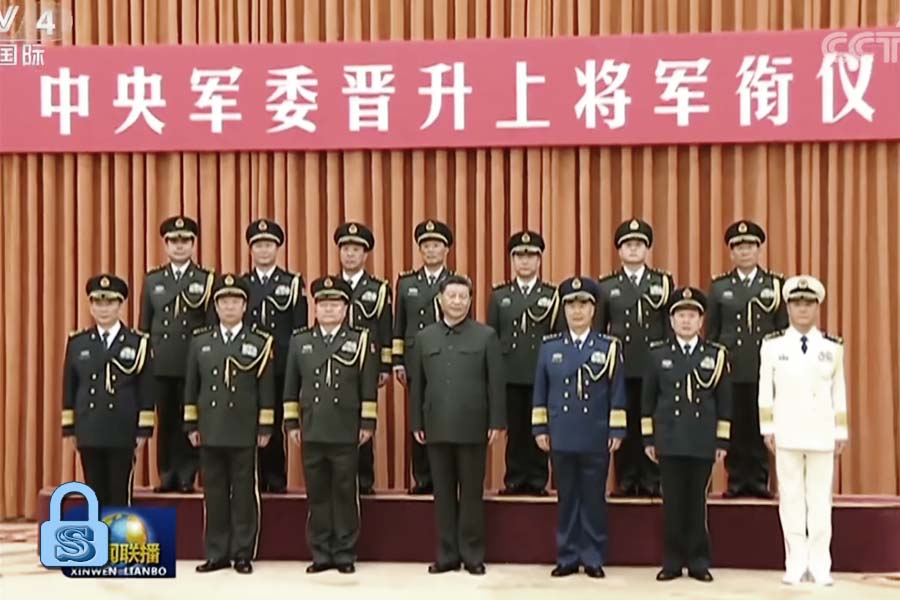
◎ We believe that Xi’s personnel moves are designed to ensure troop loyalty as he will face greatly heightened political risks should he go ahead and approve the signing of the “phase one” deal.
Irregular personnel moves (accelerated promotion [破格提拔], dismissals, investigations, etc.) in the People’s Liberation Army are usually closely connected with political developments. And the Xi leadership made a series of irregular personnel moves in the lead up to the announcement that the People’s Republic of China and the United States had reached a “phase one” trade deal.
The backdrop:
Dec. 8
– The General Office of the Central Military Commission issued a notice on policy changes concerning the promotion of military officers at the corps grade and higher (“關於先行調整軍級以上軍官軍銜晉升有關政策的通知”). The notice stated that promotion policy for officers in command positions will be adjusted first, followed by officers below the division level or those who are in professional or technical positions.
Dec. 9
– A teleconference event to honor “advanced” (先進; describing someone as “advanced” is another way of saying that the person is a “model worker”) retired military cadres and veteran affairs workers across the military branch services was held in Beijing. At the event, Xi Jinping called in to extend his greetings to the retired cadres.
Dec. 12
– Xi Jinping promoted seven military officers to the rank of general, the highest military rank in the PLA. The officers are Commander of the Eastern Theater Command He Weidong; Political Commissar of the Eastern Theater Command He Ping; Political Commissar of the Southern Theater Command Wang Jianwu; Commander of the Northern Theater Command Li Qiaoming; Commander of the PLA Rocket Force Zhou Yaning; Commander of the PLA Strategic Support Force Li Fengbiao; and head of the PLA’s Academy of Military Sciences Yang Xuejun.
– The new generals were promoted very rapidly up the ranks, taking just six years to raise from deputy corp leader or corp leader grade (major general rank) to become full generals.
– Six of the seven newly promoted generals only received their lieutenant general rank in 2016 or 2017. Their recent promotion was accelerated because previous PLA promotion policy states that generals can only be awarded a higher rank four years after their latest promotion.
– Four of the new generals are theater commanders.
– The new generals are relatively young for their rank, being between the ages of 56 to 62.
Dec. 13
– The U.S. and the PRC “reached an historic and enforceable agreement on a Phase One trade deal,” according to a statement released by the Office of the United States Trade Representative.
– Between Dec. 9 to Dec. 13, the PLA Ground Force, Navy, Air Force, and People’s Armed Police promoted a total of 16 lieutenant generals and 147 major generals.
Our take:
1. We analyzed that Xi Jinping downsized the Central Military Commission in 2017 to replace senior officials who rose through the ranks during Jiang Zemin’s era of dominance (1997 to 2012), promote a “new guard of generals that will be devoted to him,” and consolidate his control over the military.
Xi’s recent military personnel moves, including the accelerated promotion of young generals, showing appreciation for retired military cadres and updating military promotion policy, are all in line with our earlier analysis.
2. We believe that Xi made his recent military personnel moves to rally the troops and ensure their loyalty to him ahead of the announcement of the Sino-U.S. “phase one” trade deal. Xi needs to maintain a firm grip on the Party’s “gun” (槍桿子), a key lever of power, because he faces greatly heightened political risks should he go ahead and approve the signing of the “phase one” deal.
From the Office of the United States Trade Representative’s statement on the trade deal issued on Dec. 13, the PRC side would be essentially admitting to intellectual property theft and forced technology transfers, as well as agreeing to make substantial additional purchases of U.S. goods and services. The inclusion of the aforementioned points in an earlier 150-page draft trade deal is precisely what led Party “hardliners” and Xi’s political opponents to oppose the draft deal, force the Xi leadership to “renege” on it in May, and target Xi’s allies (the downfall of Xi ally Liu Shiyu being the most prominent example). Put another way, it can be assumed that Xi will likely face similar or stronger pushback from “hardliners” and political opponents over the “phase one” deal.
If Xi wishes to sign the “phase one” deal, he would either have to reach a political compromise with Party “hardliners” and his factional rivals, or make an example of factional rivals and hope that the CCP elite will not dare to challenge him on the deal. Either way, Xi must ensure that the military remains loyal to him to maintain political leverage over those who seek to oppose him.