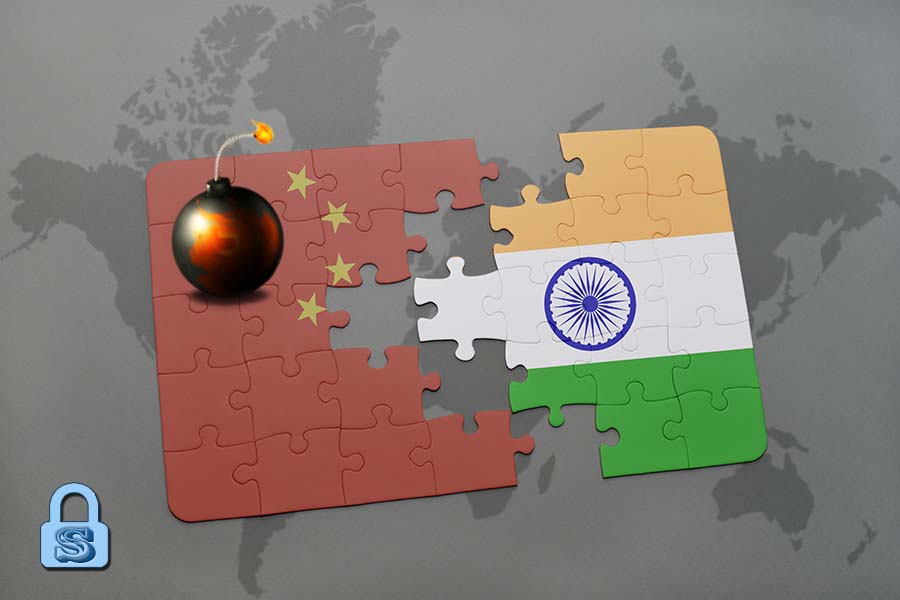
◎ India and her allies could pursue non-kinetic and indirect means to defuse border tensions before they boil over.
On Sept. 10, the People’s Republic of China and India reached a five-point agreement on a military standoff at the disputed Himalayan border region. A joint statement by PRC foreign minister Wang Yi and Indian foreign minister S. Jaishankar said that the standoff was “not in the interest of either side,” and “the border troops of both sides should continue their dialogue, quickly disengage, maintain proper distance and ease tensions.”
Despite agreeing to disengage, the Chinese Communist Party has shown no signs of being sincere in de-escalating tensions.
- On Sept. 12, the PRC claimed that five missing Indian nationals whom it released were not civilians, but intelligence agents dressed as hunters. On the same day, PRC state media reported on an inaugural air-ground joint exercise between a combined army brigade of the Tibet military command and the People’s Liberation Army Air Force that was conducted at an average altitude of 5,000 meters (16,400 feet).
- On Sept. 14, two Indian officials told Reuters that China was laying a network of fiber optic cables at the border flashpoint region, suggesting that the PRC was preparing for a prolonged standoff. A third Indian official said that the situation at the border remained “as tense as earlier” and there were no substantial withdrawals or reinforcements since the Sept. 10 disengagement agreement was reached.
- On Sept. 15, nationalistic Party media Global Times cited Chinese experts as saying that Sino-Indian border tensions may extend into the winter.
- On Sept. 16, the South China Morning Post (SCMP) cited military sources as saying that the PRC has raised its military alert level for troops at the border to the second-highest possible of four grades on Sept. 8 after gunshots were fired, but lowered the level after the Sept. 10 meeting. The last time military readiness was raised to such a high level was in 1987 following a skirmish in the Sumdorong Chu valley. SCMP’s source said that “the level can be decided by troops on the border, as happened before the 1987 skirmish, when it was adjusted several times.”
The CCP’s latest actions at the Sino-Indian border affirm our previous analysis of the futility of the Sept. 10 agreement. Politics and political legitimacy are key factors driving Beijing’s escalation of border tensions. China is presently plagued by a “perfect storm” of domestic and foreign problems, and the CCP requires solutions to simultaneously preserve regime survival and advance its domination agenda. Because the CCP regime adheres to Marxism-Leninism, its textbook solutions for crisis management tend to be destructive, not constructive; focused outwards, not inwards; and revolve around struggle, not harmony. Thus, the CCP will seek solutions out of bounds for normal countries such as the recent border skirmishes, which are in line with its classic tactic of manufacturing a “controllable” external crisis with the aim of distracting the masses from domestic issues and leveraging nationalism to solidify political legitimacy. The CCP’s manufactured external crisis tactic, however, can prove very costly if it fails to obtain some form of victory—keeping troops at the Sino-Indian border is a significant drain on China’s dwindling resources, and defeat will compound the CCP’s already numerous crises.
Some could argue that the CCP is not really looking to distract the Chinese people through a manufactured crisis because mainland media has stayed largely silent about the recent border skirmishes. If anything, the CCP appears to be downplaying the border issue, particularly in the Galwan Valley episode where it did not release official casualty figures despite a deadly melee that left 20 Indian soldiers dead. Absence of evidence, however, is not evidence of absence. The CCP will only play up the Sino-Indian border issue in propaganda outlets when it is on the cusp of victory or in prelude to an armed conflict. The latter point can be explained by the CCP’s need for a narrative where India is the aggressor and it is the “victim” to justify its use of arms when the shooting starts. India and the international community should be on high alert for the CCP’s application of the “flesh sacrifice stratagem” (苦肉計, the ancient Chinese ploy of inflicting injury on oneself to win the enemy’s trust), such as when the CCP releases an official death toll for the Galwan Valley episode, suddenly “retreats” after making incursions into Indian positions, or “allows” Indian forces to “recapture” ground previously seized by PLA troops before making a big fuss about it in propaganda outlets.
Separately, General Secretary Xi Jinping, embattled by China’s pressing problems and “perish together” factional struggle in the CCP, has a personal stake in clashes at the Sino-Indian border. Victory will boost Xi’s diminishing “quan wei” (權威) in the regime, allowing him to forge ahead in consolidating his less-than-secure grip over the Party and make a strong case for a third office term. Defeat or stalemate at the border will inspire his factional rivals to capitalize on the issue and embolden them to launch a serious challenge to his leadership.
Border strategies
As things stand, the CCP will unlikely cease its border provocations until it attains some form of victory over India, including the seizing of sizable disputed territory or dealing a grievous defeat to Indian troops. Meanwhile, India will not accept further PRC attempts at establishing faits accompli or tolerate another “bloody nose” from China, especially with defeat during the 1962 Sino-Indian War still fresh in the memory. In extrapolating from PRC behavior and motivations, China and India are headed for a minor armed conflict at the Himalayan border on the current trajectory, one that could potentially turn into a nasty three-on-one situation if pro-CCP Pakistan and Nepal enter the fray (be it joining the PRC or taking advantage of the chaos to grab territory).
New Delhi may not back down from a fight, but will prefer not to engage the PRC militarily unless forced to given other domestic priorities. The coronavirus situation in India is a particular worry, with a recent surge in COVID-19 cases and the economy plummeting 23.9 percent in the second quarter due to a strict lockdown. Meanwhile, the United States has signaled concern over the CCP’s provocations and further escalation. During a Sept. 4 press conference, President Donald Trump described the border situation as “very nasty” and noted that both sides were “going at it much more strongly than a lot of people even understand.” He added, “We stand ready to help with respect to China and India. If we can do anything, we would love to get involved and help.”
We believe that the CCP is on track to provoke a minor armed conflict at the Himalayan border region. India will likely stand up to the PRC, even if it means an outbreak of conflict. The U.S. will prefer that India and China, two nuclear-armed countries, do not escalate tensions at the border further, but will side with India in the event of an armed struggle.
In a minor armed conflict, neither side can claim to have a solid advantage over the other on paper. Fighting in mountainous regions is difficult even in the best of times, and will get tougher during the winter. In terms of military capability, the PRC appears to have an edge in technology and weaponry, while India has an advantage in mountain troop quality, supply and logistics, and proximity of personnel to the border. The participation of Pakistan and Nepal, however, would negate some of India’s military advantages over the PRC. Both sides would suffer economically, although India could potentially see U.S. and even international financial support if the PRC is proven to be the clear provoker.
The complications of a minor armed conflict could prompt India and her allies to pursue non-kinetic and indirect means to defuse border tensions before they boil over. Beijing’s provocations could backfire badly should India and her allies leverage on strategies that target CCP weaknesses and force it to reconsider further border action. Just giving the CCP pause on the border is sufficient to cause serious political problems at home for the communist regime and Xi Jinping.
Publicity
The CCP practices propaganda, censorship, and information control because it fears a negative reaction from the Chinese people who are exposed to facts and truth. Thus, Beijing has been hiding information about the Sino-Indian border skirmishes in China from the public. To de-escalate tensions and forestall armed conflict on the border, India and the U.S. could find ways to broadcast unfiltered information about the border crisis into China. Washington has recently taken steps to circumvent the CCP’s Great Firewall: On Aug. 18, the U.S. Agency for Global Media (USAGM) revived its Office of Internet Freedom, whose mission is to “support the testing, deployment, and management of technologies that circumvent internet blocking, filtering, and other censorship techniques principally used by repressive regimes, such as China and Iran.” USAGM also announced the funding of two internet firewall circumvention projects. Once the Chinese people are exposed to competing narratives, the CCP will find it harder to justify its border actions and will be less inclined to provocation.
India and the U.S. could also go the ideological route to open a non-kinetic “second front” against the CCP. The Trump administration has put the CCP on the defensive through ideological confrontation, including drawing a distinction between the Party and the Chinese people. A clear sign that the CCP is gravely concerned about the prospect of being confronted ideologically may be seen in Xi Jinping’s announcement of the five “never allows” in a major speech on Sept. 3, which appears to be a direct response to U.S. Secretary of State Mike Pompeo’s ideologically-themed, “distrust and verify” China policy speech at the Nixon Presidential Library on July 23. Should India and the U.S. call out the CCP over the ideological and political nature of its latest border actions (“the Marxist-Leninist CCP regime is partaking in authoritarian aggression to spread its hegemonic rule”) instead of going along with its narrative (“India is again taking advantage of China in a longstanding struggle”), Beijing will be forced into issuing official denials, which will in turn alert the Chinese people as to the true nature of what exactly is going on at the Himalayan border region.
Diplomacy
The CCP almost certainly chose to escalate tensions at the Sino-Indian border as part of a bid to draw attention away from its failures in the South China Sea region. The U.S. and the international community have strongly criticized and taken action against the PRC for effectively ending its “one country, two systems” arrangement with Hong Kong by imposing a national security law over the semi-autonomous city. Also, the U.S. and other countries have been strengthening diplomatic ties with Taipei and condemning Beijing’s bullying, a sore issue for the CCP regime, which claims Taiwan as its own.
To shift the CCP’s attention away from the border, India and her allies could ramp up efforts to target sensitive issues for Beijing. Already, India has been speaking up on the Hong Kong issue and quietly upgrading its ties with Taiwan. India and her allies could potentially strengthen ties with Taiwan more aggressively and openly, including supporting Taiwan’s entry into new health and economic world organizations, conducting joint military maneuvers with Taiwan, or even having naval vessels sail through the Taiwan Strait or call at the port. Acting on Beijing’s sensitive issues, and particularly Taiwan, will compel the CCP to take border disengagement seriously as it fears that further escalation will only serve as a catalyst to the world’s isolation of the PRC and further propel Taiwan on the world stage.
Geopolitics
Part of the reason why the CCP chose to manufacture an external crisis at the Sino-Indian border, a place of little strategic value, as opposed to more strategically important regions like the South China Sea or the Taiwan Strait, is because it does not enjoy military parity elsewhere. While the PLA Navy does have more ships than the U.S. Navy, it lacks the firepower and technological superiority of U.S. aircraft carrier groups in the Indo-Pacific region. Further compounding Beijing’s dilemma, the U.S. has stepped up military activity in the area as a response to the CCP’s increased militarism and threats of invading Taiwan in recent years.
In the event of a minor armed conflict or in the lead-up to one, it cannot be ruled out that India and her allies could take advantage of geopolitics to divide the CCP’s attention. For instance, India and her allies could find reasons to hold up container ships and oil tankers headed through the Strait of Malacca to China. This would create supply and logistical problems for the CCP; while things may have since improved, China’s National Energy Administration revealed last year that the country only has around 80 days of oil in storage, including its strategic petroleum reserve, or less than the 90 days recommended by the International Energy Agency for its members. The CCP will also face fresh military and political dilemmas in the event of a naval “blockade”: Public pressure would demand that China respond, but sending warships to the Strait of Malacca and the Indian Ocean will expose the PLAN’s frailties (its aircraft carriers have limited range and capabilities). Failure by the Party to respond adequately, however, and Beijing’s “strong military” propaganda myth will rapidly come undone, followed swiftly by the CCP’s political legitimacy. Regardless of how the CCP might act in such a situation, it would be rapidly forced to reconsider its engagements along the Indian border.