◎ While the CCP has sought to extricate itself from the Hong Kong quagmire, its measures have thus far only caused it to sink in deeper.
In Hong Kong, anti-extradition protests have continued for the sixth straight month. Meanwhile, the United States recently passed legislation to address human rights issues stemming from the Hong Kong government and the Chinese communist regime’s handling of the protests. And in the backdrop, Hong Kong’s economy has entered into recession as the Chinese economy deteriorates further. On top of that, the Chinese Communist Party is facing an unprecedented political crisis.
We believe that Hong Kong has already become a quagmire for the CCP. While the CCP has sought to extricate itself from said quagmire, its hardline measures have thus far only caused it to sink in deeper.
The backdrop:
Oct. 18
– The CCP announced that China’s GDP grew by 6 percent in the third quarter of 2019 from a year ago, the slowest GDP growth in at least 27 and a half years.
Nov. 15
– The Hong Kong government released data showing that the city’s GDP shrank by 2.9 percent in the third quarter of 2019. The second consecutive quarter of GDP contraction meant that Hong Kong is now in a technical recession.
Nov. 22
– The PRC’s National Bureau of Statistics revised up its nominal 2018 GDP by 2.1 percent to 91.93 trillion yuan, a move which we believe was done by the CCP to allow the central and local governments to take on more debt as it attempts to arrest the deterioration of China’s economy.
Nov. 23
– Australian newspapers reported the defection of Chinese spy Wang Liqiang. Wang revealed his role in carrying out political interference in Hong Kong, Taiwan, and Australia on behalf of his boss Xiang Xin, a PRC military intelligence officer based in Hong Kong.
Nov. 24
– Hong Kong’s pro-democracy camp won a landslide victory in local district council elections, taking 388 out of 452 seats. More than 2.9 million people, or over 70 percent of the electorate, voted in the local elections, which many viewed as a referendum on the Hong Kong government’s handling of the anti-extradition bill protests.
Nov. 25
– The Taiwanese government announced the detention and investigation of Xiang Xin and his wife Kung Ching. Xiang and Kung were trying to leave the country at Taoyuan International Airport when they were taken into custody.
Nov. 27
– U.S. President Donald Trump signed into law the Hong Kong Human Rights and Democracy Act of 2019 (henceforth referred to as the “Hong Kong Act”). Trump also signed another bill banning the export of crowd-control munitions (tear gas, rubber bullets, etc.) to the Hong Kong police.
Nov. 29
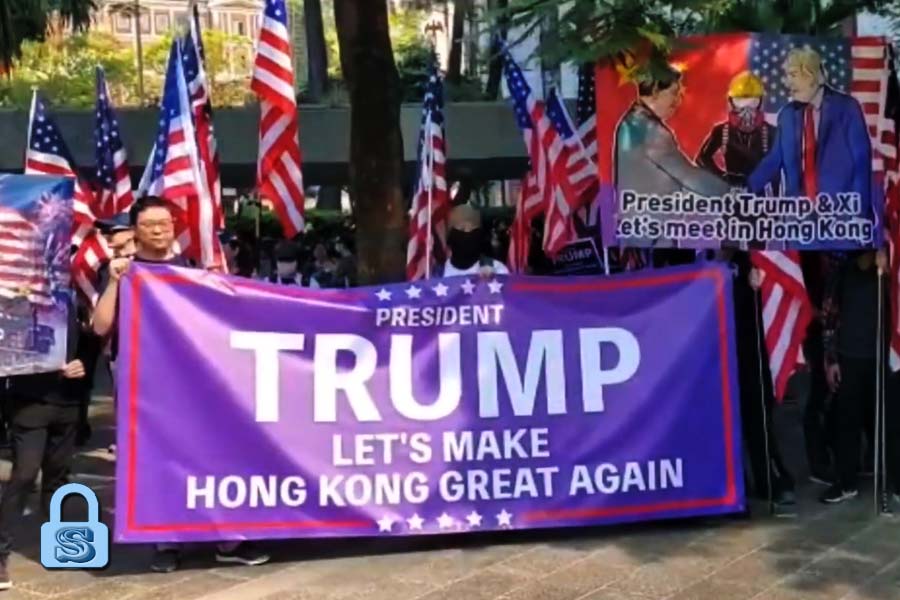
– Thousands of protesters in Hong Kong held a “Thanksgiving” rally to show their gratitude and appreciation towards the U.S. Congress and President Trump for passing the Hong Kong Act. Rally organizers put together a list of possible officials who should be sanctioned, including Hong Kong chief executive Carrie Lam, former Hong Kong police chiefs, and Wang Zhimin, head of the PRC’s Liaison Office in Hong Kong.
Dec. 1
– Hundreds of thousands of Hong Kong people participated in a police-approved, mid-afternoon protest march. Organizers estimated that 380,000 people had joined the march. Some of the protesters waved American flags, while others held aloft various signs. Some signs called on the Hong Kong government to meet the five key protest demands; other signs bore the popular protest slogan “Liberate Hong Kong, Revolution of Our Time” (光復香港, 時代革命); while still more signs read “Heaven will destroy the CCP” (天滅中共), a slogan associated with Falun Gong that Hong Kong protesters began using with increased regularity in early November.
By the late afternoon, the Hong Kong police had fired tear gas and pepper spray in an attempt to disperse the crowds; the police claimed that they were responding to some protesters who had thrown bricks at them. A brief stand-off between the police and some protesters occurred before the police pulled out of the area in the early evening.
– Chip Tsao, a prominent Hong Kong columnist, noted that days after the Hong Kong Act was passed, a wealthy pro-CCP Hong Kong businessman who traveled to America was held up at the airport. Tsao noted that the businessman was questioned for about three hours before being repatriated to Hong Kong.
On the same day, pro-Beijing Hong Kong newspaper Ta Kung Pao announced that the U.S. had restricted the visas of journalists from Ta Kung Pao and Wen Wei Po (another pro-Beijing media).
Dec. 2
– The Hong Kong government announced that it is on track to suffer its first fiscal deficit in 15 years for the 12 months ending in March 2020. Official data also showed that retail sales in Hong Kong declined a record low 24.3 percent in October, a record low.
Our take:
1. From the CCP’s perspective, Hong Kong is fast becoming an impossible problem:
- The continuation of mass protests even after the passing of the Hong Kong Act and the landmark local district council elections demonstrate the strong will of the Hong Kong people to secure their demands and not concede to authoritarian suppression.
- The U.S. has placed the CCP regime on notice with the passage of the Hong Kong Act.
- The results of the recent local district council elections show that a majority of the people in Hong Kong oppose the pro-Beijing government and establishment politicians, as well as the CCP regime. This affirms our earlier analysis regarding the CCP having already lost the hearts and minds of the Hong Kong people.
- The reporting of the district council election results by pro-Beijing newspapers and the mainland press also indicates that the CCP had likely believed its own propaganda about how a “silent majority” of the Hong Kong people were opposed to the anti-extradition bill protests. In other words, the CCP is suffering from both intelligence failure and overconfidence in its handling of Hong Kong.
- The defection of Wang Liqiang and the arrest of his boss Xiang Xin in Taiwan will undoubtedly impact the CCP’s ability to gather intelligence and carry out political interference operations in Hong Kong.
- The protests in Hong Kong have adversely affected the city’s status as an international trading hub that follows the “rule of law.”
- The protests in Hong Kong are straining the local and mainland economies.
- As long as Hong Kong remains in chaos, Xi Jinping’s political opponents will have an excuse to attack his leadership for mishandling the protests and find opportunities to escalate violence in the city to create greater problems for Xi.
2. The passage of the Hong Kong Act makes it nearly impossible for the CCP to send the People’s Liberation Army into Hong Kong to crush the protests. Given the CCP’s characteristics, however, it will still opt for heavy-handed suppression over making real concessions as a means to end the demonstrations and “normalize” the city. The Hong Kong police’s firing of tear gas at masses of protesters after what appeared to be minor provocation on Dec. 1 is a case in point. Classic CCP behavior (subversion, infiltration, incitement, etc.) and other reasons are why we believe that the Hong Kong Act will not immediately or drastically improve the situation in Hong Kong.
The cost of “stability maintenance” in Hong Kong via heavy-handed suppression and police action is very steep. We have already identified some of the main political costs in the previous point. The financial costs of “stability maintenance” are unlikely to be cheap for both the Hong Kong government and the CCP, and will strain the already rapidly weakening Hong Kong and Chinese economies. The political and financial costs of “stability maintenance” in Hong Kong will keep compounding as long as the people of Hong Kong keep taking to the streets; the loser will be the side that cannot no longer afford to pay the costs in a dragged-out “war of attrition.”
In September, we identified ‘delay and wait for change’ (以拖待變) as one of the CCP’s stratagems for dealing with Hong Kong. We wrote: “There are limitations to the CCP’s ‘delay and wait for change’ stratagem. Ideally, the CCP would want to grind down the protesters in a ‘war of attrition’ and let the protest movement ‘burn out’ over time. However, the delay stratagem could run into trouble if the protest movement ramps up with time and forces the Hong Kong government and the PRC to pour more and more resources into the city for ‘stability maintenance’ work; as both the Hong Kong and Chinese economies are deteriorating, and there is a limit to how much funding both governments can devote to keep up the suppression in Hong Kong.”
3. During the previous five months of protest, the group that bore the brunt of police violence was the “brave martial clique” (勇武派). The “brave martial clique,” however, appeared to sustain heavy losses in the aftermath of the police besieging the Chinese University of Hong Kong and the Hong Kong Polytechnic University in mid-November; this is evidenced by reduced protester street violence in recent days. The Dec. 1 mass rally shows that the “peaceful, rational, non-violent” (和理非) crowd—the bulk of the protesters—are picking up the momentum of the protest movement.
With the U.S. passing the Hong Kong Act, the anti-extradition bill protest movement has an incentive to use effective “peaceful, rational, non-violent” protest methods to keep up the resistance and stay in America’s good books. We have already observed that the protest movement has started using the Falun Gong’s anti-communist slogan (“Heaven will destroy the CCP”) at rallies; this development will likely have interesting ramifications for the Hong Kong protest movement given the CCP regime’s history of persecuting Falun Gong and the fact that Falun Gong is acknowledged to be in a “war of attrition” with the CCP.
The CCP will also give the Hong Kong protesters added reason to stick to “peaceful, rational, non-violent” protest methods. In early November, Beijing noted that the need for the Hong Kong government to enact a national security law (Article 23 of the Basic Law) had become “urgent.” Even if the Hong Kong government does not pass Article 23, we do not rule out the possibility that it could establish something akin to the colonial-era police Special Branch to deal with “foreign-backed rioters” and their “subversion” of Hong Kong.
Get smart:
The Hong Kong situation could lead to a “Berlin Wall moment” for the CCP. Businesses, investors, and governments must closely track developments in Hong Kong and CCP elite politics to mitigate risks and discover hidden opportunities.