◎ While it is easy to focus on the human rights aspect of the Xinjiang Papers, observers should be aware of its larger and more consequential political implications.
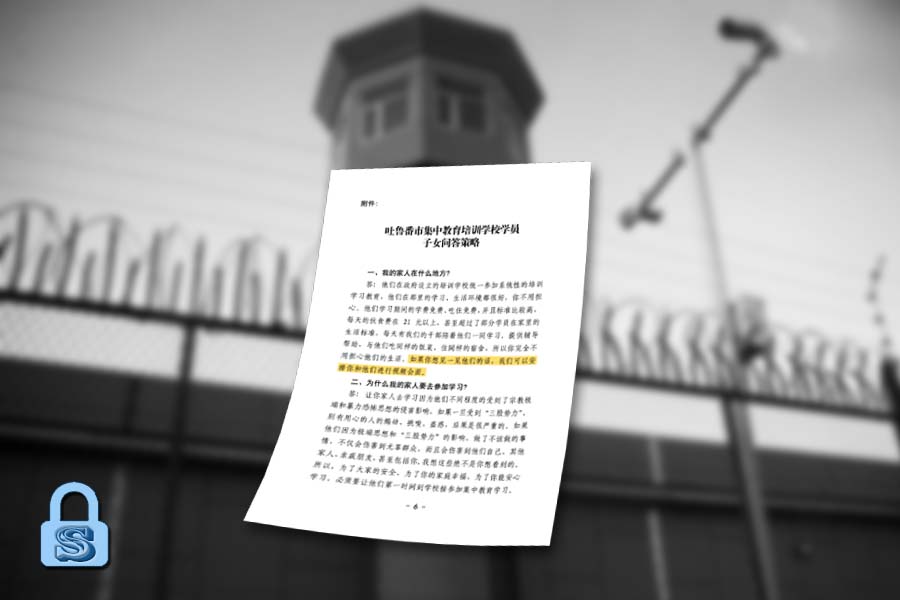
On Nov. 16, The New York Times published an article about leaked internal Chinese Communist Party documents on the mass detention of Muslims in Xinjiang Province.
The 403 pages of documents, which the Times refers to as the “Xinjiang Papers,” were provided by “a member of the Chinese political establishment who requested anonymity and expressed hope that their disclosure would prevent party leaders, including Mr. Xi [Jinping], from escaping culpability for the mass detentions.”
According to the Times report, the documents revealed that:
- Xi Jinping had laid the “groundwork for the crackdown” after visiting Xinjiang “just weeks after Uighur militants stabbed more than 150 people at a train station, killing 31.”
- The CCP was concerned by “terrorist attacks abroad and the drawdown of American troops in Afghanistan” and its impact at home.
- Internment camps in Xinjiang “expanded rapidly” after the appointment of new Xinjiang boss Chen Quanguo in 2016. “He distributed Mr. Xi’s speeches to justify the campaign and exhorted officials to ‘round up everyone who should be rounded up,’” the Times report wrote.
- Local officials who resisted the Xinjiang campaign were purged.
The Times report led many in the China watching and international community to condemn Xi Jinping and the CCP regime.
Our take:
1. The mass incarceration and persecution of Uyghur Muslims in Xinjiang is the latest human rights tragedy brought about by CCP rule. SinoInsider has been consistent in calling out and condemning the CCP’s gross human rights abuses, and we encourage others to censure the CCP as well.
The CCP is bold enough to implement the Xinjiang campaign today because the world stayed largely silent about the preceding and ongoing mass persecution campaign against Falun Gong; many of the CCP’s persecution tactics used on Uyghur Muslims were learned and carried over from the 20-plus year Falun Gong persecution campaign. The world’s silence also emboldened the CCP to continue its long-time persecution of house Christians, Tibetan Buddhists, and other ethnic minorities and religious groups in China. The human rights crisis in China will only continue and worsen unless the world stands up to the CCP’s abuses.
2. We do not rule out the possibility that the leaker of the Xinjiang Papers is acting out of conscience or other altruistic reasons. However, we have reason to doubt that conscience is the sole motivating reason for the leak:
- The leaker wants the world to know that Xi Jinping and other Party leaders are responsible for mass detentions in Xinjiang. Why not broaden the blame to the entire CCP? The CCP, after all, has a terrible human rights record no matter who is in charge.
- The documents comprise of Xi’s speeches on Xinjiang, internal speeches by other officials, and directives and reports on the control and surveillance of Xinjiang. Based on what is revealed about documents in The New York Times report, we believe that officials at the bureau level and above should be able to access those documents. Further, five years have passed since Xinjiang campaign was launched. Why did the leaker decide to hand over the documents only now and not earlier?
- Given the leaker’s motive of wanting to ensure that Xi Jinping and other Party leaders do not escape culpability for Xinjiang, the leader could have easily gone to other newspaper outlets or international human rights organizations with the documents. Yet the documents appear to be handed only to the Times.
- The fact that the Xinjiang Papers were publicized by the Times, the world’s “newspaper of record,” would have caused maximum embarrassment to the Xi Jinping leadership. This means that the leaker has a very clear understanding of how to effectively shape international opinion and use it against domestic political elites.
- We previously noted that damaging information about CCP elites tend to find their way into the mainstream press at critical moments in the CCP factional struggle (damaging leaks against the Wen Jiabao family and other Xi allies surfaced around the 18th Party Congress and 19th Party Congress period). With Xi Jinping under immense pressure from political opponents due to his handling of Sino-U.S. trade tensions, Hong Kong, and the rapidly worsening Chinese economy, the leaker could not have chosen a more convenient time to pass documents to the Times.
We would like to repeat an earlier observation about high-level CCP leaks to the press: “One of the ways in which the various factions in the CCP try to gain leverage over each other is by leaking damaging information about their rivals to overseas media outlets. These leaks can take many forms and can be obtained in many ways, including reporters suddenly discovering (or perhaps being ‘allowed’ to discover) explosive information that make for news stories that are too good to ignore. Put another way, media outlets may not be aware that they have become entangled in CCP factional struggles by virtue of the information they publish.”
3. We have been saying since late 2018 that the “you die, I live” factional struggle in the CCP has been escalating and that Xi’s grip on power is much more unstable than what mainstream observers believe. Notable signs of intense factional fighting include a “soft coup” against Xi; Xi’s call to guard against “major risk” in January; the CCP abruptly reneging on trade commitments with the U.S. in May and the sudden purge of Liu Shiyu; and the delayed Fourth Plenum and outcome.
The Xinjiang Papers is the latest sign to emerge that confirms our analysis of political crisis in the CCP regime.
4. Xi Jinping has made many political enemies over the years with his anti-corruption campaign, and the leaker could potentially belong to any faction that opposes Xi. The faction that stands to maximally benefit from the Xinjiang Papers, however, is the Jiang Zemin faction (including Zeng Qinghong and his supporters).
We explained previously that the Xi camp had leverage over the Jiang faction because the latter faction was involved in and compromised by Jiang Zemin’s political legacy of persecuting Falun Gong. To level the playing field and even gain an advantage over Xi, the Jiang faction needed to show that world that Xi’s hands were also bloodied. The Xinjiang Papers have partially achieved that effect; a Tiananmen-style event in Hong Kong would heavily compromise Xi and shift the momentum of the factional struggle in the favor of Jiang faction and other political opponents of Xi.
5. If the Xinjiang Papers are indeed the work of Xi’s political opponents, then the factional struggle is now white-hot. For the sake of self-preservation, Xi Jinping will likely seek to end the current stalemate and take the offensive. Our analysis will be confirmed if high-level CCP officials and former officials are purged in the coming weeks.
6. Some observers might be wondering why the leaker would reveal information that tarnishes the CCP’s carefully cultivated image. From our long research into CCP behavior and operations, we believe that there are two main reasons.
The first reason is the “you die, I live” factional struggle in the CCP. Per our brief guide to CCP factional politics, “personal interests, and not the interests of the Party, sometimes take higher priority in factional struggles” because the CCP elites are most concerned with survival and self-preservation. Put another way, the Party’s image can be temporarily “sacrificed” by factions whose survival is at stake; once the dust settles, the Party’s image can always be “rehabilitated” with more propaganda and influence operations.
The second and broader reason for admitting to damaging information is that the CCP has something even bigger to cover-up. For instance, the CCP only “admitted” that it was carrying out organ harvesting from executed prisoners after the first allegations that it was carrying out live organ harvesting of Falun Gong adherents and other prisoners of conscience surfaced in 2005. A lesser example of the CCP “admitting” to negative news is in its official GDP figures; while the CCP’s official data indicates that its economy is slowing, most economists estimate that China’s real growth rate is at least several percentage points lower than the official data. Hence, observers should be aware that what is “admitted” in the Xinjiang Papers is very likely only scratching the surface of the full extent of the CCP’s persecution of Uyghur Muslims.
Get smart:
While it is easy to focus on the human rights aspect of the Xinjiang Papers, observers should be aware of its larger and more consequential political implications. Businesses, investors, and governments must prepare for Black Swan events in China.