◎ We look at some key factors that would make or break trade negotiations between America and China.
On Oct. 11, United States President Donald Trump announced that the U.S. and China had “come to a very substantial phase one deal” (see here for details and early analysis). Since then, both sides have continued to signal their willingness to go ahead with a deal.
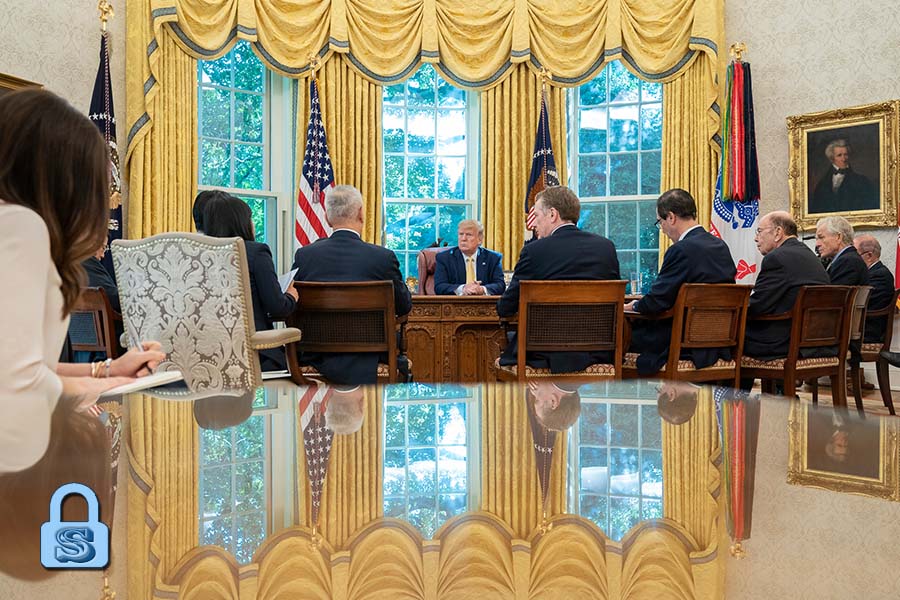
On Oct. 18, Trump told reporters at the White House that the “phase one deal” signed “quite easily, hopefully by the summit in Chile, where President Xi and I will both be,” referencing the Asia Pacific Economic Cooperation (APEC) meetings. He added that “we’re working with China very well.”
On Oct. 19, PRC vice premier Liu He said at a technology conference that “China and the US have made substantial progress in many aspects, and laid an important foundation for a phase one agreement.” He added that “stopping the escalation of the trade war benefits China, the US and the whole world. It’s what producers and consumers alike are hoping for.”
We expressed pessimism about the Sino-U.S. “mini-deal” in our early analysis of it. In this article, we look at some key factors that would make or break trade negotiations between America and China.
Make
Slowing U.S. economy and bearish markets
The U.S. economy is robust with higher consumer spending and low unemployment. However, the U.S. financial markets remain hypersensitive to trade war noise.
To prevent markets from tanking and affecting the economy before the 2020 U.S. presidential election, Trump could find it convenient to continue trade negotiations with the PRC even when there is slim hope of sealing a “monumental deal” and instead sign “mini-deals” to maintain market optimism.
Pressure from the conservative camp
Recently, President Trump’s supporters have been warning him about the trade war and how it could affect his re-election bid.
According to a Sept. 22 report by The Wall Street Journal, billionaire casino owner and Republican donor Sheldon Adelson had called and met with Trump to caution him about the Sino-U.S. trade war’s impact on the U.S. economy and his prospects for winning re-election.
And according to an Oct. 18 report by the Journal, White House economic advisor Larry Kudlow had arranged for Trump to meet with conservative economic commentator Stephen Moore and Republican economist Lawrence Lindsey. Moore said that “there was a general consensus that the economy was really strong, the best economy we’ve had in 30 years, and that what’s going to get him re-elected is the economy,” but “we all agreed that the uncertainty about the trade situation with China is a negative.”
Warnings and pressure from the conservative camp could sway Trump’s thinking on whether having a full-blown trade war is worth it and the value of having largely unproductive (thus far) trade talks with the PRC.
Trump listens to his advisors
Trump’s top China advisor Michael Pillsbury appears to be behind his administration’s relatively weak stance on Hong Kong, a toning down of hawkishness towards China (at least rhetorically), and a renewed eagerness to seal a “monumental deal” with the PRC. Also, as seen in the previous section, conservative scholars and donors are advising Trump to resolve trade tensions with China.
Sino-U.S. trade negotiations will likely be dragged out if Trump continues to listen to those who are currently advising him.
Trump’s gut
In “The Art of the Deal,” Trump noted that “one is to listen to your gut, no matter how good something sounds on paper.” And in a November 2018 interview with The Washington Post, Trump said “I have a gut, and my gut tells me more sometimes than anybody else’s brain can ever tell me.”
Trump’s instincts will undoubtedly make or break further Sino-U.S. trade negotiations.
Xi’s political needs
The Chinese Communist Party cannot accept a trade deal on Trump’s terms, especially one that requires it to admit to carrying out intellectual property theft and forces it to make structural reforms.
The CCP’s interests, however, do not always align with the incumbent Party boss; see Zhao Ziyang and the 1989 Tiananmen Square Massacre. While the CCP cannot tolerate a trade deal, it is presently in Xi Jinping’s interest to sign a deal and reach a trade truce with the United States to rescue China’s rapidly deteriorating economy and preserve his position in the face of attacks by political rivals. Thus, Xi has important political reasons for wanting a trade deal.
Note that it is one thing for Xi to want a trade deal and another for the PRC to abide by it; see China’s entry into the World Trade Organization and its subsequent flouting of the rules. Hence, the CCP can step up efforts now to open up its financial sector (Li Keqiang recently chaired a State Council meeting on removing business restrictions on foreign banks, brokerages and fund management firms) to demonstrate willingness to cooperate with America on making structural reforms, but this “reform and opening up” could easily be rolled back or inhibited after a trade agreement is signed.
Break
Political crisis in the CCP
Xi Jinping may find it to be in his interest to reach a trade agreement with the U.S., but his political rivals will do their utmost to deny him what could strengthen his position. The “you die, I live” factional struggle in the CCP will almost certainly curb Xi’s ability to make any sort of deal with Trump.
(See our analysis of political crisis in the CCP here, here, and here).
The PRC’s new cybersecurity program
On Dec. 1, the PRC’s Cybersecurity Multi-level Protection Scheme (MLPS 2.0) will come into effect. This new cybersecurity initiative will require everyone in China, including foreign companies and individuals, to fully disclose all of their data and servers to the Ministry of Public Security. Observers say that the MLPS 2.0 law will mean that the Chinese authorities will have full access to all intellectual property, personal information, trade secrets, or other data—the exact opposite of what the U.S. wants the CCP regime to do regarding structural reform and an important part of why trade negotiations were carried out in the first place.
The implementation of MLPS 2.0 has the potential to derail trade talks come December.
Hong Kong and Taiwan
The situation with the anti-extradition bill protests in Hong Kong could escalate to a point where it is no longer politically possible for President Trump to avoid confronting the CCP. Likewise, CCP efforts to subvert and influence Taiwan’s 2020 presidential election could potentially engender new controversy and force the U.S. to take action in support of the ROC.
The Sino-U.S. trade talks would immediately be in jeopardy should America confront China over Taiwan or Hong Kong.
Nationalism
Recently, South Park, the National Basketball Association, Activision Blizzard, and other U.S. companies ran afoul of the CCP regime in one way or another. Those “China scandals” have in turn roused nationalistic sentiments at the grassroots in both America and China. Rising nationalism on both sides could prove to become a serious obstacle to a Sino-U.S. trade agreement.
Other Black Swan events
Nationalism, Hong Kong and Taiwan, and political crisis in the CCP are all to a degree Black Swan events. Other Black Swan events could emerge to derail the trade talks. For instance, the detention of two Americans (Jacob Harlan and Alyssa Petersen) in China near the end of September could potentially become a flashpoint in the Sino-U.S. relationship.
Trump’s gut
See the same entry in the “Make” section.
Get smart
The U.S. and China are on a collision course. We believe that the CCP factional struggle will be a crucial factor that determines when the collision happens. Businesses, investors, and governments must track CCP elite politics and tune out trade war noise to avoid political risk in China and discover hidden opportunities.