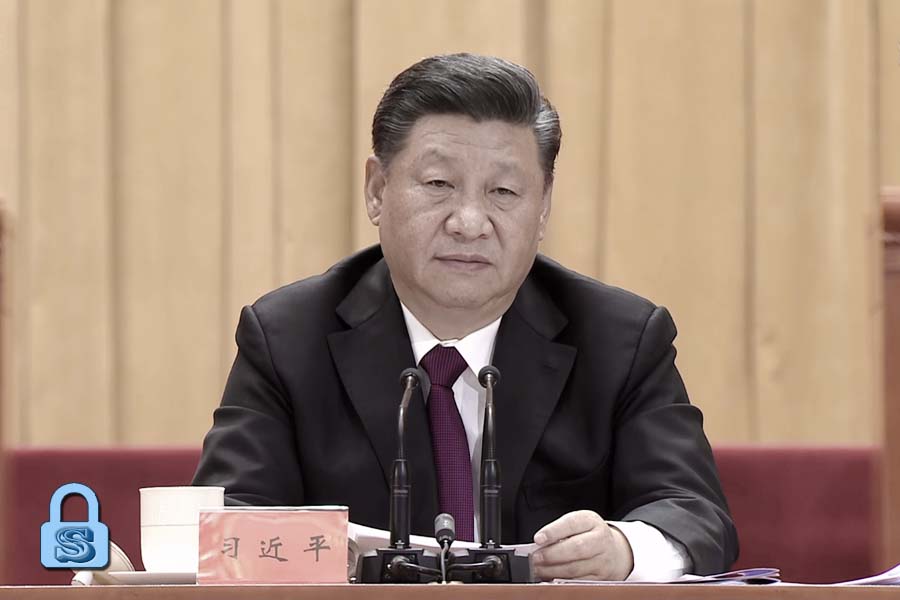
◎ Xi is making things very hard for himself and the PRC by defaulting to Party orthodoxy.
On Sept. 3, Chinese leader Xi Jinping made “important remarks” at the opening ceremony of a study session for young and middle-aged Chinese Communist Party cadres at the Central Party School in Beijing.
Key points in Xi’s remarks from state mouthpiece Xinhua’s report include:
1. Xi stressed that the People’s Republic of China’s socialist system “should not be shaken” and re-emphasized the importance of the Communist Party’s leadership.
2. Xi noted that the PRC faces “various risks and challenges,” and that cadres must resort to “struggle” to actualize the “two 100-year” goals of the “great rejuvenation of the Chinese nation.”
3. Xi singled out five challenges (五個凡是) that cadres must watch:
- “All the risks and challenges that endanger the CCP leadership and the socialist system”;
- “All the risks and challenges that endanger our country’s sovereignty, security, and development interests”;
- “All the risks and challenges that endanger our country’s core interests and important principles”;
- “All the risks and challenges that endanger the fundamental interests of our people”;
- “All the risks and challenges that endanger our realization of the “two 100-year” goals and the great rejuvenation of the Chinese nation.”
4. Xi acknowledged that “in the present and future period,” the PRC’s development has “entered a period” where “various risks and challenges continually accumulate and concentrate.”
Xi notes that the CCP faces many “major struggles,” including “economic, political, cultural, social, ecological and civilizational construction, national defense and military building, Hong Kong, Macao, and Taiwan, diplomatic work, Party-building work, etc.” He added that the Party’s “major struggles” will only grow “more and more complicated.”
5. Xi said that “struggle is an art,” and encouraged leading cadres to struggle to protect the Party and the regime.
Xinhua’s report on Xi Jinping’s remarks was 2,225 characters long. Of the 2,225 characters, “struggle” (斗争) was used 56 times; “Party” (党) featured 14 times, and “risks” (风险) was used 11 times.
The big picture:
Xi’s remarks to young and middle-aged CCP cadres come amid:
- Intensifying factional struggle in the CCP elite rank;
- An escalating trade and technology war with the United States;
- Growing wariness of the PRC by the international community, particularly of PRC-developed 5G technology and external influence operations;
- A steadily worsening Chinese economy;
- The renminbi falling below the 7 to the dollar level due to capital flight and geopolitical pressures;
- Thirteen continuous weeks of mass protests in Hong Kong with no resolution in sight;
- Growing wariness of the CCP, including “red” media and politicians, in Taiwan ahead of a presidential election year.
Our take:
1. Xi’s focus on risks to the CCP regime in his Sept. 3 remarks echoes his earlier remarks to senior CCP cadres at the opening ceremony of a study session on Jan. 21. Then, Xi warned that the regime must “persevere with the bottom line in mind to guard against major risk.” He also said that cadres must continually be on “high alert” for Black Swan and Gray Rhino events.
Xi’s Partyspeak in his Sept. 3 remarks on needing to “struggle” to overcome the “risks and challenges” of achieving the “two 100-year” goals and the “the great rejuvenation of the Chinese nation” suggest that he believes that the existential problems and risks facing the CCP and its regime are now much more severe as compared to at the beginning of the year.
2. Xi is almost certainly preparing the ground for the CCP Fourth Plenum in October by warning about and listing out the “various risks and challenges” to the regime in his Sept. 3 remarks.
We previously analyzed that “the Fourth Plenum’s agenda—‘safeguard the Party, protect its political power, and strengthen its control over society’—indicates that the CCP feels imperiled by the ‘perfect storm’ of problems it currently faces, namely, ‘strategic competition’ with the United States; the impact of the Sino-U.S. trade and tech war; capital flight and the devaluation of the renminbi; food shortages; pest and disease, etc.”
At the Fourth Plenum, Xi “will look to boost his ‘quan wei’ by highlighting the PRC’s need for strong leadership in the face of existential crisis before attempting to ram through his decisions and policies.”
3. Xi’s solution for dealing with “risks and challenges” is to step up brainwashing and encourage CCP cadres to “struggle” (斗), a key component of Party culture and Marxism-Leninism. There are several reasons why this is deeply troubling.
First, the fact that Xi feels a need to double down on ideological indoctrination and Party orthodoxy to handle non-ideological issues that threaten the survival of the CCP and the PRC suggests that there is a crisis of confidence among the cadres towards the CCP itself. And if cadres do not believe in the Party, they will be less motivated to protect it and the PRC in the face of not a handful, but an entire list of regime-threatening issues.
Second, strengthening Party orthodoxy is a double-edged sword for the Xi leadership and the CCP. On one hand, CCP cadres could become more motivated to safeguard the CCP and the PRC with increased brainwashing. On the other hand, Beijing and the CCP are limiting their available options for dealing with very tricky issues like the Sino-U.S. trade war and protests in Hong Kong. Inflexible solutions in turn will almost certainly create more problems for the CCP or escalate crises that are already very severe. In short, the CCP risks compounding its “various risks and challenges” with self-imposed ideological constraints and could end up digging its own grave.
Third, Xi is making it very hard for himself to pursue reform-minded policies down the road by defaulting to Party orthodoxy. While we believe that Xi has been “signaling left to turn right” eventually on policy, there is only so much signaling that he can do before passing the point of no return. Already, several of the PRC’s problems have been worsened by the tendency of cadres to “prefer left rather than right” (寧左勿右) in executing orders from Party central. Xi’s call for cadres to learn the “art of the struggle” will only reinforce the “prefer left rather than right” tendency in the officialdom.
Get smart:
In our China 2019 outlook, we warned of Black Swans in China and noted that the CCP regime will “likely face immense challenges from inside China and abroad.” Xi Jinping’s Sept. 3 remarks put our predictions on track for verification.
Businesses, investors, and governments must prepare for tremendous change in China.