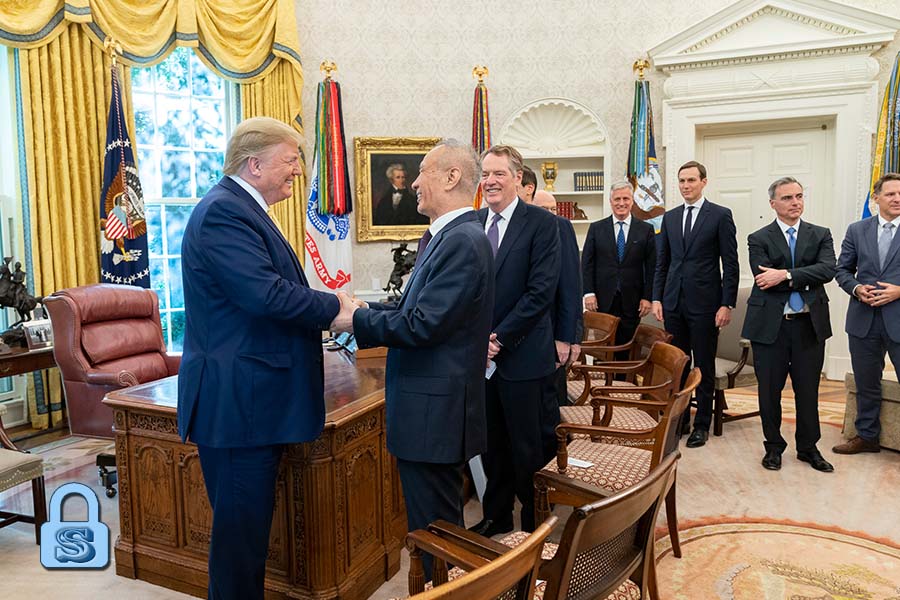
◎ A closer examination of recent developments suggests dim prospects for the “phase one” trade deal and future Sino-U.S. trade agreements.
On Nov. 7, the PRC Commerce Ministry spokesperson Gao Feng announced that “if the phase-one deal is signed, China and the U.S. should remove the same proportion of tariffs simultaneously based on the content of the deal. This is what [the two sides] agreed on following careful and constructive negotiations over the past two weeks.”
The U.S. side appeared to be in agreement. White House economic adviser Larry Kudlow told Bloomberg, “if there’s a phase one trade deal, there are going to be tariff agreements and concessions.” Also, White House spokeswoman Stephanie Grisham told Fox News on Nov. 7 that the United States is “very, very optimistic that we will reach a deal soon” with China. On Nov. 8, Grisham said, “we’re very optimistic for some kind of a deal, and I imagine if we reach one then some tariffs could be lifted.” According to a Reuters report, an anonymous U.S. official had “confirmed the rollback would be part of the first phase of a trade agreement that is still being put to paper for Trump and President Xi Jinping to sign.”
White House advisors were more dismissive of the rollback of tariffs. Peter Navarro, the director of the Office of Trade and Manufacturing Policy, said in an interview on Fox Business Network that “there is no agreement at this time to remove any of the existing tariffs as a condition of the phase one deal. And the only person who can make that decision is President Donald J. Trump. And it’s as simple as that.” Hudson Institute scholar and President Trump’s top external China advisor Michael Pillsbury said, “There is no specific agreement for a phased rollback of the tariffs. The American side has been ambiguous when and which tariffs will be lifted. The Chinese have some wishful thinking and are trying to soothe their domestic hardliners that the tariffs will someday come off.”
On Nov. 8, Trump told reporters at the White House that “China would like to get somewhat of a rollback, not a complete rollback, ‘cause they know I won’t do it. I haven’t agreed to anything.” Trump added that the completed “phase one” deal will be signed in America. “Assuming we’d get it … it could be Iowa or farm country or some place like that. It will be in our country,” he said.
Despite mixed signals on tariff rollbacks, businesses, investors, and governments might still be optimistic that a Sino-U.S. trade deal can be reached given recent signals from China:
- On Oct. 16, a PRC State Council meeting chaired by Chinese premier Li Keqiang announced the removal of business restrictions on foreign banks, brokerages and fund management firms.
- On Oct. 29, PRC commerce vice minister Wang Shouwen said that China will remove all restrictions on foreign investments not included in its “negative lists,” move faster to open up the financial industry, and “neither explicitly nor implicitly” force foreign companies or investors to transfer technologies.
- On Nov. 4, PRC foreign ministry spokesperson Geng Shuang assured the European Union that “China will spare no effort in fulfilling its promises and commitments. There is no so-called fatigue issue.”
- On Nov. 5, Chinese leader Xi Jinping told world and business leaders at the opening of the China International Import Expo in Shanghai that China will “honor our commitments” and “deliver on what we have promised.”
- On Nov. 6, a senior official with the PRC’s National Narcotics Control Commission and a U.S. Homeland Security Department attaché to China held a press conference in Hebei Province to announce the successful action against nine Chinese people who smuggled fentanyl into the United States. In August, President Donald Trump had criticized Xi for not fulfilling a promise to crack down on the smuggling of fentanyl and other opioids into America.
- On Nov. 7, the PRC State Council released opinions on further improving the utilization of foreign investment, “with the aim of promoting high-quality development and unlocking market vitality.”
Both President Donald Trump and Xi Jinping need a trade deal to alleviate domestic political and economic problems. However, a closer examination of recent Sino-U.S. developments, U.S. actions, Chinese Communist Party behavior, and factional politics in the CCP suggests dim prospects for the “phase one” trade deal and future Sino-U.S. trade agreements.
1. The U.S. and the PRC have yet to secure a venue and date to sign the “phase one” trade deal. President Trump originally wanted to sign the trade deal with Xi Jinping at the Asia-Pacific Economic Cooperation (APEC) summit in Chile. Chile, however, canceled the meeting, which was scheduled for Nov. 16 and Nov. 17, on Oct. 30. On Nov. 7, the Malaysian foreign minister said that U.S. Secretary of State Mike Pompeo had spoken to him about holding the APEC summit in America in January 2020, but Malaysia did not support the idea.
Meanwhile, various news media outlets have reported that Trump and Xi could meet in either November or December at a range of possible locations (Iowa or other U.S. states, London, Switzerland, Sweden, Macau, etc.) to sign the “phase one” deal. Trump said on Nov. 8 that his preference is “Iowa or farm country or some place like that” in America.
Unless a venue and date are fixed soon, negotiations will drag on for an extended period and could even head in a direction that endangers what senior negotiators had agreed to in October. Prolonged uncertainty over a venue and date also increases the probability of new complications arising to derail the “phase one” deal.
2. The CCP could continue to roll out policies that appear to be designed to open up the Chinese economy to a greater degree. What is done in practice tends to differ from what is stated in principle in the CCP regime, however, and the CCP’s survival-dominance dynamic and Marxist-Leninist ideology will ensure that it will always find a way to keep the economy strictly under the Party’s sway despite the introduction of economic and financial “liberalization” policies.
3. The CCP’s adherence to Marxism-Leninism and Mao Zedong Thought means that it can never be trusted to honor its commitments and promises. “With Homo-Marxian the signing of fifty-three treaties and subsequent violation of fifty-one of them is not hypocrisy but strategy,” wrote W. Cleon Skousen in the classic treatise, “The Naked Communist: Exposing Communism and Restoring Freedom.”
And as we previously observed: “By virtue of its Marxist-Leninist ideology, the CCP’s ultimate goal is world domination. And as long as the CCP is in power, it will keep working towards that goal.” Put another way, the CCP can and will make all sorts of commitments and promises today for the sake of self-preservation and to lay the foundation for its eventual domination of the globe.
4. The “you die, I live” factional struggle and escalating political crisis in the CCP (see here, here, and here) makes it very difficult for Xi Jinping to reach any kind of trade deal with America.
5. In our Special Report, we observed that the U.S. and the PRC are already in a “new cold war.” We also wrote in July that “the current Sino-U.S. conflict is not just a trade war or a tech war, but a critical battle of ideology, value systems, and morality.” Our observation has since been verified by recent developments:
- Speaking at a tech conference in Lisbon on Nov. 7, U.S. chief technology officer Michael Kratsios criticized countries that “open their arms” to 5G networks and artificial intelligence technologies developed by the PRC. Kratsios singled out Huawei and noted that Chinese firms cannot be trusted because PRC law compels them to cooperate with the CCP regime’s intelligence apparatus.
- On Nov. 6, a group of U.S. lawmakers led by Senator Marco Rubio introduced legislation that is aimed at reversing a decision to allow federal employees and military service members to invest their retirement savings in the MSCI All Country World ex-U.S. Investable Market Index, a fund that includes China-listed stocks.
Several news outlets reported in early November that the U.S. government has launched a national security review of TikTok owner Beijing ByteDance Technology Co’s acquisition of U.S. social media app Musical.ly. - On Oct. 15, the U.S. House of Representatives passed the Hong Kong Human Rights and Democracy Act of 2019.
The U.S. Department of State has repeatedly and strongly condemned the PRC’s persecution of Uyghur Muslims in Xinjiang. - In his second China policy speech, Vice President Mike Pence said that “the United States now recognizes China as a strategic and economic rival.”
- In a speech titled “The China Challenge,” Secretary of State Mike Pompeo said that “is no longer realistic to ignore the fundamental differences between our two systems and the impact.” He also noted that “the Chinese Communist Party is a Marxist-Leninist Party focused on struggle and international domination.” On a Nov. 4 interview on Fox Business Network, Pompeo said that President Trump has recognized the threat of the CCP and is “taking it head on.”
- The 2019 Presidential Message on the National Day for the Victims of Communism published on Nov. 7 concluded with a call to “build a future free from the evils of communism.”
Increasing U.S. vigilance and action will heighten the Sino-U.S. rivalry and poses a serious complication to the signing of any trade agreement between both countries.
6. Black Swans in Hong Kong and mainland China could derail PRC-U.S. plans to sign a trade deal and continue with trade talks. The recent death of Chow Tsz-lok, a 22-year-old student at the Hong Kong University of Science and Technology who fell from a multistory parking garage under suspicious circumstances and who appeared to not receive prompt medical attention due to the Hong Kong police delaying the ambulance from reaching him, could prove to be a catalyst for Black Swan events.
Get smart:
Businesses, investors, and governments must understand CCP behavior and account for broader geopolitical trends to avoid risks and discover hidden opportunities in the era of Sino-U.S. rivalry.