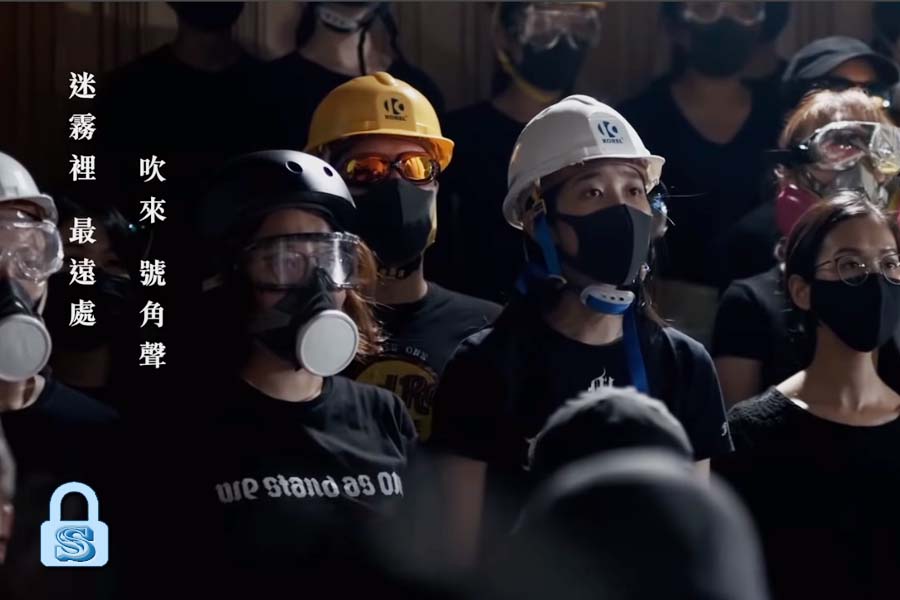
◎ Songs have the power to become strong rallying calls for protest movements.
Recently, Hong Kong protesters have been packing shopping malls and other public spaces to sing “Glory to Hong Kong” (願榮光歸香港), a two minute-long song with rousing lyrics about “freedom and liberty” and an anthem-like melody. A version of the song featuring a full orchestra and a choir that was uploaded to YouTube on Sept. 11 has since garnered over 1.4 million views. “Thomas,” the song’s composer, told the BBC that he wrote a marching-style tune to capture the energy of the protesters, and hoped that the song would “unite Hongkongers and boost public morale.”
“Glory to Hong Kong” joins the slogan, “liberate Hong Kong, revolution of our time” (光復香港,時代革命) two of the most popular rallying calls used by protesters in Hong Kong and their supporters in the city and elsewhere. The sudden popularity of the song, which first surfaced in Hong Kong’s Reddit-like LIHKG forum in August, comes amid a growing climate of fear in the city—Hong Kong police are more readily using violence to suppress the protesters, with several cases of serious injuries to protesters being reported in the press; local pro-CCP groups have stepped up violent attacks against protesters; and protesters have raised concerns about the increased number of “accidental deaths” and mysterious “suicides” of protesters in recent weeks.
Our take:
1. The Chinese Communist Party either exploits human cupidity or engages in violent suppression to control the masses. Since the handover of Hong Kong in 1997, the CCP has relied on the former method to “win over” the Hong Kong people. The popularity of the anti-extradition bill protests this year, however, forced the CCP to resort to violent suppression; we noted in early July that the Hong Kong police would “create a climate of fear in the city” and efforts would be made to fragment Hong Kong society as the CCP get a handle on Hong Kong.
However, the sudden popularity of the song “Glory to Hong Kong” and the slogan “liberate Hong Kong, revolution of our time,” as well as the growing civic-mindedness and unity of the Hong Kong people, suggest that the CCP’s use of violent suppression has backfired. Having earlier lost their hearts and minds, the CCP now faces a bona fide ideological battle with a growing number of Hong Kong protesters with dire implications for the mainland regime.
We previously wrote that the CCP fears an ideological battle in general and revolution in Hong Kong.
2. Songs have the power to become strong rallying calls for protest movements. “La Marseillaise,” the French national anthem, was adopted by the French Revolution in 1792. The protesters eventually overthrew the French monarchy and established a republic.
“Glory to Hong Kong” has the lyrics and vibes of a national anthem. The song, coupled with the slogan “liberate Hong Kong, revolution of our time,” has the potential to trigger Black Swans for the CCP, especially if its violent suppression tactics in Hong Kong result in public tragedy.
What’s next:
The anti-extradition bill protests in Hong Kong are no longer simply about one side meeting the demands of the other. There will be greater instability in Hong Kong going forward as the struggle between the Hong Kong people and the CCP enters the ideological realm.