
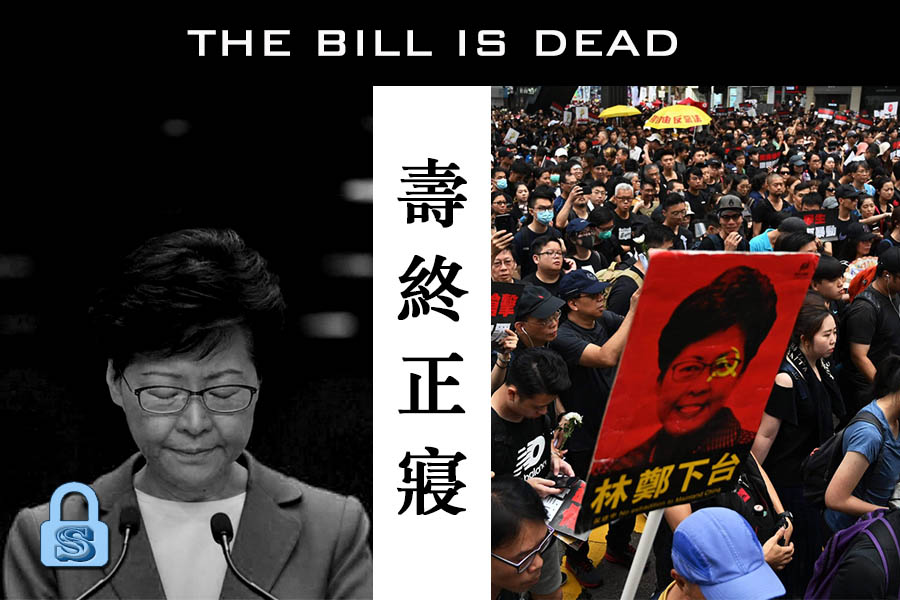
Politics Watch: The ‘Dead’ Hong Kong Extradition Bill and the CCP Factional Struggle

◎ We believe that the CCP is only making a tactical retreat in Hong Kong.


During a press conference on July 9, Hong Kong leader Carrie Lam declared “dead” a controversial extradition bill that inspired hundreds of thousands of people in Hong Kong to demonstrate in the streets and begin a protest movement. Lam also said that the Hong Kong government’s work on the bill has been a “total failure.”

Carrie Lam’s announcement was met with deep skepticism from protesters, who said that her unwillingness to withdraw the extradition bill meant that she was merely playing word games. Protesters were also unhappy that Lam did not abandon her description of a small but violent protest on June 12 as a “riot.” At the press conference, Lam said that the Hong Kong government “never designated” the entire June 12 protest as a “riot” and the phrase was used by Hong Kong police officers to describe only the violent protesters.

We believe that Lam’s announcement is likely an attempt to de-escalate tensions in Hong Kong in the wake of continued protests. The Chinese Communist Party has an interest in lowering tensions due to regime survival concerns. Party interests aside, the Xi leadership and the Jiang faction also have their respective interest in reducing tensions in Hong Kong.

The big picture:
The CCP has been finding ways to tighten its control over Hong Kong since the handover in 1997. Many observers, however, were surprised that Beijing chose a strategically inconvenient period (Sino-U.S. trade war and increasing tensions; G20 meeting; economic woes in China; food crisis; etc.) for the CCP regime to back the Hong Kong government’s push to pass amendments to the extradition law in the face of popular opposition. If the amendments were made, people in the city, including those just passing through, would be at risk of being sent to China on trial.

Based on our long-term research into CCP factional politics, we believe that factional interests could be a major factor in influencing the timing and urgency of the Hong Kong government’s effort to get the proposed extradition bill signed.

Our take:
1. The CCP fears a regime-ending revolution, and cannot afford to have the peaceful protest movement in Hong Kong evolve into one through endless provocation. At the same time, the CCP cannot be seen as giving ground to the protesters in Hong Kong lest they make greater demands.

Hong Kong leader Carrie Lam’s July 9 press conference allows the pro-Beijing Hong Kong government and the CCP to save face while appearing to be accommodating to protester demands. However, as the protesters rightly note, Lam has not given up any ground by saying that the extradition bill is “dead.”

We believe that the CCP is only making a tactical retreat in Hong Kong. Barring factional struggle factors, the CCP will try again to tighten its control over the city in a future scenario where protests die down and the Hong Kong people “forget” about the extradition bill controversy.

2. The Xi leadership and the Jiang faction both have different reasons for de-escalating tensions in Hong Kong.

The interests of the Communist Party very often take a backseat to personal interests in factional struggles. When the CCP regime is imperiled, however, factions will prioritize the Party’s protection. And the various factions have strong reasons to fear the on-going protest movement in Hong Kong, which currently displays traits (leaderless, organization-less, self-initiated, peaceful, and regular) which indicate that the CCP has to wage a never-ending war of attrition in the city. The longer the protest movement holds, the more disadvantaged the CCP becomes. We believe that the Jiang faction has made a temporary “concession” to the Xi leadership on Hong Kong in light of the protest movement’s threat to the regime. Also, the Jiang faction might not want its elite member Han Zheng to get into serious trouble for “ruining” Hong Kong.

As for the Xi leadership, we believe that Xi Jinping was not looking to provoke the extradition bill controversy to begin with or stir trouble in Hong Kong at this time. From the perspective of personal and factional interests, the Xi camp has no incentive to complicate matters in Hong Kong when it already has serious domestic problems at home (economic and financial woes, food crisis, etc.) and a Sino-U.S. trade and tech war to handle. Signs have also emerged recently which indicate that the Xi leadership did not want to escalate tensions in Hong Kong. According to a July 9 Reuters article, the People’s Liberation Army commander in the Hong Kong garrison had personally assured a Pentagon official on June 13 that the PLA will not interfere in Hong Kong affairs. On the same day, Hong Kong leader Carrie Lam declared that the extradition bill was “dead.”

The official effort to de-escalate tensions in Hong Kong could also be linked to Xi Jinping’s post-G20 meeting move to reassert his authority in the regime. The rhetorical line change in Xinhua on “structural reform” (as opposed to “structural arrangements”) and the emphasis on a “centralized and unified leadership” suggest that Xi is again trying to marginalize the influence of the “collective leadership” as he “signals left to turn right” on policy. (See the July 5 and July 8 editions of the SinoWeekly Plus newsletter)

What’s next:
1. Carrie Lam’s announcement will not do much to calm the situation in Hong Kong. We believe that the weekly protests in Hong Kong will continue and even expand in scale and scope. However, we believe that there is a very low probability of the current protest movement evolving into a full-blown revolution unless the CCP regime takes drastic action to suppress the city.

2. We believe that it is only a matter of time before the CCP again seeks to tighten its grip on Hong Kong. Also, “truces” in CCP factional struggles never last long. Hong Kong could see Black Swan events erupt before the year is out. And Black Swans in Hong Kong would likely trigger Black Swans in mainland China.

Get smart:
The political situation in Hong Kong is intertwined with CCP elite politics. Businesses, investors, and governments must track the Hong Kong situation to get a better sense of political risks in China for more informed decision-making.

[wpdreams_rpp id=0]


Search past entries by date
“The breadth of SinoInsider’s insights—from economics through the military to governance, all underpinned by unparalleled reporting on the people in charge—is stunning. In my over fifty years of in-depth reading on the PRC, unclassified and classified, SinoInsider is in a class all by itself.”
James Newman, Former U.S. Navy cryptologist
“Unique insights are available frequently from the reports of Sinoinsider.”
Michael Pillsbury, Senior Fellow for China Strategy, The Heritage Foundation
“Thank you for your information and analysis. Very useful.”
Prof. Ravni Thakur, University of Delhi, India
“SinoInsider’s research has helped me with investing in or getting out of Chinese companies.”
Charles Nelson, Managing Director, Murdock Capital Partners
“I value SinoInsider because of its always brilliant articles touching on, to name just a few, CCP history, current trends, and factional politics. Its concise and incisive analysis — absent the cliches that dominate China policy discussions in DC and U.S. corporate boardrooms — also represents a major contribution to the history of our era by clearly defining the threat the CCP poses to American peace and prosperity and global stability. I am grateful to SinoInsider — long may it thrive!”
Lee Smith, Author and journalist
“Your publication insights tremendously help us complete our regular analysis on in-depth issues of major importance. ”
Ms. Nicoleta Buracinschi, Embassy of Romania to the People’s Republic of China
"I’m a very happy, satisfied subscriber to your service and all the deep information it provides to increase our understanding. SinoInsider is profoundly helping to alter the public landscape when it comes to the PRC."
James Newman, Former U.S. Navy cryptologist
“Prof. Ming’s information about the Sino-U.S. trade war is invaluable for us in Taiwan’s technology industry. Our company basically acted on Prof. Ming’s predictions and enlarged our scale and enriched our product lines. That allowed us to deal capably with larger orders from China in 2019. ”
Mr. Chiu, Realtek R&D Center
“I am following China’s growing involvement in the Middle East, seeking to gain a better understanding of China itself and the impact of domestic constraints on its foreign policy. I have found SinoInsider quite helpful in expanding my knowledge and enriching my understanding of the issues at stake.”
Ehud Yaari, Lafer International Fellow, The Washington Institute
“SinoInsider’s research on the CCP examines every detail in great depth and is a very valuable reference. Foreign researchers will find SinoInsider’s research helpful in understanding what is really going on with the CCP and China. ”
Baterdene, Researcher, The National Institute for Security Studies (Mongolian)
“The forecasts of Prof. Chu-cheng Ming and the SinoInsider team are an invaluable resource in guiding our news reporting direction and anticipating the next moves of the Chinese and Hong Kong governments.”
Chan Miu-ling, Radio Television Hong Kong China Team Deputy Leader
“SinoInsider always publishes interesting and provocative work on Chinese elite politics. It is very worthwhile to follow the work of SinoInsider to get their take on factional struggles in particular.”
Lee Jones, Reader in International Politics, Queen Mary University of London
“[SinoInsider has] been very useful in my class on American foreign policy because it contradicts the widely accepted argument that the U.S. should work cooperatively with China. And the whole point of the course is to expose students to conflicting approaches to contemporary major problems.”
Roy Licklider, Adjunct Professor of Political Science, Columbia University
“As a China-based journalist, SinoInsider is to me a very reliable source of information to understand deeply how the CCP works and learn more about the factional struggle and challenges that Xi Jinping may face. ”
Sebastien Ricci, AFP correspondent for China & Mongolia
“SinoInsider offers an interesting perspective on the Sino-U.S. trade war and North Korea. Their predictions are often accurate, which is definitely very helpful.”
Sebastien Ricci, AFP correspondent for China & Mongolia
“I have found SinoInsider to provide much greater depth and breadth of coverage with regard to developments in China. The subtlety of the descriptions of China's policy/political processes is absent from traditional media channels.”
John Lipsky, Peter G. Peterson Distinguished Scholar, Kissinger Center for Global Affairs
“My teaching at Cambridge and policy analysis for the UK audience have been informed by insights from your analyzes. ”
Dr Kun-Chin Lin, University Lecturer in Politics,
Deputy Director of the Centre for Geopolitics, Cambridge University
" SinoInsider's in-depth and nuanced analysis of Party dynamics is an excellent template to train future Sinologists with a clear understanding that what happens in the Party matters."
Stephen Nagy, Senior Associate Professor, International Christian University
“ I find Sinoinsider particularly helpful in instructing students about the complexities of Chinese politics and what elite competition means for the future of the US-China relationship.”
Howard Sanborn, Professor, Virginia Military Institute
“SinoInsider has been one of my most useful (and enjoyable) resources”
James Newman, Former U.S. Navy cryptologist
“Professor Ming and his team’s analyses of current affairs are very far-sighted and directionally accurate. In the present media environment where it is harder to distinguish between real and fake information, SinoInsider’s professional perspectives are much needed to make sense of a perilous and unpredictable world. ”
Liu Cheng-chuan, Professor Emeritus, National Chiayi University
“Since the 2019 Hong Kong anti-extradition movement, I have periodically engaged with articles from SinoInsider. SinoInsider’s insights have deepened my understanding of the Chinese Communist Party’s regime. These resources have been invaluable in navigating the opaque world of Chinese elite politics, significantly enhancing my commentary on my Hong Kong online radio program, HK Peanut.”
Andrew To Kwan-hang, former chairman of the League of Social Democrats and founder of HK Peanut


