
This analysis is from the May 18, 2026 newsletter.
***
Trump in Beijing
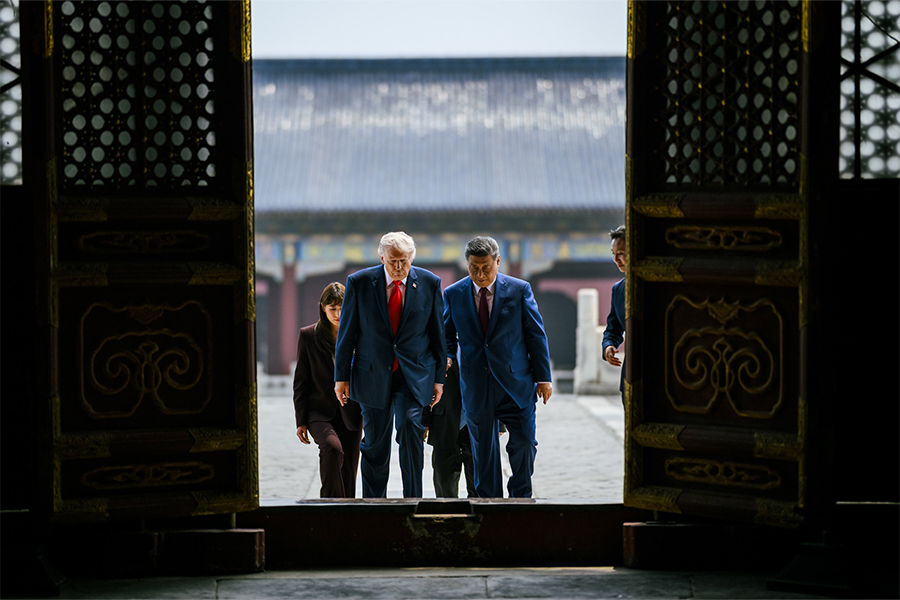
On May 14, United States President Donald Trump arrived in Beijing with several cabinet officials and a sizable trade delegation. Trump was received at the airport the previous evening by PRC vice president Han Zheng. At 10:00 a.m., Trump met PRC leader Xi Jinping for an opening ceremony outside the Great Hall of the People before the two sides held talks. The meetings of the leaders and their delegations went on for about two hours, according to news reports.
Afterward, Xi gave Trump a personal tour of the Temple of Heaven before a state banquet in the evening. At the banquet, Trump announced that he had invited Xi and his wife Peng Liyuan to visit the U.S. on Sept. 24, 2026.
On May 15, Xi took Trump on a private tour of the Zhongnanhai compound before taking tea and lunch. While in the gardens at Zhongnanhai, Trump told reporters that they had made “fantastic trade deals,” but did not elaborate. Speaking to reporters when they sat down for tea, Trump said that he and Xi “feel very similar on Iran” and both want the conflict to end.
Trump also told Xi, “We will be reciprocal, like reciprocal trade.” Trump added, “We’re going to lay it on the line. You’re going to walk away hopefully very impressed, like I’m very impressed with China.”
Official readouts
Both sides issued readouts of the bilateral meeting. The PRC readout was substantially longer than the White House’s edition.
Noteworthy content in the PRC readout includes:
- Xi noted that “transformation not seen in a century is accelerating across the globe, and the international situation is fluid and turbulent.” He then asked if “China and the United States overcome the Thucydides Trap and create a new paradigm of major-country relations?”
- Xi said that the PRC is “committed to a steady, sound and sustainable development of China-U.S. relations,” and announced the building of a “constructive China-U.S. relationship of strategic stability” (中美建設性策略穩定關係).
- The “constructive China-U.S. relationship of strategic stability” formulation (提法) will “provide strategic guidance for China-U.S. relations over the next three years and beyond.”
- “Constructive strategic stability” calls for “positive stability with cooperation as the mainstay, healthy stability with competition within proper limits, constant stability with manageable differences, and lasting stability with expectable peace.”
- Xi said that the U.S. and PRC “economic and trade teams produced generally balanced and positive outcomes.” Also, “China will only open its door wider” and “U.S. businesses are deeply involved in China’s reform and opening up.”
- Xi said that “the Taiwan question is the most important issue in China-U.S. relations.” If the issue is handled correctly, “the bilateral relationship will enjoy overall stability.” Otherwise, “the two countries will have clashes and even conflicts, putting the entire relationship in great jeopardy.” Xi added, “The U.S. side must exercise extra caution in handling the Taiwan question.”
- According to the readout, Trump said that Xi is a “great leader” and he has “tremendous respect for President Xi and the Chinese people.”
- According to the readout, Trump said that he would work with Xi to “strengthen communication and cooperation, properly handle differences, make bilateral relations better than ever before and embrace a fantastic future.”
Key points in the U.S. readout include:
- Both sides “discussed ways to enhance economic cooperation,” including “expanding market access for American businesses into China and increasing Chinese investment” in U.S. industries.
Trump and Xi “highlighted the need to build on progress in ending the flow of fentanyl precursors into the United States, as well as increasing Chinese purchases of American agricultural products.” - Trump and Xi “agreed that the Strait of Hormuz must remain open to support the free flow of energy.” Xi expressed the PRC’s opposition to the “militarization of the Strait and any effort to charge a toll for its use.”
- Xi “expressed interest in purchasing more American oil to reduce China’s dependence on the Strait in the future.”
- Both sides agreed that “Iran can never have a nuclear weapon.”
The White House later issued a fact sheet on Trump’s Beijing trip on May 17. Key points include:
- Trump and Xi “agreed that the United States and China should build a constructive relationship of strategic stability on the basis of fairness and reciprocity.”
- Both leaders agreed that Iran “cannot have a nuclear weapon, called to reopen the Strait of Hormuz, and agreed that no country or organization can be allowed to charge tolls.”
- Both leaders affirmed their “shared goal to denuclearize North Korea.”
- Both leaders agreed to create the U.S.-China Board of Trade and the U.S.-China Board of Investment. The Board of Investment will “provide a government-to-government forum for discussing investment-related issues,” while the Board of Trade will allow the governments of both countries to “manage bilateral trade across non-sensitive goods.”
- China will “address U.S. concerns regarding supply chain shortages related to rare earths and other critical minerals, including yttrium, scandium, neodymium, and indium.” Also, China will address U.S. concerns regarding “prohibitions or restrictions on the sale of rare earth production and processing equipment and technologies.”
- China approved the initial purchase of 200 Boeing aircraft.
- China will purchase “at least $17 billion per year of U.S. agricultural products in 2026 (prorated), 2027, and 2028, in addition to the soybean purchase commitments that it made in October 2025.”
- The fact sheet claimed that “China restored market access for U.S. beef by renewing expired listings of more than 400 U.S. beef facilities and adding new listings.” Also, China “will work with U.S. regulators to lift all suspensions of U.S. beef facilities.”
- China resumed imports of avian influenza-free poultry from U.S. states.
Business and other deals
May 14
1. Reporters spotted Tesla’s Elon Musk, Nvidia’s Jensen Huang, and Apple’s Tim Cook leaving the front entrance of the Great Hall of the People after their meeting and asked how it went.
Musk described the summit as “wonderful” and said “many good things” in response to a question about what they had accomplished. Huang said that the “meetings went well” and Cook made a peace sign.
2. Reuters reported that the U.S. had approved around 10 Chinese companies to purchase Nvidia’s H200 chip, but there has not been a single delivery made thus far. Beijing has been restricting Chinese firms from buying Nvidia’s advanced chips due to various strategic reasons, including developing self-sufficiency and protecting domestic chipmakers, avoiding U.S. leverage, and national security and surveillance concerns.
3. President Trump told Fox News that China agreed to purchase 200 jets from Boeing. While Trump said that this was more than the 150 that Boeing expected, analysts earlier estimated that China’s order could reach 500 planes.
4. U.S. Treasury Secretary Scott Bessent told CNBC that the U.S. and China are discussing a “board of investment that would allow Chinese firms to invest in the U.S. in non-sensitive industries. Bessent declined to confirm rumors that Beijing has plans to invest $1 trillion or more.
Our take
1. The Trump administration and the U.S. business delegation appeared to take the Beijing trip as a chance to soak up the pomp and circumstance, and possibly cut some deals on the side. The Xi leadership, however, seized the opportunity to redefine Sino-U.S. competition on the CCP’s terms with the new formulation of “constructive China-U.S. relationship of strategic stability.”
Xi’s call for “constructive strategic stability” appears to be an attempt by Beijing to transform the post-Busan summit “détente” or stalemate into a baseline for the bilateral relationship. Beijing is also looking to frame Sino-U.S. relations in a manner that the CCP can manipulate to its advantage. For instance, should Washington take future actions to say impose further technology restrictions on China or penalize China for structural excess capacity, the Xi leadership will likely refer to the Beijing summit and the “constructive strategic stability” that was agreed between Xi and Trump to argue that the U.S. is in violation of the “proper limits” of so-called “healthy stability with competition.” Put another way, the Xi leadership will likely use “constructive strategic stability” as “guardrails” to hold the Trump administration to its word at the Beijing summit and talk down future escalations in the Sino-U.S. relationship. Framing Sino-U.S. rivalry as “stability” also grants Beijing greater leeway to keep “fighting and talking” with Washington and better absorb whiplash from unexpected moves by the Trump administration and future administrations.
Xi’s call for “constructive strategic stability” to serve as “strategic guidance” for the “next three years and beyond” indicates that the CCP is planning for the long term. Beijing likely hopes to lock Washington into its version of “managed competition” (the framing favored by the Biden administration) for the remainder of the Trump administration and beyond with the goal of blunting U.S. efforts to obstruct the PRC’s development and hegemonic agenda.
Statements from the White House and senior officials suggest that the Trump administration is not fully cognizant of the CCP’s strategic moves and intentions. Secretary of State Marco Rubio’s May 14 interview with NBC indicates that the administration has bought into the PRC’s framing. Rubio said, “One of the things the Chinese emphasized, which we agreed, is strategic stability in our relationship, a constructive relationship, but also one that establishes strategic stability so that we don’t have misunderstandings that can lead to broader conflict.” The May 17 White House fact sheet statement that the U.S. and China “should build a constructive relationship of strategic stability on the basis of fairness and reciprocity” also suggest that the Trump administration is mostly going along with the CCP’s framing. That being said, the U.S. may not necessarily go along with Beijing’s new formulation in the future if and when they realize what it entails; in particular, the Trump administration’s addition of “on the basis of fairness and reciprocity” suggests that its view of “constructive strategic stability” may not be exactly what the Xi leadership has envisioned. Washington is also likely to persist with pursuing strategic competition with Beijing, just in varying degrees of intensity at different times. Ultimately, the Xi leadership may find that “constructive strategic stability” is more useful for propaganda purposes and diplomatic positioning rather than in actually “freezing” the bilateral relationship in its current “détente.”
2. The U.S. and PRC readouts did not match each other in their reported details. As stated in the previous point, the U.S. readout made no mention of the “constructive China-U.S. relationship of strategic stability,” leaving questions as to whether the Trump administration agreed to view the Sino-U.S. relationship per the CCP’s framing. The U.S. readout was also more narrowly focused on issues of U.S. interests while eschewing the PRC readout’s observations about growing international turmoil, bilateral communications, and Taiwan. Meanwhile, the PRC readout did not mention the fentanyl issue, the U.S.-China understanding of the Strait of Hormuz, the PRC’s agreement to purchase more American oil to reduce dependence on the Strait, and the opposition of both sides to Iran having a nuclear weapon.
The discrepancies between the readouts suggest that Xi and Trump were each more focused on their respective priorities and could have talked past each other to a degree. The willingness to let the other emphasize their priorities without pushback also suggests that both sides were not looking to be confrontational and were content to preserve the current stability (“stability” here is used more broadly; this does not mean that the U.S. side accepts and is abiding by Xi’s “constructive strategic stability”) in the relationship.
Other signs that the U.S-China relationship is frostier than both leaders let on is the lack of a joint press conference or joint statement, as well as the absence of details on critical topics such as rare earths (the White House fact sheet only said that China will address U.S. concerns on rare earths and other critical minerals without elaborating), artificial intelligence, the bulk of commercial deals that were reached at the summit (at least at the time of writing), and the state of the trade “truce” and discussions between both sides. In particular, Beijing’s silence on rare earths suggests that it is retaining the option of potentially imposing a critical minerals embargo around the period of the U.S. midterm elections or in response to future U.S. pressure on various matters affecting PRC interests.
3. CCP propaganda has used the Trump trip to subtly weave the narrative of a U.S. “change of heart” and a PRC “victory” in major power competition.
Within the CCP’s narrative discourse, President Trump’s efforts to “decouple” the U.S. from China (tariff wars, tech restrictions, visa restrictions, etc.) are now contrasted with his visit to China and “consensus” with Xi Jinping on “building a constructive strategic stability” with Beijing. State media has also spun the narrative that the U.S. “cannot do without” China by highlighting the fact that the American business delegation comprised the world’s top executives (quoting Trump) and describing the move as a “practical demonstration of a rational and pragmatic choice.”
Taken in its totality, the current CCP propaganda discourse on U.S.-China relations signals to the Chinese people that U.S. political and business elites are craving “re-engagement” with China after a bitter and drawn-out competition commenced in Trump’s first term. The unstated subtext of this framing is that the PRC has successfully stood up to and outlasted “American imperialist bullying” and is now setting the terms for the next phase of the relationship. Finally, the propaganda discourse reinforces the earlier narrative of how China is now a genuine great power peer with the United States.
4. Beijing endeavored to impress President Trump by catering to his personal preferences and offering him a taste of imperial-style spectacle, thereby cultivating his goodwill towards Xi Jinping.
At the end of the state banquet on May 14, the Chinese military band played “YMCA” by the Village People, one of Trump’s trademark campaign songs.
The following day, Xi afforded Trump the prestige of being a “witness to history” by personally taking him on a tour of gardens and showing him century-years-old trees in Zhongnanhai, the former imperial grounds and highly secretive compound of the CCP leadership. Xi also emphasized the exclusivity and importance he attached to Trump’s visit in noting that foreign visitors were “very rarely” received at Zhongnanhai, adding that “Putin has been here” (the PRC and Russia are in a “no limits” strategic partnership). Historically, Trump is only the fourth U.S. president to have entered Zhongnanhai.
5. Global markets were not impressed by the “tactical stabilization” reached by Xi and Trump in Beijing. Stripping away the diplomatic rhetoric, Trump’s Beijing trip did not bring any further clarity on the trade and tariff situation, and lacks details on the deals that were reached.
Below is a table contrasting market expectations before the trip and the outcomes at the time of writing:
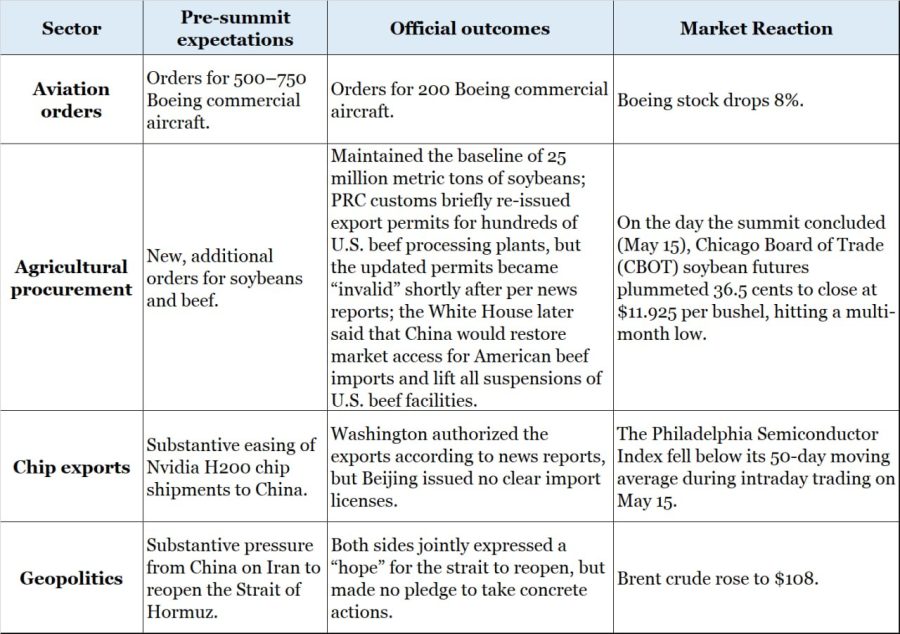
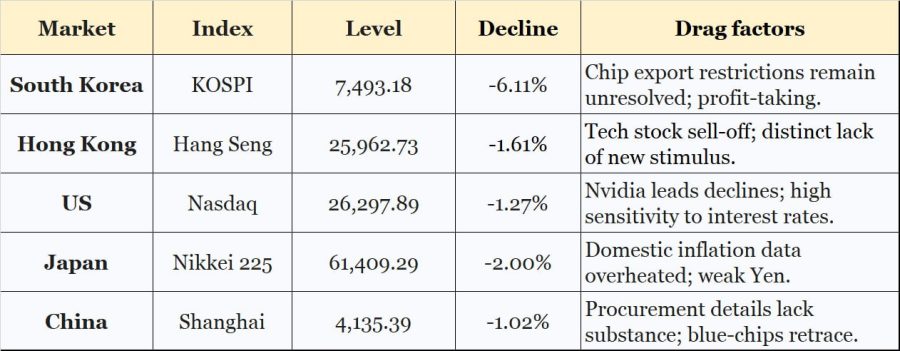
The closing data for major indices on May 15 captured the collective market reaction to the symbolic, but seemingly inconsequential, summit:
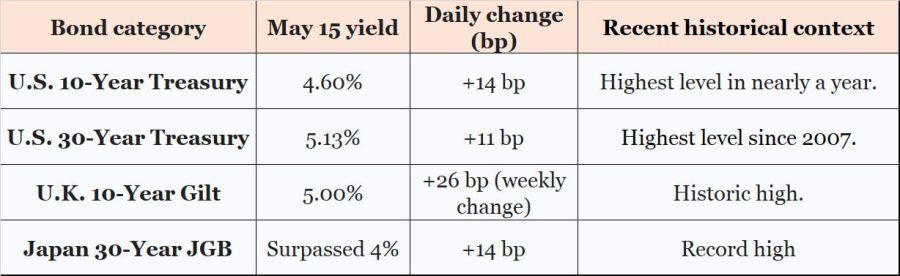
Against the backdrop of U.S. inflation data continuing to exceed expectations (CPI at 3.8 percent, PPI at 6 percent), the U.S. bond market had originally hoped Trump’s China visit would deliver signals of stability in Middle Eastern oil supplies. When those hopes failed to materialize, a wave of selling followed.
Finally, oil prices rebounded sharply on May 15 amid renewed geopolitical tensions and the depletion of the U.S. Strategic Petroleum Reserve:
- Brent crude rose 1.49 percent to $107.30 per barrel, more than 50 percent above the pre-war level of roughly $70.
- WTI crude rose 1.55 percent to $102.74.
6. The Beijing summit afforded Xi Jinping a golden opportunity to boost his “quan wei” (authority and prestige), and he promptly seized it. Just prior to the summit, the CCP slightly overshadowed Trump’s arrival and boosted Xi’s profile by lining up Xi to meet with other foreign dignitaries and releasing a commentary that framed China as the major power “equal” of the United States.
When Trump was in Beijing, Xi engaged in many “photo ops” with the U.S. president, with official photos positioning Xi as Trump’s equal. The PRC readout of their meeting on May 14 also had Trump declaring Xi to be a “great leader” and expressing his “tremendous respect” for Xi and the Chinese people.
Xi will likely look to leverage his meeting with Trump to shore up his image of a “great helmsman” and statesman in the manner of Mao and Deng, and build up towards his effort to take a fourth term at the 21st Party Congress in 2027.




