◎ We believe that the CCP will continue to play the “racism” card and could even expand its rhetoric to include direct attacks against the Trump administration.
On Feb. 18, the U.S. State Department designated five media outlets controlled by the People’s Republic of China (PRC) as “foreign missions.” The media outlets are:
- Xinhua News Agency
- China Global Television Network
- China Radio International
- China Daily Distribution Corporation
- Hai Tian Development USA
The designation of “foreign mission” effectively labels these media as agents of the Chinese Communist Party (CCP), and requires that they submit to the same restrictions as those governing foreign embassies and consulates. Starting the date of the announcement, the five outlets must notify the Office of Foreign Missions of their staff in the U.S., as well as their property acquisitions.
Secretary of State Mike Pompeo told Axios that “this action is long overdue. For years, these so-called media outlets have been mouthpieces of the Chinese Communist Party and these Chinese outlets are becoming more aggressive.”
The PRC responded angrily to the State Department’s “foreign mission” designation. Chinese Foreign Ministry spokesman Geng Shuang accused Washington of engaging in “ideological prejudice and Cold War zero sum mentality.”
Hu Xijin, editor-in-chief of the Communist Party-run tabloid Global Times, tweeted a warning of tit-for-tat retaliation by the PRC on Feb. 18 — the day of the State Department’s announcement: “Washington shouldn’t go too far in cracking down on Chinese media, or Beijing will take countermoves. Many American media organizations have branches in China … This is common sense.”
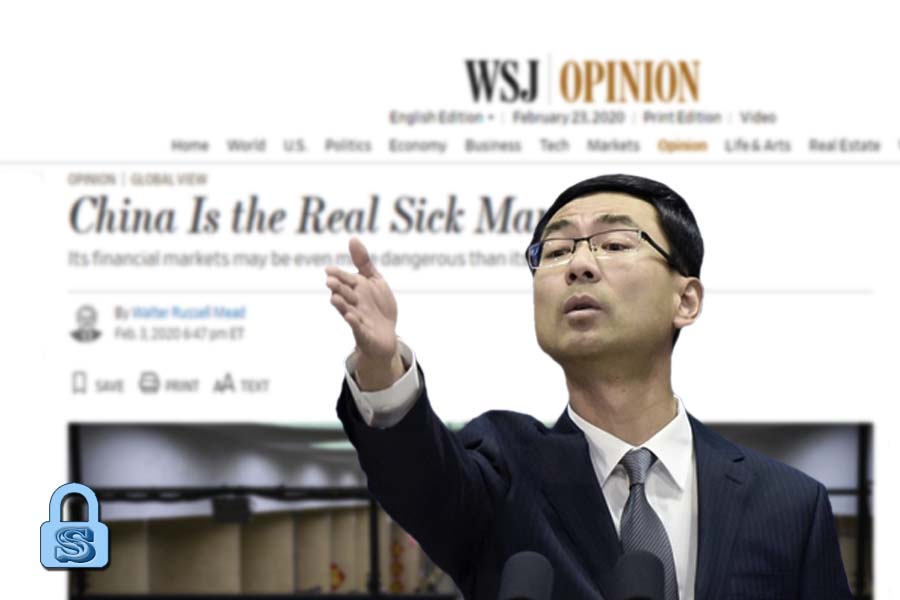
On Feb. 19, the PRC expelled three Wall Street Journal correspondents from Beijing, citing the Journal’s use of the offensive phrase “sick man of Asia” in the headline of a Feb. 3 op-ed examining the effects of the PRC’s inept handling of the Wuhan coronavirus epidemic on global financial markets.
In a Feb. 20 press briefing, Geng Shuang condemned the Journal, and urged “the US to immediately stop its ill-advised measures. We reserve the right to take further measures in response.”
Also on Feb. 20, Hu Xijin tweeted another invective against “western elites” calling the Wuhan coronavirus a “‘China virus’ or ridicul[ing] China as the “sick man of Asia.”
Pompeo condemned Beijing’s expulsion of the Wall Street Journal correspondents, saying in a Feb. 19 statement that “the correct response is to present counter arguments, not restrict speech. The United States hopes that the Chinese people will enjoy the same access to accurate information and freedom of speech that Americans enjoy.”
According to author and Washington Times journalist Bill Gertz, officials in the Trump administration told him that the State Department and White House are discussing what actions to take in response to the expulsions.
“Among the options being considered are expelling Chinese editors and reporters for publications that have slandered the United States, such as claiming that the United States was instigating pro-democracy protests in Hong Kong. Another option under consideration would expel known intelligence officers operating undercover as employees of Chinese news outlets,” Gertz wrote on Feb. 19.
Our take:
1. Beijing’s revocation of the Wall Street Journal’s reporters’ press credentials is almost certainly the CCP’s way of retaliating against the State Department’s designation of Party-controlled media outlets in the United States as “foreign missions.”
We anticipated Washington’s moves against the CCP’s overseas propaganda fronts as early as April 2018, noting that “CCP-backed media operations in the U.S. could also be actively targeted” by the Trump administration as part of its demands for reciprocity from the PRC regime in cultural exchanges between the United States and mainland China.
The CCP has exploited America’s open media environment and liberal regulatory laws to shape the local informational environment for years, pouring billions of dollars into its “Great External Propaganda Plan” (大外宣) apparatus. We wrote that “the Trump administration could demand that Beijing grant more visas to U.S. journalists, scholars, and cultural organizations … or face reciprocal visa denials,” and that the PRC’s “refusal to allow reciprocal cultural exchanges could be met with increased trade pressure.”
2. In November 2018, we noted that as part of its attempts to control media narratives on its political system and interference operations, the CCP levies accusations of “racism” to shut down criticism and “seize discourse power” (搶奪話語權). Starting May 2019, we warned that the CCP could begin to play the “racism card” in earnest to deflect and undermine the Trump administration’s China policies.
While there is no defense for the Wall Street Journal’s derogatory “sick man of Asia” (東亞病夫) headline, it is important to scrutinize the CCP’s decision to go with the “racism” angle in conjunction with its retaliation against the U.S. government’s restrictions targeting its propaganda operations.
In our May 2019 analysis, we wrote that the CCP is determined to avoid a direct ideological confrontation with the United States, because the Party’s Leninist authoritarian political system and discredited Marxist theory cannot survive a “clash of civilizations” with the universal values championed by the United States, such as liberty and human rights. Whenever possible, the CCP seeks to construe any disagreement as a racial and ethnic struggle between East and West, while masking its own hegemonic ambitions under the guise of a “community of shared future for mankind.”
3. Further moves by the U.S. in response to the expulsion of The Wall Street Journal reporters, and the CCP’s reactions to these moves, are likely to proceed according to the shifting ideological trend in Sino-U.S. relations.
We noted in July 2019 and in our 2019 Special Report that the United States and the PRC are “presently waging a zero-sum Cold War,” and that the conflict concerns not just trade or intellectual property, but is a “critical battle of ideology, value systems, and morality.”
Multiple developments in Sino-U.S. relations over the past two years have confirmed our analysis and observations. For instance, U.S. Attorney General William Barr delivered a keynote address at the U.S. Department of Justice’s China Initiative Conference on Feb. 6 where he said that “politically, the PRC remains a dictatorship under which the Communist Party elite jealously guards its monopoly on power. Marxism-Leninism and Maoism linger on as justification for Communist rule, which is authoritarian through and through.” On Feb. 15, U.S. Secretary of State Mike Pompeo gave a speech at the Munich Security Conference in Germany where he criticized “an increasingly aggressive Chinese Communist Party” and said that the West, which he defines as countries that respect “individual freedom, free enterprise, national sovereignty,” is winning against authoritarianism. (See the Feb. 17 issue of our newsletter for other recent developments.)
Given CCP characteristics, we believe that it will continue to play the “racism” card and could even expand its rhetoric to include direct attacks against the Trump administration. How the Trump administration reacts to the CCP’s accusations of “racism” will likely have significant implications for the domestic U.S. audience, which may in turn be further exploited by the CCP.
Trump’s political opponents and the liberal media could seize a fresh opening to criticize the president and his administration, and exacerbate fears of discrimination and racism against Chinese-Americans as the coronavirus epidemic grows. The “racism” narrative may also influence the results of the 2020 presidential election, though its impact is difficult to assess at this time.