
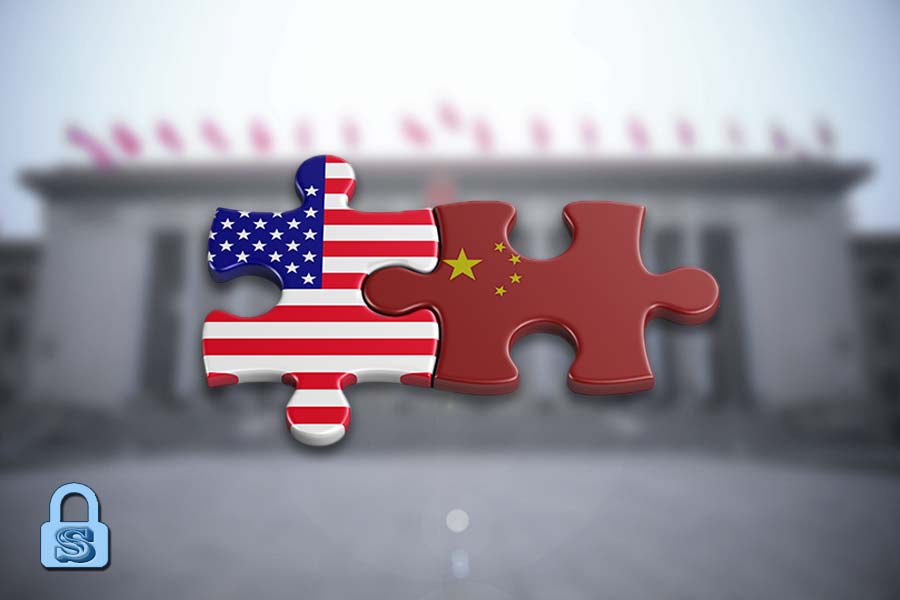
◎ An elephant in the room is Sino-U.S. relations and how it will impact Communist China’s policies.
The 2021 Two Sessions is set to commence on March 4 with the fourth session of the 13th Chinese People’s Political Consultative Conference, and on March 5 with the fourth session of the 13th National People’s Congress.
The Chinese Communist Party has been signaling in the lead up to the Two Sessions that its Party’s 14th Five-Year Plan, the economy, and financial liberalization will be key topics of discussion at the political conclave. “Reforming” Hong Kong’s political system to consolidate the CCP’s control over the city is another big topic.
An elephant in the room is Sino-U.S. relations and how it will impact Communist China’s policies.
Geopolitical ambiguity
CCP officials and scholars loved to lament that President Donald Trump was “unpredictable.” But one thing the Party was dead certain on was that the Trump administration was implementing a hardline China policy. Beijing also recognized strong bipartisan support in America for a “tough on China” approach, and has tailored its policies to account for long-term, great power competition with the United States.
The ascension of the Biden-Harris administration has injected fresh complexity in the Sino-U.S. relationship:
i. The Biden-Harris administration is crafting and projecting an image of itself assuming a “tough stance” on China. This is signaled through the administration’s foreign policy rhetoric (“extreme competition,” “biggest geopolitical test,” etc.), establishment media framing, the continuation of Trump-era “tough-on-China” technology and financial policies, targeted supply chain decoupling, freedom of navigation operations in the South China Sea and the Taiwan Strait, and mixed efforts to draw “red lines” on Xinjiang, Hong Kong, and Taiwan.
ii. Despite the Biden-Harris administration’s efforts to sound tough, it has noticeably softened its rhetoric and approach to China (see here and here).
- The COVID crisis, “existential” climate change, and the promotion of communistic “equity” at home and abroad are greater priorities than the geopolitical threat of Communist China in the Biden-Harris administration’s agenda for trade, foreign policy, and other areas.
- Ideological confrontation with the People’s Republic of China has been abandoned, with Washington sharply reducing mentions of the “China challenge” and preference for using “China” and “Chinese government” in speeches and official documents instead of “Chinese Communist Party.”
- Washington is no longer making any discernible effort to distinguish between the Chinese people and the CCP.
- The Biden-Harris administration talks about the persecution of Uyghur Muslims in Xinjiang and the arrest of pro-democracy activists in Hong Kong, but appears to have walked away from the Trump administration policy of advancing international religious freedom. It is unclear whether the Biden-Harris administration will highlight the CCP’s persecution of house Christians, Tibetan Buddhists, and Falun Gong practitioners.
- President Joe Biden explained in a televised town hall meeting that persecution in Xinjiang and the erosion of Hong Kong’s freedoms is due to Xi Jinping following “cultural norms.”
- The Biden State Department is referring to “Taiwan’s democratically elected leaders” instead of “President Tsai Ing-wen.”
- The State Department admitted that its officials in China were subjected to anal swab testing for COVID-19—a highly symbolic “bending over” and submission to CCP authority.
iii. Western establishment elites appear to be behind the “Longer Telegram” American China strategy, which essentially calls for the U.S. to target Xi Jinping, rather than the CCP. The goal of the strategy is to see “China return to its pre-2013 path—i.e., the pre-Xi strategic status quo” and the replacement of Xi Jinping by a “more moderate collective leadership.”
Early rhetoric from the Biden-Harris administration leaves open the possibility that the “Longer Telegram” strategy, or at least parts of it, is already being adopted and quietly implemented by Washington. For instance, Secretary of State Antony Blinken did not name “China” or the “Chinese Communist Party” when condemning “atrocities … committed in Xinjiang” and the undermining of freedoms in Hong Kong in remarks to the 46th United Nations Human Rights Council. Blinken’s “lapse” in not naming “China,” the “Chinese Communist Party,” or even the “Chinese government” as the perpetrator of abuses in Hong Kong and Xinjiang is almost certainly deliberate; he had no qualms in calling out the “Russian government” in the sentence just prior to the one mentioning malign PRC behavior. Blinken’s curious unwillingness to directly implicate the CCP ends up indirectly apportioning blame to one specific individual; Xi Jinping is widely considered by the international community to be personally responsible for the CCP’s Xinjiang and Hong Kong policies.
Regardless of how Washington currently views the PRC and himself, Xi Jinping will attempt to first make good with the Biden-Harris administration and establishment elites. Restoring Sino-U.S. relations to a state akin to the pre-Trump era is firmly in Xi and the CCP’s interests, and to that end, Beijing will play up financial liberalization as a “carrot” to America and Western nations at the Two Sessions.
Xi and the CCP, however, are hard-eyed realists. Beijing does not believe that Washington will abandon great power competition even if the administration in charge broadly shares its socialist vision and U.S. elites are technically “captured” by the CCP. The Party’s experience with the Sino-Soviet split in the Cold War informs it that geopolitical interests transcend ideology and mutual benefits, and the emergence of the “Longer Telegram” signals to Xi that there are more dangerous threats to his reign than Trump. This is why the Two Sessions will focus on “dual circulation,” which is intended to build up the CCP regime’s self-sufficiency, and the tightening of political control over Hong Kong, which denies both Western powers and domestic rivals the opportunity to turn the city into a “counter-revolutionary” base from which to undermine the Xi leadership.
US domestic policies and China’s economy
The U.S. does not have to roll out China-specific policies to pose a threat to the CCP regime. Washington’s COVID stimulus (a $1.9 trillion stimulus package was passed recently), the sharp increase in U.S. dollar supply due to the Federal Reserve printing money at an exponential rate over the past 12 months, soaring oil prices (from under $40 per barrel in November 2020 to over $60 in early March 2021) due to the Biden-Harris administration’s climate policies (canceling the Keystone XL oil pipeline, etc.), and spiking U.S. Treasury bond yields are creating a global inflationary environment.
The CCP has reacted to worsening economic conditions by allowing the renminbi to appreciate, opening up its financial markets to attract foreign investments, and keeping its interest rate spreads steady. This, however, has invited inflationary pressures. Meanwhile, rising U.S. Treasury bond rates could see funds leave China and flow towards the U.S.; large-scale capital outflows from China will trigger substantial market fluctuations and set the stage for a financial crisis. The CCP regime also faces the more terrifying prospect of stagflation. In a March 1 piece published in mainland media outlets, Evergrande Group chief economist Ren Zeping warned of coming stagflation, citing declines in China’s February PMI numbers, new orders, new exports, construction activity, and other economic performance indicators. Ren noted that some of the indicators have been falling for two consecutive months while the consumer price index remains at a recent-year high—a “typical feature of an economic cycle that is gradually shifting from recovery to stagflation,” he wrote.
Two Session trends
PRC premier Li Keqiang’s work report at the Two Sessions will outline what the CCP will focus on in 2021. We expect Li to announce measures to facilitate the CCP’s 14th Five-Year Plan, “vision for 2035” goals, and the “National Comprehensive Three-dimensional Transportation Plan” announced on January 24.
Possible Two Sessions initiatives include:
1. Proactive fiscal policies, including maintaining a scale of government bond issuance that is similar to that of last year (about 10 to 13 trillion yuan). Concurrently, the CCP could adopt a neutral monetary policy geared towards curbing inflation.
2. Financial risk prevention will be emphasized. This includes guarding against the idling of interbank assets within the financial system, vigorously disposing non-performing assets in the banking industry, increasing supervision over financial and tech groups, controlling the spread of debt risks possessed by medium-to-large-sized enterprises, and strictly controlling the increase of implicit local government debt.
3. The point that “houses are built to be lived in, not for speculation” will be repeated. Strict measures could be rolled out to inhibit the growth of the real estate financialization bubble and control the debt scale of property companies.
4. “Dual circulation” will be emphasized, with a focus on “domestic circulation” and expanding domestic demand.
5. The PRC could pledge further financial liberalization and the opening up of China to the outside world to attract foreign investments. Investment restrictions could be reduced and foreign investors could “enjoy” treatment reserved for Chinese nationals.
6. The digital RMB could be promoted, as well as the internationalization of the RMB.
7. “Vaccine diplomacy” and the digital RMB could be used to promote the development of the Belt and Road Initiative.
8. Plans to develop “strategic emerging industries” (advanced semiconductors, AI, 5G, Internet of Things, etc.) and improve the manufacturing chains could be announced. The proposed national transportation network could also be constructed in accordance with the so-called “industrial division of labor.” Investments in the construction of infrastructure that incorporates “networkization, digitalization, and intelligentization” could be announced.
9. The PRC could promote increased urbanization and relax anti-natalist policies (encourage the birth of two or more children).
10. The PRC could emphasize the “six stabilities” and “six guarantees,” as well as require all ministries and local governments to ensure employment and social stability.
11. The PRC could propose measures to “comprehensively revitalize” rural areas in accordance with recently announced plans, including rural land transactions and integration, intensive agriculture operations, and maintaining the results of “poverty alleviation.”
12. The PRC could announce measures to strengthen Marxist and “socialist core values” indoctrination in schools and in society.
13. Efforts to strengthen United Front operations in private enterprises could be unveiled.
14. Calls will be made to strengthen the Party’s leadership over society, including the establishment of Party organizations inside large private enterprises and institutions of higher education.
15. Measures to enhance the CCP’s social credit and surveillance systems could be announced. This furthering of techno-totalitarianism could be done in the name of epidemic prevention and control.
16. The National People’s Congress could propose amendments to Hong Kong’s electoral system that requires all candidates for district councillor, legislature, and senior government officials to be “patriotic” (愛國愛港). Rules could also be rolled out to restrict the proportion of district councillors in the election committee that picks the city’s chief executive.
17. Calls could be made to strongly oppose so-called “de jure Taiwan independence,” demand Taipei’s acceptance of the “1992 Consensus” and “one country, two systems” arrangement, and threaten military “reunification.” Concurrently, the PRC could propose preferential business and study policies to attract Taiwanese businesspeople and young people to the mainland.




