◎ The CCP likely does not believe that propaganda and disinformation will be enough to “maintain stability” once economic activity on the mainland is fully revived.
Since late February, the Chinese Communist Party has been struggling to bring both the COVID-19 coronavirus and the coronavirus narrative under control.
We previously noted various signs that indicate that the CCP has yet to bring the epidemic under control (see here, here, here).
CCP propaganda and disinformation efforts, however, have been somewhat effective in shaping the coronavirus narrative. The CCP has moved to curb negative associations of the coronavirus with the People’s Republic of China, redirect negative associations with other countries, and tout the “success” of the PRC’s authoritarian system in dealing with the epidemic. In shaping the domestic narrative on the coronavirus, the CCP has begun to direct threatening rhetoric towards Taiwan, a move which suggests that the communist regime is laying the groundwork to spark a fourth Taiwan Strait crisis.
We will briefly examine the signs, rationale, and implications of the CCP’s recent propaganda moves.
The CCP’s coronavirus propaganda strategy
In parsing CCP propaganda on the coronavirus, we identified four broad narrative lines:
1. Deny
Through Party and state media outlets, diplomats, scholars, medical professionals, and others, the CCP has for several weeks been actively denying that the COVID-19 coronavirus originated from China in an attempt to disassociate the CCP regime with the virus and “rehabilitate” the PRC’s global image.
Prominent incidents include:
- On Feb. 27, top PRC epidemiologist Zhong Nanshan said at a press conference that “though the virus was first discovered in China, it may not have originated from China.” He also said that the PRC is confident in gaining “basic control” over the epidemic by the end of April.
- During a regular press briefing on March 4, PRC foreign spokesman Zhao Lijian said that “no conclusion has been reached yet on the origin of the virus, as relevant tracing work is still underway” and that the epidemic “was not necessarily originated in China.” Zhao also said that the World Health Organization chose to name the coronavirus “COVID-19” for the purpose of “making no connections between the virus and certain places or countries.” After Zhao made his comments, several PRC diplomats began publicly echoing his narrative about the origins of the coronavirus.
- On March 4, the Washington Times reported that the CCP is promoting the theory that the coronavirus originated in the United States and that the Central Intelligence Agency was behind the epidemic outbreak in China.
- PRC embassies are emailing local journalists to suggest that they will be politicizing the coronavirus by suggesting that it may have originated in China “without supporting fact.”
- A March 10 article by human rights-focused website Bitter Winter noted that the CCP is trying to “de-Sinicize” the coronavirus by claiming that its origin is “unknown” or is still being traced, or by referring to it as the “Italian virus,” “Iranian virus,” or “Japanese virus.”
The CCP’s propaganda narrative on the coronavirus’s origins does not hold water. There is no evidence that the coronavirus emerged in places outside China before it began to spread in Wuhan. Neither has the CCP provided persuasive “supporting fact” to back its claim about the “unknown” origins of COVID-19. Also, the WHO named the coronavirus “COVID-19” to guard against the stigmatization of the place from which it originated and the people there, not to reflect continued doubt where the coronavirus came from.
On Feb. 21, we observed that “Xi and the central government could be laying the groundwork to shift the CCP’s official narrative on the origins of the coronavirus should the need arise.”
2. Denounce
After “establishing” the “unknown” origins of the coronavirus and denying that it first surfaced in China, the CCP has proceeded to fiercely denounce those who refute its disinformation.
For instance, U.S. Secretary of State Mike Pompeo started referring to COVID-19 as the “Wuhan virus” after PRC foreign ministry spokesman Zhao Lijian suggested that the coronavirus did not originate from China. On March 6, Pompeo said in an interview on “Fox and Friends” that the CCP said that the coronavirus started from Wuhan “so don’t take my word for it, take theirs.”
On March 9, PRC foreign ministry spokesman Geng Shuang said during a regular press briefing that a “certain American politician, disrespecting science and the WHO decision, jumped at the first chance to stigmatize China and Wuhan with it” when asked about Pompeo’s “Wuhan virus” remarks. On the same day, a State Department official said that Pompeo chose the language to counter CCP disinformation. The Sino-U.S. debate over how to name the coronavirus led some Western media outlets to criticize the politicizing of the epidemic outbreak.
We believe that Secretary Pompeo’s decision to go with “Wuhan virus” to describe the coronavirus is warranted to push back against CCP propaganda and disinformation. As for the issue of the politicization of the coronavirus, the timeline of events shows clearly that it was the CCP who first sought to exploit the WHO’s neutral-sounding name for the coronavirus (COVID-19) to spread propaganda and disinformation. Put another way, if the CCP did not politicize the coronavirus, Pompeo would not need to refer to it as the “Wuhan virus.”
Pompeo’s solution to the problem of CCP disinformation, however, is not without its drawbacks. By referring to COVID-19 as the “Wuhan virus,” Pompeo has re-opened the stigmatization issue just as the coronavirus is spreading more quickly in the U.S. and the Chinese in America have legitimate concerns about being targeted due to racism and xenophobia. The “Wuhan virus” language also gives the CCP another opening to play the “racism” card against the Trump administration to undermine President Donald Trump’s re-election bid and U.S. foreign interests.
3. ‘World savior’
In our emergency warning about the coronavirus on Jan. 24, we noted that the CCP will attempt to spin calamity into victory. We also told AFP in an interview in January that the CCP would very likely move to paint itself as a world’s “savior” and cultivate the image of China as a responsible stakeholder.
Starting in February, the CCP has rolled out propaganda which affirms our analysis:
- The Global Times, as well as some mainland and overseas Chinese language media outlets, reported on a Feb. 5 Bloomberg News article titled, “China Sacrifices a Province to Save the World From Coronavirus.”
- On Feb. 10, PRC foreign ministry spokesman Geng Shuang said: “By taking strong measures, China is not just acting for the sake of its own people, but for people across the world. In this battle against the invisible enemy, we are working around the clock to allow time for global preparedness, fighting on the front lines to contain the virus and setting a new standard for epidemic response.”
- On March 4, state mouthpiece Xinhua republished an opinion piece titled, “Be Self-confident, the World Should Thank China.” The opinion piece said that calls for China to apologize for the coronavirus are “ridiculous” because China “made tremendous sacrifices” in combating the epidemic. “China has paid a huge economic cost and cut-off the transmission route of the novel coronavirus. No country has made such a great sacrifice and effort during this epidemic,” the piece said.
- On March 9, the official PRC foreign ministry Twitter account posted, “China has been updating the WHO & other countries including the US on COVID19 in an open, transparent & timely manner. China’s endeavor to combating [sic] the epidemic has bought time for international preparedness. Our contribution is there for all to see.”
- On March 10, Jin Canrong, the deputy dean on Renmin University’s school of international relations, said that the PRC has been “widely praised by the international community” for demonstrating strong “soft and hard power” in fighting the coronavirus, including “leadership ability, mobilization ability, organizational ability, optimism, industrial ability, and scientific and technological capabilities,” according to a report in a pro-Beijing Hong Kong news agency. Jin also reportedly said that the international community “speaks very highly” of the PRC’s efforts, citing a report in a Western media outlet about how China sacrificed a province to save the world.
4. Menace
CCP propaganda narratives sometimes contain false binaries that are designed to help the Party survive and dominate. For instance, pushing the “coronavirus does not originate in China” narrative allows the CCP to disassociate itself from COVID-19 (survive) while blaming other countries for the spread of the epidemic (dominate). Countries and global organizations can stay on the PRC’s good side by promoting its new coronavirus origins narrative or at least not refuting it, or be in its bad graces by rejecting the narrative.
The “China is the world’s savior” narrative also presents a false binary. The world can choose to show gratitude and appreciation toward the PRC and its authoritarian system for curbing the coronavirus (survival), or the world should prepare to be held hostage by the “world’s factory” to the next big outbreak (dominate).
The menacing aspect of the “China is the world’s savior” narrative is strongly hinted at in the March 4 “Be Self-confident, the World Should Thank China” opinion piece republished in Xinhua. The piece writes: “There is great love in this world. The Chinese people and the Chinese government have not attacked the United States when it is down, and have not banned the export of masks and medicines to America. As China gradually brings the coronavirus under control, China will have much-elevated ability to export masks and medicines, and the United States is one of those on the demand side.”
On March 11, the state-run Global Times, citing a “veteran industry analyst,” said that America’s move to restrict sales to Huawei may “backfire” because “China could ban the export of face masks and other medical gear to America which are in acute shortage due to the rapid spread of the coronavirus.”
In a Feb. 27 analysis, we wrote that the CCP could seek to leverage its status as the “world’s factory” to advance its domination agenda in a pandemic.
The CCP’s coronavirus propaganda rationale
The CCP knows that it will likely struggle to curb a serious epidemic and cannot simply command the coronavirus to disappear. However, the CCP can control the coronavirus narrative, “displace concepts” (偷換概念), and convince the Chinese people at least that it has obtained “victory” over the epidemic when the reality is otherwise. By tapping into its “Red Matrix,” the CCP has found some success in “quelling” the narrative on the coronavirus; we have heard several anecdotes in recent weeks about how Chinese living abroad are contemplating returning to China because they believe that the CCP has truly turned the tide in the coronavirus battle through its draconian measures while the areas outside China are less safe/capable of dealing with the epidemic as compared to the mainland.
Propaganda is an important tool in the CCP’s kit for surviving and dominating. And controlling the coronavirus narrative is the first step for the CCP in dealing with the “perfect storm” of problems it currently faces—a build-up of societal anger over its handling of the epidemic; mounting economic woes; escalating Sino-U.S. tensions, etc. There is a very good reason why Wang Huning, the Politburo Standing Committee member who oversees regime propaganda, is the second-ranking member of the CCP’s newly created leading small group to handle coronavirus prevention and control work.
Meanwhile, Xi Jinping also has a pressing need to spin calamity into victory to maintain his edge in the CCP factional struggle. As we wrote in the Feb. 27 edition of the SinoWeekly Plus newsletter, Xi likely “sold the other CCP elites a way to transform the regime’s unprecedented risks into unprecedented opportunity to advance the Party’s domination agenda, and thus buying himself some ‘breathing space’ in the factional struggle.” The aggressiveness at which the CCP is pushing its coronavirus propaganda and disinformation hints at the intensity of the infighting among the Party elite and the internal pressures facing the Xi leadership.
Taiwan distraction
The CCP likely does not believe that propaganda and disinformation will be enough to “maintain stability” once economic activity on the mainland is fully revived. When the Chinese people return to work and regular social activities resume, the CCP cannot stop people from talking about the epidemic, how the CCP has handled the public healthcare crisis, the real number of deaths and confirmed cases of COVID-19, local government corruption, rising consumer prices, and other sensitive issues. To keep the Chinese people distracted, the CCP must engineer an external “crisis.”
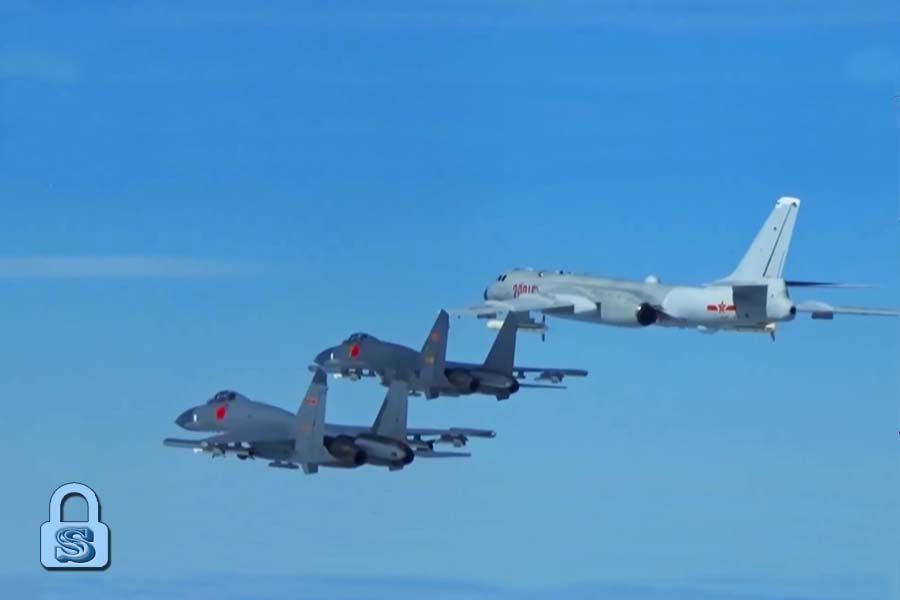
In our China 2020 outlook, we noted that the PRC could attempt a “Fourth Taiwan Strait Crisis.” Recent PRC activity suggests that the groundwork for such a crisis is being laid:
- On Jan. 23, several PLA fighter jets, Xi’an H-6 bombers, and KJ-500 early warning aircraft flew over the Bashi Channel south of Taiwan.
- On Feb. 9, Shenyang J-11 fighter jets, Xian H-6 jet bombers, and a KJ-500 aircraft flew through the Bashi Channel and Miyako Strait before returning to base.
- On Feb. 10, PLA jets participating in a long-range drill briefly crossed the centerline in the Taiwan Strait, according to Taiwan news reports. On the same day, a PLA publication quoted military spokesperson Zhang Chunhui as saying that the “schemes” of “separatist forces” in Taiwan would “not win the hearts of the people.”
- On Feb. 28, an H-6 jet bomber and J-11 fighter jets flew close to Taiwan’s southwest coast.
- The Johns Hopkins University Coronavirus Resource Center changed how it refers to Taiwan in its interactive map tracking coronavirus cases worldwide from “Taiwan” to “Taipei and environs.” A John Hopkins University spokesperson told Axios that it is retaining the “Taipei and environs” reference after the WHO’s naming scheme, according to a March 10 report. On March 11, the university again lists Taiwan under its “Cases by country/region” tab, with an asterisk next to Taiwan that contains the following footnote: “The names of locations correspond with the official designations used by the U.S. State Department, including for Taiwan.” In recent years, the CCP has successfully “persuaded” international organizations and companies, oftentimes through coercion, to change the way they refer to Taiwan to “Taipei, China” or simply “Taipei,” a move which suits its “reunification” agenda.
- On March 11, former PLA Navy rear admiral and Party princeling Luo Yuan told the nationalistic state media Global Times that Taiwanese senior officials like Tsai Ing-wen, Lai Ching-te, and Su Tseng-chang seized the epidemic period to “hit China when it is down,” “profit from China’s misfortunes” (“落井下石、趁火打劫”), and even “oppose China and plan for independence” (“反中谋独”). Luo suggested that those Taiwanese politicians should “pay the price,” and added that a timeline for PRC-ROC unification should be announced “in a timely manner” because the Taiwan issue “cannot drag on without resolution.”
- We received information that military aircraft at the PLA Eastern Theater Command have been taking off and landing with increased frequency in recent days.
Distraction and nationalism aside, the CCP is likely looking to “payback” Taiwan for upstaging the PRC in handling the coronavirus. Taiwan has won international acclaim for its meticulous and effective epidemic outbreak plan (124 discrete action items) and for having a remarkably low number of coronavirus cases (45 confirmed cases and one death as of March 10). In contrast, mainland China has the most number of coronavirus confirmed cases and deaths despite the CCP’s draconian efforts to curb the spread of the epidemic. From the CCP’s perspective, Taiwan’s success in containing the coronavirus represents a “victory” for a democratic Chinese territory and a “defeat” for its authoritarian system—something that the CCP cannot abide and has long endeavored to thwart. The CCP has sought to intimidate, infiltrate, and “beat down” Taiwan because it can not tolerate the success and prosperity of a non-authoritarian society in a territory where most of the population is ethnically Chinese. The coronavirus epidemic has made starker the difference between the PRC and the ROC’s model of governance.
What’s next for Taiwan
Unless another crisis finds the CCP quickly, it will likely force through a fourth crisis in the Taiwan Strait. As we wrote in our China 2020 outlook, “while we believe that the chances of a war breaking out are extremely low, we do not rule out the occurrence of minor or ‘near miss’ military incidents (擦槍走火).” A Fourth Taiwan Strait crisis will likely draw Taiwan, America, and Japan closer, and raise Taiwan’s international profile.
Taiwanese businessmen on the mainland should be wary of being taken “hostage” as the CCP looks for ways to embarrass the Tsai Ing-wen government.