◎ To preserve its rule, the CCP can be expected to take even more extreme measures to curb the spread of the coronavirus.
The Chinese Communist Party has implemented several measures to control and curb the spread of the new coronavirus (2019-nCoV) since acknowledging its outbreak in Wuhan on Jan. 20. Among the more drastic measures include the locking down of several Chinese cities, the extension of the Lunar New Year holiday period for companies and schools, the rapid construction of quarantine hospitals that resemble prisons or “internment camps”; and the unofficial implementation of a “self-quarantine” policy for infected persons whom hospitals do not consider to be ill enough to warrant being warded.
The CCP has also stepped up censorship, propaganda, and disinformation operations. Official figures for confirmed cases and deaths caused by the coronavirus are almost certainly downplayed to a significant degree (for explanation and analysis, see here and here). Citizen whistleblowers make forced confessions videos while some dissidents are curiously “allowed” to do some citizen journalism in Wuhan hospitals. Meanwhile, the CCP is dismissing as “conspiracy theory” claims that the coronavirus was engineered in a government laboratory and not the result of natural transmission from animals to humans; the CCP’s flat denial, scientific research, and other evidence and analysis (see here and here) indicate that the theory of the Wuhan coronavirus’s unnatural origins cannot be completely ruled out.
In analyzing what it has done so far to tackle the coronavirus, it is clear that the CCP is once again prioritizing regime security over the welfare of the Chinese people and the global population. The economic cost of the coronavirus outbreak is expected to be immense (analysts are predicting a 1-2 percent decline in China’s GDP growth in the first quarter), and economic woes are guaranteed to inflame the growing public anger over the CCP’s handling of the epidemic. The communist regime now faces the very real prospect of seeing its dwindling political legitimacy erode to dangerous levels over the coronavirus outbreak.
Two Sessions goal
To preserve its rule, the CCP can be expected to take even more extreme measures to curb the spread of the coronavirus. The measures could be rolled out sooner rather than later because the Two Sessions, the CCP’s first major political conclave of each calendar year, is scheduled to commence on March 3. The Party will likely be aiming to declare a “great and glorious victory” over the coronavirus at the Two Sessions and regain some of its political legitimacy. If the CCP cannot sufficiently contain the epidemic by the Two Sessions period, however, there is a chance that it will postpone the meetings (to end March or early April) rather than go ahead with the meetings and risk further damage to its political legitimacy.
The CCP’s measures will likely revolve around achieving two objectives, namely, limiting the spread of the coronavirus in China and the quarantine of infected persons. The CCP will likely also be hoping that the Wuhan virus, like other flu viruses, has a low and declining fatality rate even though its rate of spread is high. Further, the CCP will likely be hoping that the infected either recover quickly and develop immunity to the virus or die quickly in “self-quarantine” (“self-quarantine” deaths are not officially recorded as coronavirus deaths).
The current international climate suits the CCP and permits it to attempt more brazen coronavirus control measures. The international community is fearful of a pandemic and still hopes that the CCP regime’s authoritarian system could prove effective in curbing the spread of the virus globally. Western scientists are also working on a cure, and the discovery of an effective drug would benefit the CCP. Finally, the pulling out of foreigners from China, especially foreign diplomats and journalists, results in less scrutiny on the CCP and emboldens it to implement more drastic measures.
Possible measures
1. Local governments and the military will use their “stability maintenance” powers to “lockdown” families, building floors, whole apartment buildings, residential areas, cities, villages, and small towns. The idea behind the “lockdown” is to restrict human movement with an eye on curbing the spread of the coronavirus by the end of February. It is possible that the CCP could mandate an additional 14-day “work/study-at-home” quarantine period after the extended Lunar New Year holiday ends around the Feb. 9 – Feb. 10. The CCP could even order another two or three rounds of 14-day quarantine periods on top of the additional quarantine period if the situation calls for it, a move that could see some people returning to work or school as late as April.
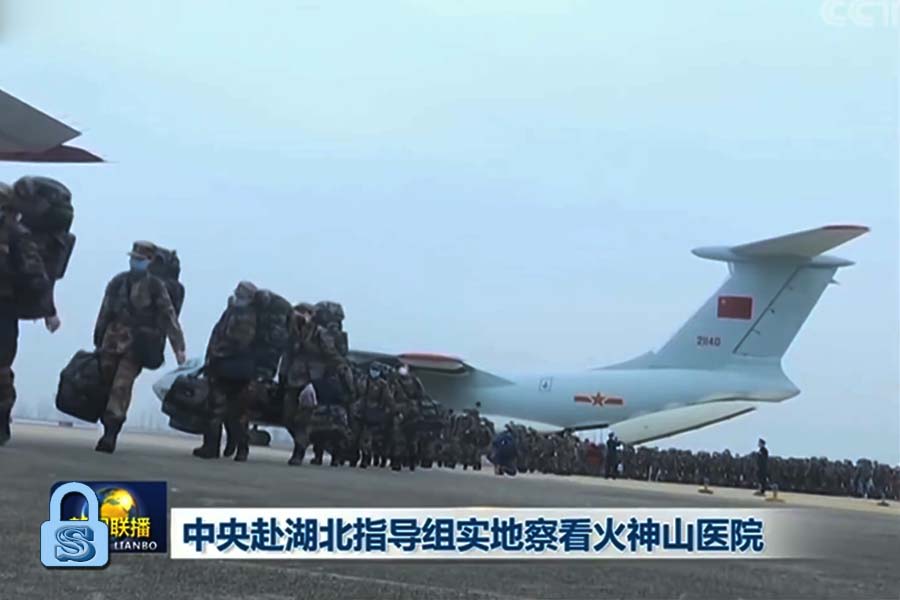
2. The CCP could increasingly deploy the military to assist in the “lockdown” of people and places. The military would have an advantage over regular public security forces in facilitating the reduction of human movement (and hence the rate of spread) and clamp down on the gathering of crowds (and hence face-to-face communication and the sparking of popular uprisings against the regime). Military deployment also benefits Xi Jinping politically: local governments will be more inclined to heed orders from Party central; Xi’s political opponents will find it more difficult to direct the dissatisfaction of the masses toward the Xi leadership; and there is a reduced chance of mutiny in the military.
To keep the military loyal to the Party, the central government could see to it that the military has control over the supplies required for epidemic prevention and control, including protective medical gear and priority access to effective treatment methods or vaccines when they become available. Giving the military control over vital supplies also facilitates its distribution to forces involved in “stability maintenance” and helps the CCP better preserve regime survival.
3. The CCP could more tightly censor the internet and even block off problematic areas from accessing the internet. When people in different areas cannot readily access information, they will find it harder to figure out what the CCP is actually doing to curb the spread of the coronavirus, voice their anger, and band together to oppose the regime.
4. The People’s Republic of China could introduce additional draconian laws aimed at limiting the spread of the coronavirus or curbing information dissemination. For instance, people could be sentenced to a maximum of 15 years in prison for spreading “misinformation” about the epidemic. Another extreme but not implausible example would be handing out the death sentence to those who refuse to “self-quarantine” after being ordered to do so by the authorities. The PRC’s goal of imposing draconian laws is “stability maintenance” and the prevention of unrest over supply shortages or dissatisfaction over the government’s handling of the epidemic crisis.
Some local governments have already enacted draconian laws aimed at “combating crimes related to epidemic prevention and control.” On Feb. 4, the Heilongjiang high court issued a notice which stressed that those who partake in “epidemic prevention and control” crimes, such as spreading “misinformation” about cures or the virus or “endangering public safety,” will be “severely punished.” Punishment includes 15-year prison sentences or the death penalty.
Also, the Washington-based Chinese Human Rights Defenders observed recently that the PRC authorities had arrested at least 325 Chinese citizens within the span of a week (Jan. 22 to Jan. 28) for spreading “misinformation” about the coronavirus.
5. The CCP could step up the purge of dissidents under the guise of facilitating “epidemic prevention and control.”
6. Hospitals will become increasingly more selective in admitting infected patients because they are under-supplied, under-staffed, and lack treatment means. Infected persons who show few symptoms or are close to death will likely be refused admission as the CCP strives to keep the official figures of confirmed cases and deaths as low as possible.
7. The Wuhan authorities are currently setting up quarantine hospitals with different levels of isolation. This, however, does not fundamentally resolve the city’s problems of inadequate medical supplies or staff. Infected patients will still find it difficult to receive treatment and even proper diets in those quarantine hospitals. From the perspective of the PRC authorities, quarantine is both a public health measure and a form of “stability maintenance.”
8. Patients who survive the coronavirus in quarantine could end up being unwitting test subjects as the CCP searches for a cure. And should the CCP develop a cure or vaccine, it will prioritize the treatment or inoculation of senior officials and their relatives first. The CCP also stands to reap huge profits if it can quickly discover a cure or vaccine for the coronavirus.
What’s next
1. Should the CCP implement the above measures, there is a possibility that it could contain the spread of the coronavirus. However, it could be some time before the epidemic is fully eliminated in mainland China. There is also a chance that recovered patients could get reinfected.
2. The Wuhan coronavirus outbreak will likely have a lasting impact on global supply chains, as well as the Chinese and global economies. President Donald Trump’s “America First” policy will look less anachronistic to American businesses and multinationals, and other countries could also look to move some manufacturing “in-house” as opposed to relying on supply chains in mainland China or countries neighboring China as they seek to mitigate the effects of lockdowns and other epidemic risks.
3. The coronavirus epidemic affects the whole of Chinese society indiscriminately and represents an immense and unprecedented challenge for the CCP regime. The Chinese people will undoubtedly evaluate the CCP’s performance and reach a judgment on the authoritarian system. Meanwhile, the CCP factional struggle could see a watershed moment as Xi’s rivals exploit the Xi leadership’s lackluster handling of the epidemic and prior setbacks (including the signing of the Sino-U.S. “phase one” deal) to challenge Xi Jinping. The second half of 2020 could see a political Black Swan event.