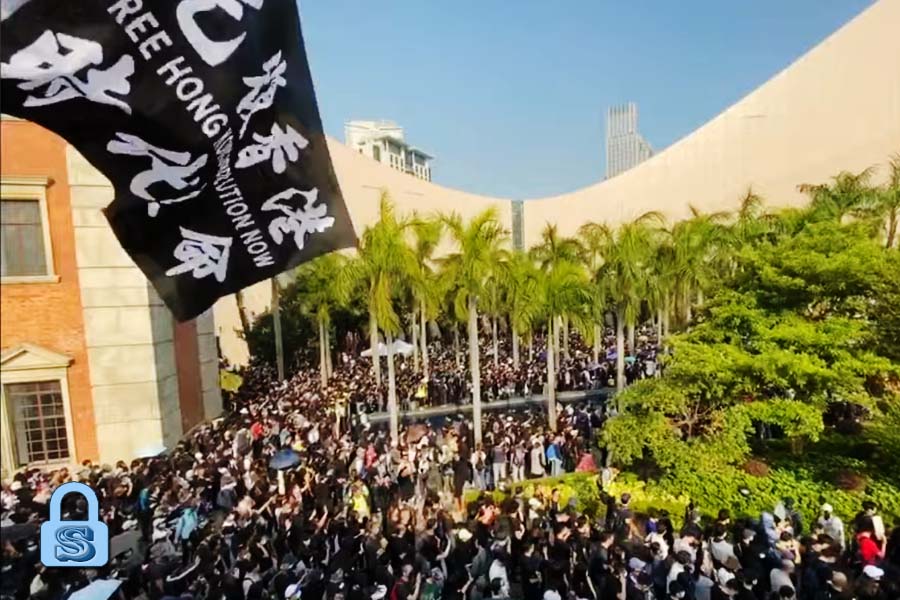
◎ Just because the organizers of the Human Rights Day rally have permission to go ahead with it does not mean that the event will be free from controversy.
On Dec. 5, the Hong Kong police gave permission to protest march organizers to carry out a big Human Rights Day rally on Dec. 8. Rally organizers Civil Human Rights Front had previously organized million-strong marches in Hong Kong in June, as well as other large-sized rallies.
On Dec. 6, new Hong Kong police commissioner Chris Tang left the city for a “courtesy visit” to Beijing. Tang is scheduled to meet with senior officials from the People’s Republic of China’s Ministry of Public Security, and is expected to return to Hong Kong on Dec. 8, the day of the Human Rights Day rally.
The big picture:
In early November, anti-extradition bill protests increased in intensity following the suspicious death of college student Alex Chow Tsz-lok at a car park where police were firing tear gas to clear protesters.
The Hong Kong authorities responded to the fresh wave of demonstrations with escalated force. Notable incidents include a traffic police officer shooting a 21-year-old protester in the chest at close-range, and riot police besieging protesters camped inside the Chinese University of Hong Kong and the Hong Kong Polytechnic University.
Responding to increased police violence in Hong Kong, the United States Congress rushed to pass the Hong Kong Human Rights and Democracy Act of 2019 (henceforth referred to as the Hong Kong Act). On Nov. 27, U.S. President Donald Trump signed the Hong Kong Act into law. The PRC government condemned the Hong Kong Act and threatened “countermeasures,” but has thus far made only symbolic gestures, including lecturing U.S. diplomats, suspending U.S. warships from visiting Hong Kong, and sanctioning nongovernmental organizations.
Our take:
1. Between August to late November, the Hong Kong police force had turned down most requests by rally organizers to hold protest rallies and marches in the city. The police, however, have been issuing permits again after the passing of the Hong Kong Act on Nov. 27, including granting permission for a protest march attended by an estimated 380,000 people on Dec. 1. This indicates that the Hong Kong Act has already achieved part of its intended effect.
2. Just because the Hong Kong police have granted permission to rally organizers to hold the Human Rights Day rally does not mean that the event will be free from controversy. For instance, the Hong Kong police fired tear gas at large crowds of peaceful protesters who were already leaving the rally using the pretext that some protesters had thrown bricks at them.
In our Nov. 3 analysis, we wrote that “the Hong Kong situation is particularly messy because there are many interests in play.” Major interest groups from the PRC and Hong Kong authorities side include the Chinese Communist Party, different factions in the CCP, the Carrie Lam government, and the Hong Kong police force. The protesters can be grouped into two camps, the “brave martial clique” (勇武派) and the “peaceful, rational, non-violent” (和理非) camp.
If there is trouble at the rally on Dec. 8, the chances that it will be sparked from the protester side are slim. We explained in a previous analysis that the “brave martial clique” appears to have sustained heavy losses due to police action in November. Also, the protest movement at large now have greater incentive to utilize “peaceful, rational, non-violent” protest methods to stay on America’s good side and because more violent tactics have largely proved ineffective and harmful to the protest movement. Thus, even when provoked, the Hong Kong protesters in general have a vested interest in demonstrating to the world that they are not the “violent rioters” that the CCP and the Hong Kong government makes them out to be.
The PRC and Hong Kong authorities side have an incentive to provoke violence at the Dec. 8 rally due to shared self-interests. Both the CCP and the Hong Kong authorities (government and police) are invested in the narrative that they are responding with “appropriate force” to stop “terrorism” by protesters. If the status quo of large and peaceful mass protests are allowed to continue, the Hong Kong people will eventually hold the Carrie Lam government accountable, and her government and the Hong Kong police will have to pay the price for using hardline measures against protesters instead of genuinely working with the Hong Kong people to find a resolution to the extradition bill impasse. And if the Carrie Lam government is humiliated, the CCP will likewise come under pressure for its role in “guiding” the Hong Kong authorities’ handling of the anti-extradition bill protests.
The CCP will not allow itself to become humiliated by failing to resolve the Hong Kong protests on its terms. When faced with an intractable problem, the CCP’s political and legal affairs apparatus usually responds with more, and not less, “stability maintenance.” Thus, it is a somewhat ominous sign that Hong Kong’s new police commissioner is meeting with senior public security officials in Beijing just days before the big Human Rights Day rally.
CCP factional groups in Hong Kong will also be inclined to take advantage of events in the anti-extradition bill protests to stir trouble and make life difficult for the Xi Jinping leadership. In particular, the Jiang Zemin faction have a strong incentive to create a situation where Xi is responsible for a Tiananmen or near-Tiananmen incident in Hong Kong (see here and here).
With the passing of the Hong Kong Act, the CCP/Hong Kong authorities can only justify using escalated police force and get away with it without attracting global condemnation if they can demonstrate that they are reacting to serious violence on the part of the protesters. And it is not beyond the CCP to manufacture an incident; have previously written about CCP incitement tactics and the Hong Kong protests (see here, here, here, here).
Based on publicly available information at the time of writing, we believe that things could go either way at the Human Rights Day rally on Dec. 8. On the one hand, the rally could see a record turn out and end peacefully, to the gain of the protest movement and to the detriment of the CCP/Hong Kong authorities. On the other hand, we cannot rule the possibility of manufactured protester violence leading to a strong response by the Hong Kong police and a nasty fallout for all sides.