◎ A Black Swan event for the Chinese regime could be just around the corner.
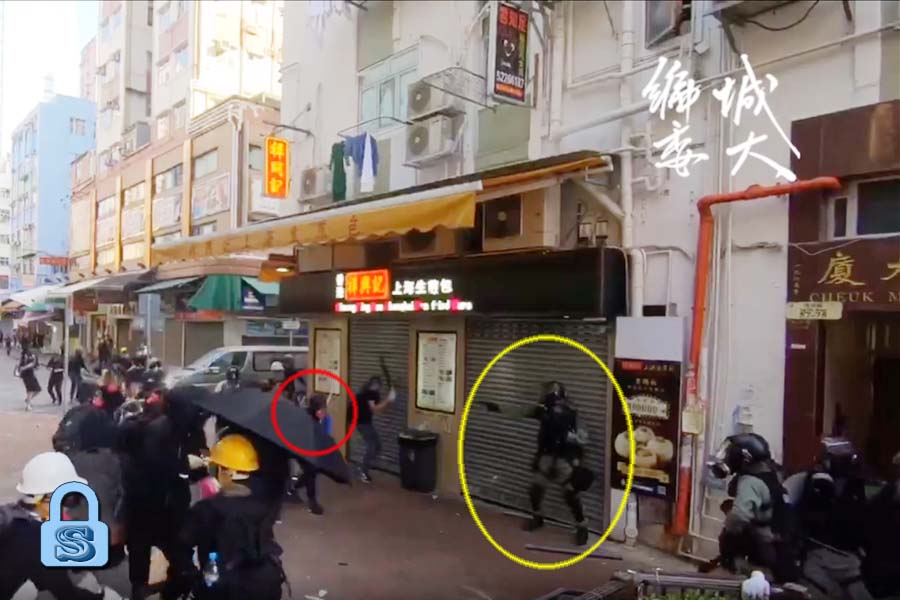
On Oct. 1, a Hong Kong police officer shot an 18-year-old protester, a secondary school student, in the chest at close range in the Tsuen Wan district of Hong Kong’s New Territories. This was the first instance where a protester was hit by police live ammunition in four months of anti-extradition bill protests. According to news and social media reports, many people in Hong Kong, and particularly the schoolmates of the teenager who was shot, were incensed by the shooting incident.
Hong Kong police chief Stephen Lo said that the shooting was lawful and fair. “Police lives were under serious threat, that’s why they fired live rounds,” he said during a press conference.
Videos of the shooting incident reveal a more complicated reality. Several khaki-clad policemen had chased a group of protesters in black to the storefront where the shooting occurred. The policeman in question held what looked like a non-lethal projectile rifle in his left hand and had his pistol already drawn in his right hand while he was chasing the protesters. After the policeman took a kick at the group of protesters who were scuffling with another group of officers, the teenage protester who was later shot swung a metal rod at the policeman’s pistol-wielding arm in what appeared to be a move to disarm him. The protester’s rod brushed the policeman’s arm while the policeman took a half step back before shooting the protester in the chest.
On the same day, police in the Causeway Bay area, Nathan Road, and the Wong Tai Sin district were heard and spotted firing live ammunition. Petrol bombs were thrown at several MTR subway stations, while Chinese banks and businesses that backed China were targeted with anti-Chinese Communist Party graffiti. On social media, photos of elementary school-aged boys and girls being arrested for protesting made the rounds.
The backdrop:
The Oct. 1 shooting incident coincides with the CCP’s grand celebration on Tiananmen Square to mark the 70th anniversary of the founding of the People’s Republic of China.
At the time of writing, the White House has not commented on the Hong Kong shooting. Both the United States House and Senate foreign affairs committee expressed concern over the use of live ammunition against protesters.
Early on Oct. 1, United States President Donald Trump tweeted, “Congratulations to President Xi and the Chinese people on the 70th Anniversary of the People’s Republic of China!”
Our take:
When viewed in isolation, the shooting incident is barely defensible from the perspective of the Hong Kong police. The shooting, however, is indefensible and highly suspicious when viewed in the larger context of police firing live ammunition in several spots in Hong Kong in situations where non-lethal crowd dispersal methods were previously preferred.
We believe that classic CCP suppression tactics and the factional struggle are two factors which very likely influenced the ease at which the Hong Kong police resorted to using live ammunition.
In mainland China, security forces typically step up intimidation or arrest dissidents and persecuted persons around so-called “sensitive dates” for the CCP regime. The idea behind the increased “stability maintenance” is to suppress potential “troublemakers” and create a climate of terror so that the Party can pass its “sensitive dates” without incident. The CCP appears to have exported its classic suppression tactic to Hong Kong to deal with the protests in the lead up to the PRC founding anniversary celebrations. This is evidenced by the Hong Kong police utilizing increasingly hardline measures and stepping up arrests in the lead up to Oct. 1 (we wrote about this in early September). Given the trajectory of protest suppression in Hong Kong, we do not rule out the possibility that the police and security forces were given permission to fire live ammunition on Oct. 1 if they deemed it necessary to “maintain stability.”
While ramping up suppression in Hong Kong is classic CCP behavior, publicly available information suggests that the Xi leadership might not approve of incidents that would lead to a Tiananmen-style incident. In interviews with overseas Chinese language media in August and September, CCP princelings (紅二代) with access to Xi Jinping said that the Chinese leader wanted those who “provoked trouble” in Hong Kong to resolve it without adding “pressure again for the central government,” and that Xi did not want to see bloodshed in Hong Kong. Also, a former CCP official turned Hong Kong businessman who began his acquaintance with Xi in the 1980s told Hong Kong’s Apple Daily in August that the Xi Jinping he knew would not order shootings in Hong Kong owing to Xi’s personal character, as well as strategic considerations. We believe that publicly available information about Xi’s unwillingness to open fire on protesters to quell the protests is credible because it is in line with his past behavior and interests. And if our assessment is accurate, it follows that the Jiang Zemin faction, which stands to gain a decisive advantage in its factional struggle with the Xi camp should shootings in Hong Kong lead to a Tiananmen-style event, is strongly suspect in the Oct. 1 shooting incident.[1]
What’s next:
1. The CCP will likely double down on creating a climate of fear in the city. That means more protester arrests and escalated use of brutal suppression tactics by the Hong Kong police and other security forces in the city. Local triads, pro-CCP groups, and mainland groups can be expected to step up their intimidation of and violence towards protesters. The level of American and international attention to Hong Kong in the coming days, weeks, and months will affect the level of violence which the CCP will feel comfortable in using to suppress the protests.
Concurrently, the CCP will continue with its existing strategies (“advancing to retreat,” “chain stratagems,” “judo move”) to manipulate international sentiment on the Hong Kong issue and reassert its control over the city. The CCP strategies which we previously analyzed can be seen clearly from Hong Kong leader Carrie Lam’s recent opinion piece in The New York Times and Andrew Nathan’s Foreign Affairs piece on how China sees the Hong Kong crisis.
2. The Xi leadership could sacrifice Jiang faction officials in charge of Hong Kong if the CCP regime faces very strong pushback from the Hong Kong people, the international community, and the United States (especially if the Hong Kong Human Rights and Democracy Act of 2019 passes Congress), and if the Hong Kong situation affects Beijing’s efforts to influence the 2020 Taiwan presidential election.
Zhang Xiaoming, director of the State Council Hong Kong and Macau Affairs Office, faces very high levels of political risk.
3. The Oct. 1 shooting incident will likely spur more people in Hong Kong to side with the protesters and galvanize the protest movement. A Black Swan event for the Chinese regime could be just around the corner.
Notes
[1] Readers might find it hard to picture how factional struggle in the CCP elite ranks can lead to a shooting incident in Hong Kong. Picturing this development requires deep understanding of the Jiang-Xi factional struggle and CCP operations.
For the Jiang faction to sway the Hong Kong police, it needs control over the central political and legal affairs apparatus as well as an informal PRC-Hong Kong police liaison system. From our research, we have reason to believe that the informal liaison system has already been established to control the mainland security forces embedded in the Hong Kong police. This informal liaison system would likely take orders from the Ministry of Public Security, which is led by Xi ally Zhao Kezhi. In turn, the MPS is directed by the Central Political and Legal Affairs Commission, which is headed by Jiang faction member Guo Shengkun. Because Zhao Kezhi was only appointed public security minister in 2017 and his predecessors were all Jiang faction members (Guo Shengkun, Meng Jianzhu, and Zhou Yongkang), the public security system today remains heavily tainted by Jiang faction influence; the Xi leadership very likely has limited control over how the public security system interprets and implements Xi Jinping’s orders even though a member of the Xi camp (who hardly has any public security experience) is now in charge. Thus, the Hong Kong police would likely be guided by orders from a CCP political and legal affairs apparatus that is still largely in the Jiang faction’s control.
To see a police shooting incident in Hong Kong, the Jiang faction has to first create the conditions that would allow for shootings to occur “naturally” so that they cannot be faulted for it later. And for shootings to occur “naturally,” a) the Hong Kong police must be infiltrated and paranoid about protester violence, while b) the protesters must be infiltrated, eager to escalate clashes with the police, and become more prone to violence. The following incidents leading up to the Oct. 1 shooting would have created the required conditions:
- On Sept. 16, Junior Police Officers’ Association chairman Lam Chi-wai issued a statement condemning protesters who hurled Molotov cocktails and petrol bombs at the police on Sept. 14 and Sept. 15. “When a rioter raises a petrol bomb to prepare to throw it, police officers on scene may very likely see it as a deadly attack upon them or others, and use relevant force or a weapon to stop it, including live ammunition,” he wrote. Lam also urged the police to “decisively use” force to protect themselves and others. “According to the police force’s guidelines on the use of force, in order to control the situation, officers can use force one level higher than the opponent,” he wrote.
- On Sept. 23, Lam Chi-wai issued another letter condemning protesters who tried to grab a police officer’s weapon in self-defense during demonstrations over the weekend. “Police pistols are our second lives when we are on duty. If our pistols are grabbed, it means that our lives are in danger,” he wrote. “Rioters, are you really mentally prepared to threaten police or other people’s lives? Regardless of whether you have this mental preparation, if you take this step, we will have to make the sole and necessary decision when we have no choice. Please think carefully,” Lam added without elaborating on what the “necessary decision” was.
- On Sept. 27, the popular Hong Kong radio station D100 Radio interviewed a retired police academy instructor. The instructor said that based on her observation, many incidents involving protesters throwing Molotov cocktails or petrol bombs were actually carried out by young undercover police who just graduated from the police academy.
- On Sept. 28, Ta Kung Pao, a pro-CCP Hong Kong media, ran a lead article which asserted that “violent protesters” were planning to launch “terror attacks” before Oct. 1. The article claimed that the “terror attacks” include destroying public property, self-immolation, killing police officers, posing as policemen to kill residents, etc. The article also claimed that the Hong Kong police have at least 5,000 officers on standby, with many first and second-line officers having canceled their holidays to prepare for trouble on Oct. 1.
- On Sept. 29, Hong Kong netizens circulated a “protester statement” which refuted “rumors” accusing protesters of carrying out “terror attacks.” Protesters will never “wantonly plunder and harm innocent residents” and will not “arbitrarily destroy shops aside from those who support the [Chinese Communist] Party,” the statement read.
On Sept. 29, several media outlets filmed riot police escorting away over a dozen “protesters” who had just set fire to an MTR station. The fact that the riot police helped the “protesters” evacuate the scene instead of arresting them led many to believe that the “protesters” were undercover cops.
With the Hong Kong police in a paranoid state, they would be more likely to draw weapons on the protesters in the heat of the moment. And if the police were granted permission from their higher-ups to use live ammunition “when necessary” to carry out “stability maintenance” work, then it was only a matter of time before the police shooting took place on Oct. 1. The Hong Kong police higher-ups would be taking orders from PRC public security agents, who would in turn have received their guidance from the Jiang faction-controlled central political and legal affairs apparatus.