
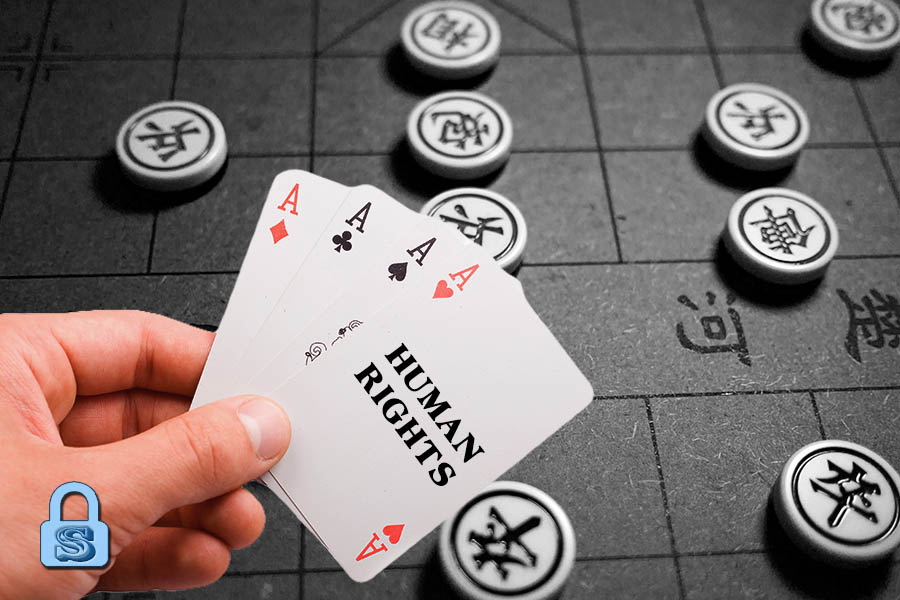
◎ The Trump administration has moved to challenge the regime on Huawei, human rights and Taiwan, as well as strengthen alliances and partnerships in the Indo-Pacific.
The Chinese regime reacted to increased United States tariffs and the breakdown of Sino-U.S. trade talks in May by defaulting to Party orthodoxy—fanning anti-U.S. sentiment, playing up nationalism, and again refusing to admit to its trade and intellectual property transgressions.
In response, the Trump administration has moved to challenge the regime on Huawei, human rights and Taiwan, as well as strengthen alliances and partnerships in the Indo-Pacific.
We look at some noteworthy U.S. actions aimed at the Chinese regime:
Huawei
See our earlier analysis here and here.
Human rights
May 31
- Minghui.org, a Falun Gong-run clearinghouse for information about the Chinese Communist Party’s persecution of the spiritual discipline, said in a notice that “an official from the U.S. Department of State recently told various religious groups that the U.S. government is imposing stricter visa vetting and may deny visas to human rights violators and perpetrators of religious beliefs.” The official also “specifically told Falun Gong practitioners that they can submit a list of perpetrators involved in the persecution of Falun Gong.”
- The Minghui notice comes 11 days after FOX 11 Los Angeles aired a special investigative report on the persecution of Falun Gong in China. FOX 11 journalist Bill Melugin and editing engineer Tony Ruiz are finalizing an upcoming film on the persecution titled “Sister’s Salvation,” according to The Epoch Times. Based on our research, mainstream media outlets in the U.S. like Fox News very rarely report on the CCP’s two-decade-long persecution campaign against Falun Gong.
Taiwan
May 11
- According to a report by ABC 7, 200 Marines from the 2nd Battalion, 23rd Marine regiment had just returned from a six-month deployment to four countries, including Japan, Korea, Taiwan, and the Philippines.
May 14
- U.S. Coast Guard cutter Bertholf and two Philippine coast guard vessels practiced search-and-rescue procedures near Scarborough Shoal.
May 20
- The U.S. Navy guided-missile destroyer USS Preble sailed within 12 nautical miles of Scarborough Shoal.
May 21
- Taiwan begins a joint air-sea military drill as part of its 35th annual Han Kuang exercises. The drill simulates repelling a PRC invasion of the island.
May 22
- The USS Preble and oiler USNS Walter S. Diehl sailed through the Taiwan Strait.
May 25
- Taiwan’s foreign ministry said in a statement that Taiwan’s National Security Council secretary general David Lee met with U.S. National Security Advisor John Bolton when the former visited the U.S. from May 13 to May 21. This was the first meeting between the national security chiefs of both countries since the U.S. recognized the People’s Republic of China over the Republic of China in 1979.
- Taiwan’s foreign ministry announces that the Coordination Council for North American Affairs, Taiwan’s de facto embassy in the U.S., will be renamed the Taiwan Council for US Affairs to “better reflect” its role in coordination U.S.-Taiwan matters.
Indo-Pacific
May 25
- U.S. President Donald Trump arrives in Japan for a four-day trip.
May 28
- President Trump and Japan prime minister Shinzo Abe address the U.S. Navy and the Japanese Maritime Self-Defense Force aboard the Japanese helicopter carrier Kaga. Trump is the first U.S. president to board a MSDF vessel.
- Aboard the JS Kaga, Trump said that Japan recently announced its intent to purchase 105 new F-35s from America and that the Kaga would be upgraded to carry those fighter planes. With the purchase, Japan would own the most F-35s among America’s allies.
- Abe said, “The Japan-U.S. alliance has become more robust than ever under the great partnership that President Trump and I have developed. The fact that we stand together on board the JS Kaga today is a testament to such a robust alliance.”
- In an interview with Fox Business Network, U.S. Secretary of State Mike Pompeo said that America is spending “a great deal of time” on making the “right strategy” on China. He added that the U.S. will share the strategy with “Singapore, Vietnam, all of these countries in East Asia and Southeast Asia” to ensure that those countries “understand these risks so that they can be part of the team, part of the alliance that pushes back against this Chinese threat.”
June 1
- The U.S. Department of Defense unveils its Indo-Pacific Strategy Report, which affirms the U.S. commitment to promoting “stability and prosperity in the region through the pursuit of preparedness, partnerships, and the promotion of a networked region.” Like the 2017 National Security Strategy, the report also refers to the PRC as a “revisionist power.”
Our take:
1. In 2018, we noted several times that the U.S. would play the human rights and Taiwan card, as well as ramp up the Indo-Pacific strategy, as it struggles to resolve trade issues with the Chinese regime.
In our China 2019 outlook, we also noted that:
- The US. will continue challenging the CCP on human rights and religious freedom issues. Key perpetrators of persecution in China could face U.S. sanctions.
- The U.S. could increase its military presence in the Indo-Pacific region. The U.S. military could hold more joint military exercises with countries in the Indo-Pacific, but may cut back on exercises with China.
- The U.S. will likely move to strengthen and deepen its relationship with Taiwan economically, politically, and militarily. For instance, the U.S. may sell advanced weaponry to Taiwan, and U.S. warships may dock in Taiwan.
- A Black Swan event could tip the Sino-U.S. confrontation in America’s favor, and produce one of two opposite outcomes in China.
The developments in recent weeks that we have highlighted in the previous section have either verified our predictions or put our predictions on track to being verified.
2. The U.S. is pressing on the Chinese Communist Party’s vital points by targeting Huawei, playing the human rights and Taiwan card, as well as strengthening alliances and partnerships in the Indo-Pacific. America’s attack on the Party’s vital points would trigger the latter’s survival instincts and force the Chinese regime to move in a leftward direction as it defaults to Party orthodoxy. This makes confrontation inevitable and virtually dooms the prospect of successful trade negotiations as long as the CCP rules China.
3. We believe that there are two reasons why the CCP has defaulted to Party orthodoxy (i.e. when in doubt, leftism is always right) in responding to the U.S. tariffs and trade talk breakdown. First, the CCP lacks effective countermeasures in an intensifying trade war with America. Second, the escalation in the CCP factional struggle has curbed Xi Jinping’s authority and allowed the Party’s “collective leadership” to dictate the Chinese regime’s U.S. policy.
What’s next:
1. Given the current trajectory in Sino-U.S. relations, the odds of a trade agreement being reached are slim to none. There is still a possibility that Trump and Xi Jinping could grow their personal relationship at the G-20 summit in June and negotiate something privately to end the trade stalemate. In this scenario, Xi must be prepared to resolve the CCP factional struggle decisively in his favor (end the Jiang faction by arresting Jiang Zemin and Zeng Qinghong) and contemplate a post-communist China in order to finalize any trade deal with the United States.
For leading indicators on the state of Sino-U.S. relations in the event of a Trump-Xi meeting at the G-20, contact us.
2. A U.S. decision to go ahead with an additional 25 percent tariffs on $300 billion worth of Chinese goods after June 24 would be disastrous for the rapidly weakening Chinese economy. The CCP’s political legitimacy, which is tied with economic performance, would take a huge hit in the event of an economic crisis, and the Chinese regime would become endangered.
Per Party characteristics, the CCP would do whatever it takes to survive (unscrupulous tactics, unimaginable sacrifices, etc.) instead of resigning itself to fate. For an idea of the sort of strategies or tactics which the CCP might pursue, please see our forthcoming analysis.
 [wpdreams_rpp id=0]



