◎ Should current trends hold, the Trump-Xi meeting at the G20 will likely do little to prevent an escalation of the Sino-U.S. “new cold war.”
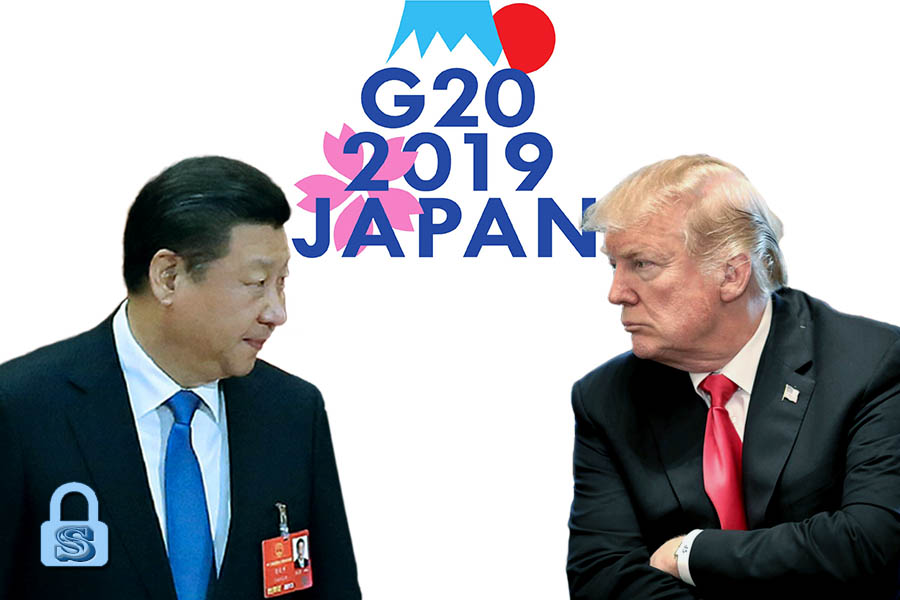
United States President Donald Trump and Chinese leader Xi Jinping are presently scheduled to have an “extended meeting” at the G20 summit in Osaka (June 28 – June 29). “Our respective teams will begin talks prior to our meeting,” Trump said in a tweet announcing the meeting on June 18.
On the U.S. side, the Trump administration has made moves and signals which indicate that it is not yet ready to ramp up the pressure on the Xi leadership in considering the fractious political situation in the Chinese regime. Meanwhile, Chinese Communist Party propaganda and rhetoric continues to be tough on America, with a few exceptions.
Should current trends hold, the Trump-Xi meeting at the G20 will likely do little to prevent an escalation in the “new cold war” between China and the United States.
The backdrop:
Tough CCP propaganda
The CCP propaganda apparatus (state media, paid internet trolls, etc.) and various ministries started issuing tough rhetoric on America after Trump announced a plan to impose tariffs on all Chinese goods and raise tariff rates in early May. Notable narratives and actions include:
- China won’t back down in the face of “maximum unilateral pressure” by the U.S., and the U.S. will “absolutely not succeed”;
- America wants a trade conflict with China because it is struggling with “economic imbalances” and a widening rich-poor gap at home. Also, U.S. politicians are targeting China to gain “political capital”;
- The People’s Daily published a series of commentaries which criticizes U.S. strategy towards China as “misguided hegemonism,” warns of the dangers of the “Thucydides Trap” to the globe, and claims that China’s economy can withstand American pressure;
- China’s tourism ministry issued travel alerts for citizens traveling to America, citing recent cases of “shooting, robbery and theft”;
- State broadcaster CCTV aired anti-U.S. Korean War films;
- Increase in online anti-U.S. rhetoric by the CCP’s “50-cent army.”
There were also noticeable “gaps” in the tough messaging:
- Speaking with Russian president Vladimir Putin at a forum in St. Petersburg on June 7, Xi Jinping said, “It’s hard to imagine a complete break of the United States from China or of China from the United States. We are not interested in this, and our American partners are not interested in this. President Trump is my friend and I am convinced he is also not interested in this.” This was the first instance of Xi publicly hailing Trump as his friend.
- On June 18, CCTV canceled a comedy scheduled for June 19 to air a Second World War romance film titled “Lover’s Grief over the Yellow River.” The film depicts a U.S. Air Force pilot falling in love with a Chinese nurse from the Eight Route Army. Trump had announced his “extended meeting” with Xi on June 18.
The CCP, however, has not deviated from the recent tough messaging. On June 21, Guo Shuqing, the head of the China Banking and Insurance Regulatory Commission and Party secretary of the People’s Bank of China, published an article in the People’s Daily that denies all accusations of unfair trading practices made by the U.S. and other countries:
- Guo denies the accusation that the Chinese regime steals technology and engages in forced technology transfers;
- Guo denies the existence of “state monopoly capitalism”;
- Guo denies that the CCP intervenes in private enterprises through Party organizations;
- Guo believes that the impact of additional U.S. tariffs on the Chinese economy would be very limited.
Trump tolerance
The Trump administration has blamed Party “hardliners” for the breakdown of Sino-U.S. trade negotiations and has avoided being overly critical of Xi Jinping:
- Both Democratic and Republican lawmakers have been very critical of Beijing and the Hong Kong government over the latter’s effort to ram through a controversial and very unpopular extradition bill. U.S. lawmakers have also slammed the Hong Kong police force for using excessive violence against protestors and are pressuring President Trump to take a tougher stance on the Hong Kong situation. However, Trump has refrained from making critical statements. Instead, he told reporters on June 12 that he “hope it all works out for China and for Hong Kong. I understand the reason for the demonstration, but I’m sure they will be able to work it out.”
- In an interview with Fox Business on June 17, Trump’s China advisor and “Hundred-Year Marathon” author Michael Pillsbury said that there is a “50 percent” chance that Xi and Trump would have a “private conversation” at the G20 before ordering their trade teams to continue with negotiations. But Pillsbury also noted that “President Xi has got politics” and has to “play to the Maoists” and “powerful hawks in China.”
- When asked about why the Chinese side reneged on trade negotiations during a congressional committee meeting in Washington on June 19, U.S. Trade Representative Robert Lighthizer said, “My speculation is that some forces in China decided that they had gone too far, went out beyond their mandate.” Lighthizer added that he had “trust and complete good faith” in the Chinese negotiators he was working with.
- On June 21, Bloomberg News reported that U.S. Vice President Mike Pence and President Trump decided to postpone a speech by Pence planned for June 24 that will criticize the Chinese regime’s human rights record until after Trump and Xi meet at the G20.
Our take:
1. The hardline messaging in CCP propaganda reflects the current dominance of Party orthodoxy in the Chinese regime. As we have written in previous analyses, the CCP clings to orthodoxy when it feels existential danger, and the Chinese regime is presently facing a perfect storm of problems. Also, Party cadres have a tendency to err on the side of Party orthodoxy (i.e., better left than right) during the Xi era because Xi consolidated power in the only way that is possible in the regime, i.e. by adhering to and promoting leftism and Party orthodoxy.
While we believe that Xi Jinping had been “signaling left to turn right,” it seems virtually impossible for him to make reform-minded moves (structural reforms, market liberalization, etc.) in the current political climate. First, the Party prioritizes survival above all and will not tolerate structural reforms because they entail the end of the Party. Second, Xi derives his power from the Party and cannot deviate too much from Party orthodoxy without undermining his own authority. Third, Xi’s rivals such as the Jiang faction and other CCP interest groups are bound to “weaponize” Party orthodoxy against Xi by forcing him to make hardline, “politically correct” moves instead of utilizing flexible strategies to resolve domestic and foreign issues.
The third point is worth unpacking. Once Xi is forced into conflict with the United States after his political rivals demand his compliance with Party orthodoxy, he is bound to come under immense pressure for “ruining China.” Xi’s rivals would then have the perfect excuse to compel him to restore the “collective leadership” (and thereby control him like how Hu Jintao was controlled) or even oust him from office. After Xi is removed or sidelined, his rivals will almost certainly drop the “hardline” stance and announce a “return to normalcy” in the Chinese regime. The regime might even find a way to sign a trade deal with America. But the regime will utilize classic CCP delaying tactics to hold off on implementing trade commitments while finding ways to undermine the Trump administration; after all, Jiang faction officials oversaw China’s entry to the World Trade Organization in 2001 as well as the Chinese regime’s failure to deliver on WTO commitments. After the CCP weathers its internal and external problems, it would again focus its efforts on global domination. Hence, Xi might not be in charge, but America and the world would still have to deal with the CCP threat in the long run.
There is a possibility that Xi Jinping agrees to make concessions to the U.S. to seal a trade deal. In this scenario, he must move rapidly to eliminate his political rivals and other “hardliners.” Otherwise, the “hardliners” will likely accuse Xi of “forfeiting sovereignty and humiliating the country” (喪權辱國) and find ways to force him to step down. Because the “hardliners” used Party orthodoxy to remove Xi, however, they will be forced to get tough on America. Sino-U.S. tensions will only intensify. Based on our assessment, Xi does not presently appear to have the confidence to suppress his political rivals and other “hardliners” in the Party. Hence, we believe that Xi will more likely maintain the regime’s tough stance on America in response to additional tariffs.
2. We believe that there are several reasons why the Trump administration has been relatively “soft” on Xi Jinping thus far:
First, Trump and Xi might have a consensus on taking the Sino-U.S. relationship in a positive direction and other issues during their face-to-face meetings in 2017. That is likely why Trump has been consistent in praising Xi and describing him as his friend, and why Xi has finally reciprocated at a crucial time.
Second, Trump might want to meet Xi at the G20 to know what he is really thinking and whether they still share their consensus before adding more tariffs and escalating the “new cold war.” In other words, Trump could be giving Xi another chance to explain why Beijing reneged on trade discussions and how the decision would affect future negotiations.
Third, the Trump administration might feel that Xi is capable of carrying out structural reforms and fundamentally resolving long-standing issues in U.S.-PRC relations, but not his “hardline” political rivals. Putting excessive pressure on Xi at the wrong time could lead to his ouster, and the Trump administration might be less keen on restarting trade talks with Xi’s “anti-American” successors.
Finally, the Trump administration might not have ideal solutions to the problems that might result from a maximum pressure campaign against the Chinese regime:
- Economic, financial, technological, and scientific “decoupling” of America and China;
- China could dump U.S. Treasurys and stock;
- Full-blown trade war leading to a global financial crisis and recession;
- Public blowback against the Trump administration as tariffs take its toll;
- A technology war;
- A currency war;
- A clash of civilizations;
- Global supply chain problems;
- Global food and energy problems;
- Global immigration, refugee, and humanitarian crises;
- Military friction in the Indo-Pacific and the Middle East, including proxy wars;
- A hot war, including nuclear risks.
What’s next:
1. In the best case scenario, President Trump and Xi Jinping could reach a trade truce at the G20 and “reboot” the trade talks. Trump could even delay the implementation of additional tariffs and the Chinese regime could dial down the anti-U.S. rhetoric.
Given the CCP factional struggle and the political climate in the Chinese regime, however, we believe that any truce would be short-lived. We expect the Trump administration to go ahead with tariffs in the second half of 2019 and for Sino-U.S. tensions to ratchet up.
2. We believe that there is a good chance that Trump will impose tariffs after the G20 summit regardless of the outcome of his meeting with Xi. The U.S. could also play the human rights card by sanctioning individual Chinese officials for the crackdown in Xinjiang and the persecution of other religious groups.
3. A long “private meeting” between Xi Jinping and Trump could lead to unexpected outcomes. For our thoughts on what could happen after a lengthy private Trump-Xi meeting, contact us.