
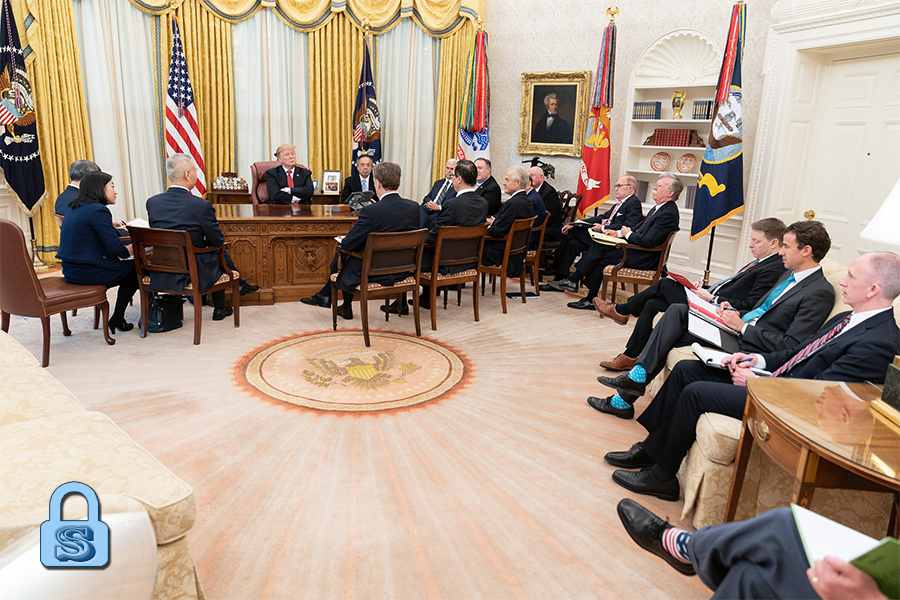
◎ America could have the ZTE model in mind in enforcing the trade deal.
Enforcement was the watchword at the meeting between U.S. President Donald Trump and his cabinet and Chinese vice premier Liu He and his team at the White House on Jan. 31.
U.S. Trade Representative Robert Lighthizer said that the “two very intense, very long days of discussions” were focused on “structural issues and the protection of U.S. intellectual property, stopping forced technology transfer, intellectual property protection, agriculture and services issues, and enforcement, enforcement, enforcement.”
“Both sides agree this agreement is worth nothing—if we can get an agreement, it’s worth nothing without enforcement,” he said, adding that enforcement was Trump’s instruction “from the beginning.”
In his remarks, Liu He affirmed that the two-day discussions revolved around the three key themes of “trade, structural issues, and enforcement.”
Our take:
1. The emphasis on enforcing a Sino-U.S. trade deal by both sides recalls the spirit of the ZTE “probation.”
After U.S. Commerce Secretary Wilbur Ross announced a strict compliance deal to replace the business ban imposed on ZTE in June 2018, we wrote that the “ZTE deal illuminates and foreshadows developments on three fronts: Sino-U.S. trade talks, U.S. national security interests, and China’s political and economic situation.”
A similar dynamic appears to be in play as the U.S. and the Chinese regime work out a bilateral trade deal.
2. We previously wrote that the ZTE “probation” is “entirely consistent” with the Trump National Security Strategy and “could later be regarded as an important milestone by the U.S. in advancing national security interests in dealings with China.”
Robert Lighthizer has made it clear that any trade deal between the two countries should be enforceable, and enforcement is a “foundational issue,” according to several news reports. Put another way, the U.S. does not trust the Chinese Communist Party regime to uphold any bargain, and will likely only go ahead with a deal if Beijing agrees to use an enforcement mechanism that protects America’s national interest and allows Washington to have the final say.
In the above scenario, it is not inconceivable that Washington ports a version of the ZTE “probation” model for inclusion in the final trade agreement. That could mean the setting up of a “trade compliance and enforcement commission” that manages U.S. enforcement teams on the mainland and is answerable to U.S. government agencies responsible for trade and even finance. The new trade agreement could contain a clause which allows the U.S. to reinstate tariffs and impose other strict penalties should China fail to comply with the deal or find ways to circumvent it. Meanwhile, China could start purchasing large quantities of U.S. agricultural and other goods as a sign of good faith; Liu He told Trump in their Jan. 31 meeting that China has agreed to buy 5 million metric tons of soybeans.
3. We wrote in June 2018: “The embedded U.S. compliance team in ZTE would give the CCP much psychological stress and present all sorts of headaches for CCP propagandists. But for the CCP propaganda apparatus, the problems of selling the new ZTE deal should pale in comparison to explaining to the public why a “national champion” collapsed ignominiously.”
Similarly, the presence of a U.S. “trade compliance and enforcement commission” in China will give Beijing severe headaches. CCP propagandists will likely have to be extra creative in crafting reasons for why the regime is allowing America to get away with a form of “extraterritoriality.” However, the Xi leadership could be willing to accept a “humiliating” U.S. enforcement mechanism if it means that it can forestall the development of existential crises (economic collapse due to trade war escalation, political coups, etc.). With China’s worsening economic situation and the escalation in the CCP factional struggle, Beijing may not have much choice on the enforcement issue.
4. Should Xi Jinping allow the U.S. to set up a strict enforcement mechanism as part of the trade deal, his political rivals and interest groups will almost certainly step up the pressure against his leadership. Domestic political interference may result in a situation where the Chinese regime cannot meet, or even blatantly flouts, the terms agreed in the trade deal regardless of the personal guarantees Xi makes to Trump.
Hence, Xi and his supporters face very high levels of political risk even if China reaches a trade agreement with the United States.




