
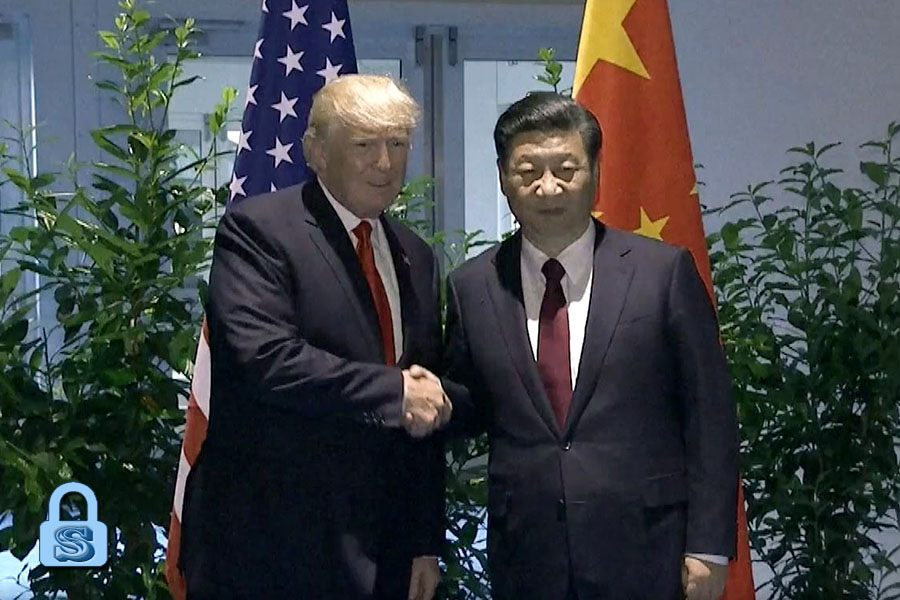
◎ Xi has pressing need to compromise, and Trump will not accept a “superficial” trade deal.
Most observers agree that both United States President Donald Trump and Chinese leader Xi Jinping want a trade deal. Some speculate that any deal between China and the U.S. will be “superficial.” Others argue that it is impossible for a deal to be reached given America’s demands for the Chinese regime to make structural reforms and the Chinese Communist Party’s likely unwillingness to compromise. Still others encourage the Trump administration not to “take the easy way out” by signing a trade deal and hence “squander” leverage over China.
Our take:
1. We believe that it is very likely that Trump and Xi are both looking to sign a broad framework trade agreement by the 90-day negotiation deadline of March 1. While the agreement might be broad, we believe that it will satisfy U.S. demands on issues like intellectual property theft, forced technology transfers, structural reforms, and an enforcement mechanism to ensure that the CCP regime follows through on its pledges.
Given the Trump administration’s stance on China, we believe that it is highly unlikely that Trump will sign a “superficial” deal. And given that the CCP will do anything to survive, there is a very good chance that Xi will offer huge concessions at the last minute to avert raised tariffs, rescue the Chinese economy, and prop up the regime’s political legitimacy.
2. In meeting Chinese vice premier Liu He in the Oval Office on Jan. 31, Trump suggested that he will be meeting Xi “maybe once and maybe twice” over the trade deal. About a week later, a White House official said that it would be “highly unlikely” that Trump and Xi will meet before the March 1 deadline, according to The Wall Street Journal. However, in an interview with Fox News on Feb. 11, White House senior counselor Kellyanne Conway said that Trump “wants to meet with President Xi very soon” and that he “wants a deal.” Trump has indicated that the trade deal will only be finalized in a meeting between him and Xi Jinping.
Trump’s “flip-flop” on meeting Xi seems to be a variant of the pressure tactic which he used against North Korean leader Kim Jong Un. In May 2018, Trump abruptly canceled his summit with Kim in Singapore after Pyongyang showed recalcitrance to the United States. He later rescheduled the Singapore summit after Kim showed good will.
In the case of the Sino-U.S. trade deal, Trump may feel that he has enough leverage over China to rehash the pressure tactic which he used against Kim on Xi. By first shutting the door on meeting Xi before the trade negotiations deadline and then indicating that he wants to meet Xi “very soon,” Trump seems to be signaling to Xi that the Chinese leader just might be able to forestall increased tariffs if he acts fast in signing a trade deal that fulfills U.S. demands.
3. We analyzed in April 2018 that China cannot withstand a trade war. Poor official Chinese economic data, as well as U.S. businesses releasing weaker fourth-quarter results and lower 2019 earning projections, indicate that our analysis is on track.
China’s rapidly worsening economy is a severe crisis for Xi Jinping and the CCP.
Because Deng Xiaoping tied the Party’s political legitimacy to economic performance, the CCP needs to rescue the economy to ensure regime survival. To stabilize and rescue the economy, the CCP must first convince America not to increase tariff rates or impose additional tariffs. And because Party culture is based on “deceit, malice, [and] struggle,” the CCP will have no qualms about giving up “untouchable national interests” and sacrificing “national honor” so long as it can catch its breath and live to fight another day. Because the CCP is shameless, Party propagandists only have to be especially shrewd when spinning narratives to cover up major concessions made by the regime to the United States.[1]
For the CCP, the ideal scenario would see it drag out negotiations for and implementation of the detailed trade agreement for as long as possible. The Party would likely seek to delay real structural reforms until close to the 2020 U.S. presidential election. Like the 2018 U.S. midterm election, the CCP will be gambling on a favorable result in the 2020 presidential election to perhaps de-escalate Sino-U.S. tensions. Thus, the Party would likely want to appear to concede heavily to Trump, but not actually give up anything substantial for the rest of his first term in office. Based on our estimation, the CCP has an extremely low chance of attaining its ideal scenario, but low odds are infinitely preferable to higher tariff rates and an escalation in the trade war after March 1 given that regime survival is at stake.
Xi Jinping also needs to prevent an escalation in the trade war to preserve his position. With a trade deal, Xi will come under immense pressure from hardliner political foes (the Jiang faction and other interest groups) for “selling-out” the regime, but could gain sufficient breathing space to subdue internal dissenters and successfully ram through structural reforms in China. Without a trade deal, the Chinese economy will likely deteriorate more rapidly, and Xi is at high risk of being ousted by rivals in the name of “bringing order out of chaos” (“撥亂反正”). In both scenarios, the regime’s odds of survival will be greatly lowered.
China will likely wait until the midnight hour before agreeing to a trade deal that meets U.S. demands because Xi and the CCP need to show the Chinese people that the regime had at least bothered to “stand its ground” before “caving” to external pressure.
4. We see two possible scenarios playing out:
a) Trump and Xi sign a deal by March 1
- Chinese and U.S. officials would make little headway in their discussions when they meet in Beijing in the week of Feb. 11;
- Xi Jinping makes a “shock” move in the final week of February by communicating his intention to Trump that China would meet U.S. demands (a repeat of Xi’s personal promise to Trump at the dinner table in Argentina);
- Trump trusts Xi, and both leaders meet before or on March 1 to sign a trade deal;
- Xi and Trump could meet in Hainan for the signing as proposed by the Chinese side. Having the signing in Hainan would signal that Xi is genuine about reform due to earlier plans to liberalize the province;
- If Trump is confident about the enforceability of the agreement, he may give Xi “face” by allowing the signing to be held on Chinese soil. In fact, Trump showing “face” to Xi will give the latter a slightly easier time in fulfilling his side of the bargain;
- There is a low probability of the trade deal signing being held in Vietnam or Florida.
b) Trump and Xi sign a deal after March 1
- Chinese and U.S. officials would make little headway in their discussions when they meet in Beijing in the week of Feb. 11;
- Xi Jinping makes a “shock” move in the final week of February by communicating his intention to Trump that China would meet U.S. demands;
- Both leaders are only able to meet after March 1 to sign a trade deal. This may be due to genuine scheduling difficulties (the second Trump-Kim summit is being held in Vietnam from Feb. 27 to Feb. 28), or lingering concerns in the Trump administration;
- Trump might or might not raise tariff rates on the March 1 deadline;
- If Trump is confident about the enforceability of the agreement, he may give Xi “face” by agreeing to have the signing in Hainan. However, we believe that the probability of a Trump-Xi meeting in Hainan is lower than a meeting in Florida;
- The Trump administration will likely push for the Trump-Xi summit to be held on American soil.
Note
[1] Historically, the CCP has been very thick-skinned in sacrificing ideology and principles for the sake of survival:
- The CCP surrendered to the Kuomintang after the Xi’an Incident and formed a second United Front to fight the Japanese. The Red Army was reorganized into the New Fourth Army and the 8th Route Army, but both armies played minimal roles in the Sino-Japanese War. After coming to power, the CCP claimed credit “leading the fight against the Japanese.”
- Before Joseph Stalin’s death, the CCP upheld him as China’s “greatest father and beloved mentor” in propaganda material—a great insult to the Chinese people per the customs of traditional Chinese culture.
- The Great Leap Forward and the Cultural Revolution bankrupted the communist ideology and forced the Party under Deng Xiaoping to embrace capitalism. The CCP rebranded their abandonment of the Marxist doctrine as “Socialism with Chinese Characteristics.”




