

This analysis is from the Jan. 29, 2026 newsletter.
***
1 Why haven’t military units yet issued loyalty pledges in the aftermath of the Zhang Youxia probe
Oddities in the CCP’s reaction following the downfall of Zhang Youxia & Liu Zhenli?
As of the time of writing this report, Beijing’s handling of the purge of Central Military Commission vice chairman Zhang Youxia and chief of the Joint Staff Department of the CMC Liu Zhenli has been marked by several curious developments:
- On Jan. 24, the PLA Daily ran a front-page editorial that effectively set the political “verdict” on Zhang and Liu. The rapidity and harshness of the “verdict” suggested that the case against the two men was urgent and very serious.
- Also on Jan. 24, the Central Commission for Discipline Inspection and the National Supervisory Commission published a notice titled, “Zhang Youxia and Liu Zhenli Under Investigation for Suspected Serious Violations of Discipline and Law” (張又俠、劉振立涉嫌嚴重違紀違法被立案審查調查). However, the notice was later taken down.
- The names and photos of Zhang Youxia and Liu Zhenli still appear in the leadership section of the official CMC website.
- CCP official media, the PLA Daily, and the various theater commands have not issued commentaries or statements expressing support for the central leadership’s decision regarding Zhang and Liu. This contrasts with past cases involving investigations of senior PLA officers (see table below).
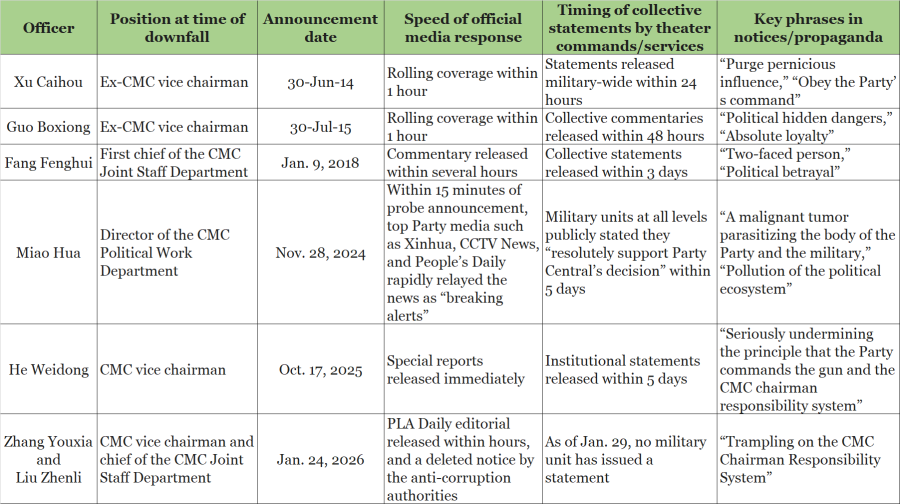
Rumors concerning Zhang’s case, panic in the PLA
Various rumors have been circulating in overseas Chinese-language circles and social since the probe of Zhang Youxia and Liu Zhenli became official, including:
- The CCP Central Committee and the CCDI have seconded more than 50 personnel to the PLA’s discipline inspection committee to assist with its work. It is expected that over 2,000 officers at or above division level will be “dealt with,” either through punishment, transfer to civilian posts, or retirement.
- A CMC internal announcement allegedly states that the entire PLA has been placed under “martial law,” with all units ordered to remain in place and prohibited from redeploying.
- All PLA units have reportedly entered Level One combat readiness (the highest level). As a result, all personnel have returned to their posts, and all external cellphone communications have been cut off.
- The PLA has reportedly “fallen into chaos” after Zhang’s detention. Officers at regimental and divisional levels and above were reportedly widely shocked that such a senior and well-established veteran commander could be taken down “so easily and within minutes,” triggering widespread panic. To avoid being “caught in the crossfire,” many regimental- and divisional-level officers reportedly submitted resignations or requests for transfer to civilian status. This was overwhelming to personnel departments, which could only forward the requests “layer by layer” up the chain.
- Xi Jinping reportedly demanded that group army commanders publicly state their support, but the commanders largely remained silent.
- Large numbers of videos that seemed to show “military vehicles heading into Beijing via expressways” circulated on mainland social media.
- Troops supporting Zhang Youxia were allegedly moving toward Beijing and confronting military police led by public security head Wang Xiaohong.
Regulations on the election work of military Party organizations
On Jan. 25, the CMC issued regulations on the election work of military Party organizations (軍隊黨組織選舉工作規定).
The Regulations, which will take effect on Feb. 1, 2026, called for:
- Upholding the guidance of Xi Jinping Thought.
- Actively adapting to the needs of building the Party’s organizational system in the military.
- Comprehensively standardizing election procedures for delegates to military Party congresses and Party member congresses, Party Committees and discipline inspection committees at and above the regimental level, as well as grassroots Party Committees, general branch committees, and branch committees.
Earlier on Dec. 27, 2025, the 19th meeting of the Standing Committee of the 14th National People’s Congress approved CMC vice chairman Zhang Shengmin as vice chairman of the PLA Election Commission. Zhang Youxia had previously served as chairman of the PLA Election Commission.
Our take
1. The lack of denunciation of the disgraced Zhang Youxia and Liu Zhenli in CCP official media and the various military units seems to contrast with Beijing’s past handling of senior officer purges. This reaction is less likely the outcome of an ongoing, fierce struggle playing out between Zhang camp holdouts and an embattled Xi leadership with an uncertain future for CCP elite politics, as some of the more storyful rumors claim, but more likely the result of the Xi leadership taking a leaf out of Mao Zedong’s handling of the Lin Biao incident.
After the Lin Biao incident on Sept. 13, 1971, Mao did not immediately demand vocal, large-scale declarations of loyalty and criticisms of his former number two from across the military. Instead, he first conducted a prolonged period of internal political cleansing and characterization (定性) to ensure that the PLA was properly rectified before he accepted their declarations. Mao probably believed that subjecting the military to an extensive “political physical examination” was necessary in light of the seriousness of Lin’s challenge to his authority and the need to more thoroughly root out Lin’s lingering influence in the military.
Zhang Youxia and Liu Zhenli are not of the same stature as Lin Biao. However, Zhang was still the most senior uniformed officer, a highly-decorated combat veteran, and a Party “princeling,” with influence over various networks and interest groups in the PLA and elsewhere. Meanwhile, Liu was in control of the PLA’s “nerve center” when he was at the Joint Staff Department, and likely also cultivated (actively or passively) interested groups and networks as he rose through the ranks. Given the extensive combined influence of the two men in the PLA (including, but likely not limited to, the equipment development system, the former Shenyang Military Region, and the Sino-Vietnamese border war system), the Xi leadership has likely judged it to be prudent to follow in Mao’s footsteps and subject the military to a harsh internal review and “rectification” to verify the political loyalty of those currently serving (especially the “key minorities”) before individual units are allowed to make public declarations of allegiance. Additionally, the Xi leadership appears to be erring on the side of caution in handling the Zhang and Liu case to preempt any potential dissent from their “cliques and faction” that could spark imitation challenges or unrest.
The PLA’s operations are likely to be inhibited to a degree if Beijing is subjecting it to an extensive “political physical exam.” Military Party Committees will be left “semi-paralyzed” for several weeks, and even months, as Party secretaries and principal leaders undergo closed-door political reviews. Such vetting could result in the dismissal, investigation, or retirement of upwards of thousands of officers, triggering a wave of early personnel reshuffles (local government reshuffles are due later this year). It is possible that the Xi leadership will take advantage of the personnel reshuffle opportunities stemming from “rectifying” the PLA and the probe of Zhang and Liu’s networks to replace all “two-faced persons” in the military and put to use “truly loyal, reliable, consistent, responsible, and accountable good cadres,” as per Xi Jinping’s speech at the Fifth Plenary Session of the 20th CCDI.
2. Some overseas Chinese commentators have suggested that the retention of Zhang Youxia and Liu Zhenli’s names and photos in the leadership section of the official CMC website hints that the “Xi-Zhang struggle” is far from over. This observation, however, reveals a lack of understanding of standard CCP administrative operations.
At the current stage, Zhang and Liu have just been subjected to an internal Party disciplinary investigation. As they have not been charged and removed from their posts, the CMC will not prematurely strike off their names and photos from their website; the CCP still needs to preserve a “veneer of legality” to demonstrate that the PRC is a “normal” country instead of a Marxist-Leninist regime that places the Party above the law. Even after Zhang and Liu are expelled from their posts and the Party, the National People’s Congress or its Standing Committee still has to formally sign off on removing them per legislation in the CCP Constitution and the PRC national defense law concerning the positions of CMC members or the CMC vice chairman.
3. The rumors circulating in overseas Chinese-speaking circles and social media should be read with extreme skepticism. Some of the rumors are plausible, including the military being subjected to tighter controls (military “martial law,” crackdown on cellphone usage, etc.), troops being placed on a higher alert level, and the seconding of civilian discipline inspection officials to aid with military anti-corruption work. Other rumors are virtually impossible, particularly the claim that “forces supporting Zhang Youxia are marching on Beijing.” There are several reasons why the latter claim is not credible.
First, the “forces supporting Zhang Youxia” would not have sufficient logistical support, weapons, and ammunition pose a threat to Beijing. The PLA enforces extremely strict controls over weapons and ammunition. In non-combat readiness conditions, soldiers on duty (such as guards) are usually issued limited ammunition intended for emergency security incidents and do not have enough to wage even a small-scale engagement. Without explicit CMC authorization, grassroots units have virtually no legal means to obtain live ammunition adequate for launching military action.
Hypothetical rogue units in the PLA would also have extremely limited access to fuel, rations, and rail transport for heavy equipment required for cross-regional troop movements. This is so as the 2016 military reforms saw the centralization and verticalization of supply management through the Joint Logistics Support Force, when previously the former military regional commands handled their own logistics. Central control over logistics means that any unit that leaves its garrison without authorization would find its supplies cut off almost immediately, leaving rogue elements stranded enroute to Beijing.
Second, there is no way that troops can march on Beijing without the central authorities being swiftly alerted and the insurrection rapidly halted given the PRC’s techno-totalitarian system. The technical threshold for troop movement is extremely high under the “CMC Chairman Responsibility System,” and all unit locations and movement signals are aggregated in real time at the CMC Joint Operations Command Center. Because units extensively use Beidou navigation and military data links, any unauthorized assembly or movement would instantly trigger alarms on command screens. Moreover, due to the functional separation between theater commanders and group army commanders (theaters focusing on operations, services focusing on force building), the actions of single units would be highly unlikely to receive cross-service support (such as from the air force, navigation, or electronic warfare units). This leaves rebellious units very vulnerable to being quickly surrounded and disarmed by forces near them that are still loyal to Party Central and possess full logistical and inter-service support.
Finally, beyond material constraints, the military’s internal “dual-command system” (military commander plus political commissar) serves as a barrier against unauthorized troop movements. Any order to deploy forces must be jointly signed by both the military and political leaders. It is highly unlikely that officers who are now being subjected to intense scrutiny and mutual surveillance following the downfall of Zhang Youxia and Liu Zhenli would be able to coordinate and embark on a large-scale mutiny.




