
1 Why haven’t military units yet issued loyalty pledges in the aftermath of the Zhang Youxia probe
Oddities in the CCP’s reaction following the downfall of Zhang Youxia & Liu Zhenli?
As of the time of writing this report, Beijing’s handling of the purge of Central Military Commission vice chairman Zhang Youxia and chief of the Joint Staff Department of the CMC Liu Zhenli has been marked by several curious developments:
- On Jan. 24, the PLA Daily ran a front-page editorial that effectively set the political “verdict” on Zhang and Liu. The rapidity and harshness of the “verdict” suggested that the case against the two men was urgent and very serious.
- Also on Jan. 24, the Central Commission for Discipline Inspection and the National Supervisory Commission published a notice titled, “Zhang Youxia and Liu Zhenli Under Investigation for Suspected Serious Violations of Discipline and Law” (張又俠、劉振立涉嫌嚴重違紀違法被立案審查調查). However, the notice was later taken down.
- The names and photos of Zhang Youxia and Liu Zhenli still appear in the leadership section of the official CMC website.
- CCP official media, the PLA Daily, and the various theater commands have not issued commentaries or statements expressing support for the central leadership’s decision regarding Zhang and Liu. This contrasts with past cases involving investigations of senior PLA officers (see table below).
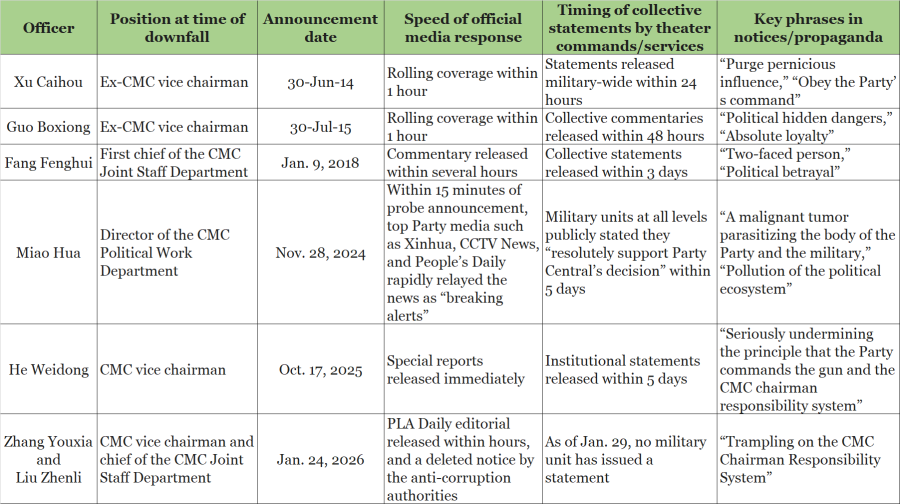
Rumors concerning Zhang’s case, panic in the PLA
Various rumors have been circulating in overseas Chinese-language circles and social since the probe of Zhang Youxia and Liu Zhenli became official, including:
- The CCP Central Committee and the CCDI have seconded more than 50 personnel to the PLA’s discipline inspection committee to assist with its work. It is expected that over 2,000 officers at or above division level will be “dealt with,” either through punishment, transfer to civilian posts, or retirement.
- A CMC internal announcement allegedly states that the entire PLA has been placed under “martial law,” with all units ordered to remain in place and prohibited from redeploying.
- All PLA units have reportedly entered Level One combat readiness (the highest level). As a result, all personnel have returned to their posts, and all external cellphone communications have been cut off.
- The PLA has reportedly “fallen into chaos” after Zhang’s detention. Officers at regimental and divisional levels and above were reportedly widely shocked that such a senior and well-established veteran commander could be taken down “so easily and within minutes,” triggering widespread panic. To avoid being “caught in the crossfire,” many regimental- and divisional-level officers reportedly submitted resignations or requests for transfer to civilian status. This was overwhelming to personnel departments, which could only forward the requests “layer by layer” up the chain.
- Xi Jinping reportedly demanded that group army commanders publicly state their support, but the commanders largely remained silent.
- Large numbers of videos that seemed to show “military vehicles heading into Beijing via expressways” circulated on mainland social media.
- Troops supporting Zhang Youxia were allegedly moving toward Beijing and confronting military police led by public security head Wang Xiaohong.
Regulations on the election work of military Party organizations
On Jan. 25, the CMC issued regulations on the election work of military Party organizations (軍隊黨組織選舉工作規定).
The Regulations, which will take effect on Feb. 1, 2026, called for:
- Upholding the guidance of Xi Jinping Thought.
- Actively adapting to the needs of building the Party’s organizational system in the military.
- Comprehensively standardizing election procedures for delegates to military Party congresses and Party member congresses, Party Committees and discipline inspection committees at and above the regimental level, as well as grassroots Party Committees, general branch committees, and branch committees.
Earlier on Dec. 27, 2025, the 19th meeting of the Standing Committee of the 14th National People’s Congress approved CMC vice chairman Zhang Shengmin as vice chairman of the PLA Election Commission. Zhang Youxia had previously served as chairman of the PLA Election Commission.
Our take
1. The lack of denunciation of the disgraced Zhang Youxia and Liu Zhenli in CCP official media and the various military units seems to contrast with Beijing’s past handling of senior officer purges. This reaction is less likely the outcome of an ongoing, fierce struggle playing out between Zhang camp holdouts and an embattled Xi leadership with an uncertain future for CCP elite politics, as some of the more storyful rumors claim, but more likely the result of the Xi leadership taking a leaf out of Mao Zedong’s handling of the Lin Biao incident.
After the Lin Biao incident on Sept. 13, 1971, Mao did not immediately demand vocal, large-scale declarations of loyalty and criticisms of his former number two from across the military. Instead, he first conducted a prolonged period of internal political cleansing and characterization (定性) to ensure that the PLA was properly rectified before he accepted their declarations. Mao probably believed that subjecting the military to an extensive “political physical examination” was necessary in light of the seriousness of Lin’s challenge to his authority and the need to more thoroughly root out Lin’s lingering influence in the military.
Zhang Youxia and Liu Zhenli are not of the same stature as Lin Biao. However, Zhang was still the most senior uniformed officer, a highly-decorated combat veteran, and a Party “princeling,” with influence over various networks and interest groups in the PLA and elsewhere. Meanwhile, Liu was in control of the PLA’s “nerve center” when he was at the Joint Staff Department, and likely also cultivated (actively or passively) interested groups and networks as he rose through the ranks. Given the extensive combined influence of the two men in the PLA (including, but likely not limited to, the equipment development system, the former Shenyang Military Region, and the Sino-Vietnamese border war system), the Xi leadership has likely judged it to be prudent to follow in Mao’s footsteps and subject the military to a harsh internal review and “rectification” to verify the political loyalty of those currently serving (especially the “key minorities”) before individual units are allowed to make public declarations of allegiance. Additionally, the Xi leadership appears to be erring on the side of caution in handling the Zhang and Liu case to preempt any potential dissent from their “cliques and faction” that could spark imitation challenges or unrest.
The PLA’s operations are likely to be inhibited to a degree if Beijing is subjecting it to an extensive “political physical exam.” Military Party Committees will be left “semi-paralyzed” for several weeks, and even months, as Party secretaries and principal leaders undergo closed-door political reviews. Such vetting could result in the dismissal, investigation, or retirement of upwards of thousands of officers, triggering a wave of early personnel reshuffles (local government reshuffles are due later this year). It is possible that the Xi leadership will take advantage of the personnel reshuffle opportunities stemming from “rectifying” the PLA and the probe of Zhang and Liu’s networks to replace all “two-faced persons” in the military and put to use “truly loyal, reliable, consistent, responsible, and accountable good cadres,” as per Xi Jinping’s speech at the Fifth Plenary Session of the 20th CCDI.
2. Some overseas Chinese commentators have suggested that the retention of Zhang Youxia and Liu Zhenli’s names and photos in the leadership section of the official CMC website hints that the “Xi-Zhang struggle” is far from over. This observation, however, reveals a lack of understanding of standard CCP administrative operations.
At the current stage, Zhang and Liu have just been subjected to an internal Party disciplinary investigation. As they have not been charged and removed from their posts, the CMC will not prematurely strike off their names and photos from their website; the CCP still needs to preserve a “veneer of legality” to demonstrate that the PRC is a “normal” country instead of a Marxist-Leninist regime that places the Party above the law. Even after Zhang and Liu are expelled from their posts and the Party, the National People’s Congress or its Standing Committee still has to formally sign off on removing them per legislation in the CCP Constitution and the PRC national defense law concerning the positions of CMC members or the CMC vice chairman.
3. The rumors circulating in overseas Chinese-speaking circles and social media should be read with extreme skepticism. Some of the rumors are plausible, including the military being subjected to tighter controls (military “martial law,” crackdown on cellphone usage, etc.), troops being placed on a higher alert level, and the seconding of civilian discipline inspection officials to aid with military anti-corruption work. Other rumors are virtually impossible, particularly the claim that “forces supporting Zhang Youxia are marching on Beijing.” There are several reasons why the latter claim is not credible.
First, the “forces supporting Zhang Youxia” would not have sufficient logistical support, weapons, and ammunition pose a threat to Beijing. The PLA enforces extremely strict controls over weapons and ammunition. In non-combat readiness conditions, soldiers on duty (such as guards) are usually issued limited ammunition intended for emergency security incidents and do not have enough to wage even a small-scale engagement. Without explicit CMC authorization, grassroots units have virtually no legal means to obtain live ammunition adequate for launching military action.
Hypothetical rogue units in the PLA would also have extremely limited access to fuel, rations, and rail transport for heavy equipment required for cross-regional troop movements. This is so as the 2016 military reforms saw the centralization and verticalization of supply management through the Joint Logistics Support Force, when previously the former military regional commands handled their own logistics. Central control over logistics means that any unit that leaves its garrison without authorization would find its supplies cut off almost immediately, leaving rogue elements stranded enroute to Beijing.
Second, there is no way that troops can march on Beijing without the central authorities being swiftly alerted and the insurrection rapidly halted given the PRC’s techno-totalitarian system. The technical threshold for troop movement is extremely high under the “CMC Chairman Responsibility System,” and all unit locations and movement signals are aggregated in real time at the CMC Joint Operations Command Center. Because units extensively use Beidou navigation and military data links, any unauthorized assembly or movement would instantly trigger alarms on command screens. Moreover, due to the functional separation between theater commanders and group army commanders (theaters focusing on operations, services focusing on force building), the actions of single units would be highly unlikely to receive cross-service support (such as from the air force, navigation, or electronic warfare units). This leaves rebellious units very vulnerable to being quickly surrounded and disarmed by forces near them that are still loyal to Party Central and possess full logistical and inter-service support.
Finally, beyond material constraints, the military’s internal “dual-command system” (military commander plus political commissar) serves as a barrier against unauthorized troop movements. Any order to deploy forces must be jointly signed by both the military and political leaders. It is highly unlikely that officers who are now being subjected to intense scrutiny and mutual surveillance following the downfall of Zhang Youxia and Liu Zhenli would be able to coordinate and embark on a large-scale mutiny.
2 China’s industrial profits saw ‘book’ growth in 2025
Official enterprise data for 2025
On Jan. 27, the PRC National Bureau of Statistics released data on profits of industrial enterprises above designated size for 2025. Those enterprises recorded total profits of 7.3982 trillion yuan for the year, representing a year-on-year increase of 0.6 percent calculated on a comparable caliber. In December 2025, profits of industrial enterprises above designated size rose 5.3 percent from a year ago, a sharp rebound of 18.4 percentage points from November’s negative 13.1 percent.
Other noteworthy data
1. In December 2025, the producer price index for industrial producers fell 1.9 percent year-on-year. The indicator has remained in contraction territory for 39 consecutive months since October 2022.
2. The Shanghai Composite Index closed up 18.41 percent for the year at 3,968.84 points in 2025, marking its best annual performance in nearly six years. Meanwhile, the Shanghai Industrial Index posted an annual gain of 25.28 percent.
3. In December 2025, the People’s Bank of China introduced eight structural monetary policy measures, including a 0.25 percentage point cut in the interest rates on various structural policy tools and an expansion of quotas totaling approximately 1.1 trillion yuan.
Our take
1. China’s industrial enterprises above designated size returning to profit after three years of negative returns appears to signal that the sector has bottomed out and is on the road to recovery. However, a closer look at the data indicates that this is just a technical rebound, with a pronounced divergence between real operating conditions and reported financial performance.
The “V-shaped” rebound of industrial profits in December 2025 was the decisive factor that pushed full-year data into positive territory. However, the combined contribution of revenue, costs, and expenses to profits in December was negative 12.2 percentage points according to CICC Macro’s decomposition of industrial profit, indicating that core operating activities continued to deteriorate that month. The main driver of the profit rebound came from “other gains and losses” (primarily investment income and fair-value changes), which contributed 17.4 percentage points. This shows that the profit recovery in December 2025 was largely attributable to the revaluation of equity assets driven by rising capital markets, rather than an improvement in the profitability of firms’ core businesses.
Investment income for industrial enterprises is typically recognized in June and December, and the strong performance of the stock market at the end of 2025 provided seasonal, technical support to corporate financial statements. This phenomenon, often described as “the stock market rescuing the balance sheet,” artificially created the appearance of positive industrial profit growth, masking real-economy losses under sustained PPI declines. If the 17.4 percentage-point contribution from December’s stock-market-driven “other gains and losses” were excluded, nationwide industrial profits for 2025 would have recorded a significant negative growth rate.
2. The rise in the stock market and its spillover effects on corporate financial statements are inseparable from the aggressive financial market rescue policies implemented in 2025. The 1.1 trillion yuan in structural monetary policy tools and targeted rate cuts introduced by the central bank in December effectively eased liquidity pressures. Against a backdrop of 39 consecutive months of PPI decline and weak real-economy investment returns, abundant liquidity flowed into the securities market, driving a sharp rise in industrial indices. “National team” funds also entered the market frequently in 2025 to stabilize expectations, pushing the Shanghai Composite Index to its best performance in six years.
By supporting equity prices through market-stabilization funds, the CCP authorities not only boosted sentiment but also directly offset profit shortfalls on the industrial side (caused by overcapacity and falling PPI) via the “investment income” line item. This led to a reversal of declines in the official data.
3. Industrial profit growth rates exhibited distinct asymmetric characteristics in observing the three major industrial categories of mining, manufacturing, and the production and supply of electricity, heat, gas, and water. Manufacturing became the core engine supporting the industrial base, while mining acted as the primary negative drag. Meanwhile, significant profit growth in utilities and livelihood-related sectors also contributed to the overall figure.
Data show that manufacturing profits (5.69157 trillion yuan, accounting for 76.9 percent of total profits) grew 5.0 percent year-on-year in 2025, an improvement of 8.9 percentage points over 2024. The CCP’s official narrative suggests that manufacturing recovery benefited from strong momentum in equipment manufacturing and high-tech manufacturing, as well as the optimization of the export structure. This narrative, however, falls apart on closer scrutiny.
In 2025, equipment manufacturing profits rose 7.7 percent, contributing 2.8 percentage points to the overall profit growth of large-scale industrial enterprises. Equipment manufacturing profits accounted for 39.8 percent of total industrial profits (up 2.6 percentage points from the previous year) and were defined by officials as the strongest growth driver. However, amid overcapacity and persistent PPI declines, large-scale corporate investment in technological upgrades remained limited. Profit growth in equipment manufacturing is therefore more likely driven by the replacement and restructuring of existing equipment as China’s industrial capacity shifts overseas, rather than by expansion of new capacity. Central bank financial data showing a slowdown in medium- and long-term corporate investment further support the view that this sector’s profits rely more on export resilience (with electromechanical products accounting for over 60 percent of exports) and structural relocation.
Meanwhile, high-tech manufacturing profits grew 13.3 percent year-on-year, far outpacing the overall industrial average. Sub-sectors such as semiconductors (integrated circuits up 172.6 percent) and drones (up 102 percent) posted striking gains. However, high-tech manufacturing value-added accounts for only 17.1 percent of large-scale industrial output and has yet to assume a dominant position. This makes it difficult for this sector alone to drive high-quality growth across the entire industrial system.
By contrast, mining performed relatively weakly. Full-year profits (834.51 billion yuan, 11.3 percent of total profits) fell sharply by 26.2 percent year-on-year, due to factors including a decline in global commodity price benchmarks, accelerated domestic energy transition, and base effects. In particular, profits in coal mining and washing fell 41.8 percent, while oil and natural gas extraction profits declined 18.7 percent. The deep downturn in these two industries directly offset the growth dividends from manufacturing, pulling overall industrial profit growth down to a marginal 0.6 percent.
At the same time, the electricity, heat, gas, and water production and supply sector recorded profit growth of 9.4 percent, with profits of 872.12 billion yuan (11.8 percent of total profits). Although similar in scale to mining, its growth contribution was more pronounced. This increase is closely linked to the shifting of local fiscal pressures and administrative price hikes in public utilities. As land-sale revenues declined, some regions reduced subsidies for public utilities, leading to price increases for necessities such as water and gas. In addition, energy regulators received more than 2,500 complaints in January 2025, with residents in some areas reporting abnormally higher electricity bills after the installation of smart meters. This suggests that part of the sector’s profit growth stemmed from administratively imposed increases in end-user costs.
4. In summary, the modest 0.6 percent growth in China’s industrial enterprise profits in 2025 and the 18.41 percent surge in the stock market represent a carefully constructed “data coupling.” Under the weight of prolonged PPI stagnation and deflationary pressures in the real economy, the “growth” in industrial profits was achieved through a combination of financial market gains, administrative price adjustments in public utilities, and technical accounting maneuvers.
This profit growth, which relies on the “premium of financial assets,” is extremely fragile. Should the liquidity environment in the stock market change or “national team” funds contract, these embellished industrial financial statements will face severe downward pressure.




