
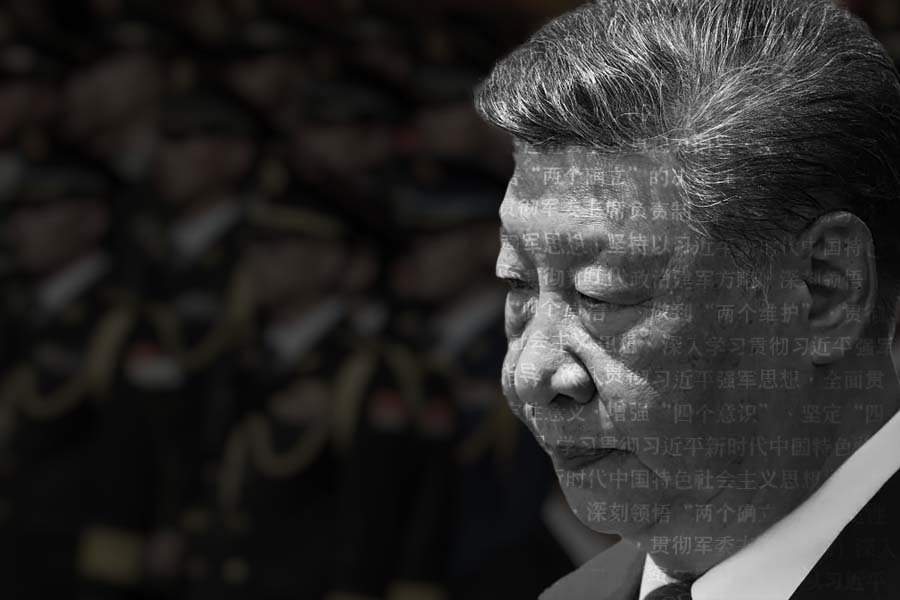
Despite purges of allies, Xi appears to remain in charge as Communist Party mouthpieces affirm his authority and ideological line.
Rumors and speculation about Xi Jinping “losing power” have been circulating on the internet for more than a year since they emerged after the conclusion of a major Chinese Communist Party conclave in July 2024. Initially confined to Chinese-speaking circles, talk of Xi’s alleged political demise grew in intensity and was eventually picked up by international media outlets from around the middle of 2025.
In an earlier piece, we observed that the “Xi losing power” narrative relies on “unsubstantiated rumors or glaring ignorance of context.” We then debunked some of the more common and less speculative arguments and evidence put forth by those who believe that Xi is on his way out, before ending with a warning about the dangers of misreading the political situation in Communist China.
Below, we explore the relationship between power and propaganda in the CCP regime to establish that Xi’s position is intact from what can be publicly observed. We then challenge the popular argument by proponents of the “Xi losing power” theory that recent personnel changes are indicative of Xi’s political misfortunes by providing the context behind the personnel purges and adjustments. We conclude by noting that Xi still faces significant political risks despite being secure in power.
Wielding the Party’s ‘pen’
CCP leaders who control the Party’s “pen,” “gun,” and “knife handle” — propaganda, military, and regime security — are considered to have a firm grip on power. The link between power and armed force (military and domestic security) is self-explanatory — political power, Mao Zedong observed, grows out of the barrel of a gun.
The relationship between power and propaganda is subtler. Party leaders who enjoy greater loyalty from the propaganda organs are in better control of their image, messaging, and political mobilization, which are vital for establishing and maintaining and growing their “quan wei” (authority and prestige) within the CCP and with the masses. By contrast, when the regime’s “pen” is not in full accord with the Party boss, the leadership will find it difficult to communicate its desired messaging, which in turn affects the leader’s ability to effectively wield and preserve his power.
Mao was a genuinely powerful CCP leader because he had substantial influence over the Party’s “pen,” the “gun,” and the “knife handle.” In an illustrative example, Mao was able to leverage his influence over the propaganda apparatus to launch the Cultural Revolution and reclaim his paramount position after being briefly sidelined following the failures of the Great Leap Forward. Meanwhile, Deng Xiaoping, and not Hua Guofeng, eventually emerged as the paramount leader in the early years after Mao’s death despite his lack of official titles as he commanded the loyalty of powerful military leaders and successfully promoted his political line over Hua’s in key Party media.
Hu Jintao, meanwhile, was never considered a CCP leader with full authority because the Jiang Zemin faction had de facto control over the “pen,” the “gun,” and the “knife handle” through its associates holding key positions in those apparatuses during the entirety of Hu’s tenure. Notably, Hu never established himself as a “core leader” the way Jiang and later Xi did.
To avoid being a “lame duck” leader like Hu and in an effort to wrestle power away from the influential Jiang faction, Xi Jinping moved as quickly as he could to rein in the “pen,” the “gun,” and the “knife handle” starting from his first term. Many political and legal affairs officials associated with the Jiang faction were purged under Xi’s anti-corruption campaign, notably former security czar Zhou Yongkang in December 2014. In January 2016, Xi issued sweeping military reforms that helped him to consolidate control over the People’s Liberation Army. Over the course of his three terms, Xi gradually replaced the bulk of ousted Jiang associates and loyalists in the military and the regime security apparatus, particularly those at the senior level, with his allies, loyalists, or those who at least did not appear to owe their careers to the Jiang faction.
Xi took much longer to bring the propaganda apparatus to heel. Jiang faction members occupied the top propaganda spots during Xi’s first term, including Politburo Standing Committee member Liu Yunshan and central propaganda department head Liu Qibao. Under the two Lius (no relation), the propaganda apparatus would occasionally engage in “advanced blackening” and “low-level red” activities to undermine Xi, including the “Xi Dada” campaign and the propaganda department-backed “red songs” concert at the Great Hall of the People in May 2016.
While Xi could not resolve personnel issues in his first term, he made inroads into consolidating control over the propaganda apparatus by mobilizing the cultural sector and official media to be loyal to the Party, and by extension, to his “core” leadership. After Liu Yunshan and Liu Qibao stepped down at the 19th Party Congress in 2017, Xi began installing allies in key propaganda roles, including central propaganda department chief, the heads of major official media, and president of the Central Party School. Xi would have a strong grip over the propaganda apparatus by the start of his third term, at least from observable metrics like personnel selection, the constant promotion of ideological campaigns revolving around Xi, and mentions of Xi in Party media.
‘Xi the Reformer’ incident
Understanding the broader context of Xi Jinping’s power consolidation efforts is necessary for making better sense of seemingly unusual political developments. One such development, which helped spark the intense speculation about Xi “losing power,” was state mouthpiece Xinhua’s publication and quick retraction of an article that ostensibly promoted Xi on the first day of the Third Plenum of the 20th Central Committee on July 15, 2024.
Titled “Xi Jinping the Reformer,” the over 10,000-character article was supposed to be a summary of the direction and course of Xi’s “reforms” since he took office. However, astute observers noted that the piece subtly deviated from Xi’s political line in at least two areas. First, the article seemed to indicate that Xi was “inheriting and promoting” Deng Xiaoping’s “reform and opening up,” which contradicts Xi’s effort to distance his political legacy from that of Deng’s in the “historical resolution” issued at the Sixth Plenum of the 19th Central Committee in 2021. Second, the piece emphasized Xi’s authoritarianism and adherence to ideology using rhetoric that gave the impression that the reforms pursued under Xi were political regression rather than Deng-style “liberalization.”
Read without further context, the “Xi Jinping the Reformer” piece would seem like a sharp jolt on the political seismogram. Surely forces inside the CCP were expressing their discontent towards the “core” leader in a major propaganda outlet. And if Xinhua was obliquely attacking Xi through excessive flattery and subverting his political line, then logically his grip on power must be becoming tenuous. Such interpretations, however, become much less plausible in considering Xi’s gradual, grinding effort to consolidate control over the propaganda apparatus and the regime in general. With Jiang faction members no longer overseeing propaganda direction or helming key propaganda organs, Xi’s consolidation of control over the military, and Xi’s strict surveillance over the Party elite via his control of the security apparatus, Xi’s lingering political enemies would find it incredibly difficult to coordinate a blatant challenge to him in the pages of Xinhua. And if Xi’s enemies are not strong enough to launch a political line challenge against him in official mainland media, then there is no “gradual power transition” taking place against Xi Jinping like how Deng ousted Hua Guofeng.
A more plausible explanation for the “Xi Jinping the Reformer” piece and its retraction is a combination of bureaucratic error at the top and either political mischief or incompetence on the part of the lower-level officials who wrote the article. Those responsible for drafting and editing the piece report could have had “low political awareness” and mistakenly acted on the assumption that the Party’s theoretical frameworks by various CCP leaders are consistent and coherent. Therefore, they saw no contradiction in linking Deng’s “reform and opening up” with Xi’s “further deepening of reforms” without realizing the fundamental disconnect between the two. Another possibility is that the article’s authors and editors harbored great dissatisfaction towards Xi Jinping or are holdouts from the Jiang era, and worked within the constraints of their positions to carry out a one-off “advanced blackening.”
Meanwhile, propaganda chief Li Shulei and his team likely failed to spot the mistakes in time as they were busy coordinating Third Plenum propaganda activities. By the time they were alerted to the errors, the piece was already published and had to be taken down. Li and his team then most likely tightened up internal review of articles and made personnel adjustments to prevent a repeat incident, which explains the absence of subsequent pieces that were subtly or overtly critical of Xi. Had Xi truly “lost power” as some have speculated and there is an ongoing effort to ease him out of power gradually, then there would be a coordinated effort in state and Party media to shift the CCP away from Xi’s political line and promote something else in its place. However, official PRC media has been extremely consistent to date in promoting Xi, his policies, and his political theories, indicating that Xi remains firmly in charge.
Other developments since the “Xi Jinping the Reformer” incident indicate that Xi, and not the “collective leadership” or other backroom powers, continues to occupy the paramount position in the Party. At the December 2024 Politburo democratic life meeting on the in-depth study and implementation of “Xi Jinping Thought,” Xi commented individually on each Politburo member’s remarks, issued specific requirements to each member, and delivered a summary — gestures that underscore Xi’s superiority over the CCP’s top leadership and highlight that he is not simply “first among equals” in the Politburo Standing Committee. Another similar display of Xi’s dominance in the CCP occurred in February 2025 when members of the Politburo, Central Secretariat, party leadership groups of the National People’s Congress Standing Committee, State Council, and National Committee of the Chinese People’s Political Consultative Conference, as well as party secretaries of the Supreme People’s Court and Supreme People’s Procuratorate submitted individual written performance reports to Party Central and Xi. Xi then carefully reviewed these reports and issued important instructions, according to state media.
Why are Xi’s allies being purged
Propaganda aside, proponents of the Xi “losing power” narrative cite recent prominent personnel adjustments as evidence backing their theory. For instance, they claim that Central Military Commission members Miao Hua and He Weidong are “Xi allies” and were removed by CMC vice chairman Zhang Youxia, who allegedly is now “in control” of the People’s Liberation Army instead of Xi and has the backing of various Party elders. They also claim that civilian officials like former Xinjiang Party boss Ma Xingrui and former Organization Department head Li Ganjie were removed from their respective positions due to a purge of “Xi allies.” Those interpretations, however, become tenuous upon closer examination of the individual cases and the broader context of Xi’s personnel reshuffle patterns and anti-corruption efforts.
Xi Jinping purged and reshuffled officials quite frequently during his tenure to clear out opponents, consolidate power to a higher degree, and improve governing efficiency. The bulk of the officials who were replaced during Xi’s first two terms were members, associates, or suspected loyalists of the Jiang faction. But after Xi loyalists Qin Gang and Li Shangfu were removed from office over alleged corruption or scandal, as well as the exposure of massive corruption connected with the PLA Rocket Force and Equipment Development Department in the summer of 2023, Xi has started to purge officials who can be regarded as his “loyalists” or “allies.”
That Xi would move against his “allies” is unsurprising for two reasons. First, Xi has always billed his anti-corruption campaign as impartial and the weight of observable evidence indicates that the effort to root out corruption is as much motivated by a desire to preserve the CCP regime as it is a tool by the Xi leadership to root out its political enemies. Second, Xi could have grown more paranoid after finding out senior officials whom he considers to be loyal and whose appointments state media claimed he vetted personally were involved in corruption or scandals. This could have led Xi to become more willing to remove those connected with the accused parties or individuals he believes could threaten his control over the Communist Party.
Miao Hua and He Weidong were both stationed in Fujian Province when Xi Jinping was serving as a local official in the provincial government, and can be considered to be Xi’s “allies.” It is unclear if either general was directly involved with the serious corruption in the PLA that was exposed in 2023. However, it is possible that Xi could believe that Miao, the chief political officer before his removal, had not fully implemented his instructions and directives on political indoctrination of the military or could have formed forbidden “cliques and factions” in the military, especially in the field of political work. And if Miao’s actions had impacted the effectiveness of Xi’s policies, weakened Xi’s control over the PLA, and worsened corruption in the military, then purging him would be the only option, no matter his personal loyalty to Xi. As for He Weidong, who has not been seen in public since March 2025 and whom Western media outlets claim has been purged, his potential fall from grace could be due to his connections to Miao and the 2023 PLA corruption scandal.
The argument that Xi’s “allies” in the military were ousted because Zhang Youxia now controls the PLA does not stand up to scrutiny. First, Zhang has continually promoted Xi’s political line on the military and the need to safeguard Party Central and the Xi “core.” Second, Zhang has been shown in state media broadcasts of high-level political meetings dutifully taking notes alongside other officials in the side rows while Xi occupies the central spot. Third, state media has announced that Xi will preside over a military parade to mark the 80th anniversary of the Second World War on Sept. 3, 2025 that will be attended by foreign dignitaries. The aforementioned developments indicate that it is Xi who holds “actual military authority,” not Zhang. And if Xi’s grip on the PLA is firm, so is his hold on power.
Meanwhile, the Xi “losing power” camp’s assertion that Ma Xingrui and Li Ganjie were removed from their respective positions because they are Xi “allies” reflects a lack of understanding of personnel reshuffle norms under Xi and a shaky grasp of political terminology. Officials who can be considered to be Xi’s “allies” are those who have served with Xi in the provinces or have close ties with him. However, commentators who claim that Li is Xi’s “ally” have not established any prior working or personal connection between the two. Those claiming that Ma is Xi’s “ally” allege that Ma and Xi’s wife Peng Liyuan were from the same hometown, but this “connection” does not automatically make Ma an “ally” of Xi’s even if it were true, given the complexities of patron-client relations in the CCP.
We believe that Ma Xingrui and Li Ganjie are more accurately classified as “technocrats,” or officials who started out in central or other state-owned enterprises before joining government later in their careers. Because “technocrats” tend to rise up the ranks through merit rather than factional associations, Xi has chosen them to replace Jiang faction officials in some key positions. “Technocrats” can be regarded as Xi “loyalists” if they continue to be favored for promotion and critical appointments, but will never be as close to Xi as his genuine allies, such as those whom he served with in the provinces like Cai Qi, Ding Xuexiang, and Li Qiang.
Xi Jinping likely swapped Li Ganjie with Shi Taifeng as head of the Central Organization Department and head of the United Work Front Department in April 2025 because he needed someone with more experience in personnel affairs to handle the important job of overseeing personnel appointments. Li spent the bulk of his career dealing with nuclear safety and environmental protection, while Shi worked at the Central Party School, which trains mid- to senior-level Party officials, for 25 years. Shi also demonstrated a willingness to undertake deep “rectification” work with his “20-year retroactive investigation” of Inner Mongolia when he was Party secretary of the province. Meanwhile, Li was definitely not marginalized when he swapped jobs with Shi, as Xi values united front work and its importance in matters of Taiwan’s “reunification,” as well as other external influence operations.
As for Ma Xingrui, it is possible that he will move on to a more important post. Ma’s next job could be a deputy position in a central leadership group or a coordination body related to Xinjiang affairs, or even a more significant role in the Central Committee’s decision-making, deliberation, and coordination bodies. The Xi leadership could also have decided to have Ma make way early so that his successor as Xinjiang Party secretary Chen Xiaojiang can be groomed for higher office at the 21st Party Congress.
The true risks facing Xi
At present, it is unlikely that Xi Jinping faces serious political threats to his paramount position. But Xi and the CCP as a whole face substantial political risks amid the many crises plaguing the regime. These include China’s rapidly worsening economy, persistent deflationary pressures, rising unemployment, the bursting of the real estate bubble and its consequences, a looming automotive industry crisis, mounting demographic and social problems, increased governance failures, and sustained trade tensions with the U.S. and other countries.
Each of the aforementioned crises could potentially trigger serious economic and social problems that would in turn transform into political problems. The Xi leadership has been warning officials of “intertwining risks” since as early as 2015, noting that “various risks and dangers are highly correlated, strongly linked, and rapidly transmitted.” This being the case, Party Central has cautioned the officialdom not to “let small risks become big risks, let individual risks become comprehensive risks, let local risks become regional or systemic risks, let economic risks become social and political risks, [or to] let international risks become domestic risks.”
Given the totalitarian nature of the CCP regime’s governance, its endemic corruption, and other pervasive ills, getting a handle on and resolving all manner of the many risks Beijing warns about is a task infinitely easier said than done. The compounding of political problems could sharply erode Xi’s “quan wei,” weaken his grip on power (e.g. regime security forces could get overwhelmed by mass incidents that may not necessarily be planned uprisings, or choose to respond passively to mass incidents), and embolden lingering “anti-Xi” forces in the Party elite and the regime to escalate factional struggle against him.




