
1 China’s fiscal data for H1 2025 does not support official GDP growth rate
China’s H1 2025 fiscal data
On July 25, the PRC Ministry of Finance released fiscal revenue data for the first half of 2025.
National General Public Budget Revenue and Expenditure
- National general public budget revenue: Down 0.3 percent year-on-year to 11.5566 trillion yuan.
- Tax revenue: Down 1.2 percent year-on-year to 9.2915 trillion yuan.
- Non-tax revenue: Up 3.7 percent year-on-year to 2.2651 trillion yuan.
- Central government general public budget revenue: Down 2.8 percent year-on-year to 4.8589 trillion yuan.
- Local governments general public budget revenue: Up 1.6 percent year-on-year to 6.6977 trillion yuan.
- Key tax categories
- Domestic Value-added Tax (VAT): Up 2.8 percent year-on-year to 3.6393 trillion yuan.
- Domestic consumption tax: Up 1.7 percent year-on-year to 898 billion yuan.
- Corporate income tax: Down 1.9 percent year-on-year to 2.491 trillion yuan.
- Individual income tax: Up 8 percent year-on-year to 794.5 billion yuan.
- National general public budget expenditure: Up 3.4 percent year-on-year to 14.1271 trillion yuan.
- Central government expenditure: Up 9 percent year-on-year to 1.9914 trillion yuan.
- Local government expenditure: Up 2.6 percent year-on-year to 12.1357 trillion yuan.
- Interest payments on government debt: Up 6.1 percent year-on-year to 668.9 billion yuan.
National Government Fund Budget Revenue and Expenditure
- Total fund revenue: Down 2.4 percent year-on-year to 1.9442 trillion yuan.
- Revenue from state-owned land use rights sales: Down 6.5 percent to 1.4271 trillion yuan.
- Total fund expenditure: Up 30 percent year-on-year to 4.6273 trillion yuan.
- Expenditure related to land use rights sales: Down 6.4 percent year-on-year to 2.0601 trillion yuan.
Backdrop
On July 15, the National Bureau of Statistics announced that China’s GDP grew by 5.3 percent year-on-year to 66.0536 trillion yuan in the first half of 2025.
Our take
The PRC’s official fiscal data for the first half of 2025 reveals inconsistencies with the reported GDP growth, casting doubt on the economy’s true vitality. Fiscal revenue, particularly tax receipts, is driven by cash flows from enterprises, production, consumption, and trade, and typically mirrors real economic activity. Robust GDP growth should align with positive tax revenue trends, while negative tax growth suggests economic activity is less vibrant than official figures indicate.
A comparative analysis of the CCP’s data shows that the official GDP figure does not quite match up with fiscal data. This suggests that Beijing likely inflated China’s growth numbers for the first half of the year.
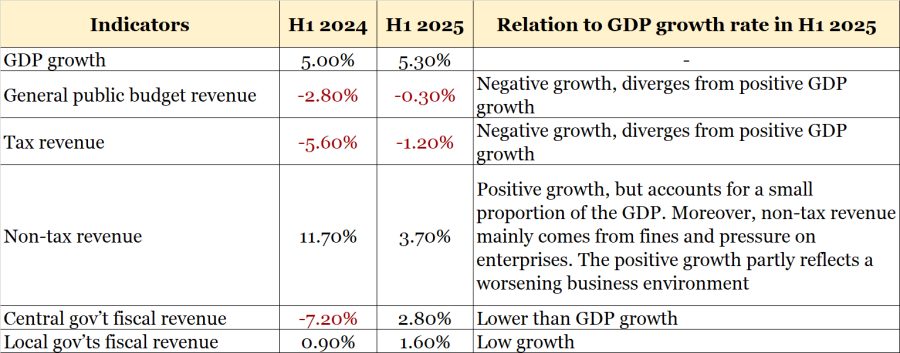
1. In the first half of 2025, China’s general public budget revenue fell 0.3 percent from a year ago while tax revenue declined 1.2 percent. This sharply contrasts with the official GDP growth of 5.3 percent. Typically, tax revenue, as a direct output of economic activity, should track nominal GDP growth after adjusting for inflation and policy factors. Negative tax growth therefore signals economic contraction rather than expansion.
This divergence between the GDP growth rate and tax growth is not isolated. China’s reported GDP in 2024 was 5 percent, yet fiscal revenue dropped 2.8 percent and tax revenue fell 5.6 percent that year. The CCP authorities attributed 2024’s tax decline to the “carryover effects of tax cuts” and “base effects,” but 2025 saw no major tax reductions. Moreover, the nationwide rollout of the Golden Tax Phase IV system — leveraging big data, AI, and blockchain to integrate tax data with over 20 departments, including banks, customs, and social security — has significantly enhanced tax collection efficiency. Public data confirms this “smart taxation” system makes 2025 tax figures more reliable and harder to evade, suggesting negative tax growth reflects genuine economic weakness, not lax enforcement.
Source: PRC Ministry of Finance
Had China’s GDP truly grown by 5 percent and higher in 2024 and the first half of 2025, then tax revenue should have remained flat or shown a slight increase. Instead, tax revenue has been in decline (see Table 1), casting into question the reported GDP growth.
2. A review of specific tax categories further underscores the mismatch between fiscal and economic growth. With GDP growth exceeding 5 percent, related taxes should indicate corresponding growth. Yet most taxes exhibit negative or low growth:
- Domestic VAT: Sourced from manufacturing and services, VAT grew 2.8 percent in H1 2025 (versus negative 5.6 percent in 2024), well below the 5.3 percent GDP growth. This signals limited industrial expansion.
- Corporate income tax: Reflecting enterprise profits, this tax fell 1.9 percent in H1 2025 (versus negative 5.5 percent in 2024), indicating widespread profit declines. This contradicts GDP growth, as the corporate sector contributes about 40 percent to GDP. Without profits, the source of growth is unclear.
- Personal income tax: Rising 8 percent in H1 2025 (versus negative 5.7 percent in 2024), this growth likely stems from tightened enforcement via the Golden Tax system, targeting overseas investment income of the wealthy and e-commerce influencers, rather than genuine income growth.
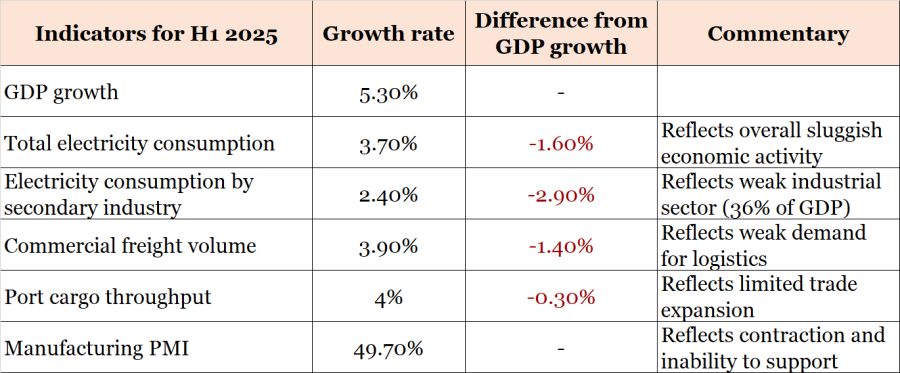
3. Other official economic metrics — electricity consumption, freight volume, and PMI — also diverge from Beijing’s official GDP number and do not substantiate the CCP’s economic narrative. Historically, these “hard indicators” serve as GDP proxies due to their resistance to manipulation. Electricity consumption correlates strongly with GDP (correlation coefficient >0.8), reflecting industrial and service activity. Freight volume indicates logistics and trade activity, while PMI gauges manufacturing and non-manufacturing sentiment (>50 signals expansion, <50 contraction). These metrics should be close to the reported GDP growth, but are not.
- Electricity consumption: Per the National Energy Administration (July 21, 2025), H1 2025 total electricity use (4.842 trillion kWh) grew 3.7 percent, with industrial use (3.149 trillion kWh, about 65 percent of the total) up only 2.4 percent. This lags quite a bit behind the official GDP growth of 5.3 percent, signaling manufacturing weakness. Historically, electricity growth tracks or slightly trails GDP, but gaps exceeding 1.5 percent often indicate overstated data.
- Freight volume: According to the Ministry of Transport (July 28, 2025), H1 2025 commercial freight volume (28.03 billion tons) grew 3.9 percent and port cargo throughput (8.9 billion tons) rose 4.0 percent, both slightly below GDP. This reflects weak logistics demand.
- PMI: The H1 2025 manufacturing PMI averaged about 49.7, below the 50 expansion threshold, indicating manufacturing contraction. Meanwhile, the composite PMI (50.7) showed only marginal expansion, which is insufficient to support the narrative of 5.3 percent GDP growth.
Sources: National Bureau of Statistics of China, National Energy Administration, Ministry of Transport
The divergence (most exceeding 1 percent) between the various economic indicators in Table 2 and the official GDP growth rate suggests that the latter figure is likely inflated.
2 How Trump’s tariff war could undercut the PRC’s competitiveness
US-China trade truce extended
July 28 to July 29
U.S. and PRC officials met in Stockholm for trade talks and to seek an extension of a 90-day trade truce. After the conclusion of the talks, U.S. Treasury Secretary Scott Bessent said that the meetings were “very constructive” and they would have to seek approval with President Donald Trump before extending the tariff pause for another 90 days.
Speaking with reporters on Air Force One, Trump said he would discuss the situation with his top advisors on July 30 and “either approve it or not.” Trump also appeared to suggest that the negotiations encountered unspecified roadblocks when he remarked, “I said, ‘Oh, here we go again.’” But he added, “Today it worked out.”
July 30
Trump told reporters at the White House, “We’re moving along with China. We’re doing fine with China. I think it’s going to work out very well. We’re right in step. I think we’re going to have a very fair deal with China.”
Trump admin’s trade deals to date
The U.S. imposed a 10 percent baseline tariff on imports from all countries from April 5, as well as varying tax rates on different countries, as part of President Trump’s “Liberation Day” move. Since then, the Trump administration has reached trade agreements with several countries, including:
Indonesia (July 15)
- The U.S. will impose a 19 percent tariff on Indonesian imports (down from a threatened 32 percent).
- Indonesia committed to purchasing U.S. energy ($1.5 billion), agricultural products ($4.5 billion), and 50 Boeing aircraft (amount undisclosed).
- Indonesia pledged to fully open the Indonesian market to U.S. goods, which enjoy zero tariffs.
United Kingdom (July 16)
- The U.S. will impose a 10 percent tariff on UK imports (down from a threatened 25 percent).
- UK car imports are subject to a 10 percent tariff within quota limits; steel and aerospace parts are tariff-free.
- The UK committed to purchasing U.S. energy ($1 billion in ethanol) and agricultural products (e.g., beef; amount undisclosed).
Vietnam (July 16)
- The U.S. will impose a 20 percent tariff on Vietnam imports (down from a threatened 46 percent). Re-exported goods (e.g., from China) face a 40 percent tariff.
- U.S. imports to Vietnam are tariff-free and Vietnam would provide more market access.
Philippines (July 22)
- The U.S. will impose a 19 percent tariff on imports from the Philippines (down from a threatened 20 percent and previously applied 17 percent).
- U.S. imports to the Philippines are tariff-free.
Japan (July 22)
- The U.S. will impose a 15 percent tariff on Japanese imports (down from a threatened 25 percent).
- Japan agreed upon a $550 billion investment framework combining investments, loans and loan guarantees provided by financial institutions backed by the Japanese government. Investments will comprise 1 to 2 percent of the total, with loans making up the bulk of the rest.
- Japan committed to purchase U.S. energy (amount undisclosed), agricultural products ($8 billion), and U.S.-made commercial aircraft (including 100 Boeing jets).
- U.S. imports to Japan are tariff-free.
European Union (July 27)
- The U.S. will impose a 15 percent tariff on EU imports (down from a threatened 30 percent).
- The EU committed to purchase $750 billion in U.S. energy products (about $250 billion annually over three years) to reduce reliance on Russian energy.
- The EU will invest $600 billion in U.S. energy and strategic industries (e.g., semiconductors, green energy).
- The EU committed to purchasing U.S. military equipment (amount undisclosed).
- U.S. imports enjoy zero tariffs and further market access.
South Korea (July 30)
- The U.S. will impose a 15 percent tariff on South Korean imports (down from a threatened 25 percent).
- South Korea pledged to invest $350 billion in U.S. projects, including shipbuilding ($150 billion), as well as semiconductors, nuclear power, batteries, and biologics ($200 billion).
- South Korea committed to purchasing $100 billion in U.S. LNG over the next three and a half years.
- South Korea pledged to “fully open” its market to U.S. goods, which enjoy zero tariffs.
- South Korea would not impose retaliatory tariffs.
Our take
At a glance, the PRC appeared to have come out ahead of the Sino-U.S. trade talks in Stockholm. While there were no major breakthroughs, the extension of the tariff deadline by another 90 days, plus earlier Trump administration concessions like allowing Nvidia’s H20 AI chip shipments to China and reportedly blocking Taiwan leader William Lai Ching-te from transiting through the U.S. en route to Central America, are definite wins for the CCP.
However, it becomes less clear that Beijing is a winner in considering the trade deals that Washington has with other countries.
1. Since the U.S.-China trade truce was reached in May 2025, the Trump administration has secured trade agreements with key trading partners and some of China’s neighbors. These nations have committed to making purchases of U.S. products or investments in exchange for lower tariff rates. While the execution rates of those agreements could only be about 10 to 40 percent due to infrastructural and economic constraints, those deals are still likely to bolster U.S. economic momentum and indirectly weaken the PRC’s export competitiveness.
European Union
- The EU pledged $750 billion in U.S. energy purchases ($250 billion annually) and $600 billion in energy and strategic sector investments. However, in 2024, U.S.-EU energy trade amounted to only $76 billion. Achieving an annual trade volume of $250 billion would require a 3.3-fold increase from the current level.
- At the same time, the total value of U.S. energy exports in 2024 was $318 billion, indicating limited production capacity. To meet the EU’s annual demand of $250 billion, the U.S. would need to significantly expand its exports of crude oil, LNG, and coal.
- Additionally, U.S. LNG export capacity and EU infrastructure are both insufficient. It is estimated that the execution rate of the agreement will be only around 20 to 30 percent. However, even a partial implementation could still boost U.S. LNG exports by 50 billion cubic meters, creating between 20,000 to 30,000 jobs.
Japan
- Japan pledged to invest $550 billion (1 to 2 percent in direct investment, the rest in loans) and to purchase energy, weapons, and agricultural products.
- According to U.S. Department of Commerce data, Japan’s FDI stock in the U.S. in 2024 was approximately $760 billion, with annual new investment of around $15 to $20 billion. The pledged $550 billion (approximately $183.3 billion annually over three years) implies that annual investment would need to increase by 9 to 12 times.
- The $550 billion pledge equals 13 percent of Japan’s GDP. However, Japan’s domestic economic growth is slow (1 percent in 2024), which limits its capacity to fulfill the pledge.
- Still, if Japan fulfills even 20 percent of the $550 billion investment framework, especially in support of U.S. semiconductor industries, it could generate between 50,000 to 100,000 high-skilled jobs in America.
South Korea
- South Korea has committed to investing $350 billion in U.S. shipbuilding, semiconductors, and other strategic industries (owned and controlled by the U.S.) and purchasing $100 billion in U.S. LNG and other energy products.
- According to U.S. Department of Commerce data, South Korea’s foreign direct investment stock in the U.S. in 2024 was approximately $50 billion, with annual new investments of about $10 billion. The pledged $350 billion (approximately $116.7 billion annually over three years) implies an 11- to 12-fold increase in annual investment.
- South Korea’s $350 billion commitment represents 22 percent of the country’s GDP. However, South Korea’s domestic economic growth is sluggish (1.5 percent in 2024), with exports declining 8.1 percent, which likely limits its ability to fulfill the commitment. Additionally, U.S. semiconductor and shipbuilding infrastructure requires years to upgrade, further impacting execution.
- We estimate that the agreement’s execution rate will be around 20 percent to 40 percent. Nevertheless, even partial implementation could create 50,000 to 100,000 high-tech jobs in the U.S., particularly in supporting the semiconductor and shipbuilding industries.
Indonesia
- Indonesia pledged to purchase $1.5 billion in energy, $4.5 billion in agricultural products, and 50 Boeing aircraft.
- In 2024, U.S. exports to Indonesia totaled about $13.5 billion. Energy (LNG and coal) accounted for about 20 percent ($2.7 billion), and agricultural products and machinery each about 30 percent.
- Due to financial constraints, Indonesia’s large-scale purchase commitments may be difficult to realize. In addition, Indonesia’s LNG terminal capacity is limited (handling about 20 million tons in 2024), and logistics and port infrastructure are inadequate, further restricting its ability to execute the agreement. We estimate that the execution rate of Indonesia’s pledged purchases is about 20 to 30 percent.
United Kingdom
- The UK pledged to purchase about $1 billion worth of ethanol and agricultural products.
- In 2024, U.S. exports to the UK were about $74 billion. Energy (LNG and crude oil) accounted for about 15 percent ($11 billion), and agricultural products and machinery about 20 percent each.
- Post-Brexit, the UK’s economy has grown slowly (2024 GDP growth rate about 0.7 percent), limiting its purchasing capacity. Because the UK will have to overcome fiscal constraints to fulfil the trade deal, we estimate that the execution rate of the deal is about 30 to 40 percent.
Vietnam and the Philippines
- Neither country made specific dollar commitments, but agreed to open markets for duty-free U.S. goods.
- In 2024, U.S. exports to Vietnam totaled about $11 billion, of which the bulk was energy and machinery. The composition of U.S. exports to Vietnam would have to be restructured if they are to significantly increase.
- U.S. exports to the Philippines in 2024 were about $9 billion, leaving limited room for increased purchases.
- Given the small scale of current trade and limited economic size, both countries are unlikely to support large-scale procurement or market absorption. We estimate the feasibility of both trade agreements to be about 20 percent to 30 percent.
South Korea
- South Korea has committed to investing $350 billion in U.S. shipbuilding, semiconductors, and other strategic industries (owned and controlled by the U.S.) and purchasing $100 billion in U.S. LNG and other energy products.
- According to U.S. Department of Commerce data, South Korea’s foreign direct investment stock in the U.S. in 2024 was approximately $50 billion, with annual new investments of about $10 billion. The pledged $350 billion (approximately $116.7 billion annually over three years) implies an 11- to 12-fold increase in annual investment.
- South Korea’s $350 billion commitment represents 22 percent of the country’s GDP. However, South Korea’s domestic economic growth is sluggish (1.5 percent in 2024), with exports declining 8.1 percent, which likely limits its ability to fulfill the commitment. Additionally, U.S. semiconductor and shipbuilding infrastructure requires years to upgrade, further impacting execution.
- We estimate that the agreement’s execution rate will be around 20 percent to 40 percent. Nevertheless, even partial implementation could create 50,000 to 100,000 high-tech jobs in the U.S., particularly in supporting the semiconductor and shipbuilding industries.
Infrastructure bottlenecks (e.g., $100 billion needed for U.S. LNG plants) and market demand (e.g., EU’s energy diversification) will likely cap full realization of Trump’s trade agreements. Historically, agreements driven by enterprises rather than government mandates typically have low execution rates.
Even at 10 to 40 percent execution, these deals signal optimism for U.S. high-end manufacturing and energy markets. They also set a precedent for nations to secure low tariffs through investment or purchase commitments, with flexibility to cite objective delays or defer to the next U.S. administration. Finally, the economic gains from the trade deals give Washington more flexibility to negotiate with the PRC.
2. The tariff gap between the U.S. and other countries compared to China will have the effect of weakening the competitiveness of Chinese goods.
Should the U.S. sustain tariffs on Chinese goods at 54 percent or higher — comprising a 30 percent reciprocal tariff and 24 percent Section 301 duties— compared to 10 percent to 20 percent tariffs for other nations (14 percent for Vietnamese transshipments), a 34 percent to 44 percent differential will significantly undermine the competitiveness of Chinese products in the U.S. market. For goods priced equivalently, Chinese products would face a 34 percent to 44 percent cost disadvantage, prompting U.S. importers to shift toward lower-tariff countries.
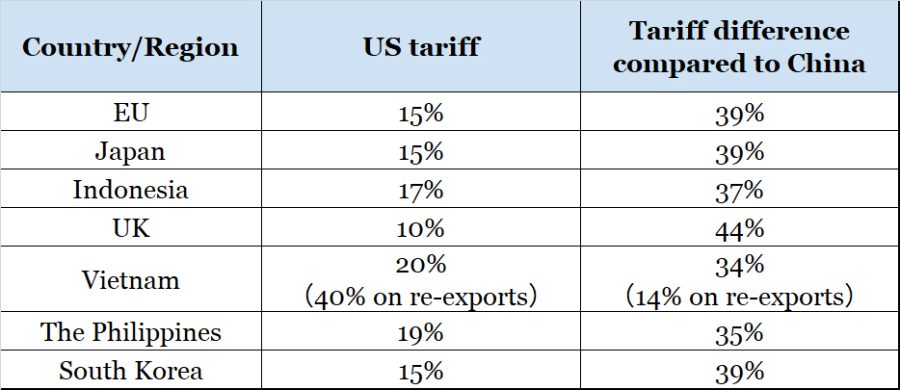
This tariff gap markedly weakens Chinese goods’ market position. In 2024, consumer goods accounted for 60 percent of China’s U.S. exports. To remain competitive, Chinese exporters would need to slash prices by 10–20 percent, but the 54 percent tariff compresses already thin profit margins (e.g., 5–10 percent for apparel), making such cuts likely to exacerbate losses. The differential will foster the maturation of substitute goods from other nations and incentivize Chinese firms to relocate production overseas.
3. We believe that U.S. tariffs on China are more likely to increase than decrease going forward as the U.S. gains leverage over the PRC with its preferential trade deals. The PRC could find itself paying an additional 10 to 20 percent more tariffs after final negotiations, resulting in a tariff rate of between 64 percent to 74 percent. Additionally, the PRC faces secondary tariffs of 100 percent if the Trump administration follows through on its declaration to penalize Russia’s oil customers should Moscow make no progress towards a Ukraine peace deal over the next 10 to 12 days.
3 Analyzing the Politburo’s Fourth Plenum announcement
Politburo announces upcoming Fourth Plenum
The CCP Politburo held a meeting in Beijing on July 30.
The meeting said that the Fourth Plenum of the 20th Central Committee would be held in October in Beijing. The main agenda items of the Fourth Plenum would be the Politburo’s report of its work to the Central Committee and the study and formulation of recommendations for the 15th Five-Year Plan.
The meeting also analyzed China’s current economic situation and laid out plans for economic work in the second half of 2025. The meeting called for adhering to the principle of seeking progress while maintaining stability, and promoting high-quality economic development through strengthening policies, deepening reforms, expanding opening up, effective risk prevention, and improving livelihoods. The meeting further called for laying a foundation for the 15th Five-Year Plan and concluding the 14th Five-Year Plan period.
In summarizing the main points of the Politburo meeting per state media reporting:
Outlook for the 15th Five-Year Plan
- The 15th Five-Year period will be a crucial stage in consolidating the foundation for socialist modernization. It faces profound and complex changes, with both strategic opportunities and risks, as well as increasing uncertainties.
- China’s economic fundamentals remain solid, with many strengths and strong resilience. Its advantages in institutions, markets, industries, and human resources are prominent.
- The country must maintain strategic composure, strengthen confidence in victory, actively respond to and adapt to changes, and focus on doing its own work well to gain strategic initiative in intense international competition.
- The development of the economy and society during the 15th Five-Year Plan must adhere to Marxism-Leninism and the political ideologies of the CCP’s five main leadership generations. It must center around Chinese-style modernization, implement new development concepts, and ensure decisive progress toward basic modernization.
Assessment of the current economic situation
- Since the beginning of this year, under the strong leadership of Party Central with Comrade Xi Jinping at its core, China’s economy has achieved steady progress, with new achievements in high-quality development. Major indicators are performing well; new quality productive forces are emerging; reforms and opening-up have deepened; key risks have been effectively mitigated; and livelihood protection has been enhanced.
- However, the Chinese economy still faces risks and challenges. There is a need to strengthen awareness of potential dangers and to consolidate the positive momentum of economic recovery.
Economic work deployments for the second half of the year
- General requirements: Guided by Xi Jinping Thought, seek progress while maintaining stability, implement the new development philosophy, accelerate the construction of a new development pattern, ensure continuity and stability of policies, enhance flexibility and foresight, and achieve the goals of the 14th Five-Year Plan.
- Macro policy: Implement proactive fiscal policy and moderately accommodative monetary policy, accelerate the issuance of government bonds, ensure the “three guarantees” at the grassroots level (basic public services, salaries, and operations), maintain ample liquidity, reduce financing costs, and support technological innovation, consumption, small and micro enterprises, and foreign trade.
- Domestic demand potential: Launch actions to boost consumption, cultivate new growth points in service consumption, promote the “two major constructions” (implementation of national strategies and building security capabilities in key areas), and stimulate private investment.
- Deepening reform: Use scientific and technological innovation to lead the development of new quality productive forces, foster emerging industries, advance the construction of a unified national market, regulate corporate competition, manage overcapacity in key industries, improve investment attraction, and invigorate all types of business entities.
- Opening-up: Stabilize foreign trade and investment, strengthen financial support, optimize export tax rebate policies, and build open platforms such as pilot free trade zones.
- Risk prevention and control: Implement the spirit of the Central Urban Work Conference, advance urban renewal, resolve local government debt risks, strictly prohibit new implicit debt, and consolidate the positive momentum in capital markets.
- Livelihood protection: Prioritize employment, implement people-benefiting policies, improve the social assistance system, strengthen agriculture, rural areas, and farmers (the “three rural” issues), consolidate poverty alleviation results, and enhance work in production safety, food safety, flood prevention and disaster relief, and energy and power supply.
- Planning work: Prepare well for the drafting of the 15th Five-Year Plan.
Backdrop
The Politburo’s announcement of the Fourth Plenum comes amid the PRC’s continued trade negotiations and tensions with the U.S., as well as endless speculation about whether Xi Jinping would be removed at the political conclave by observers from the “Xi losing power” camp.
Our take
1. The agenda items of the Fourth Plenum of the 20th Central Committee affirm our analysis from June 2025. We wrote that the CCP authorities “could hold advanced discussions of the 15th Five-Year Plan” given Sino-U.S. trade tensions and China’s economic difficulties. We also noted that a Qiushi piece that was published at the time hinted at areas that the CCP authorities could address in the 15th Five-Year Plan as Beijing looks to resolve China’s current economic troubles, and we listed specific challenges and corresponding strategies that the CCP could adopt.
Meanwhile, the Fourth Plenum’s agenda items do not address the issue of major personnel changes, which refutes the intense speculation in overseas Chinese-speaking circles that Xi Jinping is “losing power” and will be replaced at the political conclave (for deeper analysis of the topic, see here, here, and here). That being said, the Fourth Plenum could announce the removal of officials who are purged (Miao Hua, Jin Xiangjun and Lan Tianli) or officials who are reportedly under investigation (He Weidong) from the Central Committee, as well as the replacement of Central Committee alternate members with new ones.
2. Fourth Plenums in the recent two decades tended to focus on ideological issues like Party-building and “modernizing governance,” while Fifth Plenums discussed economic “Five-Year Plans.” The upcoming Fourth Plenum agenda, however, appears to be a mix of typical Fourth Plenum, Fifth Plenum, and even Third Plenum (regime reform) items. We see several possible reasons for this.
First, the Third Plenum of the 20th Central Committee was delayed by over a year before it was finally held in July 2024. The upcoming Fourth Plenum’s “hybrid” agenda could be Party Central’s way of making up for the previous delay.
Second, the Fourth Plenum of the 20th Central Committee likely included some “reform”-type agenda items (advancing “Chinese-style modernization,” etc.) as a way to reinforce Xi Jinping’s “quan wei” and emphasize the dominance of the Party and its “core” leader in all aspects of governance. This is likely a part of Xi’s power consolidation and power maintenance process, and underscores his current paramount position.
Third, Party Central could have included economic items in the Fourth Plenum agenda to show that Beijing has a plan for economic revival and potentially boost domestic confidence in the economy and the markets. Even if the 15th Five-Year Plan turns out to be a rehash of existing policies rather than a proposal offering new ideas and breakthroughs, the CCP authorities will use what was rolled out at the Fourth Plenum to further its propaganda and paper over economic setbacks.
3. Typically, plenary sessions of the Central Committee are held around a year apart from each other. Since the Third Plenum of the 20th Central Committee was held in July 2024, observers initially believed that the Fourth Plenum would be held around July to August this year. But the upcoming Fourth Plenum was instead scheduled for an unspecified date in October. We see several likely reasons why this is so.
First, plenary sessions of the Central Committee are historically held in the fourth quarter of the year. Therefore, the holding of the upcoming Fourth Plenum in October represents a return to the “norm” after a one-off “deviance” with the Third Plenum in 2024.
Second, the Xi leadership could be waiting for greater clarity on geopolitical issues so that it can finalize its various plans. For one, Sino-U.S. trade talks are still ongoing and the PRC potentially faces U.S. secondary sanctions if it continues to buy Russian oil. As things arrive at a resolution or show signs of reaching a resolution over the next couple of months, Beijing would have time to make adjustments to its 15th Five-Year Plan and other policies before announcing them at the Fourth Plenum.
Third, Xi Jinping is likely looking to consolidate and display his “quan wei” over the Party with his military parade in September before holding the Fourth Plenum. The military parade will make it demonstrably clear that Xi is the unquestioned leader in the CCP and facilitate sensitive personnel adjustment matters at the Fourth Plenum like the possible removal of Miao Hua and He Weidong from the Central Committee.




