
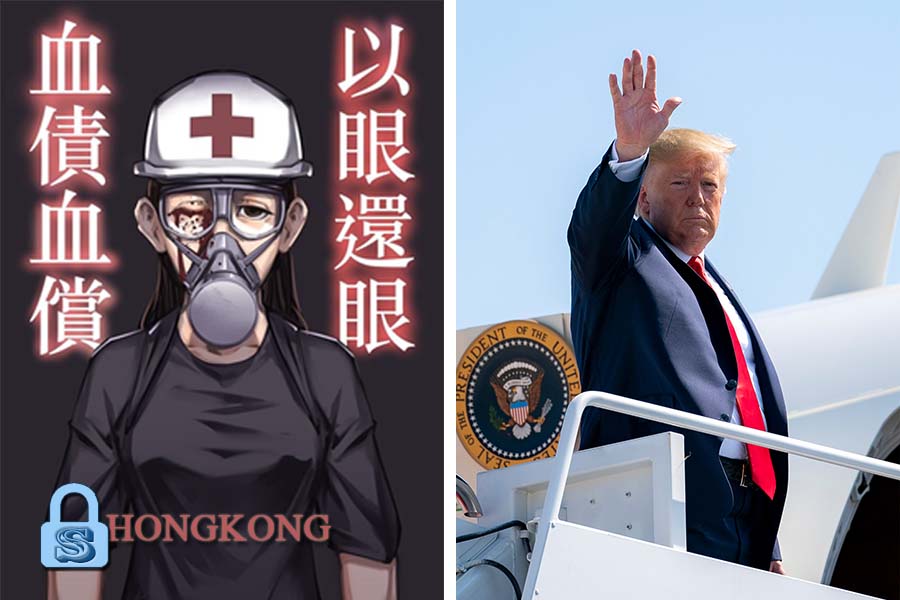
◎ Trump’s ambiguous messaging on the Hong Kong issue will embolden the CCP to keep pushing the limits in suppressing the protesters.
The People’s Republic of China recently made moves which observers believe have raised the probability of military or security force intervention in Hong Kong. Meanwhile, the U.S. announced that it is delaying some tariffs scheduled for September until mid-December.
The backdrop:
Signs of military intervention?
Aug. 12:
- Yang Guang, a spokesperson for the PRC State Council’s Hong Kong and Macau Affairs Office, described demonstrations in Hong Kong on the weekend of Aug. 10 and 11 as “deranged” and said that “the first signs of terrorism are starting to appear.”
- Hu Xijin, the editor-in-chief of the state-run Global Times, tweeted: “Videos of China’s armed police being assembling in Shenzhen, a city bordering Hong Kong, are circulated online today. I think it is a clear warning to rioters in Hong Kong. Possibility of Beijing intervening in Hong Kong’s situation is rising.”
- Over the weekend of Aug. 10, videos of PRC security trucks and armored vehicles traveling in Shenzhen, a mainland Chinese city which shares a border with Hong Kong, were circulated on both Chinese and Western social media. In the week of Aug. 12, pictures and videos of armored vehicles parked in a Shenzhen sports complex were circulated on social media.
- U.S. Senate Majority Leader Mitch McConnell tweeted, “The people of Hong Kong are bravely standing up to the Chinese Communist Party as Beijing tries to encroach on their autonomy and freedom. Any violent crackdown would be completely unacceptable. As I have said on the Senate floor: The world is watching.”
Aug. 13:
- United States President Trump told reporters, “The Hong Kong thing is a very tough situation. I hope it works out peacefully. I hope nobody gets hurt. I hope nobody gets killed.”
- Later, Trump tweeted: “Many are blaming me, and the United States, for the problems going on in Hong Kong. I can’t imagine why?”
- In a separate tweet, Trump wrote: “Our Intelligence has informed us that the Chinese Government is moving troops to the Border with Hong Kong. Everyone should be calm and safe!” Later, Trump retweeted a video of what appears to be a long convoy of military trucks traveling on the streets of Shenzhen.
- U.S. House of Representatives Speaker Nancy Pelosi urged Trump to “to walk away from his recent statements, which invite miscalculation, and to work to advance peace, justice and democracy in Hong Kong.” Her statement added that Congress “will work to pass the bicameral and bipartisan Hong Kong Human Rights and Democracy Act to reaffirm the U.S. commitment to democracy, human rights and the rule of law in the face of Beijing’s crackdown and focus on banning the sale of munitions and crowd control gear to the Hong Kong police force.”
Aug. 14:
- On Aug. 13, Hong Kong protesters at the city’s airport surrounded and attacked two mainland Chinese nationals. One carried identification which matched that of an agent from the Shenzhen security bureau, while the other was a mainland tourist who was discovered to be a journalist with the Global Times. On Aug. 14, Xu Luying, a spokesperson for the Hong Kong and Macau Affairs Office, said that the PRC expresses its “strongest condemnation of this near-terrorist act and express our deepest condolences to the injured mainland compatriots.” Xu added that “Hong Kong’s radical violent elements have completely broken through the bottom line of the law, the bottom line of morality and the bottom line of human nature.”
- The official WeChat account of the People’s Liberation Army Ground Forces of the Eastern Theater Command posted an article on the Hong Kong situation. The article claimed that “it only takes 10 minutes” to travel from Shenzhen to Hong Kong, and featured a photo of a locust with the words “Hong Kong Poisonous Elements” on its body. The article added that locusts “will gradually become extinct in the fall.”
- According to POLITICO, a U.S. State Department spokesperson said that the department is “deeply concerned” by reports of PRC military movement on the Hong Kong border. “We condemn violence and urge all sides to exercise restraint, but remain staunch in our support for freedom of expression and freedom of peaceful assembly in Hong Kong. The ongoing demonstrations in Hong Kong reflect the sentiment of Hongkongers and their broad and legitimate concerns about the erosion of Hong Kong’s autonomy. We categorically reject the false charge of foreign forces as the black hand behind the protests. The continued erosion of Hong Kong’s autonomy puts at risk its long-established special status in international affairs,” the spokesperson said.
- Democrat U.S. Senator Ben Cardin told Reuters that “I can assure you that if China comes down hard on the protesters that there will be action in Congress to enforce the autonomy agreements that were entered into that are part of the special recognition of Hong Kong.” Republican Senator Cory Gardner tweeted that the Trump administration “must make clear to Beijing that any crackdown in Hong Kong will have profound consequences for China, including imposition of U.S. sanctions.”
- President Trump tweeted: “We are winning, big time, against China. Companies & jobs are fleeing. Prices to us have not gone up, and in some cases, have come down. China is not our problem, though Hong Kong is not helping.”
Delayed tariffs and Sino-U.S. interaction
Aug. 13:
- U.S. Treasury Secretary Steven Mnuchin and U.S. Trade Representative Robert Lighthizer held a conference call with Chinese vice premier Liu He, commerce minister Zhong Shan, and central bank chief Yi Gang. According to the PRC commerce ministry, both sides agreed to communicate again by phone in a fortnight.
- After the conference call between the PRC and U.S. trade negotiators, the United States Trade Representative Office announced that some of the new tariffs of 10 percent on an additional $300 billion of Chinese goods will be delayed, while other products will be removed from the tariff list altogether. Tariffs for products like electronics (cellphones, laptops, video game consoles, etc.), some clothing and shoes, and some toys will be delayed from Sept. 1 to Dec. 15.
- When asked by reporters about the tariff delay, President Trump said, “We’re doing this for the Christmas season. Just in case some of the tariffs would have an impact on U.S. customers.
U.S. Secretary of State Mike Pompeo and CCP Foreign Affairs Work Commission director Yang Jiechi met in New York and “had an extended exchange of views on U.S.-China relations,” according to a U.S. State Department statement.
Aug. 14:
- U.S. Commerce Secretary Wilbur Ross told CNBC that the delayed tariffs “was not a quid pro quo.” When asked about Hong Kong, he said that he did not think that the U.S. would have done differently in the past and added, “What would we do, invade Hong Kong?” Ross also noted that Hong Kong is “an internal matter” for China.
- White House trade adviser Peter Navarro told Fox Business that the China tariffs were delayed to mitigate the pain on U.S. businesses, and that the notion of delaying tariffs in exchange for concessions from China is the “totally wrong way to look at it.”
Economics
- China’s economy continued to worsen in July. According to the latest official data, industrial output growth slowed to 4.8 percent in July from 2018, a 17-year low. Second quarter GDP growth was 6.2 percent, the lowest in nearly three decades.
- U.S. economic growth decelerated in the second quarter, with a GDP increase of 2.1 percent down from the first quarter’s 3.1 percent. Observers point to slumping U.S. equities and bond yields as warning signs of a recession.
Our take:
1. We wrote previously that “The CCP is prepared to use violence and bloodshed to suppress the Hong Kong protests, but seems to be less keen on using its military to carry out the suppression or impose martial law. Hence, the CCP will likely continue to rely on incitement tactics and hope that the Hong Kong police/triad/uncover PRC security force ‘white terror’ would be enough to frighten the protesters into ending the demonstrations. The CCP is likely also hoping that the Hong Kong protests would naturally peter out when the young protesters are due back in school in September. Further, the CCP will be looking to resolve the Hong Kong issue before the 70th anniversary of the founding of the People’s Republic of China on Oct. 1.”
The police tactics on the weekend of Aug. 10 and the infiltration of protester ranks affirm our analysis about CCP incitement (see here, here, and here).
Meanwhile, Beijing’s use of extreme language to describe the Hong Kong protests (“riots,” “color revolution,” “signs of terrorism,” etc.), as well as the photos and videos of security forces massing in Shenzhen, appear to be classic CCP psychological warfare tactics. The CCP’s short-term goal would be to intimidate the Hong Kong protesters into abandoning further demonstrations by making the prospect of PRC military or security forces intervention in Hong Kong look very real. The long-term goal of the CCP’s psychological warfare would be to desensitize the people of Hong Kong and the international community to the idea of PRC military or security forces intervening in Hong Kong, and hence “numb” the world to a violent PRC suppression if one is ordered.
President Donald Trump could be thinking that his tweet about U.S. intelligence and the PRC “moving troops to the Border with Hong Kong” is a caution to the PRC against intervening in Hong Kong. But from the CCP’s perspective, Trump is merely “assisting” in its psychological warfare operation. The CCP would be more hesitant to act rashly on Hong Kong or issue further tough rhetoric had Trump instead condemned the Hong Kong police violence and the CCP’s handling of the Hong Kong situation while making a firm statement of support to the protesters.
2. The unexpected meeting between Mike Pompeo and Yang Jiechi, as well as the Sino-U.S. trade negotiator conference call on Aug. 13, could be the CCP’s way of showing interest in continuing the trade negotiations and de-escalating Sino-U.S. tensions. As we wrote in May, the CCP appears to be “exploiting the Trump administration’s attachment to getting a deal to buy itself time to regroup and delay further regime-threatening pressure from America while simultaneously advancing its global hegemonic agenda.” The CCP’s short-term goal would be to delay the trade negotiations enough to deny Trump a “win” on China to help with his 2020 re-election bid. It is not clear if the Trump administration recognizes that the Sino-U.S. trade talks have become a delaying tactic.
Top officials in the Trump administration have said that the decision to delay tariffs was not influenced by PRC concessions but by internal considerations. There is no reason to doubt this explanation given that economic indicators of a recession have emerged in recent weeks. Other factors, including Beijing making promises on trade, Hong Kong, and other matters to Washington, cannot be ruled out as contributing reasons to why the Trump administration suddenly delayed some of the additional tariffs.
What’s next:
1. The U.S. and China seem to have stepped back a bit from their ongoing conflict. But the Sino-U.S. “Battle of Waterloo” is far from over. We expect to see more alternation between “clashes” and “lulls” in the fighting ahead.
2. Contrary to some news reporting, President Trump’s remarks on Hong Kong is not a “greenlight” to a potential PRC crackdown. The CCP has its own red lines, and will order a crackdown when it deems one necessary regardless of what the President of the United States says or how the rest of the world reacts.
However, Trump’s ambiguous messaging on the Hong Kong issue will embolden the CCP to keep pushing the limits in suppressing the protesters.
3. The CCP will continue to rely on incitement, infiltration, and psychological warfare tactics in Hong Kong in the hopes of winning a war of attrition against the protesters. The longer the Hong Kong situation remains unresolved, however, the more at a disadvantage the CCP becomes:
- Prolonged and escalating unrest in Hong Kong puts pressure on the Hong Kong and mainland economies, currencies, and financial markets. And the Hong Kong and mainland economies have already been steadily worsening before the protests began.
- The CCP’s gangster tactics, operations, and disinformation methods are made plain for the world to see at a time when the PRC has come under increasing scrutiny for its pernicious behavior. Already, the CCP has lost the hearts and minds of the Hong Kong people; the Party risks losing the hearts and minds of those in the international community who continue to sympathize with its communist regime.
- The PRC hopes to “reunify” Taiwan using the “one country, two systems” model and other peaceful methods. The Hong Kong situation risks completely alienating those in Taiwan who support reunification with Red China under any model.
- The Trump administration could use the Hong Kong situation to sharply pressure the CCP when it finally decides to abandon trade negotiations with the PRC.
4. As we previously wrote, the CCP will be hoping to resolve the Hong Kong issue before the PRC’s 70th anniversary on Oct. 1 and will unlikely want to intervene militarily until after the anniversary is commemorated. If the situation gets out of hand before Oct. 1, however, the CCP could resort to drastic measures to calm the protesters, including sacrificing the pro-Beijing elements in Hong Kong. This means that Hong Kong leader Carrie Lam and the undercover CCP security forces in the city are all at risk of being “taken out” (sudden health problems resulting in incapacitation and/or death, etc.) as the CCP seeks to appease the protesters without giving the impression that it has made concessions.
[wpdreams_rpp id=0]




