
1 Analyzing Beijing’s Internet of Things development action plan
On April 2, the PRC’s Ministry of Industry and Information Technology, together with eight other departments, jointly issued an action plan for “promoting the innovative development of the Internet of Things industry” from 2026 to 2028 (推動物聯網產業創新發展行動方案 [2026—2028年]). The plan aims to further accelerate the comprehensive integration of IoT technologies into production, consumption, and social governance, promote the deep integration of the digital economy with the real economy, and support the development of “new quality productive forces.”
The plan proposes that China will achieve the following by 2028:
- Formulate or revise more than 50 advanced and applicable standards.
- Develop 10 application sectors with over 100 million connections and 15 sectors with over 10 million connections.
- Strive to get the total number of IoT terminal connections to reach the scale of 10 billion.
- Have the core IoT industry exceed 3.5 trillion yuan in size.
The plan outlines five key priorities and 16 specific tasks:
Promote innovation and upgrading of IoT devices
- Achieve breakthroughs in key sensing technologies.
- Accelerate optimization and upgrading of application terminals.
- Enhance the connectivity capabilities of network equipment.
Improve IoT platform service performance
- Build high-capacity IoT platforms.
- Optimize platform operation and management.
Cultivate IoT application scenarios
- Deepen IoT integration in industrial production.
- Stimulate demand for IoT applications in the consumer sector.
- Strengthen IoT service supply in social governance.
Strengthen IoT network infrastructure
- Expand network deployment coverage.
- Accelerate multi-network integration.
- Improve intelligent network connectivity.
Foster a robust IoT industry ecosystem
- Improve the IoT industrial system.
- Highlight the leading role of enterprises in innovation.
- Deepen the integration of IoT and artificial intelligence.
- Unlock the value potential of IoT data.
- Strengthen IoT security regulation.
China’s IoT development
The Internet of Things (IoT) is far more than simple device connectivity for the CCP. At its core, it represents the comprehensive “coverage” and “control” of the physical world by the digital world. The IoT also serves as the glue integrating the “digital economy” with the “real economy.”
The IoT architecture is typically divided into four layers:
- Perception: Sensors, RFID, cameras. These “sensory organs” represent the starting point of data collection.
- Network: 5G, narrowband IoT (NB-IoT), satellite connectivity. This functions as the “neural network.”
- Platform: Cloud computing and AI processing. This is the “brain” of IoT and is responsible for decision-making.
- Application: Smart cities, industrial automation. These represent the movement of the “nerve endings.”
Through IoT, the CCP seeks to transform data into a core factor of production. By achieving “full-domain perception” and “deep integration” across the entire production process, it aims to further upgrade China’s manufacturing capabilities from being a mere “hardware manufacturer” to a “standards setter” and “system controller.”
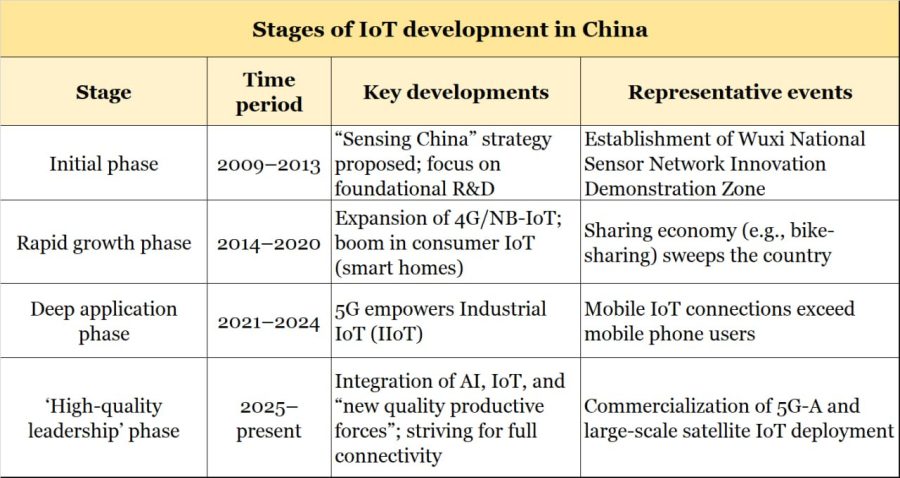
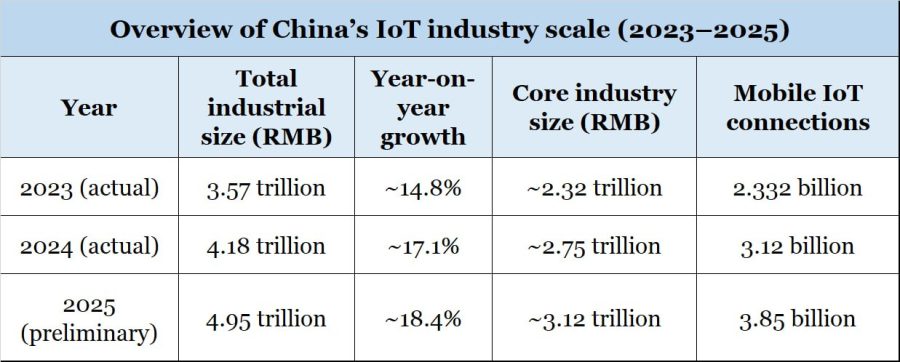
By the end of 2025, the number of mobile IoT terminal connections in China had reached 3.85 billion, far exceeding the number of mobile phone users (approximately 1.8 billion). China also operates the world’s largest 5G network (with 4.25 million base stations), providing it with an unparalleled large-scale testing ground for IoT deployment.
Our take
Beijing’s IoT industry development action plan is not simply a roadmap for industrial upgrading. The plan serves as a political declaration of sorts: In the face of external technological containment, internal growth transitions, and mounting local fiscal pressures, the CCP is tapping into state capitalism to achieve technological breakthroughs that will allow it to survive and dominate.
1. The action plan reveals the CCP’s ambition to leverage state capitalism to crowd out Western private enterprises and influence the Global South.
Chinese firms have already established a dominant position in the cellular IoT module market. The top five suppliers — including Quectel, China Mobile, and Fibocom — collectively account for 74 percent of the global market share. Through government subsidies and the cost amortization enabled by a massive domestic market, Chinese companies are able to drive down the cost of AI chips and modules to below $5 per unit. This form of “low-price dumping” is difficult for Western private firms to withstand; for instance, Swiss IoT company u-blox, facing compressed profit margins, was forced to exit the cellular module business in 2024.
Concurrently, the CCP is leveraging the “Digital Silk Road” to promote its IoT solutions across the Global South (including ASEAN, Africa, and Latin America). In collaboration with the United Nations and South-South cooperation organizations, Chinese firms are exporting infrastructure based on IPv6 and proprietary operating systems (HarmonyOS, Euler). Once the smart cities or power grids of Global South nations become monopolized by Chinese modules, the CCP gains the potential capability to remotely intervene in — or even shut down — the target country’s critical infrastructure via firmware updates (OTA).
2. Despite the ambitious scope of Beijing’s action plan, China’s IoT industry still faces numerous structural challenges.
i) China has the lead in the number of 5G base stations and the scale of IoT connections. However, it still suffers from serious structural weaknesses in the “perception” layer, the most fundamental and critical layer of IoT. China’s self-sufficiency in core hardware also remains low even though it ranks first in connectivity.
- Domestic sensors are mainly focused on low- to mid-end assembly with limited technological sophistication, while China’s reliance on imports for high-end sensors reaches 80 percent.
- China is almost entirely import dependent on core control chips for sensors, with an import ratio as high as 90 percent.
- China’s dependence on the U.S., Japan, and Germany for key precision manufacturing equipment exceeds 85 percent.
Although Chinese firms dominate in quantity, most are positioned at the lower end of the value chain (focusing on packaging and basic testing). China’s indigenous innovation remains weak in the higher-end segments like micro/nano displacement sensors and high-resolution vision sensors.
ii) U.S. technology sanctions have become an unavoidable external variable for the development of China’s IoT industry. For example, the U.S. Federal Communications Commission has explicitly stated that products from five Chinese firms, including Huawei and ZTE, pose “unacceptable risks to national security.” This is not merely a market access issue for the PRC; Western technology sanctions entail a fragmentation of global technology standards. As long as the West continues tightening export controls on high-precision instruments and semiconductor manufacturing equipment, China’s “digital neural network” faces disruption risks due to supply cutoffs.
Likely as a response to Western technological “containment” and to build “cyber sovereignty,” Beijing’s IoT action plan emphasizes twice the need to “accelerate large-scale IPv6 deployment” and “support default activation of the IPv6 protocol.” IPv6 provides not only a vast pool of IP addresses, but also built-in security and traceability features that facilitate state control over cyberspace. Meanwhile, China’s share of global 6G patents has already exceeded 48 percent.
The PRC is attempting to create a “patent trap” in next-generation mobile communication standards by gaining control over standard-setting (with the plan targeting more than 50 standards), thereby offsetting the U.S. advantage in foundational semiconductor technologies. However, this “fortress-style” development model may also lead to increasing decoupling from the global mainstream ecosystem, driving up R&D costs due to reduced international collaboration. While Beijing may consolidate control domestically and across the Global South, it risks losing competitiveness in high-end global markets.
iii) The action plan prioritizes application transformation across production, consumption, and social governance. However, from a commercial standpoint, these application scenarios face a serious lack of return on investment.
Per IoT terminal data from 2023 to 2025, the industry exhibits signs of inflated growth:
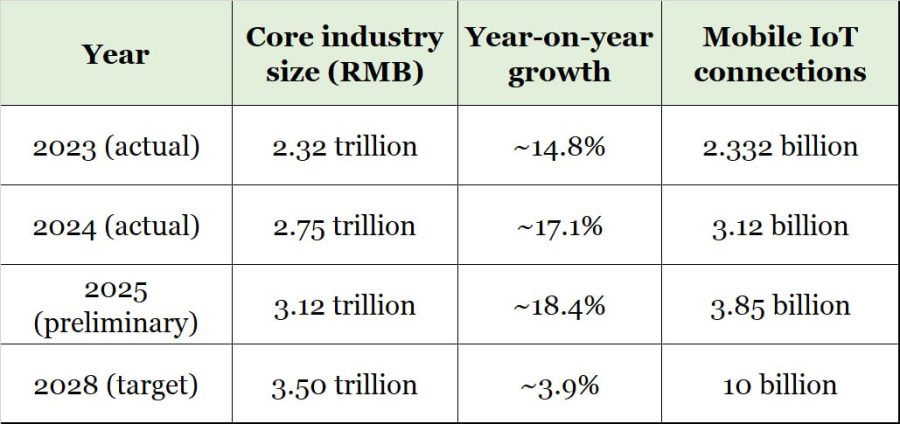
From 2025 to 2028, the compound annual growth rate of the core industry is projected to drop sharply to around 3.9 percent. This suggests that the previous high growth was largely driven by infrastructure investment and “numerical expansion” (i.e. data manipulation), while the target of 10 billion connections may consist largely of low-value sensor nodes with limited economic return.
Applications in the “social governance” domain, as highlighted in the plan, essentially represent the deep integration of IoT technology with state stability maintenance systems. The plan supports areas such as “urban intelligent control, risk early warning, and emergency response.” While these projects often enjoy stable funding since they directly serve governance objectives, their net economic contribution (beyond boosting the output of security-related firms) remains questionable. Many such projects are financed through government special-purpose bonds.
iv) The CCP authorities have invested massive amounts of capital to support the development of the IoT foundation, notably, the integrated circuit industry. This state-directed investment model, however, has produced significant distortions and engendered corruption. For instance, the National Integrated Circuit Industry Investment Fund (commonly known as the “Big Fund”) has managed over 300 billion yuan across its first two phases and mobilized more than 1 trillion yuan in social capital. However, China has not seen significant breakthroughs in semiconductor development (The advanced chips produced by Chinese fabs are still two to three years behind those in Taiwan and South Korea) even as the industry has been targeted by the anti-corruption campaign.
Under the CCP’s authoritarian system, the operational logic of the “Big Fund” often follows a pattern of “the government selecting the track, and officials selecting the enterprises.” This model ignores the objective laws of semiconductor R&D, leading to a massive influx of capital into low-level, redundant construction projects, or being exploited by companies to defraud the government of subsidies. Therefore, the action plan’s proposal to “guide social capital to support industrial innovation” is highly likely to devolve into a new round of rent-seeking activities, given the current environment characterized by a lack of rule-of-law protections and transparency.
v) The IoT industry is a form of “new infrastructure” characterized by long investment cycles and high upfront costs, making it heavily dependent on central government funding. If such funding falls short, local governments — under pressure to meet political targets such as “10 billion connections” — may resort to data manipulation or coercive tactics (i.e. forcing enterprises into purchasing unnecessary equipment).
Local governments will likely struggle to find funds to support IoT development. According to the PRC government work report presented at the 2026 Two Sessions, the fiscal deficit ratio is expected to remain around 4 percent this year. Although Beijing is expanding the scale of special-purpose bond issuance, they are primarily allocated to resolving local debt risks and funding key projects, leaving limited room for new large-scale IoT investments.
3. On paper, Beijing’s IoT industry development action plan is essentially a digital encirclement and breakthrough strategy. On the one hand, the plan seeks to squeeze out the survival space of Western private enterprises through low pricing, court the Global South nations, and achieve a form of non-military technological expansion. On the other hand, the plan appears to boost the PRC’s technological self-sufficiency. In reality, however, China’s 80 percent dependence on imported high-end sensors, the heavy debt burden of local governments, and the emergence of artificially constructed technological silos could see this 3.5 trillion yuan “digital leap” transform into a costly macro-level bubble.
Based on current data and policy momentum, the following projections can be made for the development of China’s IoT industry over the next three years:
- By 2028, China will very likely officially report an industry size exceeding 3.5 trillion yuan, with total connections reaching 10 billion. However, this growth will also likely be achieved by forcibly reclassifying industries that do not inherently belong to the IoT and through large-scale procurement by local governments.
- China may gain an advantage in 6G standards and in specific applications (such as smart mining and port automation). However, in core areas like sensor materials, precision manufacturing, and high-performance computing chips, China’s gap with the United States, Japan, and Europe may widen further due to ongoing sanctions.
- With the enforced rollout of IPv6 and domestic operating systems (such as HarmonyOS and Euler), China’s IoT ecosystem may evolve into a system that dominates the Global South while becoming partially decoupled from the Western technological ecosystem.
Ultimately, the development of China’s IoT industry is a microcosm of the PRC’s “state capitalism” model. It demonstrates the CCP regime’s powerful mobilization capacity in response to crises, but also exposes fundamental flaws in its innovation mechanisms, capital efficiency, and supervision of governing organs. Whether the ambitious 3.5-trillion-yuan goal becomes an engine for a new round of economic growth or another digital bubble built on debt and deception will depend on whether high-end sensors and precision equipment can be localized, whether the industry can avoid “Great Leap Forward-style” blind investment, and whether the central government can resolve the issue of local governments reporting fraudulent figures to pad their political achievements.
2 Ma Xingrui’s downfall foreshadows deepening purge
On April 3, state mouthpiece Xinhua reported that Ma Xingrui, a member of the CCP Politburo and deputy head of the Central Rural Work Leading Group, was placed under investigation for “serious violations of discipline and law.”
***
Ma previously served as Party secretary of Xinjiang until he was abruptly reassigned in July 2025. Ma also missed several key meetings since November 2025, including a Politburo session in late November, another Politburo session and the Central Economic Work Conference in December, the annual plenary session of the Central Commission for Discipline Inspection in January 2026, and the 2026 Two Sessions (see here for the implications of Ma’s absences from meetings and our theories about why the Xi leadership might want to investigate him).
Ma is the fourth sitting Politburo member to be investigated since Xi Jinping took office in 2012. The others were former Chongqing Party boss Sun Zhengcai, as well as Central Military Commission vice chairmen He Weidong and Zhang Youxia.
***
Two of Ma Xingrui’s former secretaries vanished from public view in the lead up to the announcement that he was officially being probed:
Ma Xingrui’s downfall has been accompanied by the dismantling of his political base. In China’s elite politics, “secretaries” and “hometown ties” are two core elements in building networks of protection.
- Gao Shiwen, mayor of Nanchang City, has been “missing” since February 2026. A Shandong native like Ma, Gao served as the former’s secretary during his time at China Aerospace Science and Technology Corporation.
- Guo Yonghang, the former vice chairman of the Guangdong provincial Chinese People’s Political Consultative Conference, was removed from office on March 27, 2026. Another Shandong native, Guo served as Ma’s secretary-general when the latter was Party secretary of Shenzhen. Guo’s reassignment to the provincial CPPCC in January 2026 (he was previously Party secretary of Guangzhou) suggests that he was already being sidelined and that the CCP authorities were then in the final stages of building a case against him.
The “disappearance” of Ma’s former secretaries suggests that they were investigated in connection with his case.
Our take
The official announcement of the Ma Xingrui probe affirmed what many observers have suspected ever since he stopped attending key Party meetings in late 2025, namely, that Ma was in political trouble.
Ma’s downfall also confirms a trend that has been building since the People’s Liberation Army Rocket Force and Equipment Department scandal in 2023. During his first two terms, Xi Jinping’s “self-revolution” campaign was semi-rhetorical at best because virtually no Xi loyalist was probed by the anti-corruption authorities. But the “self-revolution” campaign moved beyond rhetoric after Xi began to “turn the knife inward” on his loyalists (or perceived loyalists) following the exposure of serious corruption in the military and defense industry. The official probe of Ma — a former aerospace expert who owed his political career entirely to Xi — underscores the indiscriminate nature of the Xi leadership’s current anti-corruption efforts.
1. Xinhua offered no details on why Ma Xingrui was purged beyond the formulaic charge of “serious violations of discipline and law,” a euphemism for corruption. However, corruption alone is an insufficient charge to justify the removal of a sitting Politburo member. It is likely that Ma will eventually be directly or indirectly accused of several things, including corruption that was so severe that it undermined Xi Jinping’s policy objectives, disloyalty to Xi and Party Central, misgovernance while he was serving in the provinces, and involvement with “cliques and factions.”
We previously indicated that no publicly available evidence suggests Ma’s involvement in factional politics or displays of disloyalty. That being said, Ma had worked under or had interactions with Xi’s factional rivals at various stages in his aerospace industry and public sector careers. Below we examine Ma’s career and isolate areas that could have gotten him into serious political trouble.
Aerospace and military
Born into a family of mine workers, Ma went on to study mechanics in college and eventually earned a doctorate in the subject at Harbin Institute of Technology in 1985. After spending some years in academia, Ma was appointed vice dean of China Academy of Space Technology in 1996 before moving on to China Aerospace Science and Technology Corporation in 1999. Ma would spend the next 14 years at CASC, where he would eventually be promoted to general manager.
When Ma was at CASC, Jiang Mianheng, the elder son of Xi’s chief political nemesis Jiang Zemin, served as vice president of the Chinese Academy of Sciences from 1999 to 2011. The younger Jiang held senior leadership roles in major space projects such as Shenzhou-5, Chang’e-1, and Shenzhou-7, while Ma served as a core executor in these same programs, including as deputy commander of the Lunar Exploration Program (Chang’e Project) and head of the satellite systems technical group. It is unclear whether Jiang Mianheng and Ma Xingrui established a patron-client relationship while they belonged to various scientific programs at the time. That being said, it would not be difficult for anti-corruption investigators to “connect the dots” between the two men and take a page from Stalin’s purges (“show me the man and I’ll show you the crime”) after Ma fell afoul of the Xi leadership.
In contrast, anti-corruption investigators would not have to work very hard to find “evidence” of Ma’s potential gross malfeasance while he was at CASC. China’s aerospace and defense industries were regarded as a “state within a state” during the Jiang Zemin-Hu Jintao era, directly protected by the central leadership (then dominated by the Jiang faction) and operating with a high degree of autonomy. Due to its close ties to national defense, spending, procurement, and technology transfers within these industries long existed in a vacuum of oversight. While he was general manager of CASC, Ma Xingrui would oversee annual R&D and production budgets amounting to hundreds of billions of yuan. Subsequent audits and internal whistleblowing suggested widespread issues during the period when Ma was in charge, including inflated costs, falsified accounting, and collusion with private contractors. These issues would eventually come under scrutiny as the Xi leadership assessed the damage to the military modernization program and sought to discern the extent of corruption in the defense industry in the aftermath of the 2023 PLARF scandal.
It is possible that Ma Xingrui was directly implicated in the PLARF corruption scandal. Ma previously oversaw national military production and R&D when he was vice minister of industry and information technology and director of the State Administration for Science, Technology and Industry for National Defense. Had investigators found that the PLARF’s equipment quality problems originated with the state-owned defense enterprises and not the military units themselves, then it was inevitable that Ma would be held accountable following Beijing’s retroactive investigation into the military and defense industry.
Provincial governments
After transitioning into government, Ma Xingrui would be “parachuted” into the provinces to serve as the number one or number two official in Shenzhen (Party secretary), Guangdong (governor), and Xinjiang (Party secretary).
While in Shenzhen, (2015 to 2016), Ma reportedly had close interactions with China Evergrande’s Hui Ka Yan (Xu Jiayin). There are hints that Ma, whose governing style was described as “pragmatic” and “innovative,” could have acted improperly in favoring Hui and Evergrande while striving to boost his political achievements. After a high-level meeting between Ma and Hui, Evergrande would eventually relocate its headquarters from Guangzhou to Shenzhen during Ma’s tenure in Shenzhen. There were also allegations that Ma strongly backed Evergrande’s acquisition of key land development rights in Shenzhen, as well as its involvement in urban redevelopment projects.
After Hui Ka Yan was placed under “coercive measures” by the CCP authorities in September 2023, rumors began circulating that he implicated multiple Guangdong officials for bribing him. While there is no official confirmation linking Ma directly to the Evergrande case, the fall of Ma’s former secretary Guo Yonghang was widely interpreted as indicating that investigations have extended into Ma’s political-business network during his time in the Guangdong officialdom.
At the end of 2021, Ma replaced hardliner Chen Quanguo as Party secretary of Xinjiang. In Xinjiang, Ma introduced policies aimed at “normalizing” governance in the region as he sought to strike a balance between “stability maintenance” and development. Ma’s “progress” in Xinjiang, however, would take a backseat during the COVID-19 pandemic years. Eventually, the extended COVID lockdown in Urumqi from the second half of 2022 would culminate in the Nov. 24 apartment fire tragedy and help to trigger the nationwide “white paper movement.” But when the governance crisis hit, Ma had already been elevated to the Politburo at the 20th Party Congress and did not appear to suffer any political repercussions at the time.
Some reports in overseas Chinese language media claim that Ma’s family and local enterprises in Xinjiang were involved in “interest transfers” concerning a 3.3 trillion yuan infrastructure development fund that Ma Xingrui oversaw as provincial Party secretary. While this claim is hard to independently verify, the CCDI is known to closely scrutinize the transparency of Xinjiang’s development funds.
2. Several overseas Chinese media outlets and commentators are claiming that the purge of Ma Xingrui is another sign of “Xi losing power.” They argue that Ma is essentially a political “proxy” of the Xi family because Ma and Xi Jinping’s wife Peng Liyuan share the same hometown (Yuncheng City in Shandong Province), and Ma’s downfall suggests that Xi is not powerful enough to protect a close “confidant.”
We find this argument very unconvincing. First, CCP documents, propaganda, and other publicly observable signs indicate that Xi is very much secure in power (see here, here, and here). Given so, there is no question that Xi is leading the current purges in the CCP, rather than being the subject of a purge. Second, the claim that Ma and Peng are from the same hometown does not shed any light on their personal relationship and the relationship between Ma and Xi. Moreover, personal relationships do not necessarily transfer over into political relationships in the CCP.
Hometown networks sometimes do matter in factional politics. However, the core basis for factional formation is the search for career security and protection of power (per the American political scientist Lucian Pye). A study of Xi and Ma’s respective careers shows that while Ma owes his official career progression to Xi and likely became a loyalist later on, they had no prior factional associations. Xi did not have his own faction when he took office in 2012, and given the dominance of the Jiang faction, did not have sufficient control over personnel arrangements in his first term. Meanwhile, Ma moved into government from the aerospace sector in 2012, and was almost immediately “parachuted” into Guangdong the following year.
Ma would continue rising up the ranks after Xi consolidated power in his first term and had greater control over personnel issues. However, this appears to have more to do with Xi’s preference for having so-called “technocrats” (i.e. officials with backgrounds in state-owned enterprises or research institutions) in key positions because the latter are perceived as lacking clear factional affiliations (in contrast, it is relatively easier to identify the potential factional background of career officials by tracking who was responsible for their promotion and how quickly they were elevated vis-à-vis their performance) rather than factional “favoritism.” At no time also did Ma receive special promotion or treatment during this official career, unlike those who were actually close with Xi such as Li Qiang and Cai Qi.
Xi’s selection of Ma for key roles beyond his first term does place the latter in the Xi camp from at least Xi’s second term on, and suggests that Xi considered Ma to be a loyalist at one point. Therefore, it can be argued that Xi is “depersonalizing” his purges as he strives to boost governing efficiency, eliminate political risks, and consolidate power to higher degrees through the anti-corruption campaign. The “depersonalization” of Xi’s anti-corruption campaign means that factional rivals are no longer the primary targets, but anyone who is deemed not to be “absolutely loyal” to Xi. Going forward, it should not be surprising to see even officials with actual personal ties to Xi and his family, as well as long-time political confidants, get removed if they are considered disloyal to Xi and Party Central, undermined the “CMC Chairman Responsibility System” and jeopardized military modernization goals, or engaged in corruption considered to be severe enough to have shaken regime security (major financial misconduct, selling regime secrets to foreigners, etc.).
3. Ma’s downfall should not be viewed as an isolated incident, but rather examined within the broader context of Xi Jinping’s sweeping personnel reshuffles and power consolidation within the CCP during his third term. Notably, the Fourth Plenum of the 20th Central Committee saw one of the largest political shakeups since the reform and opening-up era: Attendance was around 85 percent; the bulk of the 36 absent Central Committee members were from the military and the defense industry; and 14 full and alternate Central Committee members were expelled. While Ma retained his seat on the Central Committee at the Fourth Plenum, his absence from the meeting suggests that he was already being implicated in the sweeping military and defense industry probe that was underway due to the 2023 PLARF scandal.
Ma’s political career is over, but the ripple effects of his case will likely extend to the CCP’s 21st Party Congress. Other active officials with military or defense industry backgrounds could be closely scrutinized and potentially run into trouble between now and 2027, including Yuan Jiajun (former Zhejiang Party secretary and Politburo member) and Zhang Guoqing (PRC vice premier).
4. The purge of Ma Xingrui signals the failure of Xi Jinping’s experiment with appointing “technocrats” (like Ma, Yuan Jiajun, Li Ganjie, and Chen Jining) to fill key positions in lieu of officials with suspect factional backgrounds who rose up the ranks during the Jiang-Hu era. There are at least three issues with the “technocrat” experiment:
- Homogenization of corruption: “Technocrats” are no less resistant to systemic corruption after they enter government. In sectors like aerospace and defense where oversight is weak, technical expertise can even become a sophisticated tool for disguising corruption and manipulating procurement processes.
- Questions of loyalty: “Technocrats” often have independent career trajectories, and their loyalty to the Party “core” is likely to be more transactional than ideological. When the system faces pressure (such as the “white paper movement” or setbacks in military modernization goals), their “pragmatism” may be interpreted as political opportunism.
- Depletion of political talent: Frequent purges have led to the loss of capable officials. After Ma’s case, the remaining “technocrats” are likely to become more defensive and self-protective, which would in turn weaken their administrative effectiveness. This is likely to carry significant costs for a regime seeking economic and diplomatic stability.
5. From his removal as Xinjiang Party Secretary to the official announcement of his downfall, Ma Xingrui’s case unfolded over roughly nine months. The entire sequence of developments —“reassignment to another post → transition through a nominal position → repeated absences → official announcement of investigation” — could yet become a standardized procedure for Beijing’s handling of Politburo-level officials who have been marked for removal. In theory, the extended marginalization process affords the Xi leadership with a more technical and controlled method for managing high-level purges while minimizing political shocks to the system.
With the removal of figures such as Ma Xingrui, Zhang Youxia, and He Weidong, the composition of the next Politburo and its Standing Committee is likely to tilt further toward so-called “pure politically loyal” figures. Competence and professional background are likely to continue declining in importance in Beijing’s evaluation of cadres for higher promotion. The endless political tests stemming from Xi’s effort to “rebalance” the system are likely to create more rather than fewer dilemmas and inefficiencies in Xi’s and the CCP’s governance of China.




