
1 CCP’s latest anti-corruption data indicates Xi’s efforts at rectifying the regime’s ills are failing
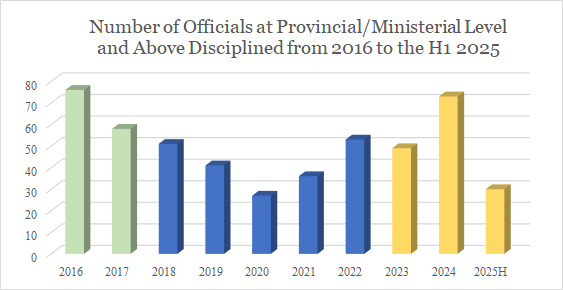
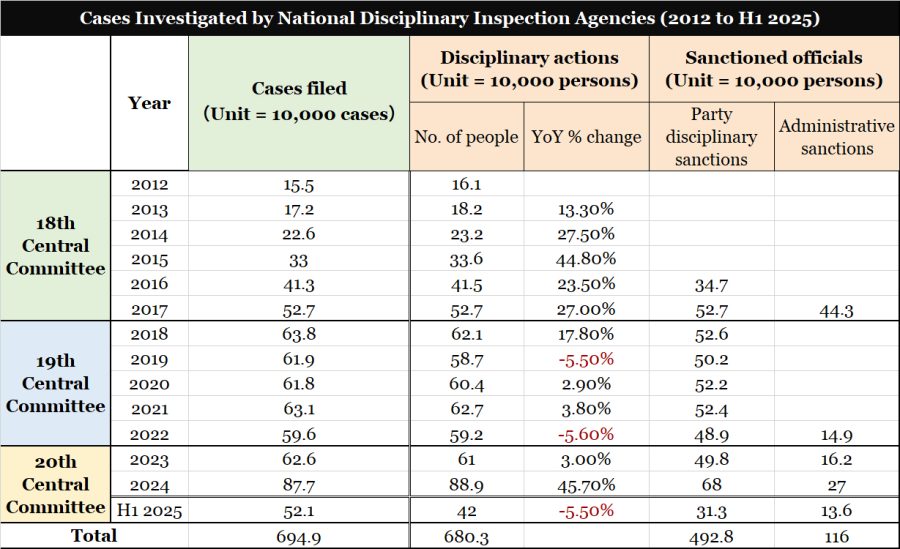
On July 19, the Central Commission for Discipline Inspection and the National Supervisory Commission released a report on disciplinary and supervisory investigations conducted nationwide in the first half of 2025. During this period, disciplinary and supervisory agencies across the country filed 521,000 cases and disciplined 420,000 individuals, including 30 officials at the provincial and ministerial level.
Backdrop
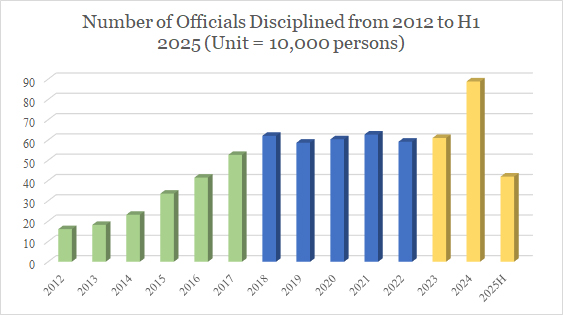
Xi Jinping’s anti-corruption campaign led to the disciplining of 6.8 million Party members and officials between 2012 and the first half of 2025, according to aggregated anti-corruption data released by the anti-corruption authorities over the years.
Source: Central Commission for Discipline Inspection website
Source: Central Commission for Discipline Inspection website
Source: Central Commission for Discipline Inspection website
Source: Central Commission for Discipline Inspection website
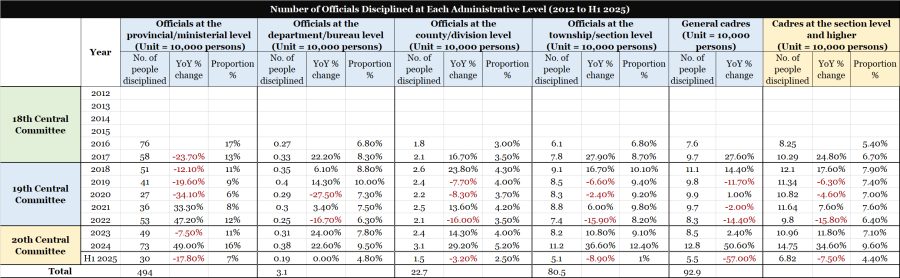
According to publicly available CCP data, the estimated number of officials at each administrative level is as follows (the proportion of disciplined officials is calculated based on these estimates):
- Provincial/ministerial level and above: Approximately 450 people.
- Department/bureau level: Approximately 40,000 people.
- County/division level: Approximately 600,000 people.
- Township/section level: Approximately 900,000 people.
Our take
Xi Jinping launched an anti-corruption campaign shortly after taking office in 2012, ostensibly to improve Party discipline and root out endemic corruption in the officialdom. While unstated, the campaign was likely meant to rectify the persistent problem of Beijing’s “orders not leaving Zhongnanhai” and improve governing efficiency. The Xi leadership also used the anti-corruption campaign to purge the regime of the Jiang Zemin faction and other “anti-Xi” elements.
The CCP’s data (see Table 3) shows that nearly a third of all officials have been disciplined since the launch of the anti-corruption campaign. However, the efficacy of the campaign is increasingly coming into question as Beijing continues to struggle with having its policies properly implemented and the CCP’s governance problems mount.
1. Publicly available CCP data indicates that there are currently about 1.54 million officials at the section level and above. Assuming an annual official turnover rate of about 10 percent (based on the average civil servant recruitment growth rate of 10.9 percent from 2016 to 2024), there were roughly 3.311 million officials in total at or above the section level over the past 13.5 years (2012 to H1 2025). In the same period, the CCDI has disciplined 1.0676 million officials at the section level or higher. Assuming that 20 percent of those individuals were disciplined multiple times and “double-counted,” that leaves over 960,000 officials who have faced disciplinary action of some sort since Xi came to power, or nearly a third of the officialdom.
Xi Jinping likely operated on the assumption that having a more disciplined cadre would improve governing efficiency, allowing him to better resolve the crises left behind by his predecessors and new ones that emerged during his tenure. However, wielding the stick too vigilantly appears to be lowering rather than raising governing efficiency given the unspoken incentive structures in the CCP system:
- Corruption is so pervasive in the regime that hardly any official is untainted. Therefore, virtually all officials live in fear of being targeted by the anti-corruption campaign and having their career prospects ruined. The exceptions are officials with strong political backing or those who believe that they can engage in even deeper corruption to preserve and advance their interests.
- Most officials have become risk-adverse to avoid being scrutinized and investigated over mistakes. Therefore, officials look to avoid accountability by implementing policies in a “politically correct” manner (“preferring left rather than right”), reporting only positive developments to their higher-ups and the central authorities while obscuring negative news, or only engaging in projects that they believe Beijing wants without considering the local conditions.
The prevalence of bureaucratism and governing dysfunction in the officialdom has forced the Xi leadership to take more focused actions to ensure proper policy implementation:
- The June Politburo meeting reviewed the work of Party Central’s decision-making, deliberation, and coordination bodies, which are meant to promote policy implementation and get officials to “avoid formalism and bureaucratism.”
- In mid-July, People’s Daily published a report on its front page that carried Xi Jinping’s remarks at the Central Urban Work Conference where he criticized local governments for over-investing in artificial intelligence, computing power, and new energy vehicles. Xi added, “We should not only focus on how much GDP has grown and how many major projects have been built, but also on how much debt is owed. We should not let some people pass the buck and leave problems to future generations.”
- In promoting a unified national market, the central government has frequently indicated that local protectionism remains prevalent and has hindered the implementation of central economic policies.
2. Aggregated CCDI data reveals that the anti-corruption campaign was likely impacted by factional struggle dynamics during Xi’s second term.
Tables 1 and 2 above show that anti-corruption efforts noticeably stagnated under the 19th Central Committee when Jiang faction member Zhao Leji served as CCDI secretary. For instance, the number of disciplined officials at the provincial/ministerial level or higher hit a low in 2020 and the total number of disciplined cadres remained stagnant. Meanwhile, the slight uptick in the number of disciplined cadres in 2021 can be attributed to a rectification and education campaign targeting the political and legal affairs system that Xi launched that year.
Following the appointment of Xi ally Li Xi as CCDI secretary at the 20th Party Congress and Xi Jinping signaling his commitment to regime rectification in a trip to Yan’an, the number of discipline cadres would surge under the 20th Central Committee. In 2024, the total number of disciplined cadres and provincial/ministerial-level officials increased by nearly 50 percent compared to 2023; 2024 saw a focusing of anti-corruption efforts in the financial sector. And as of the first half of 2025, the number of disciplined cadres has already approached half of 2024’s total.
What’s next
Xi Jinping will likely intensify anti-corruption efforts alongside other endeavors to improve governing efficiency as he struggles to haul the regime out of its many crises. Xi could also use the anti-corruption campaign to further consolidate his position and lay the groundwork to perpetuate his rule into a fourth term and beyond.
2 Analyzing the MPS special service bureau chief reshuffle
On July 21, the PRC State Council announced the appointment and dismissal of several state personnel. The appointments included the elevation of Ling Zhifeng, the former director of the Ministry of Public Security’s political department, to vice minister of public security. Ling was concurrently appointed Party secretary and director of the MPS special service bureau.
***
Ling Zhifeng (age 56) is a native of Zhejiang Province who spent the bulk of his career in local governments in Zhejiang. Ling once served as head of a county, a municipal police chief, the director of the provincial emergency management department, and Party secretary of Jinhua City. When Xi Jinping was serving in the Zhejiang provincial government (2002 to 2007), Ling was head of the Chun’an County Organization Department and a Standing Committee member of the Chuan’an County Party Committee (December 2002 to August 2008). In 2022, Ling was transferred to Guangxi Province to serve as head of the provincial public security bureau. Less than a year later, Ling was promoted to director of the MPS political department.
Wang Zhizhong (59), a vice minister of public security and the former head of the MPS special security bureau, was appointed director of the National Immigration Administration in April 2025.
Backdrop
On July 9, MPS vice ministers Chen Siyuan and Sun Maoli were removed from their post, while former Guangxi provincial public security bureau director Yang Weilin was appointed as vice minister of public security. We analyzed the personnel reshuffle in an earlier newsletter.
Our take
Ling Zhifeng’s promotion and new roles, as well as recent personnel reshuffles in the public security system, suggest that Xi Jinping is strengthening his control over the Party’s “knife handle” (regime security apparatus) by both injecting fresh blood into its top leadership and preventing allies from amassing excessive power.
1. Ling Zhifeng’s career trajectory indicates that his elevation up the ranks is likely linked to the political relationships that he built or did not have while serving in Zhejiang.
- When Xi Jinping was in the Zhejiang provincial government, Ling did not rank high enough to work with Xi and establish direct connections. However, Ling would likely have plenty of interactions with Xi’s allies at lower levels in the Zhejiang government, and those allies could have recommended Ling to Xi later on.
- Ling’s career progression was unremarkable during the Jiang Zemin-Hu Jintao era. He served nearly 11 years in Zhejiang’s Chun’an County (December 2002 to August 2014) before reaching the position of county Party secretary. This suggests that he was not favored by the Jiang Zemin faction, which could have been one reason for his promotion to higher offices in recent years.
2. Like the newly appointed vice minister of public security Yang Weilin, Ling Zhifeng does not appear to have any prior working relationship with public security minister Wang Xiaohong.
It is possible that the Xi leadership promoted Yang and Ling over other candidates who appear to be groomed by Wang or are connected with him to prevent Wang from forming “cliques and factions” (wittingly or unwittingly) and accumulating too much power in the public security system through personnel reshuffles. If so, then Xi Jinping is drawing lessons from having investigated loyalist senior officials like Qin Gang and Li Shangfu in 2023, as well as the exposure of massive corruption in the People’s Liberation Army that same year that led to the downfall of other loyalist officials.
Going forward, the Xi leadership could make similar types of personnel changes in other regime apparatuses to ensure that senior officials, including those who can be considered as Xi’s allies, cannot consolidate too much influence through favorable personnel adjustments and expanding their networks. This does not mean that Xi mistrusts his allies or is preparing to purge them, but is a reflection of increased paranoia on Xi’s part and a pragmatic move to more thoroughly safeguard his paramount position.
3. Wang Zhizhong being replaced as director of the important MPS special service bureau suggests that he could soon be headed for retirement. Wang is currently at the vice ministerial-rank and is slated to retire when he turns 60 in 2026, barring a promotion.
4. Some overseas Chinese observers, including those who speculate that Xi Jinping is “losing power,” believe that Ling Zhifeng is part of the so-called “new Zhejiang army,” or officials who held provincial or local government posts when Xi was serving in Zhejiang and are believed to belong to the Xi camp. We do not believe that the “new Zhejiang army” categorization is helpful to determine who is in Xi’s faction, especially in the case of officials like Ling who did not spend enough time with Xi while he was in Zhejiang to form meaningful patron-client or working relationships.
That said, Ling being regarded as part of the “new Zhejiang army” creates a dilemma for observers who also adhere to the “Xi losing power” narrative. If Xi is marginalized or already replaced as asserted, then he should not be able to tighten his control over senior officials and Party elders by appointing a loyalist as head of the MPS special service bureau to oversee their security.




