◎ A delayed IPO for Ant allows the CCP to lower its financial and political risks.
Updated on Dec. 1, 2021.
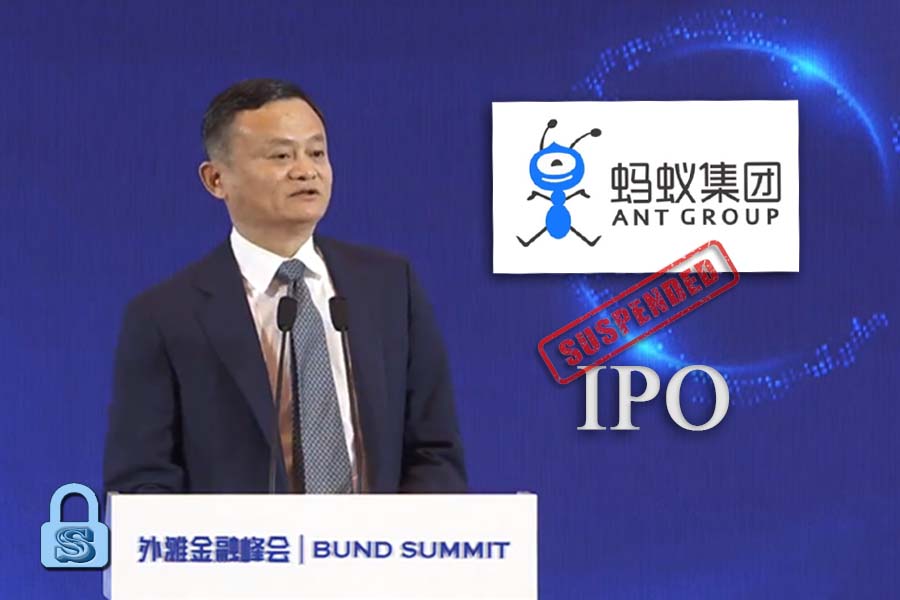
Ant Group’s record $34 billion initial public offerings in Shanghai and Hong Kong were recently suspended after PRC regulators stepped in early this week. The suspension fueled speculation that Jack Ma, Ant’s owner, had run afoul of the CCP.
A review of developments leading up to Ant Group’s listing suspension, however, suggests that it was motivated by structural, and not personal, issues.
Oct. 24
The China Finance 40 Forum held the second Bund Financial Summit in Shanghai. Both PRC vice president Wang Qishan and Jack Ma spoke at the event.
Wang delivered a keynote speech via video conferencing on the topic of financial risks. China’s financial sector “should not follow the crooked path of speculation and gambling, the circuitous side path of financial bubbles, or the pernicious path of Ponzi schemes,” he said.
Ma spoke at the forum later in the day. In his speech, he suggested that the CCP’s financial regulators were hindering economic development in their zeal to control systemic financial risks. “Today, there is too much red tape and too few policies [supporting businesses]. My greatest fear is that regulators create a situation where they have no risk, but the whole economy is at risk of not developing,” he said.
Ma also said that “good innovations are not afraid of supervision, but they do fear outdated supervision.” He specifically referred to the Basel Accords, a set of regulatory regulations for the banking industry, and questioned their suitability for China.
Ma said China’s current risks are not systemic financial risks, but the risks of lacking a healthy financial system. Ma believes that China needs to innovate boldly, and create an environment tolerant of mistakes and allows for corrections to build a healthy financial ecosystem.
Ma also sought to distance internet financing (what Ant Group does) from peer-to-peer financing (P2P), which has a bad reputation of being fraudulent platforms. “How can there be thousands of internet financing companies in China within a few years,” he questioned.
Nov. 2
1. Four PRC financial regulators—People’s Bank of China, China Banking and Insurance Regulatory Commission, China Securities Regulatory Commission, State Administration of Foreign Exchange—summoned Jack Ma, Ant Group executive chairman Eric Jing, and Ant chief executive Simon Hu to a meeting.
Ant said in a statement that “views regarding the health and stability of the financial sector were exchanged” in the meeting between its executives and PRC regulators. Ant pledged to meet regulation and serve China’s economy and people.
2. In the evening, the PBoC and CBIRC issued new financial rules aimed at controlling large state-owned and private conglomerates, as well as internet companies like Ant Group. Key parts of the rules include:
- Defining what qualifies as an internet microfinancing business.
- Classifying firms that operate two or more financial businesses in China as financial-holding companies.
- Financial-holding companies need to register and pay up capital of at least 5 billion yuan ($731 million). This rule also applies to large businesses with financial assets (including loans) comprising 85 percent or more of their total assets.
- Cross-provincial microfinancing business is forbidden pending approval.
- Individual microfinancing loans should not exceed 300,000 yuan or over a third of an individual’s annual income in the last three years. The balance of loans to groups or organizations should not exceed 1 million yuan.
- Microfinancing loans shall not be invested in bonds, stocks, financial derivatives, asset management products, or other financial instruments. Loans shall also not be used to finance mortgage payments.
3. Guo Wuping, director of the CBIRC’s consumer rights protection bureau, published an article in mainland media titled, “The Chaos of Fintech Companies Infringing on Consumer Rights is More Worthy of Attention.” Key takeaways from the piece include:
- Guo criticizes fintech companies (like Ant Group) for engaging in consumer abuse.
- Guo argues that fintech companies products are not inherently different from credit cards or small loans issued by banks. Therefore, fintech companies are benefiting from regulation arbitrage at the expense of banks, resulting in unfair competition. Without clear government rules and regulations, it would be difficult to protect consumer interests.
- Fintech companies do not have uniform standards in setting fees and charges, and their rates are generally higher than licensed financial institutions. This means that while fintech products are accessible to the masses, the masses do not benefit from ease of access (普而不惠).
- Fintech companies are susceptible to similar credit, operational, and liquidity risks as regular financial institutions due to the nature of their business. Worse, fintech companies could trigger new types of financial risks.
- PRC regulators should extend their oversight over licensed financial institutions to cover fintech companies engaged in financing business.
- The authorities should strengthen anti-monopoly and antitrust measures against fintech companies.
Nov. 3
1. The Shanghai stock exchange announced the suspension of Ant Group’s IPO on its Nasque-style Science and Technology Innovation Board (STAR Market), claiming “significant change” in the regulatory environment without elaborating. The Hong Kong stock exchange also announced the suspension of Ant’s IPO. Ant was supposed to list on both exchanges on Nov. 5.
2. According to mainland media, Ant’s executive chairman Eric Jing called an emergency meeting with senior and middle management on the night of Nov. 3. Jing reportedly told them, “The past few days were the darkest and most difficult days in the history of Ant Group and Alibaba.” The meeting noted that the company’s IPOs would be delayed for at least half a year by conservative estimates.
Nov. 4
In a commentary titled, “Providing Safeguards to Prevent and Resolve Financial Risks,” Party mouthpiece People’s Daily stressed that financial security is an “important component of national security.” The commentary noted that the prevention and resolution of financial risks, particularly the prevention of systemic financial risks, is a fundamental aspect of financial work. Further, the commentary pointed out that financial risks detected early on will help avoid heavy costs down the road.
Our take
1. There has been heated speculation that the suspension of Ant Group’s IPOs boils down to a feud between Wang Qishan and Jack Ma over the latter’s comments at the second Bund Financial Summit in Shanghai on Oct. 24. Commentators are framing Ma’s remarks as a direct challenge to Wang, Xi Jinping, and the CCP, and reason that Ant’s listing suspension was “punishment” for Ma being overly candid with the authorities.
At a glance, the speculation about Jack Ma seems convincing given the often personal nature of elite politics in the CCP. After all, prominent Party princeling “Cannon” Ren Zhiqiang, who was sentenced to 18 years in jail in September on “corruption” charges, only got into trouble after issuing very critical comments about Xi’s handling of the coronavirus early this year.
The speculation, however, does not bear scrutiny in examining the circumstances surrounding Ma’s Shanghai speech and his political position. Ma almost certainly knows that he is in no position to criticize Wang Qishan or the CCP because is “merely” a very successful private entrepreneur in the PRC (capitalists are scum in Marxist-Leninist regimes), not a member of the “red” aristocracy like Ren Zhiqiang. Put another way, it is highly unlikely that Ma planned to publicly attack the PRC vice president and unofficial “eighth” member of the Politburo Standing Committee at a forum where the latter just spoke about curbing financial risks and when the Xi leadership has been consistently addressing the issue for some time (see point 2). Also, Ma’s remarks come across as complaints and pleas, not criticism and insults; Ren called Xi a “clown” and an “emperor with no clothes,” whereas Ma struck a defensive tone and spoke in generalities. Thus, we have reason to believe that Ma likely knew that the regulators were coming for Ant Group, but felt that he needed to make a last-ditch appeal in hopes of drawing public sympathy and perhaps swaying regulators.
Jack Ma’s gamble, however, was never going to work given the financial risks that Ant’s IPOs would bring for the CCP as it struggles with regime crisis (see point 3).
2. In an earlier analysis, we noted that Wang Qishan’s speech at the second Bund Financial Summit is indicative of the CCP’s “concerns and fears amid a rapidly worsening Chinese economy and an escalating ‘new cold war’ with the United States.” Wang’s warning on financial risks is entirely consistent with Xi Jinping’s position on the topic, particularly since the start of his second term.
Xi raised the issue of “safeguarding national financial security” during a Politburo meeting on April 25, 2017. During a national-level conference on financial work from July 14 to July 15 that year, Xi stressed that “finances are what gives the country its core competitiveness; financial security is an important component of national security; and the financial system is an important, fundamental system in the country’s economic and social development.” The conference also proposed a Financial Stability and Development Committee, and the agency was established in November and placed under the leadership of Xi ally and PRC vice premier Liu He.
Creating agencies and rolling out policies aside, Xi has also sought to curb financial risks by arresting and intimidating prominent financiers:
- January 2017: Tomorrow Group founder Xiao Jianhua was “vanished” from his luxury apartment in Hong Kong. Xiao is a known “white glove” (白手套) or bagman, for members of the CCP elite.
- June 2017: Anbang Insurance Group chairman and chief executive Wu Xiaohui is investigated by the authorities for economic crimes. The following year, Wu was sentenced to 18 years in prison for fundraising fraud and embezzlement.
- August 2017: Dalian Wanda Group founder Wang Jianlin was restricted from leaving the country. After “resurfacing,” Wang begins selling Wanda’s assets to cover the company’s liabilities.
Xi’s financial sector-related anti-corruption actions appeared to inspire Chinese entrepreneurs to publicly demonstrate their fealty to the CCP:
- May 26, 2017: Jack Ma, then chairman of Alibaba, said during that year’s China International Big Data Expo, “We need to redefine [attitudes toward] the planned economy and the market economy; the market economy is not necessarily better than the planned economy.”
- Jan. 19, 2018: Jack Ma donned Maoist revolutionary gear and sang two verses from the classic “red” opera, “Taking Tiger Mountain,” during a gala event at the China Entrepreneur Club. Previously, Ma preferred to pose as celebrities such as Michael Jackson.
- June 2018: Pictures of Tencent CEO Pony Ma and JD.com CEO Liu Qiangdong wearing Red Army costumes at the CCP “red” tourist site in Yan’an were circulated on the Chinese internet.
3. The CCP likely put a halt to Ant Group’s IPOs after realizing belatedly that the company would profit immensely from the listings but leave the massive financial risks of its operations for Beijing to clean up. Ant could also become a legitimate political threat to the CCP by virtue of capital accumulation; at a certain point, money is power.
The CCP is aware of the scale of capital that Ant and Jack Ma can accumulate through financialization. On Nov. 3, mainland media reported Huang Qifan, China Center for International Economic Exchanges vice chairman and former Chongqing mayor, as saying, “Now Jack Ma spends and borrows hundreds of billions of dollars, but where does he get the money from? First, from bank loans, then through asset-backed securities. [Through ABS, Ma’s] 3 billion in funds grows a hundred times to 300 billion.”
Already, Alibaba Group, the affiliate company of Ant, is in the “too big to fail” category. According to Alibaba’s financial reports, the company’s pre-tax profits in 2015, 2016, and 2017 were 4.254 billion yuan, 2.906 billion yuan, and 13.190 billion yuan respectively. Ant’s 230 billion yuan ($34 billion) IPOs will massively boost its financial presence. Factor in asset-backed securities (see Huang Qifan’s comments above), and Ant becomes a 23 trillion-yuan behemoth within a few short years. Ant’s financial clout will weaken the PBoC’s ability to issue currency, create a massive debt risk, and ultimately become a massive political liability for the CCP.
As early as 2016, PRC premier Li Keqiang observed that fintech and “internet entrepreneurship,” which was supposed to be an innovative solution to solving financial difficulties in the real economy, ended up becoming a hotbed of financial fraud. By suspending Ant’s listings now, Beijing is looking to both curb the potential for fraud and ensure that politics, not capital, has the final say in the regime.
4. If Ant’s IPOs present a real financial and political threat to the CCP, then why were they approved in the first place shortly after the company announced them this July?
It is possible that middle to lower-level officials, eager to accumulate political capital and find solutions to coming regulation of Chinese companies listed in U.S. exchanges, thought that it was a good idea early on to approve Ant’s listings. After all, officials stand to claim a “great political achievement” by helping Ant secure a world-record IPO in the STAR Market that Xi Jinping has promoted. High-ranking officials then pulled the brakes later on after recognizing (correctly) that the political and financial threats posed by the IPOs vastly outweigh the benefits of claiming a record listing and attracting large amounts of foreign funds to China that would help Beijing deal with Sino-U.S. “new cold war” financial obstacles.
5. The Ant Group listing suspension episode is a lose-lose situation for the parties involved.
Ant will likely be able to proceed with its IPOs again at a later date. The CCP’s new financial rules governing fintech, however, will see its valuation and profits greatly slashed. There could also be lesser enthusiasm for Ant’s IPO with the specter of suspension looming. Some observers have estimated that Ant’s annual return on principle would be only double when it eventually lists instead of eight times as projected had the Nov. 5 IPO proceeded as planned. While this is bad for Ant from a business perspective, Beijing will breathe a little more easily knowing that it has at least prevented the financial risk of Ant’s value falling sharply after a record IPO. Also, from Xi Jinping’s perspective, hitting Ant now to mitigate financial risks is preferable to letting the IPOs go ahead and opening the door for his factional rivals to exploit using “unrestricted warfare” tactics at a later date.
A delayed IPO for Ant allows the CCP to lower its financial and political risks. However, the suspension is “no loss, no gain” because investors will question the actual degree of “financial liberalization” in China if the CCP can simply stop a record IPO with seemingly no rhyme or rhythm mere days before it is scheduled to take place. The fact that Jack Ma and Ant’s top executives can be summoned to “drink tea” with regulators also starkly reminds investors of the political risks they face when investing in Chinese companies, even if they are some of the most prominent.