
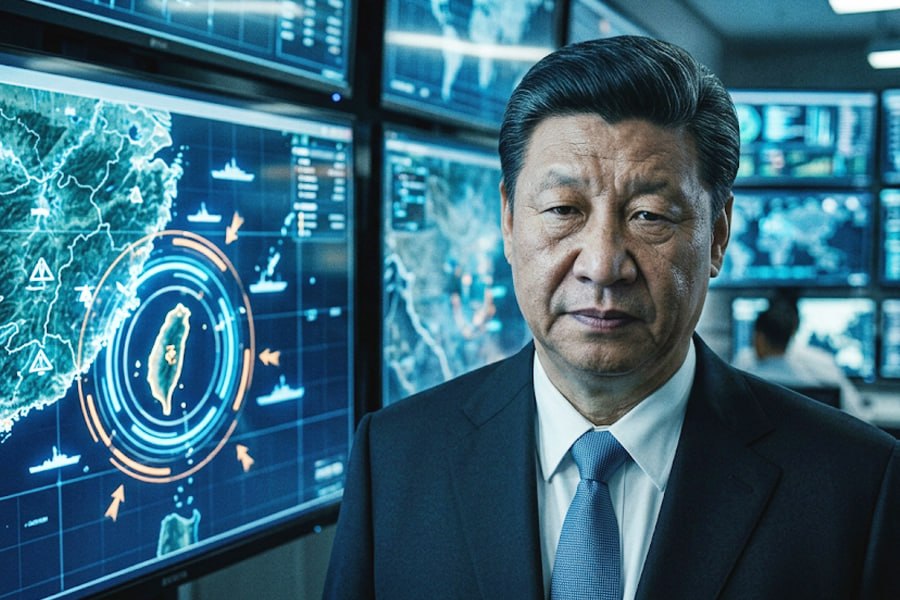
On July 1, Xi Jinping delivered a speech to mark the 105th anniversary of the Chinese Communist Party at the Great Hall of the People in Beijing.
Key points in Xi’s speech include:
- Xi said that the world has entered a phase of major transformation and volatility. He warned that the People’s Republic of China is now in a period where “strategic opportunities coexist with risks and challenges.” Xi also urged the Party to prepare to navigate “high winds, rough seas, and even perilous storms.”
- Xi credited the CCP’s 105-year survival and success with qualities such as commitment to self-reform, “willingness to struggle,” and its connection to the Chinese people.
- Xi depicted the CCP as the only political force capable of steering China toward its goal of modernization. He stressed that the Party must maintain its nature, conviction, and character to remain fit to govern.
- Xi said that a strong country requires a strong military to safeguard national sovereignty and security. He urged continued efforts to achieve the Party’s centenary military goals.
- Xi said, “A strong country must have a strong military, and only a strong military can ensure national security.”
- Xi repeated the CCP’s longstanding goal of achieving “reunification” with Taiwan. While Xi did not mention “peaceful reunification,” he also did not threaten to use military force to take Taiwan.
- Xi emphasized the necessity of “full and strict Party self-governence.” He framed self-reform as a defining strength, vowing to “eliminate all viruses that erode the Party’s healthy body.”
- Xi urged the CCP to remain focused on the overarching goal of building a modern socialist country by the middle of the century, emphasizing that “time waits for no one and history waits for no one.”
Indirect pressure on Taiwan
Xi’s speech suggests that the CCP prefers to avoid a decisive military confrontation over Taiwan with the United States and its allies inside the First Island Chain. Rather, Beijing would first opt for options other than war to achieve its “reunification” objective, including focusing on building up the PRC’s ability to project military power globally.
Beijing is likely betting that the Taiwan issue will become progressively easier to resolve if it can constrain the U.S. internationally, control critical maritime chokepoints, cultivate a global network of partners (including Russia, Iran, and countries in the Global South), and increase Taiwan’s international isolation. The CCP’s long-term strategy could see:
- Development of overseas strategic footholds: The People’s Liberation Army will likely continue to expand overseas military infrastructure, including the modernization of Ream Naval Base in Cambodia, ongoing operations at the PRC support base in Djibouti, and efforts to establish a presence along Africa’s Atlantic coast. These developments would see the PLAN’s strategic focus expand beyond East Asia to encompass the Indian Ocean and even the Atlantic Ocean.
- Normalization of gray-zone legal operations: Beijing is institutionalizing routine China Coast Guard law enforcement activities in both the Taiwan Strait and the South China Sea, with the objective of gradually treating the Taiwan Strait as the PRC’s internal waters. Rather than initiating open warfare, this approach seeks to blur the distinction between peace and conflict, test the political resolve of the U.S. and Japan, and constrain Taiwan’s exercise of sovereign authority.
- Perceived Western ‘weakness’: The CCP continues to believe that Western political systems suffer from persistent structural weaknesses, leading to the phenomenon that PRC official discourse terms “the East is rising, the West is in decline.” Beijing’s interim strategy is the preservation of domestic regime stability while waiting for the U.S. and Europe to become increasingly preoccupied by internal political polarization or simultaneous geopolitical crises (including conflicts in the Middle East, the Russia-Ukraine war, and the Indo-Pacific) thereby creating conditions in which Taiwan could face heightened international isolation and greater pressure to enter negotiations.
Strategic viability
The viability of Beijing’s ambitious strategy of global military power projection and strategic encirclement ultimately depends on the stability of China’s domestic political system and economic foundations. Yet in his speech, Xi Jinping hinted at persistent political instability when he repeatedly invoked the themes of “remaining steadfast in confidence” and “continuing the struggle.” The repeated use of such rhetoric reflects Beijing’s underlying concerns about structural weaknesses in China’s economy, society, and governance. We have identified five such weaknesses:
First weakness: Official emphasis on ‘ideals and convictions’ vs. the reality of declining ideological cohesion.
On the one hand, the CCP has expanded mandatory political education and ideological assessments across schools, state-owned enterprises, and, increasingly, private and foreign-invested firms. Digital platforms such as Study Xi, Strong Nation (Xuexi Qiangguo) are widely used to monitor daily participation in political study.
After four decades of market-oriented economic development, however, genuine ideological commitment to Marxism-Leninism has substantially weakened among both ordinary citizens and government officials. As ideological conviction diminishes, political authority is forced to increasingly rely on administrative enforcement rather than voluntary adherence. From this perspective, intensive political education and ideological standardization reflect an increasing dependence on bureaucratic discipline and political compliance to maintain institutional cohesion.
Second weakness: Official emphasis on ‘relying on the people’ vs. the reality of social and bureaucratic disengagement
The PRC’s National Bureau of Statistics suspended publication of the youth unemployment rate (ages 16–24) in 2023 before introducing a revised statistical methodology. Even under the revised methodology, youth unemployment has remained elevated. Independent researchers and academics (including previous estimates by scholars at Peking University) have argued that actual labor market pressures are substantially greater than official figures suggest. This environment has contributed to the emergence of social phenomena such as “lying flat,” “unfinished babies” (爛尾娃, i.e. young university graduates who face immediate unemployment), and the so-called “Ten-No Youth” (a list of 10 items of things that youths should not do, reflecting withdrawal from social expectations and economic participation), reflecting broader forms of passive social disengagement.
Meanwhile, local officials have operated under heightened political scrutiny and personal risk since the launch of the anti-corruption campaign in 2012. Combined with fiscal tightening and declining public-sector compensation, many local officials have adopted a defensive administrative approach summarized by the saying, “The more you do, the more mistakes you make; doing nothing is safest.” This has produced a form of bureaucratic “soft resistance.” When both younger generations and frontline administrators become increasingly disengaged, the state’s overall governance capacity is weakened.
Third weakness: Official recognition of ‘challenges ahead’ vs. the reality of fiscal and technological constraints
According to publicly available fiscal data and Ministry of Finance information, China’s local governments continue to face substantial implicit debt burdens, particularly through local government financing vehicles. Many local governments can no longer rely on land-sale revenues to finance public expenditure. Meanwhile, following the financial distress experienced by major property developers such as Evergrande and Country Garden, China’s real estate market has experienced sustained weakness in both investment and sales, contributing to liquidity pressures within the financial system and declining asset values.
Challenges to the Chinese economy also come in the form of external tech restrictions. Under the second Trump administration, the U.S. Bureau of Industry and Security has continued expanding export controls affecting advanced semiconductors, lithography equipment, artificial intelligence, and related technologies. While the PRC has achieved substantial production capacity in sectors such as electric vehicles and lithium batteries (part of the so-called “New Three” industries), significant vulnerabilities remain for China in foundational technologies, advanced chip architectures, and high-end materials.
Fourth weakness: Official vision of a ‘community with a shared future for mankind’ vs. the reality of strategic miscalculation
Beijing has sought to establish alternative trade and financial networks through initiatives such as the Belt and Road Initiative, closer engagement with the Global South, and expanded use of the Cross-Border Interbank Payment System. However, China’s domestic economic slowdown and fiscal constraints have reduced its ability to provide large-scale overseas financing. At the same time, many developing countries remain economically dependent on Western markets and investment and are therefore unlikely to align exclusively with Beijing on ideological grounds.
Meanwhile, cooperation among the United States, Japan, Europe, and Taiwan on supply-chain “de-risking” has continued to strengthen. As the international community increasingly comes to grips with the CCP threat, Beijing’s vision of a “community with a shared future for mankind” will face increasing obstacles and challenges.
Fifth weakness: Official call for ‘self-revolution’ and strict Party governance vs. the persistence of system corruption
In recent years, the CCP has conducted extensive anti-corruption investigations. This has notably led to the downfall of many senior military officers, including the PLA Rocket Force leadership, former defense ministers Li Shangfu and Wei Fenghe, and Central Military Commission members like Miao Hua, He Weidong, and Zhang Youxia. Also purged were many executives at major state-owned banks and officials in the healthcare sector.
Despite an anti-corruption campaign that has entered its fourteenth year, Beijing continues to emphasize the need to “eradicate the viruses that erode the Party’s body.” This indicates that corruption remains embedded within the regime’s institutional structure. In the absence of an independent judiciary and a free press, corruption cannot be fully eliminated through internal Party discipline alone. Therefore, the Xi leadership’s “self-revolution” has increasingly become a political instrument for consolidating authority and managing intra-Party competition more so than an effective instrument for eradicating corruption. Repeated political purges will undermine bureaucratic efficiency, producing a self-reinforcing cycle in which anti-corruption efforts and corruption continue to coexist without any final resolution.
‘Time waits for no one’
At the conclusion of his speech, Xi Jinping employed unusually forceful rhetoric. “Time waits for no one. History waits for no one. All Party members must remain true to our founding mission… and must have the courage to struggle and the ability to prevail in struggle,” Xi said. These remarks constitute the clearest indication of the historical sense of urgency underlying the speech.
From the perspective of demographic trends and long-term economic cycles, the PRC’s strategic window for geopolitical competition is gradually narrowing. Notably, China’s rapid population aging, persistently low birth rates, and a shrinking working-age population mean that the regime’s long-term potential growth rate is expected to decline structurally and the PRC is likely to “grow old before growing rich.” Meanwhile, growing recognition of the CCP threat by more countries and greater efforts to do something about the threat (especially in Europe) will increasingly constrain the CCP’s strategic space.
Xi acknowledges that “strategic opportunities coexist with risks and challenges” in the “new era,” and is preparing Chinese society for protracted troubles ahead. For instance, Xi reiterated the Party’s “Three Musts” in his speech marking the 105th anniversary of the CCP’s founding, placing emphasis on “hard work” and the “courage to struggle.” This language is an effort to prepare both Party members and the broader public psychologically for a more difficult economic environment. It also suggests that the CCP leadership is signaling that the high-growth era of the past four decades has ended and that Chinese society should prepare for prolonged economic adjustment, including the possibility of external financial sanctions or other adverse international developments.
Amid slowing economic growth and growing domestic dissatisfaction, the Xi leadership may increasingly rely on ideological mobilization and political struggle as instruments of governance. Should domestic challenges become more difficult to address through economic policy alone, Beijing’s incentive to create or intensify geopolitical tensions, such as maritime confrontations in the South China Sea or military pressure around the Taiwan Strait, could increase as a means of reinforcing domestic political cohesion.




