
1 Li Qiang’s 2026 gov’t work report reveals contest between regime security and structural reform
The Fourth Session of the 14th National People’s Congress opened at the Great Hall of the People in Beijing on March 5. PRC premier Li Qiang delivered the government work report at the opening session. Below are some key details from the work report:
2025 government work review
- China’s GDP grew 5 percent to reach 140.19 trillion yuan.
- 12.67 million new urban jobs were created. The average surveyed urban unemployment rate was 5.2 percent.
- One year of free preschool education was implemented nationwide, benefiting 14 million children.
- A nationwide childcare subsidy system was implemented, benefiting more than 30 million infants and toddlers.
- Grain output reached 1.43 trillion jin (about 715 million metric tons).
- Annual production of new energy vehicles exceeded 16 million units, and EV charging facilities surpassed 20 million units.
- The urbanization rate of the permanent population reached 67.9 percent.
- The long-term care insurance system covered 300 million people.
- The minimum monthly basic pension for urban and rural residents was increased by 20 yuan.
- The average concentration of PM2.5 in prefecture-level and above cities declined by 4.4 percent.
Main targets in the draft outline of the 15th Five-Year Plan
- Lay the foundation for doubling per capita GDP from 2020 levels by 2035, reaching the level of moderately developed countries.
- Reduce carbon dioxide emissions per unit of GDP by 17 percent cumulatively, continuing green and low-carbon transformation in key sectors.
- Advance the Digital China initiative, with the core digital economy industries accounting for 12.5 percent of GDP.
- Increase average years of schooling for the working-age population to 11.7 years.
- Accelerate construction of a Healthy China and a strong sports nation, raising life expectancy to 80 years.
- Address population aging, increasing the share of nursing-care beds in eldercare institutions to 73 percent.
- Narrow regional and urban–rural gaps, accelerate agricultural and rural modernization, consolidate poverty alleviation achievements, optimize major productivity layouts, and promote people-centered new urbanization.
- Raise grain production capacity to around 1.45 trillion jin (725 million metric tons) and energy production capacity to 5.8 billion tons of standard coal.
- Coordinate the orderly resolution of risks related to the real estate sector, local government debt, and small and medium-sized local financial institutions.
Main expected targets and key tasks for 2026
- Economic growth: Achieve growth of between 4.5 percent to 5 percent, with efforts to achieve better results.
- Urban surveyed unemployment rate: About 5.5 percent, or create more than 12 million urban jobs.
- Consumer price inflation: About 2 percent, with household income growth to keep pace with economic growth.
- Achieve basic balance in international payments.
- Grain output: Around 1.4 trillion jin (700 million metric tons).
- CO₂ emissions per unit of GDP: Reduce by about 3.8 percent.
- Fiscal and economic policies
- The budget deficit ratio is planned at around 4 percent, while continuing a moderately accommodative monetary policy.
- Issue 250 billion yuan in ultra-long-term special government bonds to support consumer trade-in programs for goods.
- Create a 100 billion yuan special fiscal-financial fund to stimulate domestic demand.
- Encourage qualified regions to implement spring and autumn school breaks and promote staggered paid leave for workers.
- Issue 200 billion yuan in ultra-long-term bonds to support large-scale equipment upgrades.
- Launch province-wide pilot programs to extend rural land contracts for another 30 years after expiration.
- Promote the urban integration of migrant agricultural workers, easing requirements for their children to register for high school entrance exams in destination cities.
- Social policies
- Increase per capita fiscal subsidies for resident medical insurance by 24 yuan.
- Raise the minimum basic pension for urban and rural residents by another 20 yuan per month.
- Strengthen housing support for newly married and first-child families and support improved housing demand for families with multiple children.
- Sports
- Prepare for participation in the 2026 Asian Games.
- Accelerate the restructuring of China’s youth football training system.
Our take
The year 2026 marks a critical intersection between the CCP’s 14th Five-Year Plan and the upcoming 15th Five-Year Plan. Li Qiang’s government work report is therefore not merely a routine annual deployment of economic tasks, but also a comprehensive declaration of the strategic shift in national priorities for the next five to ten years. Against the backdrop of intensifying global geopolitical conflicts, deep restructuring of supply chains, and dramatic changes in China’s demographic structure, the CCP’s policy framework for 2026 reflects a complex posture of seeking “transformational resilience” within the boundaries of “security.”
From a macroeconomic perspective, the core signal released by the 2026 government work report is a fundamental adjustment in China’s growth paradigm. The long-standing model — reliance on debt-driven expansion, an orientation towards real estate, and infrastructure investment — is being replaced by a new model centered on “new quality productive forces,” using “market clearing under administrative intervention” as a policy tool, and framed by national security as the overarching priority.
The PRC’s transition to the new growth model, however, is unlikely to be smooth. Elevated fiscal deficits, weak domestic demand confidence, global trade frictions caused by industrial overcapacity, and deep-seated deflationary expectations together form the complex set of challenges currently facing China’s economy.
1. The annual GDP growth target (between 4.5 percent to 5.0 percent) set in the 2026 government work report is the lowest official target since 1991. This target reflects Beijing’s recognition of the reality that the property market has not yet bottomed out, local government debt pressures remain heavy, and external demand is increasingly uncertain. Under such conditions, rigidly maintaining growth at around or above 5 percent would impose disproportionately high costs on the central and local governments in terms of debt and systemic risk.
Li Qiang stated in the report that the target is intended to leave room for structural adjustment, risk prevention, and reform. The official logic behind this shift is that without effectively resolving existing risks and cultivating new drivers of growth, short-term acceleration could actually worsen long-term structural imbalances.
Even with a more pragmatic target, achieving growth within this range still faces the pressure of divergence between nominal GDP growth and real growth. Due to persistently weak PPI (Producer Price Index) and subdued CPI (Consumer Price Index) growth, China’s economy in 2026 remains under the shadow of deflation. If nominal growth falls below real growth, the deflationary effect will effectively increase the real burden of debt. This is why the report calls for “promoting a reasonable recovery in prices.”
2. The 2026 government work report indicates that fiscal policy in 2026 will be “more proactive and effective.” A key indicator is the planned deficit ratio of around 4 percent, continuing near historic highs, while the planned scale of general public budget expenditure exceeds 30 trillion yuan for the first time. The logic behind this expansionary stance is that against a backdrop of shrinking private investment and cautious household consumption, public finance must fulfill the roles of “lender of last resort” and “investor of last resort.”
Regarding the deficit structure, 2026 exhibits a clear trend of “central leveraging and local deleveraging.” The national fiscal deficit is set at 5.89 trillion yuan — an increase of 230 billion yuan over the previous year — with this entire increment being absorbed by the central government. This reflects a realization among policymakers that after weathering the collapse of land finance and the pressures of debt resolution, local governments lack the capacity and fiscal space for large-scale expansion. By having the central government proactively take on debt, its lower borrowing costs can be used to swap out the high-interest hidden debts of local governments, thereby alleviating the overall liquidity crisis.
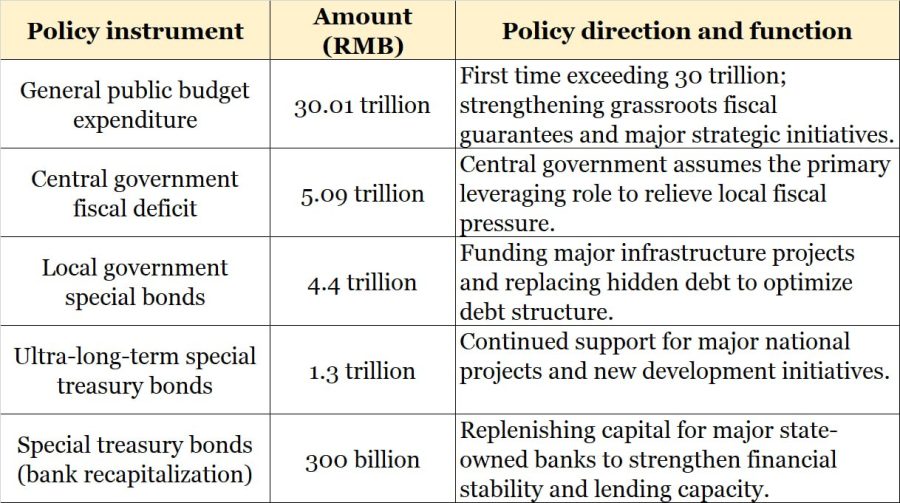
However, this fiscal expansion also faces severe challenges on the revenue side. As real estate-related tax revenues remain sluggish, multiple provinces have downgraded their fiscal revenue forecasts for 2026. This implies that local fiscal deficits will widen, and fiscal sustainability will depend heavily on the central government’s credit backing and the coordination of monetary policy. If debt growth persistently outpaces the growth of fiscal revenue, China’s finances will fall into a state of structural rigidity where new debt is primarily used to service interest and rollover old debt rather than being invested in development areas with high multiplier effects.
3. In alignment with a “more proactive” fiscal policy, the latest government work report states that the authorities will adopt a “moderately loose” monetary policy in 2026, directly reflecting the Xi Jinping leadership’s high state of alert regarding deflationary pressures. The focus has shifted from simple aggregate liquidity injection toward “promoting the low-level operation of integrated social financing costs.”
A subtle but significant change in the report is the adjustment of the phrasing on financing costs from “driving a decline” to “promoting low-level operation,” with a specific emphasis on “regulating credit market business conduct and reducing intermediary financing fees.” This reflects the People’s Bank of China’s recognition that while benchmark rates are falling, small and medium-sized enterprises have not felt a substantial drop in actual borrowing costs due to bank margin protection mechanisms and various hidden guarantee and appraisal fees. Therefore, squeezing the profits of the financial intermediary layer through administrative means has become the new path for transmitting monetary policy to the real economy.
However, the limitations of monetary policy are becoming increasingly apparent. In an environment of falling real estate price expectations and accelerating population aging, China is exhibiting signs of a “liquidity trap.” Even as interest rates drop, companies are reluctant to expand investment due to declining profit margins, and households lean toward precautionary savings as their balance sheets shrink (due to falling home prices). Consequently, the CCP is planning to use monetary policy as a “fiscal booster” in 2026, compensating for the contraction of private credit by supporting the issuance of special treasury bonds and providing new policy-based financial instruments (totaling 800 billion yuan).
4. Debt risk remains the primary variable constraining China’s economic performance in 2026. While Li Qiang’s government work report moves risk resolution slightly lower in priority — suggesting that Beijing believes systemic risks are temporarily under control — the intensity of the work has shifted from “steady” to a more coercive “active and orderly” approach.
The central government is attempting to convert the hidden debts of local governments into explicit debts through a 12 trillion yuan debt resolution package. Within the 4.4 trillion yuan of local government special purpose bonds planned for 2026, “replacing hidden debt” has been given a prominent position, replacing the previous function of land reserve acquisitions. This is essentially a debt rescheduling aimed at avoiding “sudden-death” defaults by local governments through reducing interest burdens and extending repayment cycles.
It is worth noting that while risks are “converging,” the debt resolution process itself has a powerful balance-sheet-shrinking effect. When local governments devote massive energy and financial resources to “filling holes” rather than “blazing trails,” the vitality of the local economy is inevitably weakened. Furthermore, the government will no longer provide bailouts for the operational debts of financing platforms (LGFVs). This foreshadows more market-based defaults in China’s credit market in the coming years, which, while helping to break “implicit guarantees,” may also trigger a chain reaction of financial risks in a fragile market environment.
5. The 2026 government work report states that China’s 2026 defense budget will grow by 7 percent, reaching 1.91 trillion yuan. This figure marks the 11th consecutive year of single-digit growth while once again significantly outstripping the GDP growth target of between 4.5 percent to 5.0 percent. In a year where the contradiction between fiscal revenue and expenditure is so prominent, the rigid growth of military spending sends an unmistakable signal: Beijing views the enhancement of military capability and national security as the highest priority, transcending short-term economic interests.
From a structural perspective, the sustained growth in defense spending highly overlaps with “new quality productive forces” such as aerospace, embodied AI, and quantum technology. Li Qiang mentioned “accelerating the construction of advanced combat capabilities,” which in practice means using defense procurement to support the R&D and market application of high-end manufacturing. However, this resource allocation model carries a massive opportunity cost. China’s share of military spending in Asia has approached 44 percent amid an intensifying global arms race. Continuous high-level military investment may crowd out urgently needed spending on social welfare and education, further exacerbating the structural weakness of domestic demand.
Some experts have pointed out that military investment has to remain at high levels in 2026 if the PLA is to meet its 2027 centenary milestone targets and complete the tasks laid out for it in the 15th Five-Year Plan. Therefore, this security-driven budget allocation allows the Chinese economy to show a certain “resilience” at the macro level while simultaneously increasing overall fiscal rigidity.
6. The 2026 government work report places priority on driving “internal demand-led growth” and the “construction of a powerful domestic market.” This represents Beijing’s attempt to correct the Chinese economy’s long-term over-dependence on external demand and fix weak internal consumption. However, how Beijing intends to convert the Chinese public’s “precautionary savings” into “actual consumption” remains the weakest link in the current policy framework.
The CCP authorities have proposed the implementation of a “plan to increase urban and rural resident income,” alongside the establishment of a 100 billion yuan “fiscal-financial synergy special fund for internal demand.” Furthermore, 250 billion yuan in ultra-long-term special treasury bonds have been allocated for the “consumer goods trade-in” program. While these figures sound substantial, the per capita subsidy is limited when distributed across China’s 1.4 billion people. The deeper issue is that consumption cannot be solved simply by “handing out money”; it depends on long-term expectations regarding future income.
International organizations, such as the World Bank, have pointed out that a significant portion of the high savings rate among Chinese households (nearly 50 percent) is intended to cover potential expenditures on healthcare, education, and elderly care. Although the 2026 report mentions some improvements, such as a 20 yuan monthly increase in basic pensions and free preschool education, a significant gap remains compared to the social safety nets of developed nations or even many countries with similar income levels. Research by the IMF suggests that if China were to double its social spending, it would effectively increase consumption’s share of GDP by approximately 4 percentage points. The current social security system still primarily focuses on “broad coverage at a low level,” which compels residents to contract their spending to ensure basic survival security when faced with asset shrinkage caused by falling home prices.
7. “New quality productive forces” represents the most ambitious industrial layout in the 2026 government work report. It is not merely a technological upgrade but an attempt to reshape China’s position in the global value chain. However, this state-driven technology race, while yielding breakthroughs, has also directly triggered severe “involution” (cut-throat competition).
Industrial policy in 2026 follows the dual track of “optimizing existing stock” and “achieving incremental breakthroughs.” In sectors like integrated circuits, aerospace, and biomedicine, the government emphasizes “autonomous controllability” and “patching weaknesses.” Notably, the government’s “AI Plus” initiative has shifted from pure algorithm R&D to infrastructure for AI agents, physical AI (embodied intelligence), and the synergy between power and computing grids.
To combat overcapacity and predatory pricing, the 2026 report for the first time proposes to “thoroughly rectify involutionary competition,” deploying a hybrid toolbox of administrative and legal measures:
- Capacity regulation and energy standards: Raising environmental and energy consumption thresholds to forcibly eliminate inefficient capacity in sectors like photovoltaics (polysilicon), glass, and PVC.
- Standard-led quality supervision: Guiding enterprises to pivot from “price wars” to “quality and innovation wars.”
- Anti-monopoly and fair competition: Strengthening reviews to restrict local governments from using illegal subsidies to sustain “zombie enterprises.”
However, the essence of “involution” is the mismatch between supply-side policy subsidies and a long-term slump in demand. When every local government pours resources into the “industries of the future” designated by the center, overinvestment becomes an institutional inevitability. While necessary, the current rectification plan essentially uses “administrative means” to correct “administrative distortions.”
In fields like polysilicon and EVs, excessive competition has accelerated technological iteration but pushed gross margins for many private firms into the single digits or losses. If the fight against “involution” merely manifests as mandatory administrative production cuts without a market-based mechanism for mergers and acquisitions, the industry may lose its vitality or trigger severe unemployment.
8. As China stands at the starting point of the 15th Five-Year Plan, various structural economic problems accumulated over the long term are entering a concentrated “pressure test” period.
i) While Beijing emphasizes “reversing deflation” in 2026, multiple hurdles remain. The expansion of fiscal spending is still mainly concentrated on the supply side (major infrastructure projects and technological R&D) and risk resolution (debt swaps). Funds that directly benefit households and stimulate end-demand consumption remain relatively limited. As long as the negative wealth effect from the real-estate sector (the shrinking of household assets) persists, the marginal propensity of households to consume will be unlikely to recover substantially. If nominal GDP growth continues to lag behind real GDP growth, it could trigger a “debt-deflation spiral” in which policy efforts are gradually swallowed by rising debt-servicing costs.
ii) Beijing is hoping that high-tech manufacturing will replace real estate as the main growth engine, which is already causing dramatic shifts in China’s export structure. However, countries (particularly those in the West) are very concerned about China’s industrial overcapacity, prompting them to adopt tariff and non-tariff barriers (such as restrictions targeting electric-vehicle exports). If China’s advanced manufacturing capacity cannot be effectively absorbed domestically due to weak demand, nor smoothly released into global markets due to trade conflicts, then “new quality productive forces” could evolve into another wave of large-scale overcapacity, further eroding corporate profit margins.
iii) 2026 represents a critical tipping point for China’s aging population. The pension payment pressures created by a wave of retirements are forming a “scissor gap” with the slowing growth of fiscal revenue. Although the government has proposed gradual retirement-age postponement, in the short term this may suppress labor-market renewal, while in the long term it risks weakening younger generations’ confidence in the social security system. Under such circumstances, maintaining high levels of defense and security spending will increasingly intensify the classic “guns versus butter” dilemma.
iv) Beijing’s comprehensive debt-resolution package has, for now, successfully shifted risk from local governments to the central government, and from hidden liabilities to explicit ones. However, this does not eliminate the risks, but merely consolidates them onto the sovereign balance sheet. If structural reforms fail to restore stronger nominal growth during the 15th Five-Year Plan period, the central government’s balance sheet could eventually face downgrade pressure, thereby weakening the credibility foundation of the renminbi.
9. In summary, the 2026 government work report reveals a governing system attempting to dance on the edge of a cliff. Beijing must endure the pain of slowing growth while maintaining high levels of security spending. Also, Beijing must use administrative measures to correct market failures (such as excessive competition or “involution”), while at the same time calling for the return of private-sector confidence.
Beijing’s current policy mix has made some progress in stemming the economic “bleeding” and “stabilizing” economic fundamentals. However, those policies are insufficient in “reviving the heart” (restoring end-user demand) and “clearing blockages” (allowing market-based restructuring and exits). Over the next five years, the CCP authorities will face the twin struggles of preventing systemic collapse and pushing through structural transformation. If Beijing fails to truly implement reforms in income distribution, break administrative monopolies, and seek some degree of easing in international relations to safeguard exports, but instead relies solely on the single growth engine of “new quality productive forces,” then it is unlikely that it will be able to steer the massive Chinese economy out of deep waters.
Thus, 2026 is not only the first year of a new planning cycle but also a critical turning point that may determine whether China’s economy over the next decade drifts into “stagnant mediocrity” or achieves a “difficult rebirth.” In particular, Xi Jinping’s emphasis on broad regime security and strict Party discipline (so-called “self-revolution”) has placed heavy constraints on economic growth and on the willingness of local officials to take initiative. As a result, China’s economic outlook for 2026 appears highly pessimistic.
2 PRC hikes diplomatic spending amid growing geopolitical instability
China boosts diplomatic budget
On March 5, the PRC Ministry of Finance proposed that 70.975 billion yuan (about $10.3 billion) be allocated to diplomatic spending in 2026, an increase of 9.3 percent from 2025 and the fifth consecutive year of increased diplomatic expenditure. The projected spending is much higher than the GDP growth target of 4.5 percent–5 percent and the 7 percent increase in defense spending.
Our take
1. The CCP authorities’ diplomatic budget has been steadily rising in recent years, climbing from 59.733 billion yuan in 2024 to 70.975 billion yuan in 2026. When viewed in the broader context of the PRC’s expenditure, the scale of the increase reflects Beijing’s strategic emphasis on pushing diplomacy.
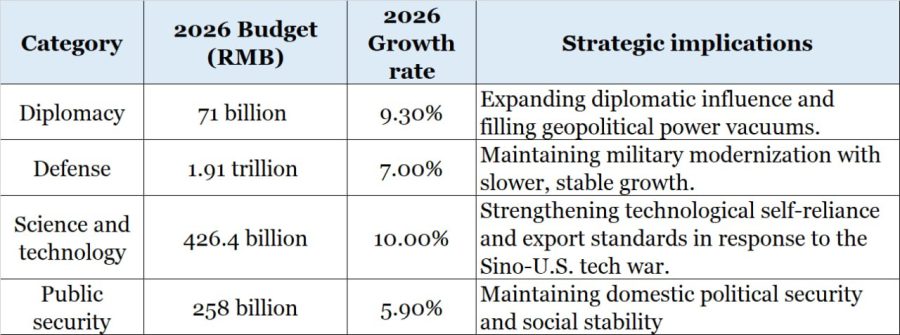
By comparison, China’s defense budget has maintained relatively stable single-digit growth over the past decade at, typically at around 7.2 percent. The proposed budget for 2026 is slightly lower at around 7 percent, the lowest growth rate since 2021. Also, the increase in diplomatic spending is second only to Beijing’s investment in science and technology.
2. A significant portion of China’s diplomatic spending includes foreign aid. Historical data shows that the PRC’s foreign aid expenditures increased more than sixfold over 25 years, rising from 3.92 billion yuan in 1999 to 24.872 billion yuan in 2024.
The surge in the 2026 budget is largely intended to support a new phase of the Belt and Road Initiative, including:
- Investment in the next generation of so-called “small but beautiful” (小而美) projects (small in scale, big in impact, and sustainable and replicable).
- Strategic restructuring of existing debt arrangements.
- Administrative and financial support required for overseas economic expansion without direct military force.
Therefore, the increase in diplomatic budget signals Beijing’s intention to systematically use diplomacy as a tool to advance its non-military global influence and objectives. We previously analyzed that the CCP is pushing forward its external domination agenda through economic leverage and soft power. The PRC is also leveraging its advantages in energy transition technologies and digital infrastructure to absorb domestic industrial overcapacity while exporting green technology and digital systems to partner countries. This approach allows Beijing to establish long-term influence over those economies.
At the same time, China promotes education and innovation programs abroad to deepen dependence on the “China model.” These initiatives aim to cultivate local elites who accept Chinese technological standards and governance philosophies, ensuring that the development trajectories of participating countries gradually converge with Beijing’s strategic interests.
3. Aside from growing China’s external influence and building hegemony, Beijing also appears to be relying more on diplomacy as a defensive measure to cope with geopolitical isolation. Since the U.S.-China trade and tech war kicked off in President Donald Trump’s first term, the PRC has faced the most complex external security environment since the beginning of the “reform and opening-up” era. The U.S. and its allies have formed military and geopolitical networks in the Indo-Pacific with countering the CCP in mind, including AUKUS and the U.S.–Japan–South Korea trilateral partnership. Meanwhile, the CCP faces pushback from neighbors in its periphery, including ongoing confrontations with the Philippines in the South China Sea and clashes with India in the border region stemming from PRC actions. Viewed in totality, Beijing likely perceives the mounting geopolitical pressures against China as a sign that it is being strategically isolated on the world stage.
Against this backdrop, the PRC’s increased diplomatic budget serves as a form of “strategic insurance.” By stepping up diplomatic engagements with ASEAN countries, Central Asia, and Middle Eastern nations, Beijing is looking to weaken the pressure of perceived U.S. “containment.” This year, China plans to host the Second China-Arab States Summit and push forward negotiations for a free trade agreement with the Gulf Cooperation Council. Such initiatives require substantial diplomatic resources to coordinate competing interests.
For Beijing, the urgency of diplomatic tools may even exceed that of military expansion. In an age where geopolitics is shaped by nuclear deterrence, competition for alignment during peacetime — “camp competition” short of war — could end up determining the balance of power between the major powers.
At the same time, the PRC is no longer satisfied with merely participating in the existing international system and appears to be aiming to become a rule-maker. A significant portion of the 2026 diplomatic budget has been allocated to activities promoting the Global Development Initiative, Global Security Initiative, and Global Civilization Initiative, which form the theoretical framework for Beijing’s vision of an “equal and orderly multipolar world order.”
4. Whether Beijing will find success in gaining long-term strategic advantage from expanded diplomacy spending remains uncertain.
First, Beijing’s external strategy is constrained by domestic economic slowdown. Already, the PRC has lowered its GDP growth target to the 4.5 percent to 5 percent range. Amid a prolonged real estate downturn and a local government debt crisis, balancing large expenditures on foreign aid and diplomatic operations with domestic goals such as “common prosperity” poses a major challenge for the Xi Jinping leadership. If diplomatic spending cannot quickly translate into domestic economic benefits, such as opening new export markets, the sustainability of the move will come into question.
Second, Beijing’s diplomatic expansion is likely to provoke strong reactions from neighboring countries and the Western bloc.
- Dual threat: Although the growth rate of China’s defense budget has slowed slightly, its military activities in the South China Sea and the Taiwan Strait do not appear to be diminished. Therefore, the PRC’s dual-track approach of “diplomatic smiles combined with military strength” could be perceived as a threat by neighboring states, pushing countries such as Japan, South Korea, and the Philippines to strengthen their military capabilities and heighten military ties with the U.S. to better guard against the CCP.
- Structural contradictions in China–EU relations: The European Union is adopting more defensive industrial policies in response to surging Chinese exports. Whether the 2026 diplomatic budget can successfully mitigate tensions over trade subsidies and technology security between China and Europe remains to be seen.
- The trap of proxy conflicts in the Middle East: The PRC seeks to play the role of mediator in the Middle East. However, as tensions escalate following the outbreak of the Iranian conflict, Beijing may be forced to choose between Iran and the Gulf states, which could put at least some of its large diplomatic investments at risk.
5. In conclusion, Beijing’s decision to raise its diplomatic budget by 9.3 percent in 2026 represents a milestone in its global strategic transformation. The PRC appears to be formally entering a stage of “diplomacy-driven offensive engagement” as it comes to terms with existing geopolitical realities. Through economic leverage, technological integration, and soft-power initiatives, the CCP aims to pave the way for long-term non-military expansion. Beijing’s diplomatic strategy is derived from Xi’s political theories (“great power diplomacy”) and is one of the political assets that Xi Jinping could rely on in pushing for another term at the 21st Party Congress in 2027.
The PRC’s strategic shift in resource allocation provides a clear warning to the U.S. and its allies: the arena of competition is no longer limited to the acquisition of advanced weapons systems, technology restrictions, or nuclear restraint. Beijing is attempting to leverage its fiscal resources and systemic advantages to accelerate the construction of a parallel international system at a time when the “American empire” is preoccupied with its own internal and external challenges. Great power competition will increasingly involve development commitments to the Global South, agenda-setting within multilateral institutions, and efforts to define what constitutes a “fair world order.”




